
Testosterone and Muscle Hypertrophy: What Science Says
Yes, testosterone helps muscle growth - but the part that matters most is long-term hormone exposure, not the short post-workout spike. In human studies, testosterone increased lean mass, muscle fiber size, and, at times, strength. The biggest effects showed up with higher doses, longer use, and in people who started with low testosterone.
Here’s the short version:
- Testosterone supports muscle growth through androgen receptors, protein synthesis, and muscle cell activity.
- Human trials show a dose-response pattern. In one 20-week study, healthy men gained about 3.4 kg at 125 mg/week, 5.2 kg at 300 mg/week, and 7.9 kg at 600 mg/week.
- TRT in hypogonadal men often adds about 1.2 to 2.5 kg of lean mass versus placebo.
- Post-workout testosterone spikes are not a good predictor of growth. Studies found little to no link between those short hormone bumps and later gains in muscle size or strength.
- Training still drives the result. Testosterone can shift the body toward growth, but you still need hard, repeatable lifting with solid technique.
If I had to sum up the whole article in one line, it would be this: testosterone can help muscle get bigger, but it works best as part of a longer process tied to steady exposure and good resistance training.
The Science of What INCREASING Testosterone Does to Muscle & Strength
How Testosterone Supports Muscle Growth at the Tissue Level
Testosterone works inside muscle tissue through androgen receptors and growth-signaling pathways. At a basic level, it helps muscle adapt over time through androgen receptor activity, anabolic signaling, and satellite cells.
Androgen Receptors, Protein Synthesis, and Anabolic Signaling
At the tissue level, testosterone supports hypertrophy through signaling, nuclear addition, and repair. It binds to androgen receptors and changes gene expression tied to muscle growth.[26] It also activates Akt/mTOR signaling, which increases muscle protein synthesis.[12][14] At the same time, it lowers muscle breakdown by dampening atrophy-related signaling.[9][25][14]
That matters because muscle growth isn't just about making more protein. It's also about shifting the whole cell toward a growth state. Testosterone helps push that shift, which changes how muscle fibers expand over time.
Satellite Cells, Myonuclei, and Fiber Growth
As muscle fibers grow, they need more myonuclei to keep up. That's where satellite cells come in.
Satellite cells are muscle stem cells located just outside the fiber membrane. When they're activated, they divide and fuse with existing fibers, adding new myonuclei and increasing the fiber's transcriptional capacity. Testosterone directly supports this process because satellite cells express the androgen receptor, and testosterone can stimulate both their proliferation and differentiation.[13][22] It also upregulates follistatin and suppresses myostatin-related signaling, both of which shift muscle toward growth instead of atrophy.[21][9]
Human dose-response data make this easier to picture. In healthy young men given testosterone for 20 weeks, satellite cell counts increased from about 0.3-0.6 per mm at baseline to 1.5-4.0 per mm at 300-600 mg/week, along with increases in myonuclear number.[19][23] In older men, satellite cell proportion rose from about 3% of nuclei at baseline to 6.2%, 9.2%, and 13.0% at 125, 300, and 600 mg doses, respectively.[20][24] Those are meaningful shifts in the muscle's ability to keep growing.
That said, newer research in satellite cell-depleted animal models shows that testosterone can still produce some hypertrophy even without large myonuclear additions.[11][14][16] So the current view is a bit more nuanced. Satellite cells seem to matter most for large, sustained hypertrophy, while shorter-term or more moderate growth can lean more on stronger signaling inside existing myonuclei.
These same pathways also affect how muscle comes back after hard training.
What These Mechanisms Mean for Recovery and Adaptation
After training, muscle repairs and rebuilds through a controlled recovery cycle. Testosterone supports that cycle by increasing satellite cell activation, promoting expression of myogenic regulatory factors such as MyoD, myogenin, and Pax7, and boosting local IGF-1 production.[15][17]
It also helps preserve net protein balance during periods of high training stress, which cuts down how much muscle tissue is broken down before it can be rebuilt.[15][18] For lifters, that means a better ability to handle training volume and recover between sessions.
Still, these effects don't happen in a vacuum. They depend on a strong resistance-training stimulus. Testosterone amplifies the response to mechanical tension created by resistance training, and controlled loading through full, stable ranges of motion gives AR-mTOR and satellite cell pathways something to work with.[12][14][17]
Together, these mechanisms help explain why testosterone status can shape both the size and the quality of the training response.
What Human Trials Show About Testosterone and Hypertrophy
The mechanisms above only matter if they hold up in actual people over time. And they do.
Controlled human trials show that keeping testosterone elevated for weeks or months can increase lean mass and muscle size. The effect also tends to be dose-dependent. Put simply, more testosterone usually means a bigger muscle-building response. But the size of that response still depends on the dose, the group being studied, and whether resistance training is part of the plan.
Dose-Response Trials in Healthy Men
One landmark 20-week study looked at healthy young men given weekly intramuscular testosterone enanthate doses ranging from 25 mg to 600 mg. Lean mass, or fat-free mass, went up in a dose-dependent way at the higher doses. At 25 to 50 mg/week, there was no meaningful change.[27][6]
A second trial found the same basic pattern during training. Healthy men were split into four groups: placebo, placebo plus strength training, 600 mg/week testosterone without training, or 600 mg/week testosterone plus strength training for 10 weeks. The testosterone-plus-training group had the biggest gains in lean mass and strength.[5][41]
What stands out here is that the testosterone-only group still added lean mass and muscle size even without a formal training program.[5][41] That helps show how doses above the normal physiologic range can drive an anabolic effect on their own.
Evidence in Women and Hypogonadal Men
In men with clinically low testosterone, randomized controlled trials and meta-analyses show that TRT increases lean mass by about 1.2 to 2.5 kg compared with placebo.[4][35] Reviews also point to larger gains from intramuscular TRT than from transdermal forms.[31][32][34][3]
Strength gains are smaller than the changes in muscle size, but they still show up. One meta-analysis found an average grip strength gain of about 3.3 kg, along with better self-reported physical function.[35] Starting level matters too. Men who begin below about 250 to 264 ng/dL tend to get a bigger response than men who are already closer to the normal range.[35][3]
Trials in women have used lower, more physiologic doses. In young, physically active women, moderate-dose testosterone over 10 weeks led to meaningful lean mass gains, type II muscle fiber hypertrophy, and better capillarization.[28][37][29]
Comparison Table: Populations, Doses, Training, and Outcomes
The studies below make the pattern pretty clear: dose, population, and training all shape the size of the response.
| Population | Testosterone Regimen | Duration | Resistance Training | Primary Hypertrophy Outcomes | Key Limitations |
|---|---|---|---|---|---|
| Healthy young men | 25–600 mg/week TE (intramuscular) | 20 weeks | No (controlled) | Lean mass increased dose-dependently: +3.4 kg at 125 mg/week, +5.2 kg at 300 mg/week, +7.9 kg at 600 mg/week; no significant change at 25–50 mg/week.[27][6] | No training component; tightly controlled diet may not reflect actual day-to-day conditions |
| Healthy young men | 600 mg/week TE ± strength training | 10 weeks | Yes (standardized) | Testosterone-plus-training: ~6.1 kg lean mass, large triceps/quadriceps CSA gains, bench/squat improvements of ~22 kg and ~38 kg.[5][41] | Supraphysiologic dose limits generalizability; small sample |
| Older men | 25–300 mg/week TE (intramuscular) | 20 weeks | No (controlled) | Dose-dependent increases in skeletal muscle mass, leg strength, and power; functional outcomes did not improve in parallel.[38][39] | Functional measures were less sensitive; no training arm |
| Hypogonadal men | TRT (intramuscular, transdermal, or patch) to mid-normal range | Several months to 1 year | Variable | Lean mass +1.2 to 2.5 kg; grip strength +3.3 kg; modest functional improvements.[4][35][31] | Mixed study designs; variable training control; route of administration affects outcomes |
| Young active women | Moderate-dose testosterone | ~10 weeks | Variable | Total lean mass +1.9%; leg lean mass +2.4%; type II fiber hypertrophy; improved capillarization.[28][37][29] | Smaller absolute changes than in male trials; limited long-term data |
| Postmenopausal women | Higher-dose testosterone | Variable | No | Lean mass increased; leg press strength did not change significantly.[40] | Short follow-up; strength outcomes were inconsistent across trials |
Across studies, testosterone tends to increase muscle size more reliably than strength, especially in older adults or less-trained groups.[33][35][36] That gap matters. More muscle does not always turn into more usable strength on its own. Resistance training is still the clearest way to turn added muscle into force you can actually use.
One more point matters here: these findings come from sustained testosterone exposure, not from the short-lived hormone bump that happens after a workout.
Acute Post-Exercise Hormone Spikes vs. Long-Term Testosterone Exposure
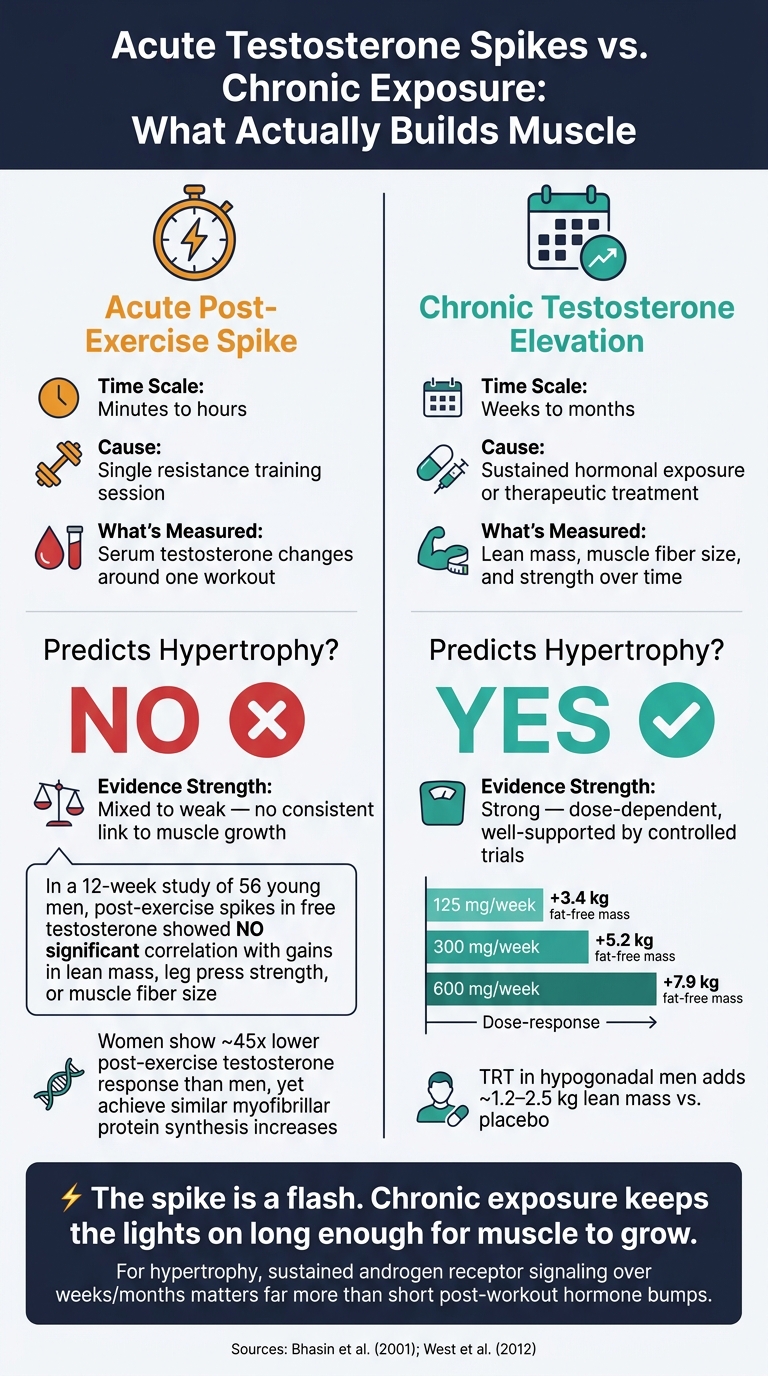
Acute Testosterone Spikes vs. Chronic Exposure: What Actually Builds Muscle
Why Post-Workout Hormone Spikes Are Not the Main Driver
A hard workout can bump testosterone up for a short time. But that rise fades fast - usually within minutes to hours. And when you look at what happens inside muscle tissue, that short-lived change just doesn’t last long enough to be the main engine of hypertrophy. Duration matters more than the peak itself.
Circulating total and free testosterone usually return to baseline, or even dip below it, within about 30 minutes after exercise, depending on workout intensity.[45][7] That’s a tiny window, and it’s not enough to drive measurable muscle growth on its own.
This matters because post-workout hormone spikes get talked about all the time in fitness circles. But the data doesn’t support them as a solid predictor of growth. In a 12-week study of 56 young men, researchers found no significant correlations between post-exercise increases in free testosterone or IGF-1 and gains in lean body mass, leg press strength, or muscle fiber cross-sectional area.[2][1] So if the goal is hypertrophy, chasing a short spike is a weak programming strategy.
There’s another clue here too. Men and women both show similar increases in myofibrillar protein synthesis after resistance exercise, even though women have a much smaller testosterone response after training - about 45 times lower than men’s.[42] If the spike were the main thing driving adaptation, that pattern would be hard to explain.
Why Chronic Exposure Produces Measurable Muscle Changes
The studies that show clear hypertrophy outcomes tend to have one thing in common: testosterone stays elevated for weeks or months, not minutes. That longer exposure gives muscle enough repeated androgen-receptor signaling to shift protein synthesis, satellite cell activity, and remodeling in a way that adds up over time.[1][46]
That’s the big difference. A brief post-lift bump is more like a flash. Chronic exposure is more like keeping the lights on long enough for the work to get done.
The dose-response data from Bhasin et al. (2001) shows this clearly. Healthy men who received weekly testosterone enanthate injections for 20 weeks gained:
Those changes came from sustained, pharmacologically maintained elevations - not the kind of rise you get from one squat workout.
Comparison Table: Acute Spikes vs. Chronic Elevation
| Factor | Acute Post-Exercise Spike | Chronic Testosterone Elevation |
|---|---|---|
| Time scale | Minutes to hours | Weeks to months |
| Cause | Single resistance training session | Sustained hormonal exposure or therapeutic treatment |
| What is measured | Serum testosterone changes around a single workout | Lean mass, muscle fiber size, and strength over time |
| Predicts hypertrophy? / Evidence strength | No consistent evidence; mixed to weak for predicting growth[1][2] | Yes, dose-dependent and well-supported; stronger for tissue adaptation[5][43][44] |
| Practical relevance | Limited for programming decisions | More relevant for understanding true anabolic effects |
That distinction matters when people make big claims about recovery, “anabolic windows,” or workout design. The better question isn’t whether testosterone blips upward after training. It’s whether the change lasts long enough to alter muscle tissue in a measurable way.
Practical Takeaways for Lifters on Recovery and Training Quality
What the Evidence Supports for Muscle Growth and Recovery
Once you set aside short-term hormone spikes, the main question becomes simple: what actually helps muscle growth and recovery?
The answer is that testosterone’s anabolic effect depends on a few things: baseline status, dose, age, sex, and how long exposure lasts. The clearest upside shows up in men with low testosterone. In that group, TRT increases lean body mass by about 1.22 kg versus control. In healthy men with normal testosterone levels, bigger long-term doses lead to bigger gains.[48][4]
Testosterone’s effect on muscle size and lean mass shows up more consistently than its effect on performance. Several trials report measurable hypertrophy without equal increases in strength.[47][10] That gap matters. More muscle doesn’t automatically mean better performance. Technique, neural adaptation, training quality, and recovery all shape how much of that new muscle you can actually use.
For lifters, that’s the practical point: recovery habits matter because they help you keep training well, session after session. And that repeatable training signal is what drives growth over time.
Why Exercise Technique Still Matters for Hypertrophy
Testosterone can boost adaptation, but it doesn’t do the work for you. Training quality still sets the ceiling.
Mechanical tension remains the main driver of hypertrophy through mechanotransductive signaling, not short-lived shifts in systemic hormones.[8] Testosterone may increase the body’s capacity to adapt, but it can’t replace the signal created by hard, well-executed lifting.
That’s why productive hypertrophy still comes back to the basics:
- repeatable movement
- enough range of motion
- stable force production
- low injury risk
If your technique breaks down, the muscle-building stimulus usually gets worse too. In plain English: sloppy reps are a bad trade.
Conclusion: Key Points from the Current Science
Taken together, the current evidence points to four practical takeaways:
- Testosterone affects hypertrophy through androgen receptor signaling, protein synthesis, satellite cell activity, and myonuclear addition.
- Human trials show larger lean-mass gains at higher doses and in people with low baseline levels.
- Acute post-workout spikes are weak predictors of growth; long-term exposure matters more.
- Resistance-training quality still determines how much of that potential turns into usable adaptation.
FAQs
Can testosterone build muscle without lifting?
No. Testosterone alone cannot build muscle without the mechanical tension and training stimulus from lifting.
Muscle hypertrophy happens mainly through progressive overload. That means gradually increasing training stress with more weight, more reps, or more time under tension during resistance exercises. Consistent lifting gives your muscles the mechanical stress and metabolic demand they need to adapt.
Who benefits most from TRT for muscle growth?
The sources provided here don’t say who benefits most from TRT for muscle growth. Instead, they focus on training itself: progressive overload, tempo work, volume tracking, technical precision, and AI-assisted form analysis.
If your goal is to get as much as you can from your natural training, CueForm AI can review your squat, bench press, and deadlift videos and give you personalized feedback on your form and movement quality.
Why don’t post-workout testosterone spikes predict gains?
Post-workout testosterone “spikes” don’t reliably predict hypertrophy. In plain English, a short-term jump in testosterone after training doesn’t tell you much about how much muscle you’ll build.
Muscle growth depends far more on the training stimulus and recovery than on brief hormone swings. That means the stuff you do week after week tends to matter more than what happens in the hour after a workout.
What moves the needle most:
- Progressive overload
- Adequate volume
- Rep quality
- Keeping fatigue under control
There’s also a common mistake here: doing too much, too soon. A sudden spike in training load, such as more than 20% weekly volume, can drive up fatigue. And when fatigue gets too high, you may need a deload instead of getting better growth from the extra work.