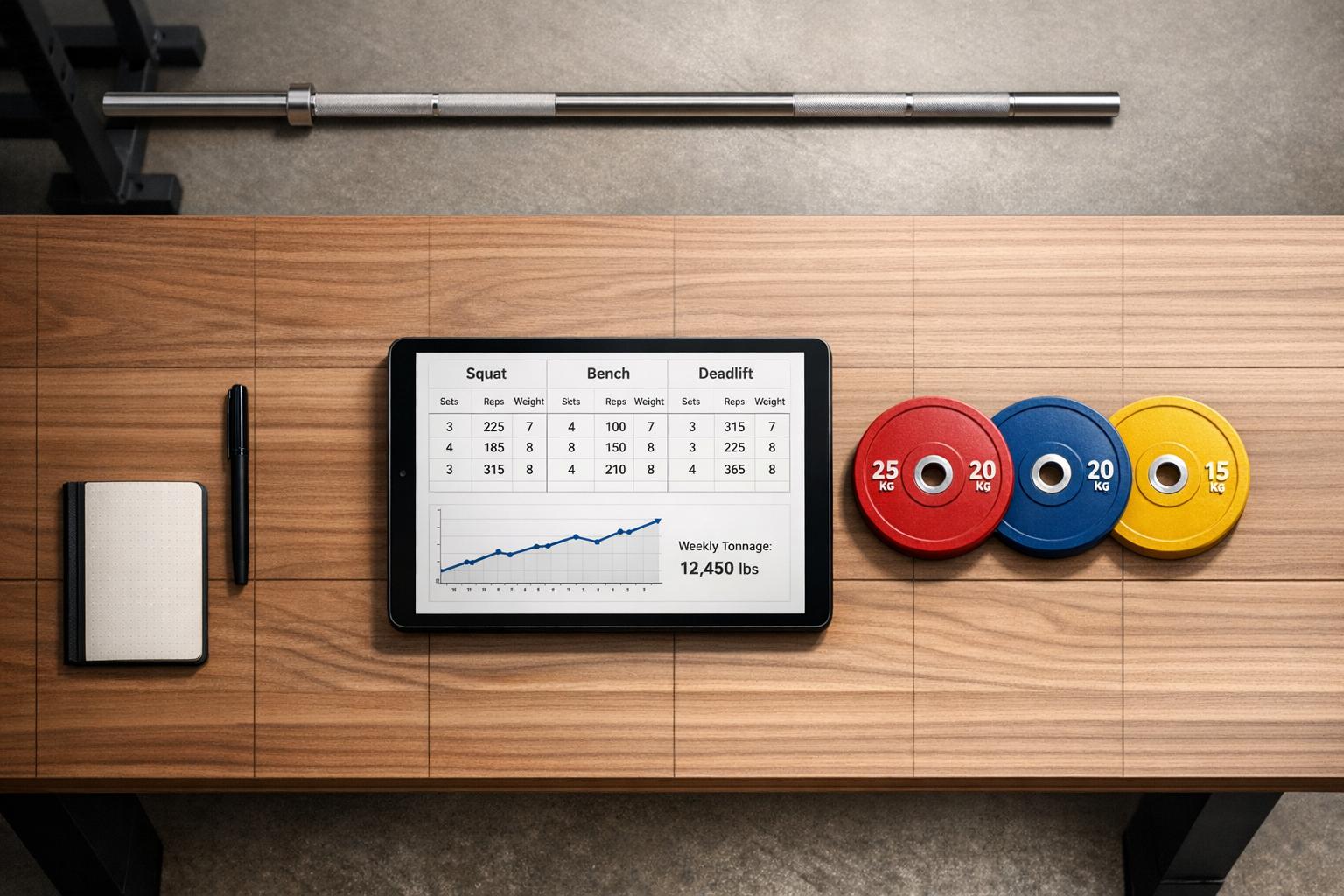
Tracking Volume for Squat, Bench, and Deadlift
If you want to get stronger, tracking your workout volume is essential. Here's why: volume, calculated as sets × reps × weight, directly impacts your strength and muscle growth. By logging your squat, bench press, and deadlift data, you can measure progress, identify what works, and avoid overtraining or undertraining.
Key takeaways:
- Volume formula: Sets × Reps × Weight
- Focus on working sets: Skip warm-ups below 50% of your 1RM.
- Weekly progression: Aim for a 2–5% increase in volume load.
- Balance work and recovery: Spread workload across the week and plan deloads every 3–4 weeks.
- Track consistently: Record sets, reps, weight, and RPE to improve precision.
Tracking volume ensures you're hitting the right workload to build strength while managing fatigue effectively. Start logging your lifts today to train smarter and make consistent progress.
Ultimate Guide To Powerlifting Volume (Science Backed)
Volume Tracking Basics: Key Concepts and Metrics
Volume Tracking Metrics Comparison for Strength Training
What Is Volume and How Do You Calculate It?
Training volume is a way to quantify the total workload of your session [1][4]. The formula is simple: Sets × Reps × Weight. Here’s how it breaks down: "sets" refers to the number of rounds, "reps" is the number of repetitions per set, and "weight" is the load you’re lifting. For instance, if you perform 5 sets of 5 reps of squats at 225 lbs, your total volume would be 5 × 5 × 225 = 5,625 lbs [4]. If the weight changes between sets, calculate the volume for each set and then add them up [4].
There are two types of volume to be aware of:
- Absolute tonnage: This includes all weight moved, giving you the full picture of your workload.
- Relative volume: Focuses only on the working sets where you’re pushing close to failure (0–2 reps left in the tank). This avoids inflating totals with lighter, less effective sets [2][4].
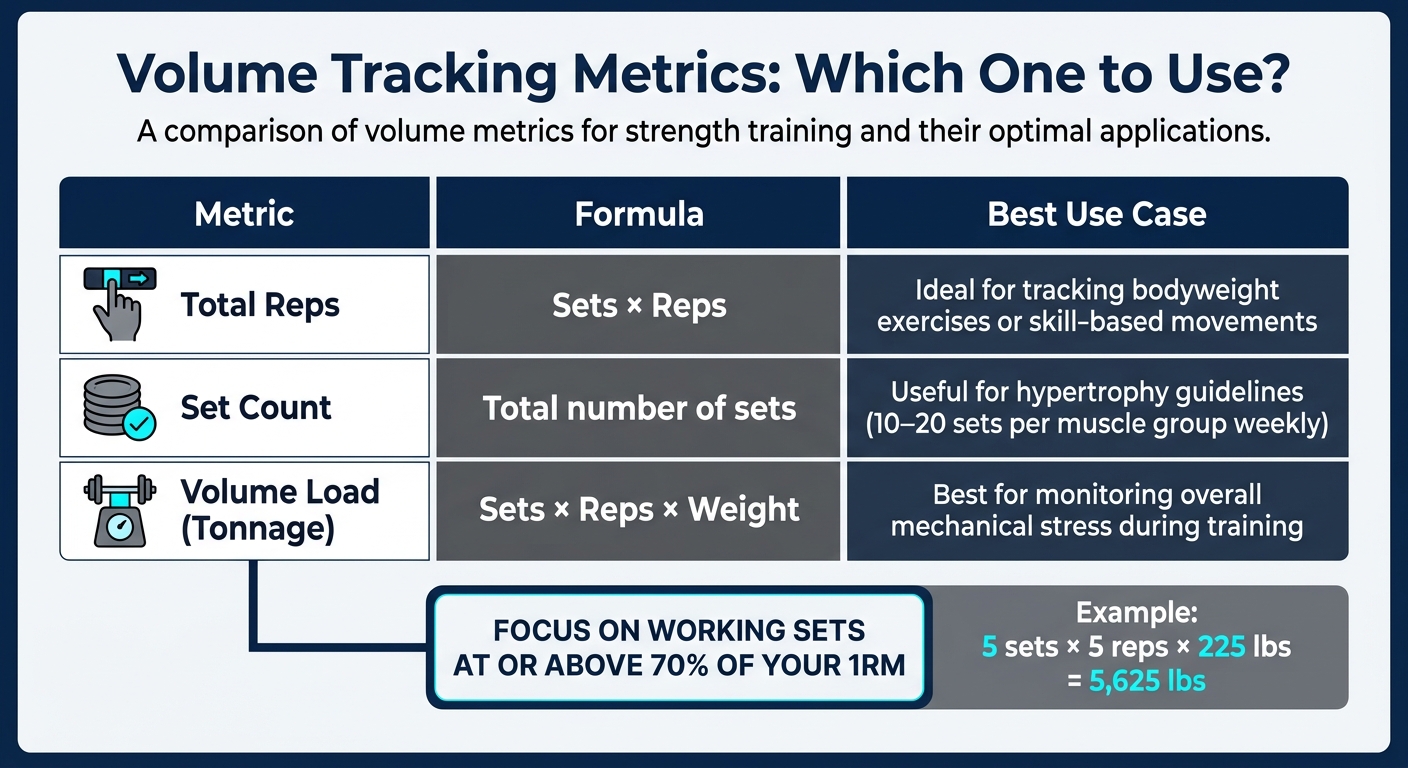
Here’s a quick breakdown of key metrics:
| Metric | Formula | Best Use Case |
|---|---|---|
| Total Reps | Sets × Reps | Ideal for tracking bodyweight exercises or skill-based movements [4] |
| Set Count | Total number of sets | Useful for hypertrophy guidelines (10–20 sets per muscle group weekly) [4][5] |
| Volume Load (Tonnage) | Sets × Reps × Weight | Best for monitoring overall mechanical stress during training [4] |
These calculations are the backbone of effective volume tracking, helping you understand how your workload impacts strength gains, muscle growth, and recovery.
Why Volume Matters for Strength Gains
Volume plays a central role in building both muscle size and strength. Research highlights a strong connection between training volume and muscle growth, with gains peaking at around 15–20 sets per muscle group per week [4]. For core lifts like the squat, bench press, and deadlift, tracking volume ensures you’re applying progressive overload - the gradual increase in training stress that drives adaptation.
However, the relationship between volume and muscle growth isn’t perfectly linear. For example, doubling your volume doesn’t double your gains - it typically results in about 50% more muscle growth [5]. This means adding volume should be done thoughtfully. Aiming for a 2–5% increase in weekly volume load is a manageable way to progress [4]. On the other hand, sudden spikes of over 20% in weekly volume can lead to excessive fatigue, signaling the need for a deload week to recover [4].
Nathan Jones, PT, DPT, sums it up well:
"The number of hard sets you do per muscle group per week determines more about your results than almost anything else in your program" [5].
For the squat, bench press, and deadlift, keeping tabs on your working sets throughout the week helps you strike the right balance - ensuring you’re doing enough to build strength without overloading your recovery capacity.
How to Track Volume for Squat, Bench Press, and Deadlift
Let’s break down how to monitor volume for your main lifts effectively.
Volume is calculated using the formula: Sets × Reps × Weight. Focus on working sets performed at or above 70% of your one-rep max (1RM) and skip warm-up sets below 50% of your 1RM [4] [2] [6].
Tracking Squat Volume
For squats, apply the tonnage formula to all primary working sets. For example, if you do 4 sets of 8 reps at 185 lbs, the total volume is 4 × 8 × 185 = 5,920 lbs [4]. If your weights vary - for instance, 2 sets at 185 lbs and 2 sets at 205 lbs - calculate each separately and add them together:
(2 × 8 × 185) + (2 × 8 × 205) = 2,960 + 3,280 = 6,240 lbs.
Tracking Bench Press Volume
When tracking bench press, combine tonnage with Rate of Perceived Exertion (RPE) for a clearer picture [7] [3]. For instance, 5 sets of 5 reps at 225 lbs result in a total volume of 5 × 5 × 225 = 5,625 lbs [4]. However, if those sets felt like an RPE 9 instead of the planned RPE 7, it indicates higher training stress despite the same tonnage [7] [3]. Logging both weight and RPE helps you better understand your training intensity.
Tracking Deadlift Volume
Deadlifts are taxing, so only include sets performed at or above 70% of your 1RM to manage recovery [4]. For example, 3 sets of 3 reps at 405 lbs yield 3 × 3 × 405 = 3,645 lbs [4]. While the total tonnage is often lower for deadlifts, it’s still effective for building strength. Studies show that strength-focused sessions generally produce between 6,600 and 13,200 lbs of total volume, while hypertrophy sessions can range from 17,600 to 33,000 lbs, thanks to their higher rep counts [6].
Best Practices and Common Mistakes in Volume Tracking
Tips for Effective Volume Tracking
Mastering the basics of volume tracking is one thing, but applying these practices can take your precision to the next level.
Log your sets right away - ideally within 15 seconds of finishing them [8]. This ensures your records are accurate and up-to-date. Studies suggest that athletes who consistently track their workouts can progress 2 to 3 times faster than those who rely purely on intuition [3].
Keep your system straightforward. Focus on five essential metrics: the exact exercise name (e.g., "Barbell Back Squat" instead of just "Squat"), the weight used, the number of reps completed, working sets, and a quick RPE (Rate of Perceived Exertion) note [8]. Trying to track excessive details, like grip width or rest periods down to the second, often leads to burnout within a few weeks [8].
Leverage digital tools like spreadsheets or workout apps to handle calculations for tonnage and intensity [1][3]. These tools not only save time but also help visualize your progress over weeks or months. If you're focused on technique, consider using form analysis tools like CueForm AI. This ensures that your tracked volume reflects quality reps performed with proper form - because poor technique won't deliver the same results.
Common Mistakes to Avoid
Even with a solid tracking system, avoiding common pitfalls is just as important.
Don’t include warm-up sets in your volume calculations. Warm-up sets don’t provide the same training stimulus as working sets. As world record powerlifter Blaine Sumner explains:
"Doing a warm up set of 135 X 10 has a higher 'volume' than doing a single at 1,000 lbs, so higher volume does not necessarily mean harder... I propose only working sets count towards tracking volume" [2].
Avoid chasing higher tonnage numbers at the expense of proper technique. Pushing volume while ignoring fatigue or letting your form deteriorate can lead to injuries and stalled progress [1]. Instead, focus on long-term trends - weekly and monthly progress matters far more than one "off" session [1][8].
Lastly, be specific when logging exercises. For example, if you record "Bench Press" one week but fail to note whether it was flat barbell, incline, or dumbbell, it’ll be tough to track your progress over time [8]. Similarly, exclude sets that don’t contribute meaningful overload to your training goals.
Tracking Volume Over Time to Measure Progress
Using Benchmarks to Assess Progress
Benchmarks provide a practical way to measure long-term progress by building on volume metrics. Tracking changes in volume over time gives you concrete data, eliminating the need for guesswork when evaluating your progress.
One useful metric is average intensity, calculated by dividing total tonnage by total reps. For example, lifting 10,000 lbs over 50 reps results in an average intensity of 200 lbs. This measurement helps pinpoint which intensity ranges - like 70–80% or 80–90% of your one-rep max (1RM) - deliver the best strength gains. Research indicates that elite weightlifters maintain an average intensity of about 75% across all training lifts [9].
Monthly lift totals also serve as valuable benchmarks. Novice lifters typically aim for 1,100–1,300 lifts per month, while advanced athletes may handle up to 2,700 lifts [9].
Tracking progress can make a huge difference. Studies show that athletes who monitor their performance achieve up to 35% greater gains compared to those who rely solely on intuition [3]. As BenchRep puts it:
"The golden rule: What isn't measured can't be improved. Elite athletes track every session without exception" [3].
These benchmarks create a foundation for incorporating wave loading, a method that manages stress and ensures steady progress.
Wave Loading for Sustainable Progress
Wave loading, which involves varying your training load over a set period, is an effective way to manage fatigue and avoid burnout. This approach works especially well for intermediate and advanced lifters, who often reach the limits of linear progression. By introducing planned variations, wave loading allows for recovery and fresh stimuli, promoting long-term gains [10].
A typical wave-loading cycle might span three weeks, followed by a deload in the fourth week. For instance, coach Andy Baker’s program for raw lifters includes:
- Week 1: 75% of 1RM for about 30 total reps (e.g., 5 sets of 6)
- Week 2: 80% of 1RM for around 25 reps (5 sets of 5)
- Week 3: 85% of 1RM for 15–20 reps (5 sets of 3–4)
- Week 4: Reduce volume by 30–40% to recover and supercompensate [9][10].
Auto-regulation is key to making wave loading work. Adjust your sets and reps to hit your volume targets without sacrificing form. For example, if your goal is 25 reps at 80%, you might do 5×5 on strong days or 6×4 when energy is lower. The focus is on meeting the rep target without pushing to failure [10]. This method helps prevent stagnation without the need for constant program changes.
Instead of fixating on daily fluctuations, track tonnage trends weekly or monthly. A well-structured program should show gradual increases in total workload, even if individual sessions vary due to factors like stress or sleep [1]. However, if you miss 10% or more of your target reps in two consecutive sessions, it’s wise to reduce the load by 10% for one session. This allows for recovery before resuming progression [11].
Conclusion
Tracking your workout volume is a game-changer when it comes to improving your core lifts. By consistently logging your sets, reps, and weight, you replace guesswork with a clear, data-driven approach. This method not only eliminates random programming but also gives you solid proof of your progress over time.
The numbers tell the story. Research shows that athletes who track their progress can achieve up to 35% more gains compared to those relying on intuition alone [3]. Simply put, keeping accurate records is non-negotiable for anyone serious about improvement. Whether you're just starting out or aiming to hit new personal bests, tracking your data provides the roadmap you need to move forward.
Make it a habit to log your working sets right after each session, calculate your weekly tonnage for key lifts, and review your progress monthly. Tools like CueForm AI can help you track volume while ensuring your technique stays sharp. After all, if your form deteriorates under heavy loads, your volume data loses its value. Combining video analysis with volume tracking gives you a complete understanding of your performance.
Once your tracking system is in place, focus on gradual, consistent progress. Aim to increase your total volume by 2% to 5% each week [4], stick to 15–20 sets per muscle group, and schedule deload weeks every three to four weeks. By balancing these strategies with proper recovery, you set yourself up for long-term strength gains.
Strength isn’t a mystery - it’s measurable. Track your volume, study the trends, and fine-tune your programming to keep pushing your limits.
FAQs
How do I track volume when the weight changes set to set?
To keep track of training volume when weights vary, multiply the weight used by the number of reps performed for each set. Write down these values for every set, then add them together to calculate the total volume for the session. This approach helps you monitor your workload accurately, even when the weights change between sets.
Should I count warm-up sets in my squat, bench, and deadlift volume?
When calculating the volume for squats, bench presses, and deadlifts, warm-up sets typically don’t count. These sets are meant to get your muscles and nervous system ready for the heavier lifts ahead, not to add to your overall training stimulus. Instead, focus on tracking your working sets - the ones done with your actual target or working weight. This approach ensures you’re accurately monitoring your training volume and progress.
How do I know when to deload based on my weekly volume?
Tracking your weekly training load is key to knowing when to take a step back. Keep an eye on your volume load - calculated as Sets × Reps × Weight. If you notice a sudden jump of more than 20% in a week, or if you're feeling overly fatigued, stuck in a performance plateau, or seeing a drop in your usual output despite sticking to your routine, it’s a clear signal to deload. Paying attention to these trends allows your body to recover properly and keeps your progress on track.