Ultimate Guide to Fitness App Gamification
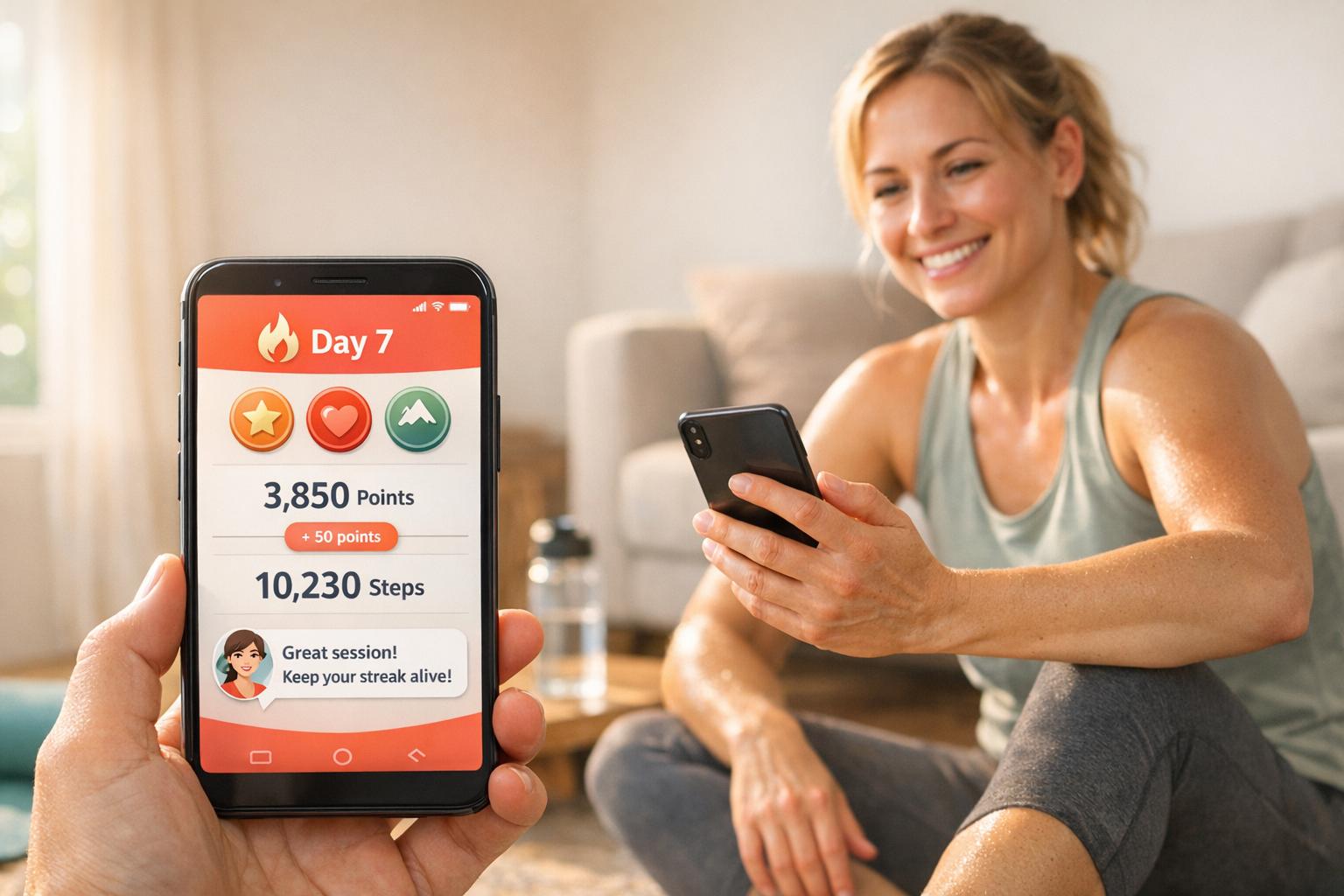
Gamification makes fitness apps more engaging by adding game-like elements such as points, badges, streaks, and challenges. These features help users stay motivated by providing instant rewards and a sense of progress, even when physical results take time. Research shows gamified apps can increase daily activity levels, improve retention, and make workouts feel rewarding.
Key Takeaways:
- Why Gamification Works: It taps into psychology, offering immediate rewards (e.g., XP, badges) and leveraging motivation through streaks and challenges.
- Core Features: Badges celebrate milestones, streaks build habits, and points/levels encourage consistent effort.
- Proven Results: Studies show gamified apps boost step counts by over 1,400 steps/day and improve goal adherence by up to 53%.
- Examples: Apps like Strava, Fitbit, and Garmin use unique badge systems to inspire users through competition, milestones, and variety.
- AI in Gamification: Tools like CueForm AI focus on form and technique, blending gamification with personalized feedback for strength training.
Gamification isn't just about making workouts fun - it’s a strategy to maintain consistency and motivation, transforming fitness apps into tools for lasting success.
Why gamification can transform your fitness (science-based)
Core Gamification Features in Fitness Apps
Fitness apps use gamification to make workouts more engaging and enjoyable. By tapping into psychological principles, they encourage behavior changes through rewards, challenges, and progress tracking. Let’s take a closer look at how features like badges, streaks, and points keep users motivated and coming back for more.
Badges and Achievement Systems
Badges act as visual markers of success, celebrating key milestones and measurable progress. Many apps spice things up by introducing rarity levels - like Common, Rare, and Legendary - so users feel a real sense of accomplishment when earning them. Early wins with badges leverage the "endowed progress effect", giving users a sense of momentum that pushes them to aim for the next goal.
Streaks and Progress Tracking
Streaks track how many days in a row a user stays active, playing on the principle of loss aversion - the fear of breaking a streak can be a strong motivator. The longer the streak, the more invested users become in maintaining it, even on tough days. To keep things fair, some apps include streak freezes, allowing users to pause their progress during unavoidable breaks like vacations or illness, ensuring they don’t lose their hard-earned momentum.
Points, Levels, and Challenges
Points, often referred to as XP, offer instant gratification for effort, encouraging users to put in more work. Accumulating points leads to level-ups, which act as mini finish lines. This taps into the "goal-gradient effect", where users push harder as they get closer to a milestone. Time-bound challenges add an extra layer of urgency and focus, while variable rewards - like surprise bonus points or rare collectibles - keep things unpredictable and fun.
Here’s a quick breakdown of these features, their psychological drivers, and how they’re best used:
| Feature | Psychological Driver | Best Use Case |
|---|---|---|
| Streaks | Loss Aversion | Building daily habits and consistency |
| XP/Levels | Goal-Gradient Effect | Encouraging long-term progress and milestones |
| Badges | Competence & Mastery | Celebrating achievements and tracking growth |
| Challenges | Urgency & Focus | Tackling specific, time-sensitive objectives |
Badge and Achievement Systems in Leading Fitness Apps
Fitness App Badge Systems Comparison: Features and Engagement Metrics
Examples of Badge Systems
When it comes to gamification, fitness apps are tapping into badge systems to keep users engaged and motivated. Each app approaches this differently, tailoring their rewards to specific user behaviors and goals.
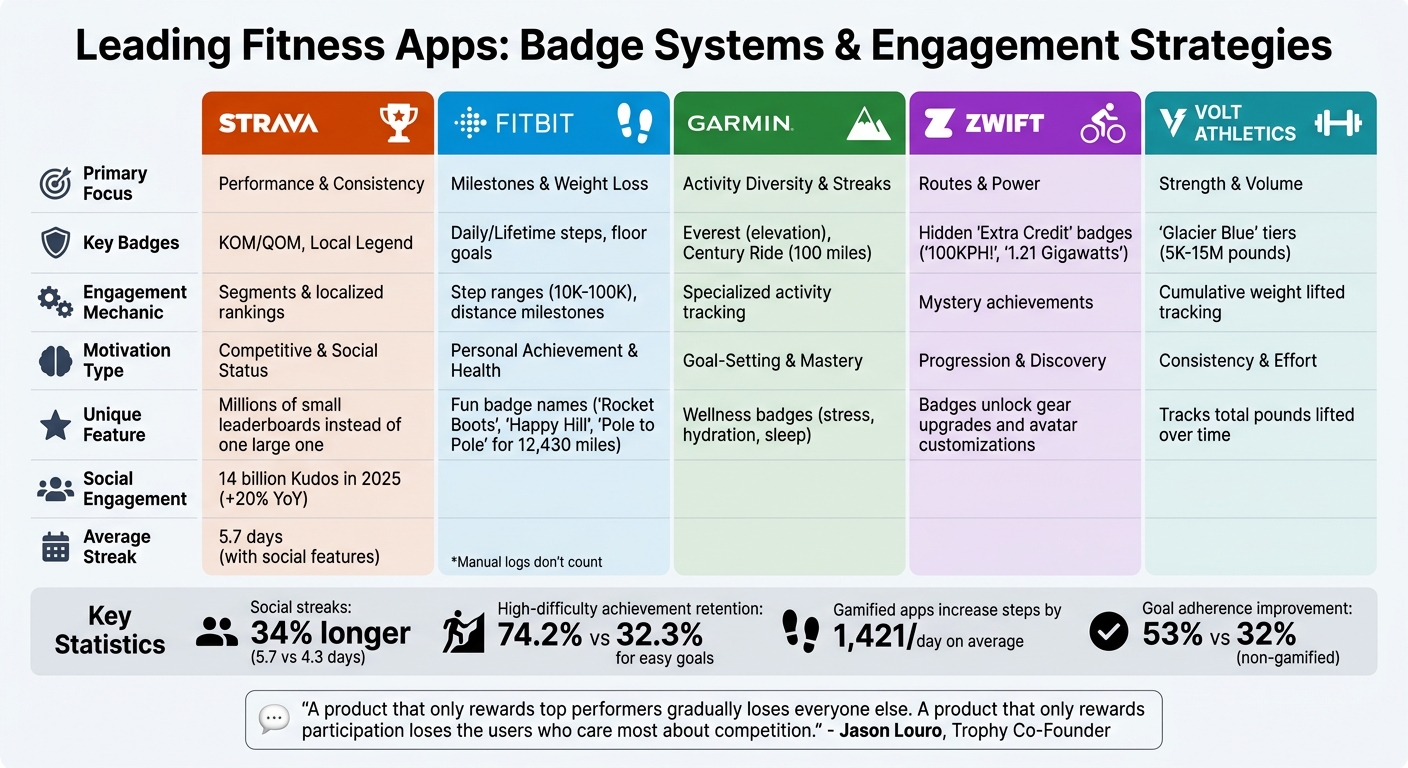
Strava stands out with its dual-track system. Users can earn performance-based titles like "King of the Mountain" (KOM) or "Queen of the Mountain" (QOM) by clocking the fastest times on specific routes. On the flip side, consistency-based titles such as "Local Legend" reward those who complete the most efforts on a segment over 90 days[6].
Fitbit takes a milestone-oriented strategy, celebrating both daily and lifetime achievements. For example, daily step badges range from 10,000 to 100,000 steps and come with fun names like "Rocket Boots." Lifetime distance badges, such as the "Pole to Pole" title for covering 12,430 miles, mark significant accomplishments. Fitbit also tracks floor climbing, awarding badges from 10 floors ("Happy Hill") to 700 floors ("Rainbow"). Importantly, manually logged activities don’t count, ensuring badges reflect genuine effort[5].
Garmin focuses on variety and mastery. Its badge collection includes awards like the "Everest" badge for cumulative elevation gain and the "Century Ride" for cycling 100 miles in one go. Garmin also ventures into wellness, offering badges for stress management, hydration, and sleep tracking[4].
Zwift, a virtual platform for cycling and running, adds an element of surprise with hidden "Extra Credit" badges. Examples like "100KPH!" or "1.21 Gigawatts" only reveal themselves once earned. These badges also unlock in-game perks like equipment upgrades and avatar customizations, tying rewards to progression[8].
Volt Athletics tracks strength milestones, awarding "Glacier Blue" badges for cumulative weight lifted. These range from 5,000 pounds to an impressive 15 million pounds, encouraging users to push their limits over time[9].
These examples illustrate how apps use distinct approaches to keep users engaged, whether through competition, personal milestones, or discovery.
Badge System Comparison and Engagement Effects
Badge systems don’t just motivate users - they also drive measurable engagement. Apps with social streaks, where users’ activity is visible to others, see average streak lengths of 5.7 days. That’s 34% longer than the 4.3-day average in apps without social features[6]. High-difficulty achievements also play a role: users who complete them have a retention rate of 74.2%, compared to 32.3% for those who focus on easier goals[6]. Strava, for instance, recorded over 14 billion "Kudos" interactions globally in 2025 - a 20% jump from the previous year - underscoring the power of social validation[7].
"Strava has essentially replaced one large demotivating leaderboard with millions of small motivating ones."
– Jason Louro, Co-Founder, Trophy[6]
Here’s a breakdown of how leading apps use badges to engage users:
| App | Primary Badge Focus | Engagement Mechanic | Motivation Type | Unique Feature |
|---|---|---|---|---|
| Strava | Performance & Consistency | Segments (KOM/QOM) and Local Legend | Competitive & Social Status | Localized rankings make wins achievable[6] |
| Fitbit | Milestones & Weight Loss | Daily/Lifetime steps and floor goals | Personal Achievement & Health | Fun names like "Rocket Boots"[5] |
| Garmin | Activity Diversity & Streaks | Specialized badges (Climbing, Century Ride) | Goal-Setting & Mastery | Elevation-based "Everest" badges[4] |
| Zwift | Routes & Power | Hidden "Extra Credit" badges | Progression & Discovery | Badges unlock gear and XP bonuses[8] |
| Volt | Strength & Volume | Cumulative "Weight Lifted" tiers | Consistency & Effort | Tracks total pounds lifted over time[9] |
Apps like Strava excel by breaking global competition into smaller, more achievable challenges, keeping users of all levels motivated. Meanwhile, platforms that balance rewards for both consistency and peak performance ensure they appeal to a broader audience. As Jason Louro points out, "A product that only rewards top performers gradually loses everyone else. A product that only rewards participation loses the users who care most about competition."[6]
These strategies show how well-designed badge systems can boost user retention and performance through gamification, making fitness goals feel both rewarding and attainable.
How Gamification Affects User Retention and Performance
Research on Gamification Benefits
Studies consistently show that gamification has a measurable impact on both user retention and performance. Take the BE FIT trial conducted in 2017 by the University of Pennsylvania's Center for Health Incentives and Behavioral Economics. This 12-week randomized clinical trial involved 200 adults from 94 families. Even during the 12-week follow-up, participants in the gamified group achieved their goals 44% of the time, compared to just 33% for the control group. This demonstrates that the benefits of gamification can extend well beyond the initial intervention phase [1].
A more recent 2022 meta-analysis of 16 randomized controlled trials found that gamification led to a daily increase of 1,421 steps on average [1][3]. Similarly, the STEP UP trial, a 36-week study involving 602 overweight and obese adults across 40 U.S. states, reported that participants using a competition-based gamification approach took an additional 920 steps per day compared to the control group [1].
"Apps that incorporate gamification elements produce greater improvements in physical activity than apps that rely on standard tracking and programming alone."
– eClinicalMedicine (The Lancet) [3]
Further analysis shows that 60% of studies combining gamification with wearable activity trackers reported significant improvements in physical activity. Across 2,407 participants, these gamified interventions resulted in a small-to-medium positive effect (Hedges' g = 0.42), translating to a 66% relative improvement in goal achievement rates compared to standard tracking methods [1][3]. These findings highlight the psychological techniques driving these results, which we'll explore next.
Positive Reinforcement vs. Streak Pressure
The improvements in retention and performance largely stem from two key psychological strategies: positive reinforcement and loss aversion. Positive reinforcement - through rewards like badges, unlocked levels, or achievements - satisfies core psychological needs outlined in Self-Determination Theory (SDT), such as autonomy, competence, and relatedness. This method creates intrinsic motivation, which is more sustainable than relying on sheer willpower [1].
On the other hand, streak systems tap into loss aversion, leveraging the fear of losing progress to encourage consistent engagement. By combining these two strategies, gamification addresses both habit-building and daily commitment: rewards help users build a sense of identity and long-term habits, while streaks ensure continuous participation.
"Effective gamification applies proven psychological mechanisms to improve exercise adherence."
– Domenic Angelino, Chief Exercise Scientist, FitCraft [1]
Incorporating variable reward schedules - like surprise badges or mystery achievements - can further enhance engagement by creating anticipation and excitement. This unpredictability often leads to more persistent behavior. Additionally, apps that adjust difficulty levels to keep users in the "flow zone" (a balance between boredom and frustration) tend to see better long-term adherence [1].
AI-Powered Gamification for Strength Training with CueForm AI
CueForm AI's Badge System for Form and Progress
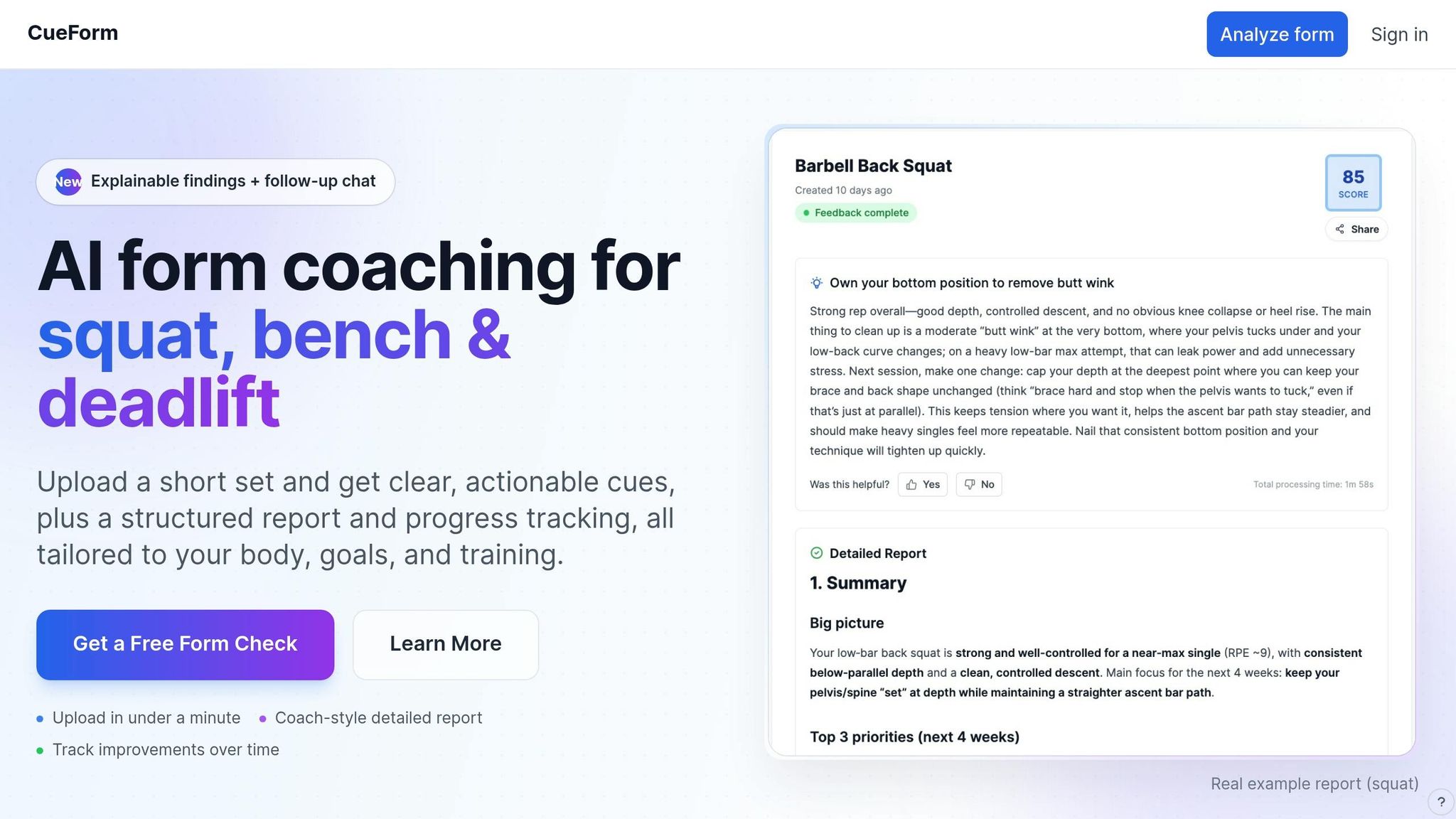
CueForm AI takes a fresh approach to badge systems by incorporating form analysis, ensuring progress is based on both performance and technique. It assigns a technique score for each lift, focusing on compound exercises like squats, bench presses, and deadlifts. The system evaluates key form elements - such as squat depth, knee tracking, bench press bar path, shoulder blade retraction, deadlift hip hinge mechanics, and lockout position - while also tracking the weight you lift. This dual-tracking method not only highlights strength gains but also emphasizes improvements in movement quality. Plus, you can set specific goals and target frequencies, a strategy shown to increase exercise adherence by 27% [10][11]. By prioritizing precision, CueForm AI creates a foundation for personalized achievements that encourage steady progress.
Personalized Achievements and AI Feedback
CueForm AI turns your training videos into actionable insights almost instantly. The platform pinpoints technique issues and provides real-time feedback, while the Chat with Coach AI feature offers tailored guidance to refine your performance. Whether you're asking, "What should I be feeling during this lift?" or seeking advice on specific cues, this feature supports your training goals and builds a sense of control and mastery [10].
"We turn your video into cues you can use next session - grounded in bar path, positions, and the context you provide." – CueForm AI [10]
This personalized feedback system aligns with 2025 research, which found that 80% of participants felt AI-powered tools helped them achieve their fitness goals, while the same percentage reported being motivated by gamification elements [2]. By combining objective metrics with context-aware feedback, CueForm AI ensures that your achievements reflect real progress, not just arbitrary milestones.
Free vs. Starter Plan Comparison
CueForm AI offers flexible plans to suit a variety of lifters, from casual gym-goers to those aiming for precise form refinement:
| Feature | Free Plan | Starter Plan |
|---|---|---|
| Monthly Cost | $0 | $10 ($89/year, save 26%) |
| Detailed Reports | Pay per report | Unlimited (up to 100/month) |
| AI Coach Chat | Limited message quota | Extended AI chat quota |
| AI Model Quality | Standard | Enhanced/Better AI models |
| Form Analysis | Unlimited quick feedback | 100 full reviews per month |
| Progress Tracking | Technique score & load lifted | Technique score & load lifted |
The Free plan provides unlimited quick feedback, making it a great option for everyday use. On the other hand, the Starter plan is designed for lifters who want to dive deeper into their technique. It includes unlimited detailed reports, enhanced AI models for sharper analysis, and an expanded chat quota - all of which are perfect for those committed to refining their form [10].
Conclusion
Gamification transforms fitness apps from basic workout trackers into tools that keep users engaged by leveraging psychological principles like operant conditioning, loss aversion, and the goal-gradient effect. Instead of relying solely on willpower, these strategies create lasting motivation. For example, gamified fitness interventions help users hit their step goals 53% of the time, compared to only 32% in non-gamified setups, and they add an average of 1,421 extra steps per day [1].
The best fitness apps succeed by addressing core psychological needs - offering meaningful choices, opportunities to demonstrate mastery, and ways to connect socially. Features like badges and achievement systems provide quick feedback, especially in the early stages of a fitness journey. Building on these principles, CueForm AI tailors gamification specifically for strength training.
CueForm AI brings a unique approach by tracking both performance and technique. It evaluates form quality alongside weights lifted, ensuring that achievements reflect real progress rather than arbitrary milestones. With features like technique scores, personalized AI coaching, and goal-setting tools, it creates a cycle where showing up leads to effective workouts and sustained engagement.
Both the Free and Starter plans from CueForm AI incorporate gamification and personalized feedback, making workouts not only productive but also enjoyable. By combining AI coaching with gamified elements, CueForm AI turns strength training into a routine that’s both rewarding and easy to stick with [2].
FAQs
How can I tell if a badge system is motivating me?
A badge system can inspire you to stay active, consistent, and focused on your goals. It works by tapping into psychological principles like operant conditioning (rewarding desired behaviors), the goal-gradient effect (increased effort as you get closer to a goal), and loss aversion (avoiding the feeling of missing out). To see if it’s working, track measurable changes in your fitness routine - like increased workouts, longer sessions, or hitting milestones more often.
Can streaks backfire and make me quit?
Breaking a streak can sometimes have unintended consequences. When someone misses a day, it might lead to feelings of guilt or even discouragement. For some, this can spiral into abandoning the habit entirely. That’s why it’s essential to strike a balance between staying motivated and allowing yourself some flexibility. This approach can help prevent burnout or unnecessary frustration.
How does CueForm AI score my lifting technique?
CueForm AI helps refine your lifting technique by analyzing videos of exercises such as squats, bench presses, and deadlifts. Through advanced video analysis, it pinpoints form issues and delivers tailored, actionable feedback to enhance your performance. Plus, you can interact with the AI coach to ask follow-up questions or receive advice aligned with your specific goals, ensuring the feedback is both detailed and relevant.