5 Benefits of AI-Powered Workout Plans
AI-powered workout plans are changing the way people approach fitness by offering personalized, data-driven solutions tailored to individual needs. Unlike static PDFs or spreadsheets, these plans use your fitness level, recovery data, and preferences to create workouts that adjust as you progress. Here's a quick look at what makes them stand out:
- Personalized Workouts: Plans are built around your fitness goals, equipment, and lifestyle.
- Dynamic Adjustments: Miss a session or hit a plateau? The system recalibrates automatically.
- Real-Time Feedback: AI tracks your form, providing corrections to improve technique and prevent injuries.
- Injury Prevention: Identifies risks through data analysis and adjusts to avoid potential problems.
- Motivation Tools: Progress tracking, gamification, and adaptive feedback keep you engaged.
With AI, fitness routines become smarter, safer, and more effective, making it easier to achieve your goals while minimizing risks.
AI-Powered Workout Plans: Key Benefits and Performance Statistics
1. Personalized Plans That Match Your Fitness Level and Goals
Tailored to You
AI workout planners start by analyzing your individual profile to create a program that’s designed just for you. They factor in your strength, mobility, recovery patterns, and lifestyle details - like your work schedule, the equipment you have access to, and your daily habits - to craft a plan that fits seamlessly into your life [2][9].
Your preferences and motivation levels are also part of the equation [2]. This approach ensures the program is practical and realistic, not based on some one-size-fits-all model. As LoadMuscle puts it:
An AI workout planner eliminates this problem by generating the plan around your specific situation from the start. [3]
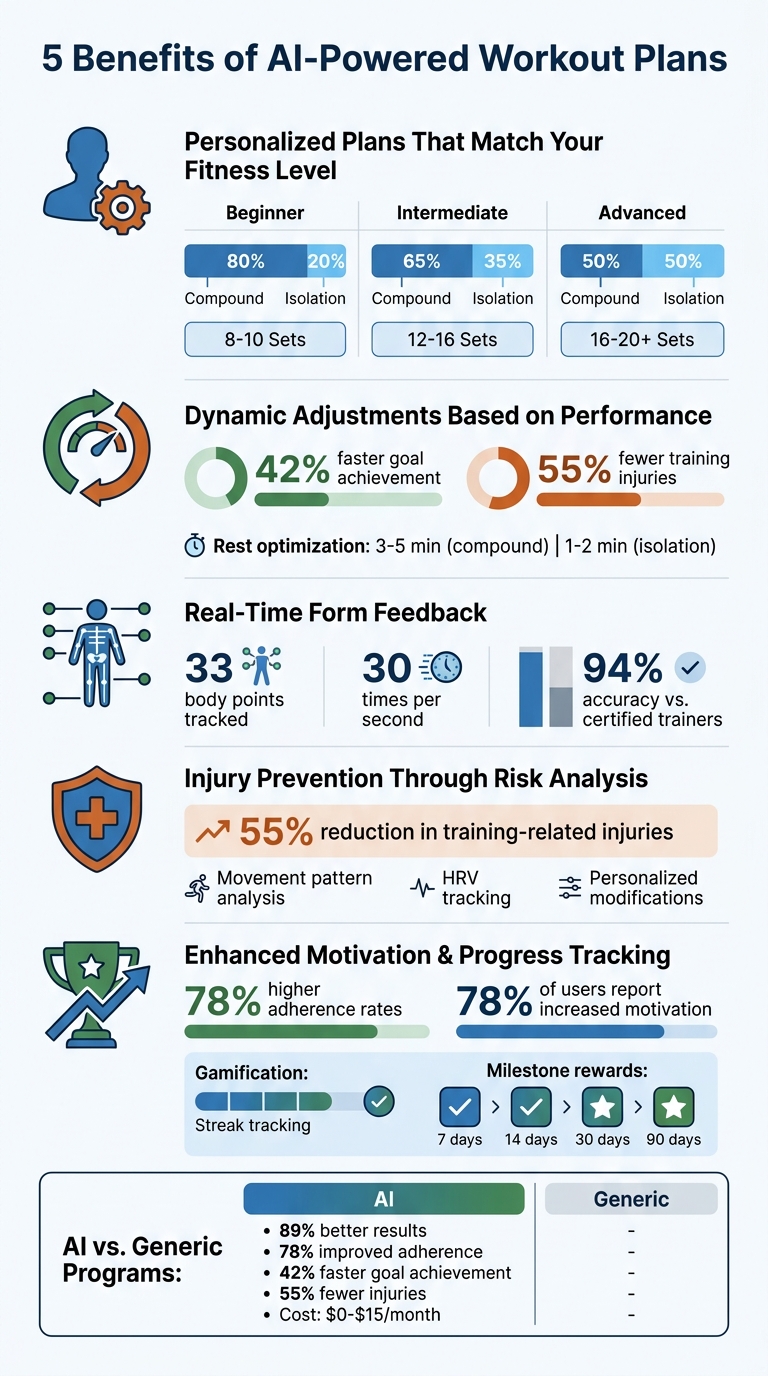
The AI doesn’t just stop at logistics. It structures your workouts to balance key movement patterns - push, pull, hinge, squat - and adjusts the ratio of compound to isolation exercises based on your experience level. For example, beginners often focus on 80% compound movements to build a solid base, while advanced athletes may shift toward a 50/50 split [3]. Even the weekly workout volume changes depending on your level: beginners might start with 8–10 sets per muscle group, while advanced lifters can handle 16–20+ sets to keep making gains.
| Training Level | Compound-to-Isolation Ratio | Weekly Sets per Muscle |
|---|---|---|
| Beginner | 80% Compound / 20% Isolation | 8–10 Sets |
| Intermediate | 65% Compound / 35% Isolation | 12–16 Sets |
| Advanced | 50% Compound / 50% Isolation | 16–20+ Sets |
To get the most out of this system, it’s important to provide as much detail as possible - like your injury history, the specific equipment you own, and which muscle groups you want to prioritize [3][8]. The more the AI knows, the better it can sift through countless exercise combinations to find the ones that are perfect for you.
This high level of personalization also allows the program to adjust automatically as you progress, ensuring that your workouts stay challenging and effective over time.
2. Automatic Adjustments Based on Your Performance
Real-time Adaptability
AI workout systems keep a close eye on every session, tracking details like weights, reps, and how challenging the workout feels to you. If you consistently hit your target reps, the system automatically tweaks the load or volume for your next session. And if a set feels too easy, you can give immediate feedback, prompting the AI to adjust the intensity right away [3][5][10]. It doesn’t stop there - the system also fine-tunes your recovery to help you perform at your best over time.
Fatigue and Recovery Modeling
The AI doesn’t just push you harder - it also pays attention to signs of fatigue. By analyzing your RPE (Rate of Perceived Exertion) and drops in performance, it can recognize when you’re overdoing it [3][5]. In these cases, the system might recommend a deload or reduce intensity to help you avoid burnout and overtraining.
As Jacked points out:
Static programs can't answer [real-life] questions. They're designed for idealized trainees operating under controlled conditions - conditions that rarely exist in real life. [1]
Research backs this up. Users of AI-driven workout plans hit their goals 42% faster and experience 55% fewer training-related injuries, thanks to better fatigue management and early identification of risk factors [2]. The system also optimizes rest times based on the type of exercise - suggesting 3–5 minutes for heavy compound lifts and 1–2 minutes for isolation movements, ensuring you recover properly between sets [4].
The pros and cons of using AI to plan your next workout
3. Custom Feedback and Form Corrections to Improve Your Technique
AI doesn’t just modify your workouts - it actively works to fine-tune your form as you go.
Form Correction Accuracy
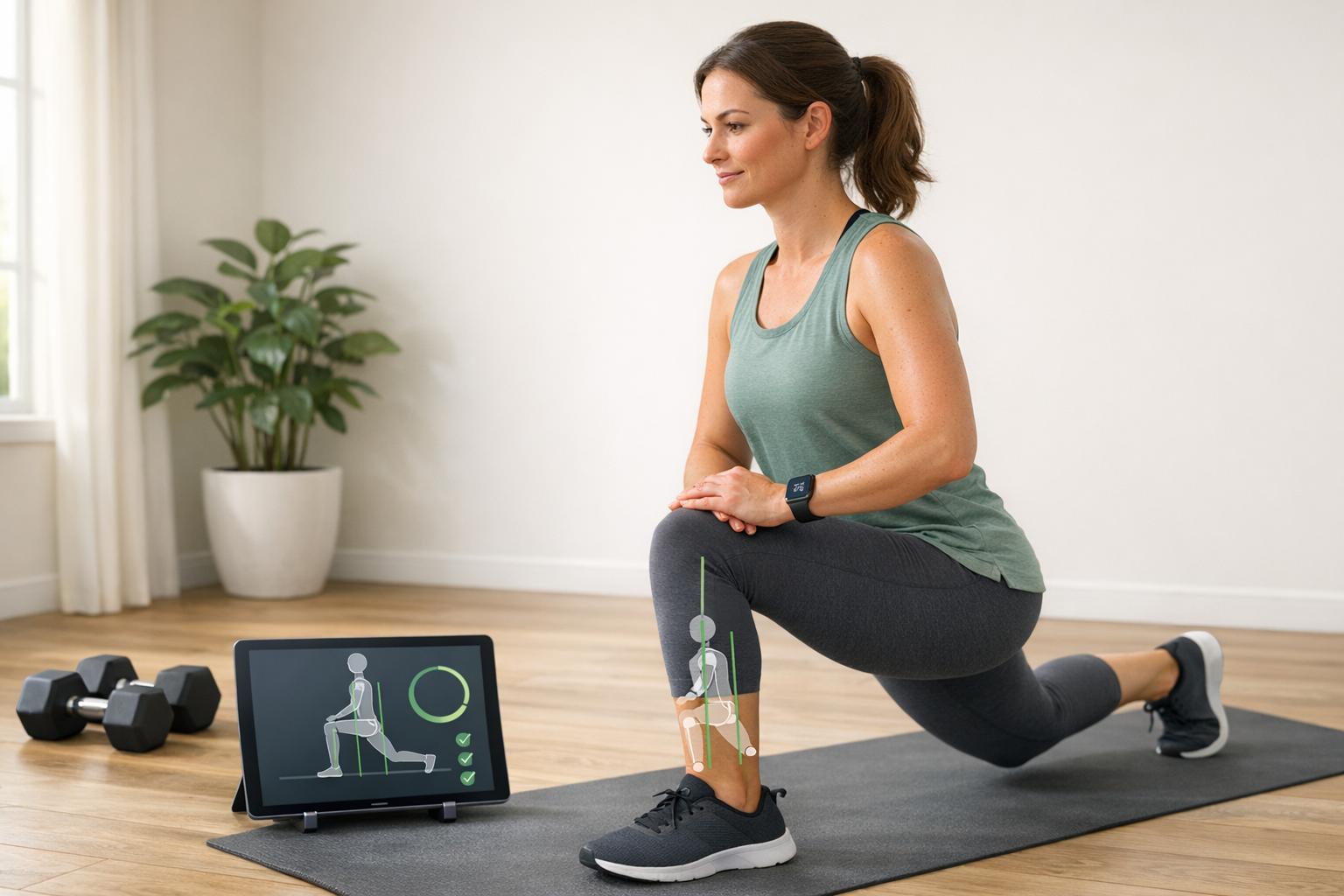
Using advanced tracking, AI monitors over 33 critical body points (like shoulders, hips, knees, and ankles) at a rate of 30 times per second. This data creates a digital skeleton of your movements, comparing your posture and joint angles to biomechanically optimal ranges. When something’s off, the system steps in with real-time audio cues, such as, "Lower your hips 2 inches", helping you adjust immediately [11].
A 2024 study from Stanford revealed that AI form analysis aligns with certified personal trainers 94% of the time in identifying form errors. Even better, it spots mistakes faster than the human eye. Whether it’s knees buckling during squats, shallow depth, or a rounded back, the system quickly pinpoints and addresses these common issues [11].
Real-Time Adaptability
Beyond correcting form, AI takes care of the small details so you can focus on your performance. It automatically tracks your reps, monitors your range of motion, and logs sets - no need for manual input. Just ensure you have a clear 6×6-foot workout space and a stable phone stand for optimal results [11].
Some tools, like CueForm AI, go a step further by analyzing videos of key lifts like squats, deadlifts, and bench presses. They provide personalized technique feedback with actionable suggestions. You can even chat with an AI coach to discuss your unique goals and limitations, getting advice tailored specifically to you.
"It's like having a trainer in my pocket who actually cares about my limits. The form corrections saved me from re-injuring my knee." – Sarah, Marketing Manager [11]
This kind of precise, instant feedback doesn’t just improve your technique - it makes your workouts safer and more effective.
4. Injury Prevention Through Risk Analysis
AI-driven workout plans dive deep into multiple data points to identify potential risks and help you avoid injuries.
How AI Helps Prevent Injuries
AI goes beyond real-time form corrections by analyzing movement patterns to highlight potential risks. Using your smartphone camera, it assesses joint angles and flags unsafe movements like knee valgus, butt wink, or raised heels. These seemingly minor issues can lead to serious injuries, such as spinal or ACL damage [12].
It can also detect imbalances or compensatory movements, like uneven weight distribution during a deadlift, and recommends corrective exercises to address these issues [12].
Wearable tech plays a role, too. By tracking metrics like heart rate variability (HRV), sleep quality, and stress levels, AI evaluates your recovery status. If it senses you're not fully recovered, it adjusts your workout intensity or schedules a deload week. This approach has been shown to cut training-related injuries by 55% [2].
"Poor form not only diminishes results but also paves the way for a range of injuries, especially when lifting heavy weights." – CueForm AI [12]
For individuals with prior injuries, AI customizes programs to avoid aggravating problem areas. For example, if you’ve had shoulder issues, it might replace overhead presses with safer options like landmine presses. By reviewing your training history and current limitations, it creates workouts designed to protect your vulnerable spots [13].
5. Better Motivation and Progress Tracking
Progress Tracking and Motivation Tools
AI-powered fitness platforms bring a fresh approach to keeping you motivated and tracking your progress. These tools go beyond just showing numbers on a scale; they offer visual insights into your fitness journey. Features like 3D body scans, muscle-group heatmaps, and performance graphs provide a detailed look at your strength improvements. Plus, every set, rep, and weight is automatically logged, helping you know exactly when it’s time to step things up.
It’s no surprise that 78% of users report feeling more motivated when using AI fitness apps [17]. Gamification elements like streak tracking, milestone rewards at intervals (7, 14, 30, and 90 days), and points systems make the process feel engaging and rewarding, keeping you accountable to your goals.
What truly sets these platforms apart is their adaptive feedback loops. After each workout, you can quickly rate the session’s difficulty on a 1–5 scale or flag it as "too easy" or "too hard." With just 10 seconds of input, the AI fine-tunes your next session, ensuring you’re always challenged appropriately and avoiding fitness plateaus [15][16][10]. Syncing wearables like the Apple Watch adds even more depth by tracking recovery and performance data, giving you a complete view of your fitness progress [14][16].
"The source of the program matters less than its quality and your adherence." – LoadMuscle [6]
Research backs this up: personalized fitness plans lead to 78% higher adherence rates compared to generic programs [2]. This personalized approach can be the difference between sticking with your fitness routine for the long haul or giving up early.
Conclusion
AI-powered workout plans bring a smarter, more personalized approach to fitness compared to static templates and traditional training. They deliver 89% better results than generic programs, improve adherence rates by 78%, help users reach goals 42% faster, and cut training-related injuries by 55% [2].
AI has transformed the fitness landscape by making elite-level coaching tools widely available. Features like progressive overload automation, fatigue management, and periodization - once reserved for expensive personal trainers - are now accessible for as little as $0–$15 per month [6]. As Ali Shamkhani from FITXM explains:
"AI and trainers both have value, but AI offers scalability and precision at a fraction of the cost" [7].
To make the most of these benefits, choosing the right AI platform is key. Look for tools that adapt to your performance by analyzing multiple data points. For strength training, CueForm AI stands out by offering video-based form analysis for exercises like squats, bench presses, and deadlifts. It provides personalized technique feedback and actionable cues to help you lift more safely and effectively. With unlimited form checks available on the free plan and detailed reports starting at just $10/month, it’s an affordable way to minimize injury risks while boosting your performance.
FAQs
What data does an AI workout plan need from me to personalize workouts?
To design a workout plan that fits you perfectly, AI typically asks for a few key details: your fitness goals, current experience level, the equipment you have access to, your schedule, and any personal preferences. By gathering this information, it can create a plan that matches your lifestyle and helps you work toward your specific objectives.
How does AI change my plan if I miss workouts or feel too fatigued?
AI takes the guesswork out of your fitness routine by tweaking your workout plan based on your recent performance, energy levels, and any changes to your schedule. This way, your training remains both effective and safe - even if you skip a session or feel worn out. These adjustments help balance recovery, reduce the risk of injury, and ensure you stay aligned with your fitness goals.
Do I need special equipment for AI form checks, or is my phone enough?
Your phone is all you need to get feedback on your exercise form. With tools like CueForm AI, you can simply upload videos recorded on your phone and receive detailed, personalized insights about your technique. The best part? You don’t need any fancy equipment - just your phone.