How AI Customizes Training Plans
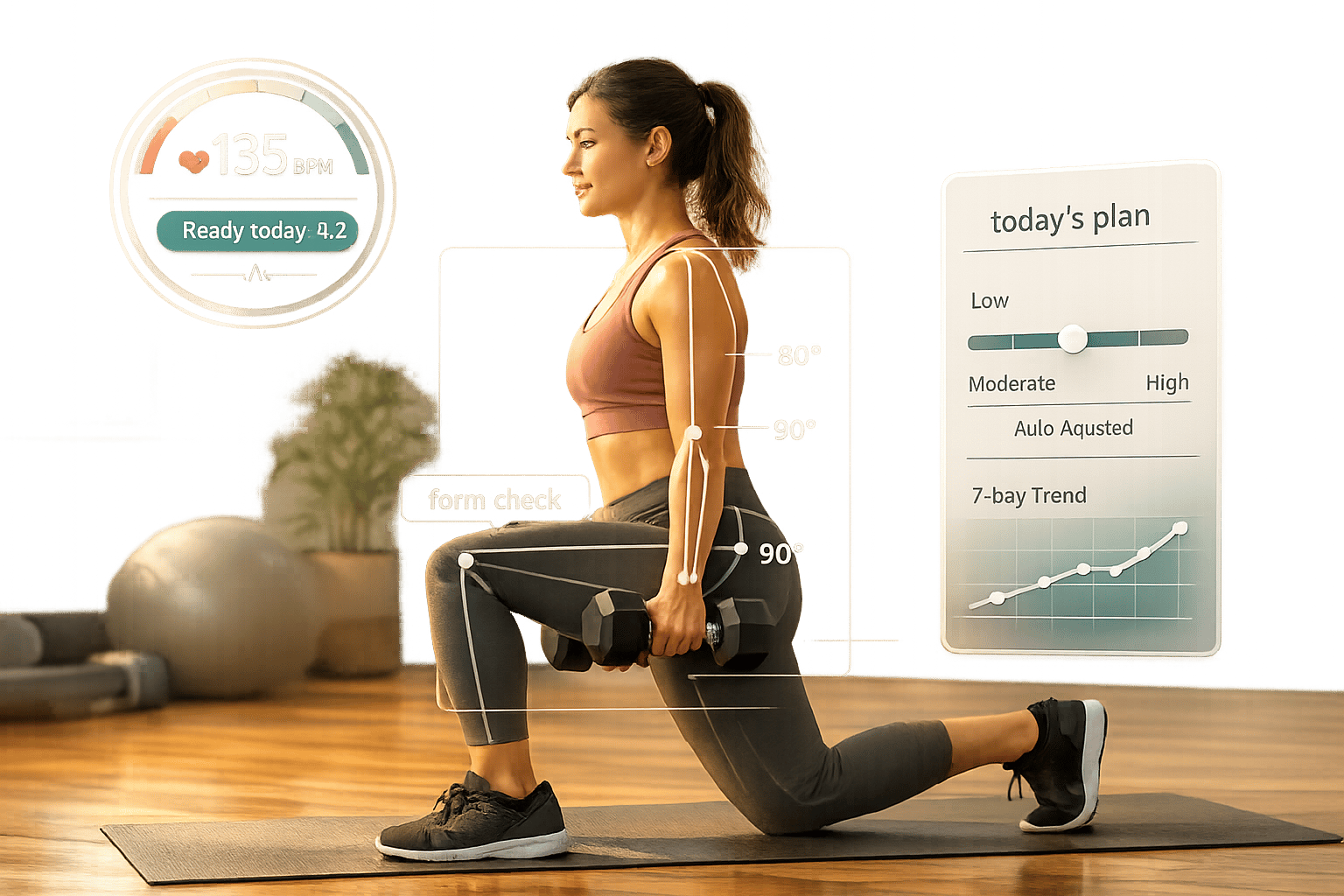
Generic workout plans don’t work for everyone. They ignore your unique fitness level, recovery ability, and progress history, often leading to stalled results or injuries. AI fixes this by creating personalized training plans that adjust to your goals, experience, and daily readiness. Here’s how it works:
- Tracks Your Data: AI uses your workout history, sleep, soreness, and energy levels to fine-tune your plan.
- Analyzes Form: Video analysis detects issues like poor squat depth or improper bar path and gives actionable feedback.
- Customizes Progression: Plans evolve in real-time, adjusting intensity, volume, and exercises to keep you improving.
- Prevents Plateaus: AI spots early signs of stalled progress and switches strategies, like adding new exercises or deloading.
- Affordable Coaching: AI tools like CueForm AI offer unlimited form checks and tailored advice starting at $10/month.
AI-driven training removes guesswork, helping you build strength safely and efficiently while keeping costs low.
AI Training Plans: Better or Just Hyped?
How AI Assesses Your Fitness and Technique
Before creating a personalized training plan, AI takes a deep dive into how you move, recover, and respond to workouts - going far beyond just tracking your numbers.
Data Sources AI Uses for Fitness Assessment
AI pulls together multiple data points to get a full picture of your fitness. It starts with your user profile, which includes details like body weight (in pounds), height, training experience, past injuries, and personal goals. Then, it looks at your workout history - tracking exercises, weights used, sets, reps, and how your performance changes over time. For instance, if your squat improves from 185 lb to 225 lb over eight weeks using a 3x5 program, the AI calculates your progress and adjusts your training volume accordingly.
Another critical layer is readiness data, which includes factors like your sleep duration, soreness, daily energy levels, and RPE (Rate of Perceived Exertion). These inputs help the AI determine whether to push harder or dial things back. For example, if your sleep has averaged just 5.5 hours over the past three nights and your resting heart rate is elevated, the AI might automatically reduce your deadlift intensity by 5–10% for that session. Wearable devices can streamline this process, feeding readiness data directly into the system for real-time adjustments.
Here’s a breakdown of how different data sources are used:
| Data Source | Example Inputs | AI Application |
|---|---|---|
| User profile | Body weight, training age, injury history, goals | Sets starting loads, volume, and exercise difficulty |
| Training history | Sets, reps, loads, session RPE | Estimates 1RM, tracks progress, flags weaknesses |
| Readiness & lifestyle | Sleep, soreness, heart rate, HRV | Adjusts daily training intensity |
| Video & motion data | Joint positions, bar path, range of motion | Detects technique issues and monitors form progress |
To refine these insights even further, video analysis plays a key role in understanding how you move.
How Video Analysis Evaluates Your Form
While logged numbers tell part of the story, your movement quality is just as important. AI video analysis uses computer vision and pose estimation to track key body points - like shoulders, hips, knees, and ankles - frame by frame. From a simple smartphone video, it can measure joint angles, bar path, tempo, and symmetry. A 2023 systematic review found that pose-estimation systems can classify sport-specific movements with over 90% accuracy when trained on the right datasets. For exercises like squats and push-ups, accuracy rates range between 80–95%.
Platforms like CueForm AI use this technology to analyze the Big 3 lifts: squats, bench presses, and deadlifts. By uploading or recording your set, the AI identifies issues like knee collapse during squats, early hip rise in deadlifts, or excessive elbow flare in bench presses. These observations are turned into actionable advice, such as “push your knees out” or “keep the bar closer to your shins,” which you can apply immediately. You can even chat with the AI coach for guidance on details like back angle or stance width.
For the best results, record your sets from a side or 45° angle in well-lit conditions to ensure clear tracking.
How AI Builds Custom Training Plans
AI takes your movement patterns and recovery data to design a training plan that fits your individual needs.
Exercise Selection and Load Management
AI uses advanced algorithms to pick exercises from a vast database, ensuring a balance in movement patterns - like combining horizontal and vertical pushes and pulls, hip hinges, squats, and carries. This approach helps develop muscles evenly. It also considers your injury history to avoid risky exercise pairings, such as heavy deadlifts and barbell rows in the same session.
For beginners, the focus is on building strength with an 80/20 split: 80% compound movements (like squats and deadlifts) and 20% isolation exercises. As your experience grows, this shifts to a 50/50 split, allowing targeted work on weaker areas. Rest periods are customized based on your goals: 1–2 minutes for muscle growth (hypertrophy) and 3–5 minutes for building maximum strength.
| Training Level | Compound/Isolation Ratio | Weekly Sets per Muscle | Progression Method |
|---|---|---|---|
| Beginner | 80% / 20% | 8–10 sets | Linear (add weight each session) |
| Intermediate | 65% / 35% | 12–16 sets | Double (add reps, then weight) |
| Advanced | 50% / 50% | 16–20+ sets | Undulating Periodization |
AI doesn’t stop there - it continuously adapts your plan based on both your daily performance and long-term progress.
How AI Adjusts Plans as You Progress
Once your exercises are selected, AI tracks your performance during each session. If you hit your target reps, it increases the weight. If you miss your goal or report high effort levels (using Rate of Perceived Exertion), it adjusts by maintaining or lowering the load.
Over time, AI organizes your training into structured phases:
- On-ramp phase: Focuses on building technical skills.
- Accumulation phase: Increases work capacity.
- Intensification phase: Peaks your strength.
- Deload weeks: Scheduled every 4–8 weeks to help you recover and prevent fatigue.
This adaptive approach isn’t just theoretical - it’s backed by research. Athletes using AI-driven programs see 23% greater strength gains compared to those on static plans [5]. Plus, users stick with these dynamic, auto-adjusting programs 43% longer than traditional templates [4]. Over time, that consistency adds up to real progress.
sbb-itb-c91a623
How AI Manages Progression and Plateaus
Even the most well-designed training plans can hit a wall. AI steps in to address these challenges as they happen.
Auto-Regulation and Real-Time Workout Adjustments
AI doesn't wait until the end of a training cycle to make changes - it works in real time. By continuously monitoring your performance, it can make instant adjustments. For example, if your bar speed slows or your perceived effort (RPE) spikes during a set, the AI may reduce the weight, decrease the volume, or extend your rest periods to prevent overtraining.
It goes beyond just performance metrics. AI uses live biometric data like heart rate variability (HRV), sleep quality, and readiness scores to guide these adjustments. On a day when your readiness is low, it automatically lowers the intensity of your workout instead of pushing you into a session your body isn’t prepared for. This approach is backed by research: auto-regulated training programs have been shown to produce a 12% greater increase in maximal strength compared to fixed-set programs [4]. By responding in the moment, AI helps you avoid plateaus before they even take hold.
How AI Identifies and Breaks Through Plateaus
AI doesn’t just react - it anticipates. By analyzing trends in your performance, it can spot potential plateaus before they fully develop. Studies show that AI can detect subtle declines in lifting volume 14 to 21 days before you start feeling the physical effects of overtraining [4]. It tracks factors like stalled weight progression, slower rep speeds, and higher RPE trends to differentiate between a temporary rough patch and a true plateau.
"Software algorithms can detect microscopic downward trends in your lifting volume 14 to 21 days before you actually feel the physical symptoms of overtraining." - TrainMate Team [4]
When a plateau is confirmed, AI has a range of strategies to tackle it. It might introduce a new exercise variation, like swapping back squats for Bulgarian split squats, pulling from a library of 4,000+ movements [3]. If adding weight to the bar isn’t cutting it, the AI could shift the focus to metabolic stress by increasing rep ranges and shortening rest intervals. For more stubborn plateaus, it can transition your program to Daily Undulating Periodization (DUP), which mixes up rep ranges and intensities within the same week to target different muscle fibers [4].
| Method | How AI Spots the Problem | How AI Fixes It |
|---|---|---|
| Auto-Regulation | High RPE or slow bar speed | Reduces weight or volume mid-session |
| Deloading | Stagnant strength over 2+ weeks | Schedules a low-intensity recovery week |
| Exercise Rotation | Diminishing returns on a lift | Swaps in a mechanically similar variation |
| Periodization Shift | Plateaued linear progression | Switches to undulating or block periodization |
| Rest Optimization | Failed reps at high intensity | Adjusts rest intervals to match your goals |
How AI Improves Form and Lowers Injury Risk
AI Coaching vs. Traditional Coaching: Cost, Access & Performance
Building strength is great, but it can come at a cost if poor technique leads to injuries. That’s where AI steps in - it spots form issues early, long before they become ingrained habits. By identifying these problems upfront, AI ensures your training stays as tailored to your needs as your progress.
How AI Detects Form Breakdowns
AI takes a detailed approach to analyzing your lifts. It breaks down video footage frame by frame, focusing on key joints and comparing their movement to safe biomechanical ranges. This allows it to catch subtle mistakes - like knees caving inward (knee valgus) or a rounded back - that can lead to injuries if repeated over time. For example, imagine a recreational lifter squatting 225 pounds. If the system detects chronic knee valgus during their sets, it can recommend reducing the weight and incorporating corrective exercises before the issue becomes a serious problem. This precise detection helps create personalized feedback that addresses your specific needs.
CueForm AI's Customized Cues
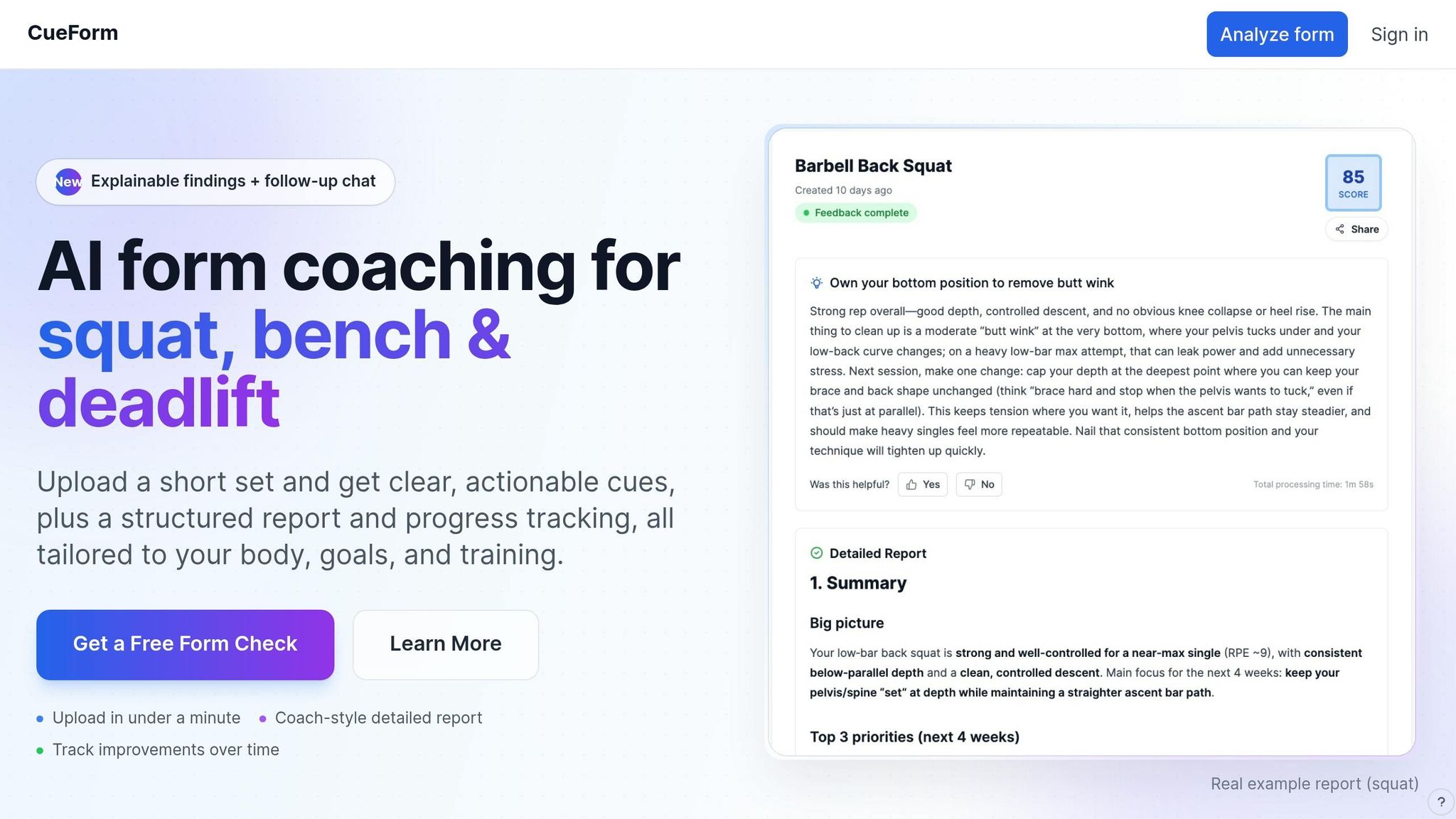
CueForm AI is a tool designed to help lifters refine their technique on an ongoing basis. Simply upload videos of your squats, bench presses, or deadlifts, and you’ll get instant, targeted feedback - like tips on knee tracking or bar positioning - delivered via an AI chat. What’s unique is how it adjusts its advice based on your body type and goals. For instance, if you have long femurs and naturally lean forward more in a back squat, CueForm AI won’t automatically mark it as incorrect. Instead, it evaluates whether your spine and knees are in safe alignment based on your proportions.
If you’re unsure about a cue, you can ask the AI for clarification - like, “What should this feel like?” - or even correct it if it misinterprets your stance. The system tracks your Technique Score alongside your lifting progress, giving you a clear picture of how your form is improving. The basic plan is free, while the Starter plan, at just $10 per month, offers unlimited detailed reports and access to the AI coach chat.
Form Feedback Methods Compared
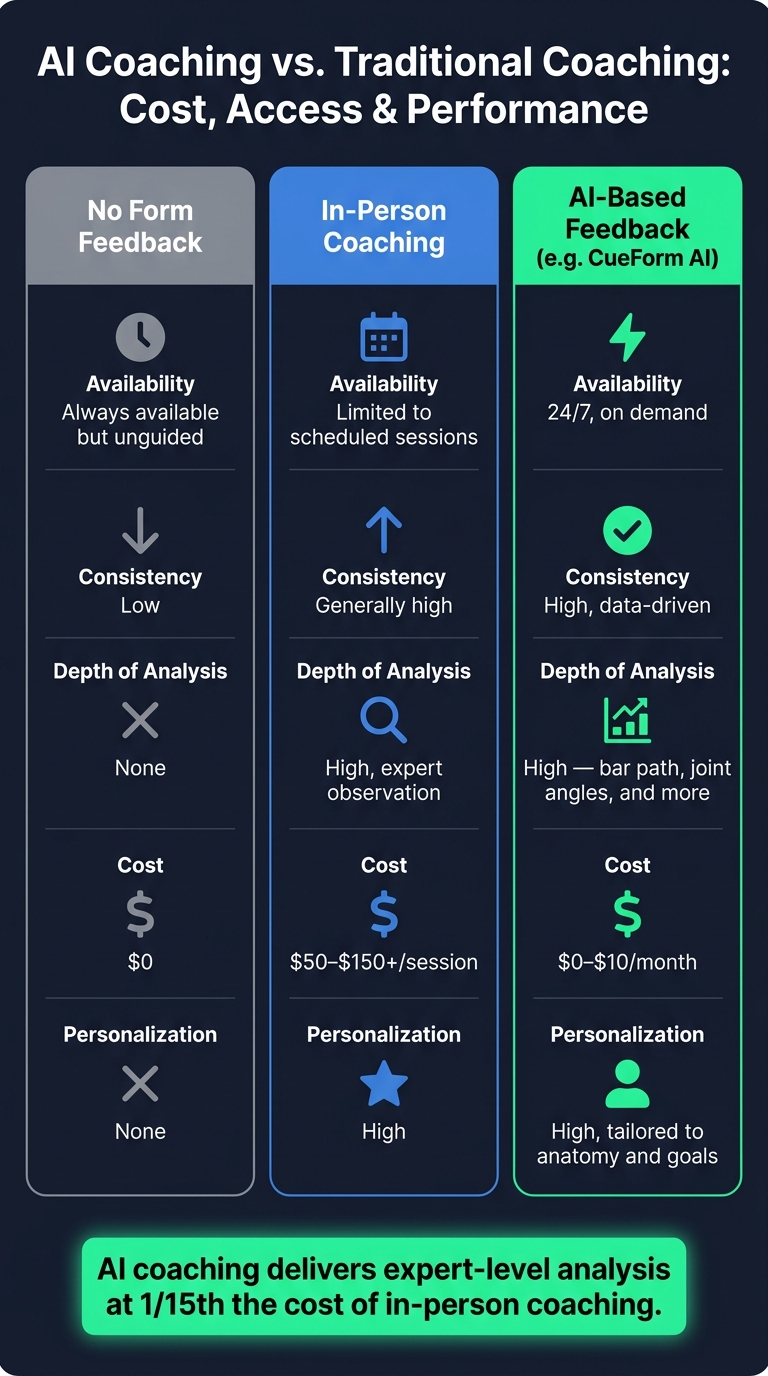
AI-based feedback offers a new level of accessibility and consistency compared to traditional training methods. Here’s how it stacks up against no feedback and in-person coaching:
| Metric | No Form Feedback | In-Person Coaching | AI-Based Feedback (CueForm AI) |
|---|---|---|---|
| Availability | Always available but unguided | Limited to scheduled sessions | 24/7, on demand |
| Consistency | Low (relies on self-assessment) | Generally high, though it varies | High (consistent, data-driven analysis) |
| Depth of Analysis | None | High (expert observation) | High (assesses bar path, joint angles, and more) |
| Cost | $0 | High ($50–$150+/session) | Low ($0–$10/month) |
| Personalization | None | High | High (tailored to your anatomy and goals) |
For lifters training solo - whether at a commercial gym or in a home garage - AI offers a practical safety net. While it can’t replace hands-on coaching for complex adjustments, it’s a reliable way to ensure you’re not unknowingly repeating risky movement patterns as you push for heavier lifts.
Conclusion: Where Personalized Strength Training Is Headed
AI is changing the game when it comes to training plans. Unlike traditional static programs, AI-driven plans adapt in real time. They adjust variables like volume, intensity, and exercise selection based on your personal training history and current condition. This shift moves us far beyond the generic, one-size-fits-all approach, paving the way for consistent, long-term progress.
Another major shift is affordability. Hiring a top-tier human coach typically costs $200–$500 per month. In contrast, AI-driven training options are available for as little as $7–$10 per month [1][2]. This makes high-quality training guidance accessible to a much broader audience.
AI advancements in form analysis are also changing the way coaching works. Modern tools don’t just point out mistakes - they explain why they happen and provide actionable tips to fix them. CueForm AI, for example, states: "We turn your video into cues you can use next session - grounded in bar path, positions, and the context you provide" [2].
Key Takeaways
AI-driven strength training is reshaping the fitness landscape in several key ways:
- Personalization: Training plans are tailored to your specific fitness level, body mechanics, and recovery needs - offering far more than generic templates.
- Steady Progression: Adaptive strategies like undulating periodization and planned deloads every 4–8 weeks help ensure consistent improvement [1].
- Injury Prevention: Advanced video analysis of foundational lifts like the squat, bench press, and deadlift helps AI tools identify and correct form issues before they lead to injuries.
For those training on their own, CueForm AI offers a free plan with unlimited form checks, actionable feedback, and progress tracking - no strings attached. Lifters looking for more in-depth guidance can upgrade to the Starter plan for $10 per month (or $89 annually), unlocking detailed reports and extended access to the AI coach chat [2].
FAQs
What data do I need to track for AI to personalize my plan?
To craft a training plan that fits you perfectly, AI requires specific details about your fitness goals - whether you're aiming for strength gains or muscle growth (hypertrophy). It also considers your experience level, any past injuries, the equipment you have access to, how often you can train, and how long each session can last.
CueForm AI takes this a step further by analyzing video recordings of your exercises, like squats or bench presses. It evaluates key metrics such as joint angles and movement tempo, offering personalized feedback tailored to your unique form and movement patterns.
How accurate is AI form analysis from a phone video?
AI-powered form analysis through smartphones delivers impressive precision, with accuracy rates ranging from 92% to 99% for movement classification and pose correction. Leveraging computer vision technology, it tracks 33 body landmarks and calculates joint angles with an accuracy margin of just 3-5 degrees, comparable to professional lab systems. CueForm AI takes it a step further by offering confidence scores and personalized feedback via its conversational coaching feature. To achieve optimal results, ensure proper lighting, a stable setup, and full-body visibility during use.
How does AI know when I need a deload or program change?
AI can spot when it's time for a deload or a tweak in your training program by digging into your performance stats, fatigue levels, and recovery data. It keeps an eye on patterns like missed reps or consistently high effort scores. Plus, it factors in recovery metrics - things like your sleep quality and heart rate variability. When signs of burnout or a plateau start stacking up, the system adjusts your plan to help you recover better and keep making progress.
Related Blog Posts
Plans
Choose the plan that best fits your needs.
Free
Try it out
Starter
Perfect for fitness enthusiasts