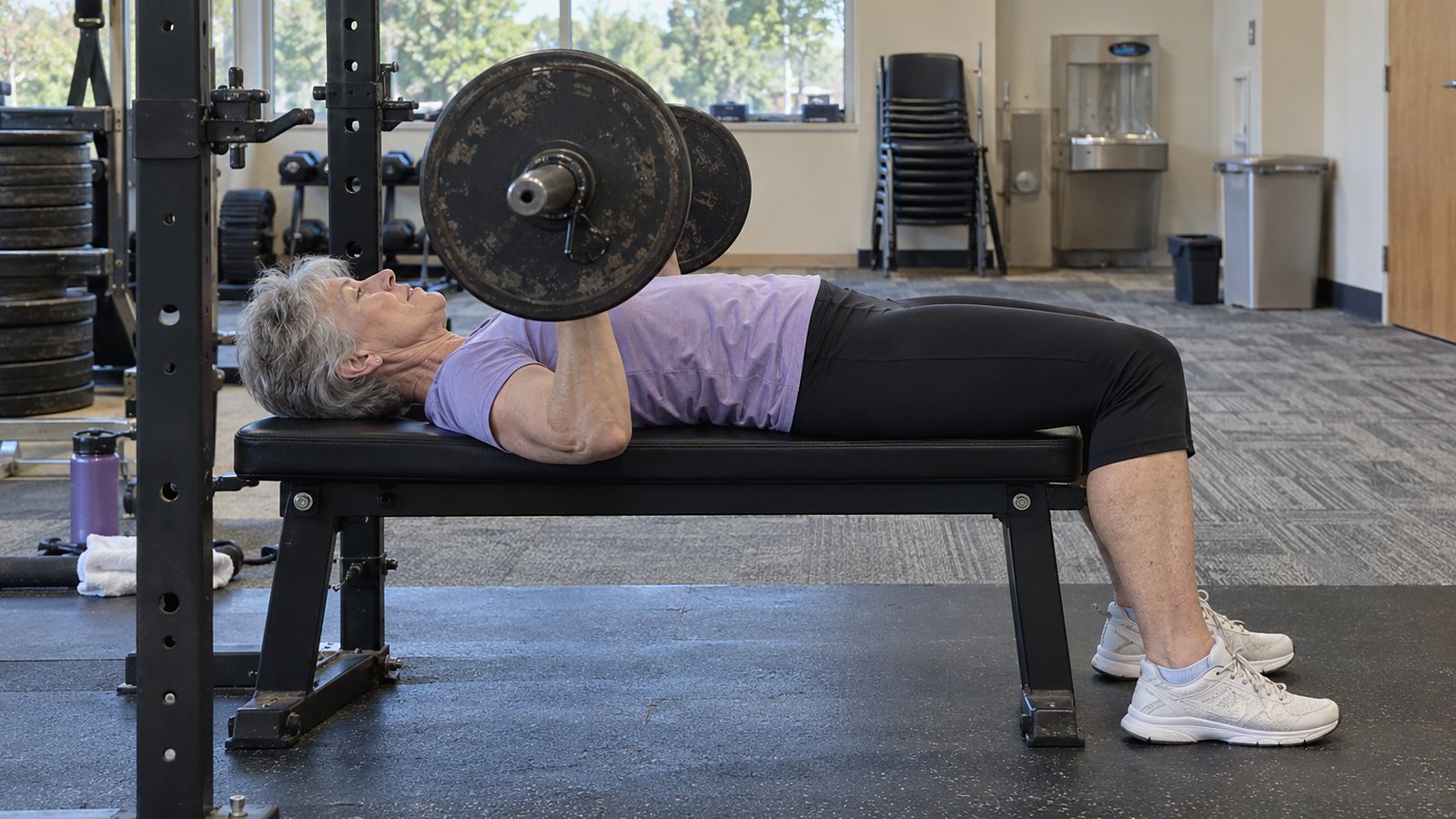
Bench Press Bar Path: Where the Bar Should Touch and Where It Should Go
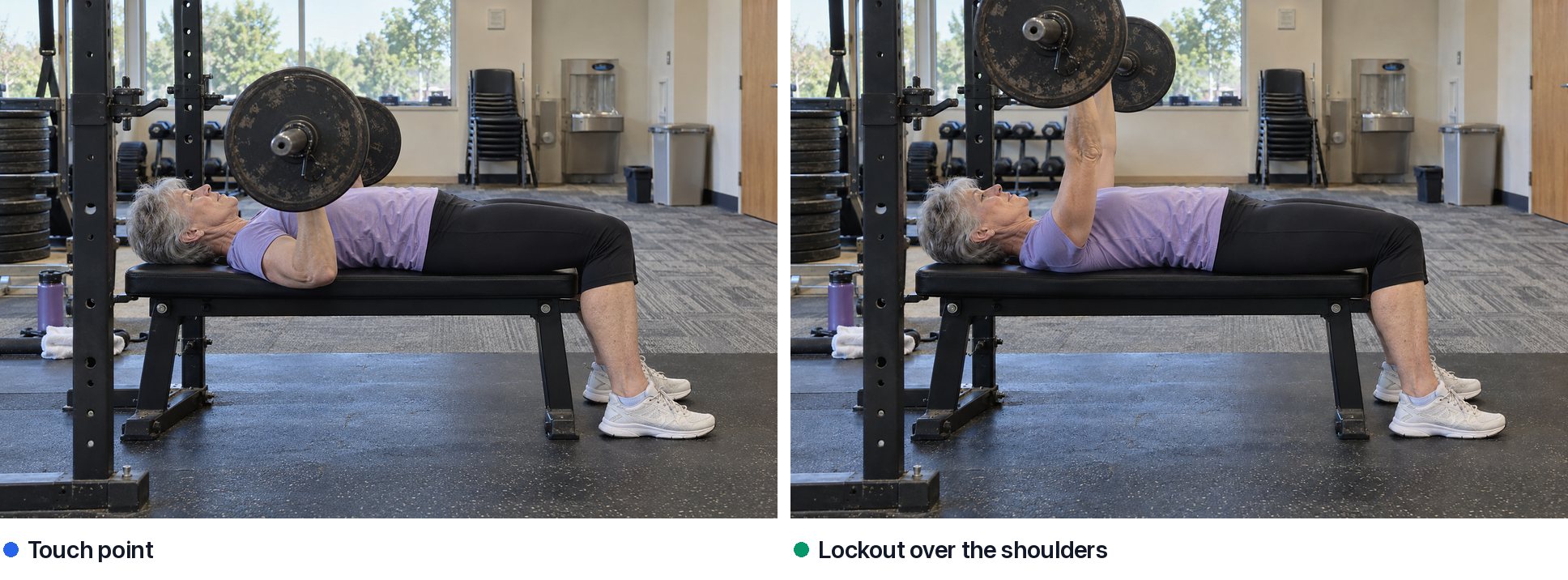
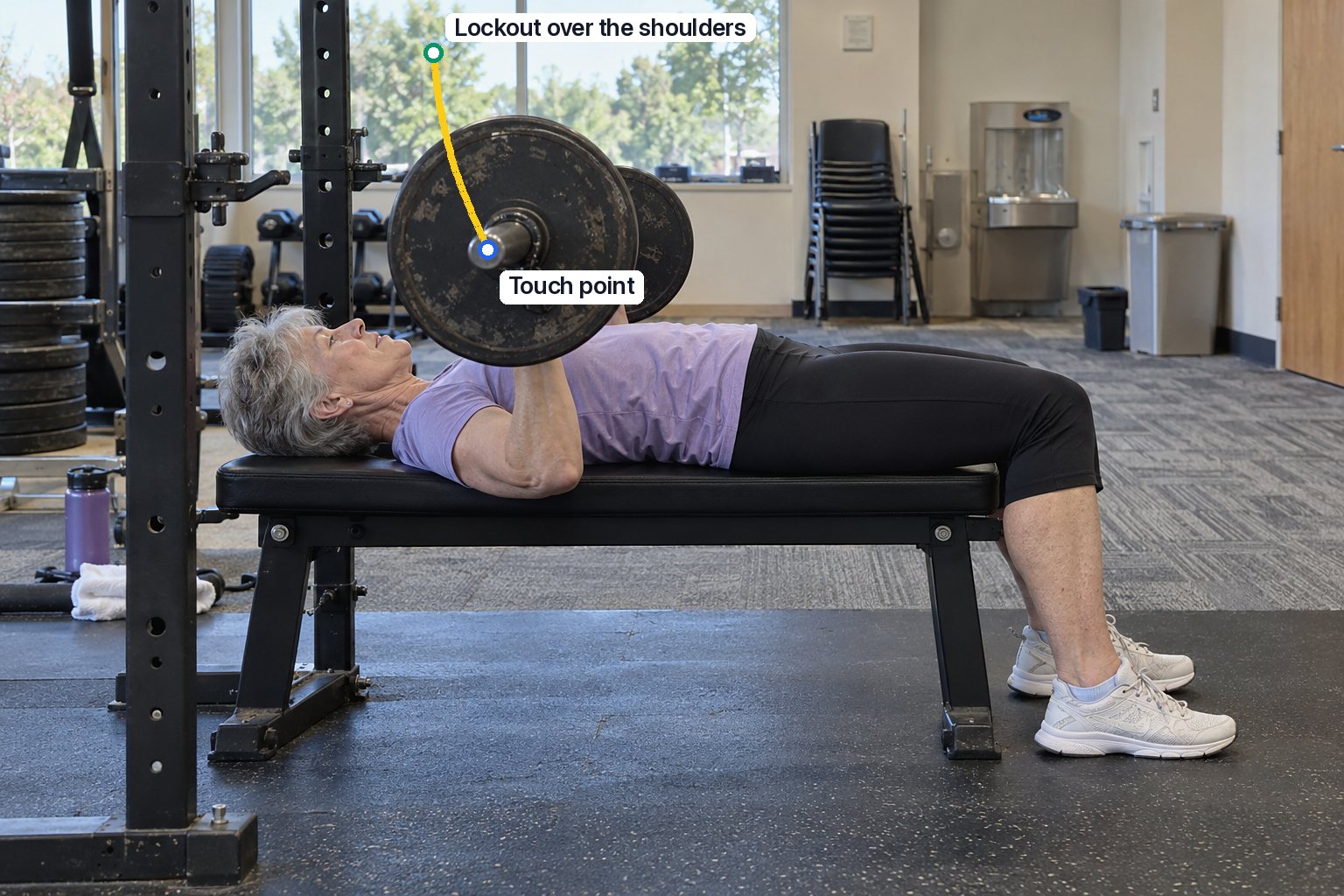
A good bench press bar path is a slight diagonal: the bar comes down to your lower chest and goes back up over your shoulders. It is not a straight vertical line.1 Seen from the side, the bar touches lower on your chest than where it locks out, and a strong press drives it back toward your shoulders early, then finishes straight up.2
Where should the bar touch on the bench press?
For most lifters, the bar touches the lower chest, somewhere between the nipples and the bottom of the breastbone (sternum).3 At the touch, your forearms should be close to vertical under the bar. A grip that puts them there gives you the longest range of motion.4
There is no single touch point for everyone. Your bench press bar position on the chest depends on your grip, your elbows, your arch and your proportions.5 A closer grip usually brings the touch lower.6 The bar also follows your elbows: tuck them toward your sides and it lands lower, flare them and it moves up toward your throat.5 Lifting your chest higher, with more arch, lets it touch lower still.7
Find your touch point with the empty bar, then lower to that same spot on every rep.
If touching your chest hurts, don't force it. Shorten the range, lighten the load or pick a similar press that is pain-free.8 See a doctor or physical therapist if shoulder pain is getting worse or hasn't improved after two weeks. Get urgent help for sudden or very bad pain, pins and needles that don't go away, or pain that started with an injury.9
What a correct bench press bar path looks like
Film from the side and a good bench bar path has three parts:
- Lockout. The bar sits over your shoulder joints, where it balances on straight arms.10
- The descent. The bar travels down and slightly toward your feet to your touch point.2
- The press. Off your chest, the bar drives up and back toward your face, then finishes almost straight up over your shoulders.2
Some coaches call this shape a J-curve.11
The path can't be vertical because the bar touches lower than it locks out. A vertical path over your shoulders would mean touching high on your chest with your elbows flared straight out to your sides. Bringing the elbows down a little instead moves the touch down your chest and turns the path into a diagonal.1
Does bar path matter?
Yes, for how much you can press. Expert benchers keep the bar closer to their shoulders than novices.12 They drive it back early in the press, while novices push straight up first and move it back near the top. The farther the bar sits in front of your shoulders, the harder your chest and front delts work.2
Thomas McLaughlin's studies of meet lifters found that the elite benchers who kept improving year after year moved the bar back toward their shoulders sooner as they got stronger.2 A clean path is still only one part of a good rep: bar path and rep quality tell you different things.
Why the bar drifts
Bar drift usually starts in one of three places: where the bar touches, which way you press, or where you look.
You touch too high
The bar follows your elbows, so when they flare out level with your shoulders, the touch moves up toward your collarbones.5 Most lifters shouldn't touch higher than their nipples.3 Touching high and keeping your elbows flared for the whole press is weaker than touching lower and flaring them only as the bar leaves your chest.6
You press straight up
The novice lifters in McLaughlin's studies pressed straight up off their chest, and their bar moved back toward their shoulders only near lockout. That kept the bar in front of their shoulders through the hardest part of the lift, a few inches off the chest.2 If your lockout ends over your chest rather than your shoulders, the bar finished in front of its balance point.10
Your eyes follow the bar
If you watch the bar come down and go up, you have no fixed target, so it lands somewhere slightly different each rep. Stare at one spot on the ceiling instead, and the bar goes to the same place, and through the same path, every rep.13 The same applies to the start of the set. If you lower the first rep before the bar is over your shoulders and your eyes have found their spot, that rep starts somewhere different from where it finishes.14
How to fix your bar path
Try one fix at a time with a light weight, and film a set after each.
1. Fix your eyes on one spot
Cue: Fix your eyes on one ceiling spot and press the bar to it every rep.
Lie far enough down the bench that, looking straight up, your eyes line up with the side of the bar nearest your feet. That leaves room for the bar to travel on a diagonal.15 Unrack, and with the bar locked out over your shoulders, find a mark on the ceiling just above it. That mark is your eye target. Keep your eyes on it, not the bar, from the unrack to the last rep.13
Drill: empty-bar sets. Do two sets of five with the empty bar, eyes on the mark, then add weight in small steps while the path holds. Rippetoe finds most novices press a decent groove within a couple of sets this way.13
On your next filmed set: every rep locks out in the same place, over your shoulders.
2. Touch lower on your chest
Cue: Bring the bar down to the bottom of your breastbone on every rep.
Use this cue if your bar touches high, near your collarbones. The bottom of the breastbone suits most lifters, and yours may sit a little higher or lower. Pull your shoulder blades together and down, lift your chest to meet the bar and touch lightly.16 Let your elbows come down a little closer to your sides, so your forearms are upright under the bar at the touch.5
Drill: paused bench presses. Lower to a light touch on your chest, hold until the bar is still with your whole body tight, then press without a heave.17 The pause shows you exactly where the bar lands. Chalk the middle of the bar: one clean line on your shirt means a consistent touch, and a broad smear means it moves.3
On your next filmed set: the bar touches at the same height every rep, with your forearms close to vertical.
3. Press back over your shoulders
Cue: Press the bar back toward a fixed spot on the ceiling above your face.
From the touch, drive the bar up and back toward your face. Let your elbows flare as the bar leaves your chest, not before. Drive your heels into the floor so your chest stays up and pushes the bar back.6 Once the bar is over your shoulders, finish straight up to lockout.2
Drill: tempo bench presses. Lower for 3 seconds to the same spot on your chest, touch lightly, then press up and back to your ceiling mark. Lowering under control helps keep the bar from wandering on the way down,3 and expert benchers lower the bar more slowly than novices.12
On your next filmed set: in the first few inches off your chest, the bar moves toward your face, and it locks out over your shoulders, not over your chest.
See it in your own set
Bar path is hard to judge from under the bar: your eyes are on the ceiling, and the path can change as a set gets hard.18 Film from the side at bench height, about 3 meters away, with the bar in frame from the bottom of each rep to lockout and your chest clear of the plates. CueForm traces the bar's path on your video, shows where it wandered, and checks whether the bar reached your chest. Check your bench press bar path from one video.
To see how the tracing works, read how AI bar path analysis works. The barbell bench press guide covers the rest of the lift.
FAQ
Should the bar touch your chest on bench press?
Yes, for a full rep. Powerlifting rules require the bar to reach your chest or abdomen and stay still before you press.19 Stopping at 90 degrees trains a shorter press: in trained men, full-range bench presses built more strength over 10 weeks than partial ones.20 Train with the full range you have.21
Should the bar path be a straight line?
No. On a flat bench, the bar touches lower on your chest than where it locks out, so the path is a slight diagonal.1 The work is the same either way, because only the vertical distance counts, but driving the bar back toward your shoulders first is the more efficient way to do it.2
Where should the bar touch on incline bench press?
Higher than on a flat bench: around the top of your breastbone, just below where your collarbones meet it. The incline bench press bar path is close to vertical, with the bar staying almost directly over your shoulders.22 CueForm checks the flat bench press, so film a flat set for a form check.
Why does the bar drift toward my face?
Some drift toward your face is right: off your chest, the bar should move back until it's over your shoulders.2 It's a problem when the bar touches near your collarbones or locks out over your face. Check for flared elbows pulling the touch up,5 and for a set started with the bar over your throat.14
Sources
-
Rippetoe M. Starting Strength: Basic Barbell Training, 3rd edition. The Aasgaard Company, 2011. Chapter 5, "Learning to Bench Press", p. 188, and "Elbows", pp. 194–195. ↩
-
Nuckols G. Bench press bar path: how to fix your bar path for a bigger bench. Stronger by Science, updated 2023. ↩
-
Nuckols G. How to bench press: the definitive guide. Stronger by Science, updated 2023. Section "Descent". ↩
-
Rippetoe M. Starting Strength: Basic Barbell Training, 3rd edition. The Aasgaard Company, 2011. Chapter 5, "Learning to Bench Press", p. 185, and "Hands and grip", p. 192. ↩
-
Rippetoe M. Starting Strength: Basic Barbell Training, 3rd edition. The Aasgaard Company, 2011. Chapter 5, "Elbows", pp. 195–196. ↩
-
Nuckols G. How to bench press: the definitive guide. Stronger by Science, updated 2023. Sections "Ascent" and "Shoulder flexion". ↩
-
Rippetoe M. Starting Strength: Basic Barbell Training, 3rd edition. The Aasgaard Company, 2011. Chapter 5, "Elbows", pp. 196–197. ↩
-
Helms E, Morgan A, Valdez A. The Muscle and Strength Pyramid: Training, 2nd edition. Muscle and Strength Pyramids, 2019. "Adherence", p. 21. ↩
-
NHS. Shoulder pain. Reviewed May 2023. ↩
-
Rippetoe M. Starting Strength: Basic Barbell Training, 3rd edition. The Aasgaard Company, 2011. Chapter 5, "Learning to Bench Press", pp. 186–187. ↩
-
Austin D, Mann B. Powerlifting: The Complete Guide to Technique, Training, and Competition, 2nd edition. Human Kinetics, 2022. Chapter 5, "Mechanics of the J-Curve Technique", pp. 82–83. ↩
-
Madsen N, McLaughlin T. Kinematic factors influencing performance and injury risk in the bench press exercise. Medicine and Science in Sports and Exercise, 1984. ↩
-
Rippetoe M. Starting Strength: Basic Barbell Training, 3rd edition. The Aasgaard Company, 2011. Chapter 5, "Learning to Bench Press", pp. 187–188. ↩
-
Rippetoe M. Starting Strength: Basic Barbell Training, 3rd edition. The Aasgaard Company, 2011. Chapter 5, "Racking Errors", p. 212. ↩
-
Megsquats. 3 easy squat fixes: quick technique fixes for the barbell squat and bench (opens in a new tab). Video; bench set-up from 11:27. ↩
-
elitefts. Fix your squat and bench instantly: upper back secrets (opens in a new tab). Video; bench press from 4:36 and 8:05. ↩
-
Nuckols G. How to bench press: the definitive guide. Stronger by Science, updated 2023. Section "Pausing". ↩
-
Duffey MJ, Challis JH. Fatigue effects on bar kinematics during the bench press. Journal of Strength and Conditioning Research, 2007. ↩
-
International Powerlifting Federation. Technical Rulebook, sections 4.2 and 4.2.1. Effective 1 March 2026. ↩
-
Martínez-Cava A et al. Bench press at full range of motion produces greater neuromuscular adaptations than partial executions after prolonged resistance training. Journal of Strength and Conditioning Research, 2022. ↩
-
Helms E, Morgan A, Valdez A. The Muscle and Strength Pyramid: Training, 2nd edition. Muscle and Strength Pyramids, 2019. "Exercise Selection: Range of Motion", p. 155. ↩
-
Rippetoe M. Starting Strength: Basic Barbell Training, 3rd edition. The Aasgaard Company, 2011. Chapter 7, "Bench Press Variations", pp. 312–313. ↩