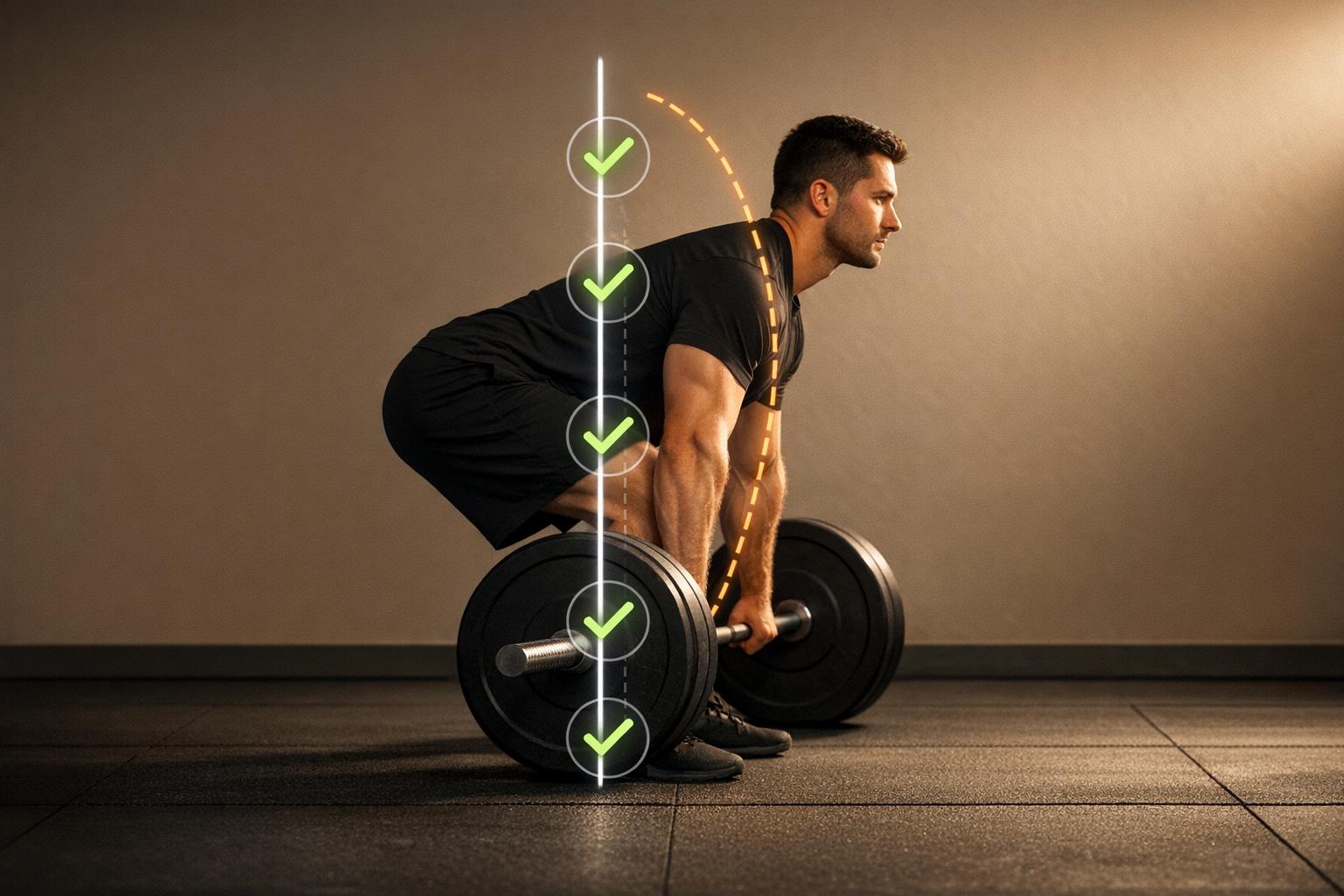
Bar Path vs. Repetition Quality: Key Differences
Want to improve your lifts and avoid injuries? Understanding the difference between bar path and repetition quality is crucial. Here's the breakdown:
- Bar Path: Tracks the barbell's movement during a lift. A straight or consistent path improves efficiency and reduces wasted energy.
- Repetition Quality: Focuses on your body's movement, like joint alignment, spinal position, and control, ensuring safe and effective form.
Quick Overview:
- Bar Path: Best for refining efficiency and lifting heavier weights. Ideal for experienced lifters or specific exercises like Olympic lifts.
- Repetition Quality: Prioritizes safety and form. Perfect for beginners, injury prevention, or fatigue management.
Both metrics work together: Bar path shows how the bar moves; repetition quality explains why it moves that way. Use them strategically to lift smarter and safer.
What is Bar Path in Strength Training?
Bar path refers to the route a barbell takes during a lift, tracing its movement from start to finish. It’s essentially the "map" of your barbell’s journey for each repetition.
The shape of this path changes depending on the exercise. For squats and deadlifts, the ideal bar path is a straight vertical line directly over your midfoot. In the bench press, the bar usually follows a slight arc - starting over your shoulders, descending to your chest, and then pressing back toward your shoulders. Olympic lifts like cleans and snatches are a bit more complex, with the bar following an "S" shape. This happens because the bar stays close to your body, moves slightly outward during hip extension, and then returns inward during the catch phase.
Why does this matter? A proper bar path ensures that all the force you generate is used efficiently. If the bar drifts forward or swings excessively, you waste energy. Studies show that even small deviations of 0.8–1.2 inches can reduce power output by up to 15% [4]. Larger deviations - over 4 inches - can triple your risk of injury [4]. Spotting these issues early helps you correct them before they lead to failed lifts or unnecessary strain on your joints.
Benefits of Bar Path Tracking
Monitoring your bar path comes with several perks:
- Increased load capacity: By cutting down on wasted motion, you can lift heavier weights more safely.
- Lower injury risk: Tracking helps you catch erratic movements before they develop into harmful habits.
- Improved consistency: Comparing bar paths over time ensures your form stays solid, even as fatigue sets in.
For experienced lifters, bar path tracking becomes even more essential. Take Olympic weightlifting, for example: bending your arms too early during a clean or snatch can increase energy use by 22%. This extra effort can turn a lift you could have nailed into a failed attempt [4]. By analyzing each phase of your lift, you can pinpoint where your technique might be breaking down - whether it’s hips rising too fast in a deadlift or the bar drifting too far forward in a clean.
How to Measure Bar Path
These days, technology makes tracking bar path easier than ever. Many smartphone apps let you record your lifts from a side angle and overlay the bar’s trajectory on your screen. More advanced platforms, like CueForm AI, use computer vision to analyze the bar frame-by-frame. These tools are highly accurate, with some measuring within ±0.3 cm compared to the ±0.8 inches typical of standard 2D video apps [4]. Some systems even let you overlay previous lifts as faint lines, so you can see if your form stays consistent across multiple reps.
To get the most accurate results, record your lifts from the side at a perfect 90° angle to the bar. For squats and deadlifts, ensure the bar stays aligned over your midfoot - any forward drift signals a technique issue. In the bench press, the bar should follow a smooth arc. A straight-line path might indicate improper form, which could strain your shoulders.
Accurate bar path tracking doesn’t just help you refine your technique - it sets the stage for comparing bar path data with rep quality, which we’ll dive into in the next section.
What is Repetition Quality in Strength Training?
Repetition quality measures how well you perform a movement, focusing on factors like joint alignment, muscle activation, and overall control. Unlike bar path - which tracks the barbell's movement - repetition quality evaluates your entire body's performance. It looks at things like spinal alignment, stability throughout the movement, and whether your body moves through the correct positions safely and efficiently.
Several elements contribute to high-quality reps. Joint alignment is one of the most important. For instance, your knees should track in line with your toes, with the middle of your kneecap aligning vertically with your second toe. Similarly, your spine should remain neutral, avoiding excessive rounding or arching [2]. Range of motion is another key factor. A full squat generally requires at least 15–20 degrees of ankle dorsiflexion and 120 degrees of hip flexion [2]. Control and stability are equally crucial. This means managing the weight throughout the movement - controlling the descent, keeping your heels planted, and generating force through muscle tension rather than relying on momentum or bouncing at the bottom.
"Repetitions are the atoms of a training session. The fundamental building block of everything we do in the gym." - VBTcoach [3]
Here's an often-overlooked fact: muscles produce up to 40% more force during the lowering phase of a movement compared to the lifting phase [5]. High-quality reps capitalize on this by slowing the descent, which increases mechanical tension. This combination of active muscle engagement and passive stretch under load is what drives both strength and muscle growth [5].
Repetition quality also serves as an early warning system for fatigue. As you tire, your form can start to break down - your range of motion may shorten, one side of your body might shift more than the other, or your knees could start caving inward. Spotting these signs early allows you to adjust your training before these compensations lead to injury [3] [6].
Benefits of Evaluating Repetition Quality
Paying attention to repetition quality can help you avoid injuries, improve your movement mechanics, and enhance your performance. For example, knee valgus (knees caving inward) increases stress on your ACL, while lumbar flexion at the bottom of a squat - commonly called "butt wink" - shifts the load from your muscles to your spinal discs and ligaments [2]. Identifying and correcting these issues immediately can save you from long-term problems.
Instead of guessing what went wrong, repetition quality analysis provides specific feedback. It can pinpoint whether your hip flexion is limited, your torso angle is collapsing, or one side of your body is moving differently than the other. Advanced tools like AI-driven assessments can detect these issues in real-time by using pose estimation to calculate joint angles frame-by-frame [2].
"The biggest benefit is that it catches technique drift when the set gets heavy, because that's when lifters are most likely to compensate without realizing it." - Steps.live [7]
Research backs up the importance of quality over quantity. In a 10-week study, lifters who used a full range of motion gained more muscle and strength than those who used partial range of motion, even though the full-range group completed less total training volume [5]. This underscores why focusing on quality reps is so effective.
How to Measure Repetition Quality
There are several ways to measure repetition quality, from basic observation to advanced AI tools. Simple methods like recording your lifts from the side or performing functional movement screenings can reveal alignment issues, asymmetries, and inconsistencies in your range of motion. These approaches help you understand not just that your form is breaking down, but also why.
For a more detailed analysis, AI-driven video assessments are a powerful option. These systems use computer vision to track key joints - like shoulders, hips, knees, and ankles - creating a digital model of your movement. This allows the software to measure joint angles, movement patterns, and symmetry in real-time [2]. For example, CueForm AI can analyze videos of squats, bench presses, and deadlifts to detect form breakdowns and suggest actionable corrections. It tracks range-of-motion consistency across reps and identifies subtle technique issues that might go unnoticed by the human eye.
To get the most out of AI assessments, use them strategically. Analyze your first set to establish a baseline, your heaviest set to see how increased intensity affects your form, and your final set to monitor how fatigue impacts your technique [6]. This approach provides a clear picture of your performance and helps you make informed adjustments during your training.
Bar Path vs. Repetition Quality: Main Differences
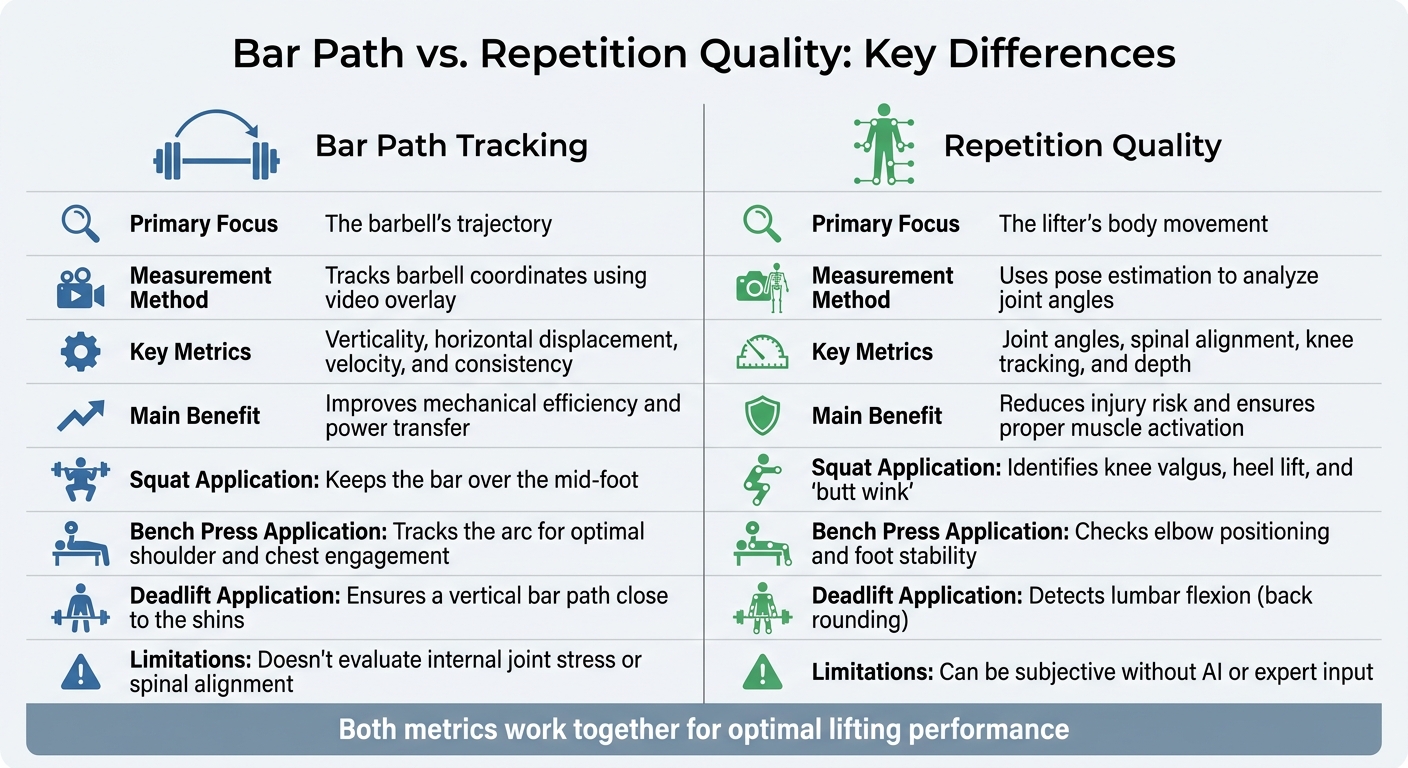
Bar Path vs Repetition Quality in Strength Training: Key Differences Comparison
Grasping the distinctions between bar path and repetition quality can help you align these metrics with your specific training goals.
Bar path focuses on the barbell's trajectory [1][8], while repetition quality zeroes in on the lifter's biomechanics [2]. Think of it this way: bar path measures how the bar travels, and repetition quality examines how well your body moves.
From a technical perspective, bar path tracking relies on computer vision to map the barbell's movement coordinates [1]. On the other hand, repetition quality uses pose estimation to create a digital skeleton, analyzing joint angles and movement patterns [2]. AI tools like MediaPipe, YOLO, and PoseNet are often utilized for this purpose, capturing lifter movement in either 2D or 3D space [2].
"The bar path determines the lift efficiency and affects the athlete's ability to complete exercise with heavy weight."
- Sergii Putsov, Head of Sport Science, PhD [8]
These differences influence how each metric applies to various lifts. Bar path tracking ensures proper alignment for maximum efficiency - like maintaining a vertical bar path in squats and deadlifts or achieving the correct arc in a bench press [1][8]. Meanwhile, repetition quality pinpoints technique errors, such as knee valgus, heel lift, "butt wink", improper elbow tuck, or lumbar flexion [2].
In essence, bar path tracking is about optimizing power transfer and lift efficiency [8], while repetition quality prioritizes injury prevention and correct muscle engagement [2]. Below, a side-by-side comparison highlights these distinctions.
Comparison Table: Bar Path vs. Repetition Quality
| Feature | Bar Path Tracking | Repetition Quality |
|---|---|---|
| Primary Focus | The barbell's trajectory [1] | The lifter's body movement [2] |
| Measurement Method | Tracks barbell coordinates using video overlay [1] | Uses pose estimation to analyze joint angles [2] |
| Key Metrics | Verticality, horizontal displacement, velocity, and consistency [1][8] | Joint angles, spinal alignment, knee tracking, and depth [2] |
| Main Benefit | Improves mechanical efficiency and power transfer [8] | Reduces injury risk and ensures proper muscle activation [2] |
| Squat Application | Keeps the bar over the mid-foot [1] | Identifies knee valgus, heel lift, and "butt wink" [2] |
| Bench Press Application | Tracks the arc for optimal shoulder and chest engagement [1][8] | Checks elbow positioning and foot stability [2] |
| Deadlift Application | Ensures a vertical bar path close to the shins [1] | Detects lumbar flexion (back rounding) [2] |
| Limitations | Doesn't evaluate internal joint stress or spinal alignment [2] | Can be subjective without AI or expert input [2] |
When to Use Each Metric
Deciding between bar path tracking and repetition quality depends on your training goals and phase. Each metric serves a distinct purpose, so knowing when to prioritize one over the other can improve both performance and safety.
When to Use Bar Path Tracking
Bar path tracking is all about mechanical efficiency and maximizing strength. For powerlifters prepping for competition, analyzing the bar's movement during heavy lifts can uncover imbalances, like core weaknesses or an inconsistent bench press arc, that might otherwise go unnoticed [1].
Olympic weightlifters also rely heavily on bar path tracking [1]. In lifts like cleans, jerks, and snatches, the bar must follow a precise "S-shape" trajectory. Even minor deviations - just 0.8–1.2 inches (2–3 cm) - can slash power output by as much as 15% [4]. In these explosive movements, success often hinges on millimeter-level precision in bar placement.
Another key benefit of bar path analysis is tracking consistency across reps. Many apps let you compare your current bar path to previous reps, which helps identify technique breakdowns caused by fatigue [1].
"Providing the immediate visual feedback for the lifter - especially combined with velocity data - is a highly effective way to instigate real change because bar path taps into the visual learning skills of the lifter" - Metric VBT [1]
That said, beginners might find bar path data overwhelming. For them, focusing on repetition quality is usually more effective for building basic body awareness and movement intuition [1]. However, when the goal shifts to refining technique or protecting joints, repetition quality takes the spotlight.
When to Focus on Repetition Quality
Repetition quality is the go-to metric for injury prevention and joint health. If you're recovering from issues like knee valgus, lumbar flexion, or muscular imbalances, tracking joint alignment and spinal position should be your top priority [2].
For beginners, repetition quality is especially important. It helps establish proper movement patterns and develop body awareness [6]. Learning to maintain a neutral spine or prevent knee cave lays the groundwork for more advanced techniques, including bar path tracking.
When training for hypertrophy or performing accessory movements like lunges or split squats, repetition quality often outweighs bar trajectory [6]. To build muscle effectively, you need to ensure that target muscles are engaged and joints are moving correctly.
Finally, pay close attention to repetition quality during fatigue sets. Spotting form breakdowns early lets you adjust your training load before bad habits take root [6].
How CueForm AI Uses Both Metrics

CueForm AI takes the concepts of bar path and repetition quality and combines them to deliver a comprehensive analysis of your lift. Using advanced technologies like computer vision and pose estimation models - such as MediaPipe, YOLO, and PoseNet - it creates a digital skeleton of your body while tracking the barbell's movement. This way, it links the "what" (the bar's trajectory) with the "why" (the body mechanics behind it) [2].
When you upload a video of your lift, the AI dives into details like joint angles, spinal alignment, and the verticality of the bar path [2]. For example, if the bar shifts forward during a squat, the system doesn’t just highlight the issue - it digs deeper to identify underlying causes. It might flag limited ankle dorsiflexion (often requiring at least 15–20° for a proper squat) or an excessive hip hinge as potential culprits [2]. From there, it generates actionable tips like "push through your heels" or "keep your chest up", giving you clear guidance you can use right away [9].
"We turn your video into cues you can use next session - grounded in bar path, positions, and the context you provide." - CueForm AI [9]
What sets CueForm AI apart is its ability to tailor feedback based on individual factors like femur length or training goals. This ensures the system can distinguish between genuine technical errors and natural variations in form [9]. Each report includes a Findings section that outlines key metrics - such as joint angles, bar trajectory, and stability markers like knee valgus or heel lift - so you get transparent, data-backed coaching instead of vague or overly generalized feedback.
Beyond these metrics, CueForm AI monitors bar speed, tempo, and consistency across sets. It even flags warning signs like hip wobble or uneven weight distribution, helping you address potential issues before they turn into bad habits [2]. If you have additional questions or want to refine your feedback, the Chat with Coach AI feature allows you to discuss sensations, clarify details, or adjust the AI’s understanding of your stance and goals [9]. By combining raw data with practical coaching insights, CueForm AI bridges the gap between analysis and actionable advice.
Conclusion
Bar path and repetition quality aren't opposing metrics - they work together to give a clearer picture of your lifting technique. Bar path tracks the barbell's movement through space, highlighting inefficiencies like forward drift or unnecessary horizontal shifts. Repetition quality, on the other hand, dives into the mechanics driving that path, focusing on factors like joint angles, velocity, tempo, and range of motion. When combined, these metrics transform vague feelings during a lift into concrete, actionable insights.
"Your bar path is more than just a result of your biomechanics and gravity; it is a detailed and insightful roadmap of your technique." - Metric VBT [1]
Using both metrics together provides a well-rounded view of your training. Bar path helps ensure force efficiency by keeping the load balanced over your mid-foot. Meanwhile, repetition quality can highlight potential issues, such as knee valgus or lumbar flexion, which may increase injury risk. Plus, as fatigue sets in and your sense of body awareness diminishes, shifts in bar path and velocity act as objective indicators that your technique might be slipping.
The trick is to avoid getting bogged down in overanalyzing. Use these tools strategically - check your form during your first set to establish a baseline, evaluate your heaviest set to assess performance under maximum load, and monitor your final set to track fatigue [6]. Then, step away from the data and rely on feel, allowing your body to absorb the corrections so you can lift safely and effectively - even when the cameras aren’t rolling.
FAQs
Which matters more for me right now: bar path or rep quality?
For most lifters, focusing on rep quality should take precedence - especially if your goals include improving technique, avoiding injuries, and boosting performance. Paying attention to proper form, maintaining control, and being consistent are key factors that directly influence both strength and safety.
While tracking the bar path can be useful for fine-tuning technique or fixing specific problems, the best approach is to prioritize high-quality reps. Use bar path tracking as a feedback tool rather than the main focus to achieve the best outcomes.
How can I tell if a bad bar path is caused by mobility or bracing issues?
A poor bar path is usually the result of either mobility limitations or improper bracing. Limited flexibility in areas like the shoulders, hips, or ankles can force your body to compensate during lifts. On the other hand, weak bracing - meaning a lack of core stability - can lead to instability throughout the movement. To pinpoint the issue, review videos of your lifts to identify what’s going wrong. If mobility is the problem, focus on specific exercises to improve flexibility. If bracing is the culprit, strengthen your core and refine your technique to make your lifts smoother and safer.
What’s the simplest way to track both metrics from my lifting videos?
The easiest way to analyze bar path and evaluate repetition quality in your lifting videos is by using an AI-based tool like CueForm AI. With this tool, you can upload videos of your squat, bench press, or deadlift, and it will provide detailed feedback. This includes tracking the bar path and assessing your technique. By identifying potential issues and offering biomechanical insights, it helps you refine your movements and track your progress over time.