Hip Shift in the Squat: Why You Shift to One Side and What to Do About It
A hip shift in the squat is your hips moving toward one side as you lower or stand up, often easiest to see near the bottom.1 A small hip shift during squat sets is common2 and rarely the first thing to fix.3 Film it first, then test your stance, depth and tempo one at a time.
Uneven squat or hip shift? How to check on video
An uneven squat can mean the bar tilts, one knee drifts in or one foot carries more of your weight. These can go together: lifters who stood with more weight on one foot also tilted and twisted the bar more.4 A hip shift, sometimes called a lateral shift, is your hips moving sideways over your feet.
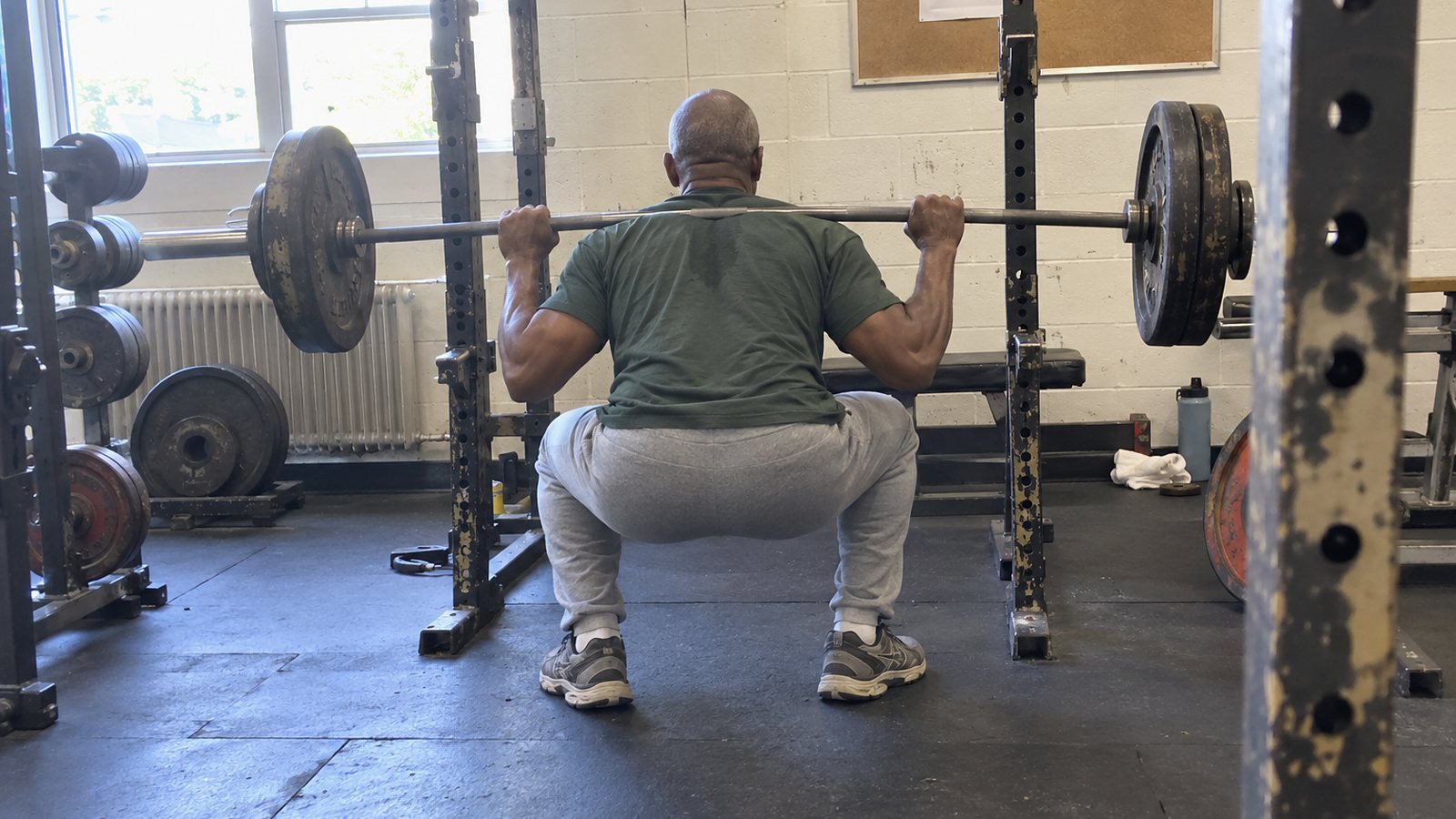
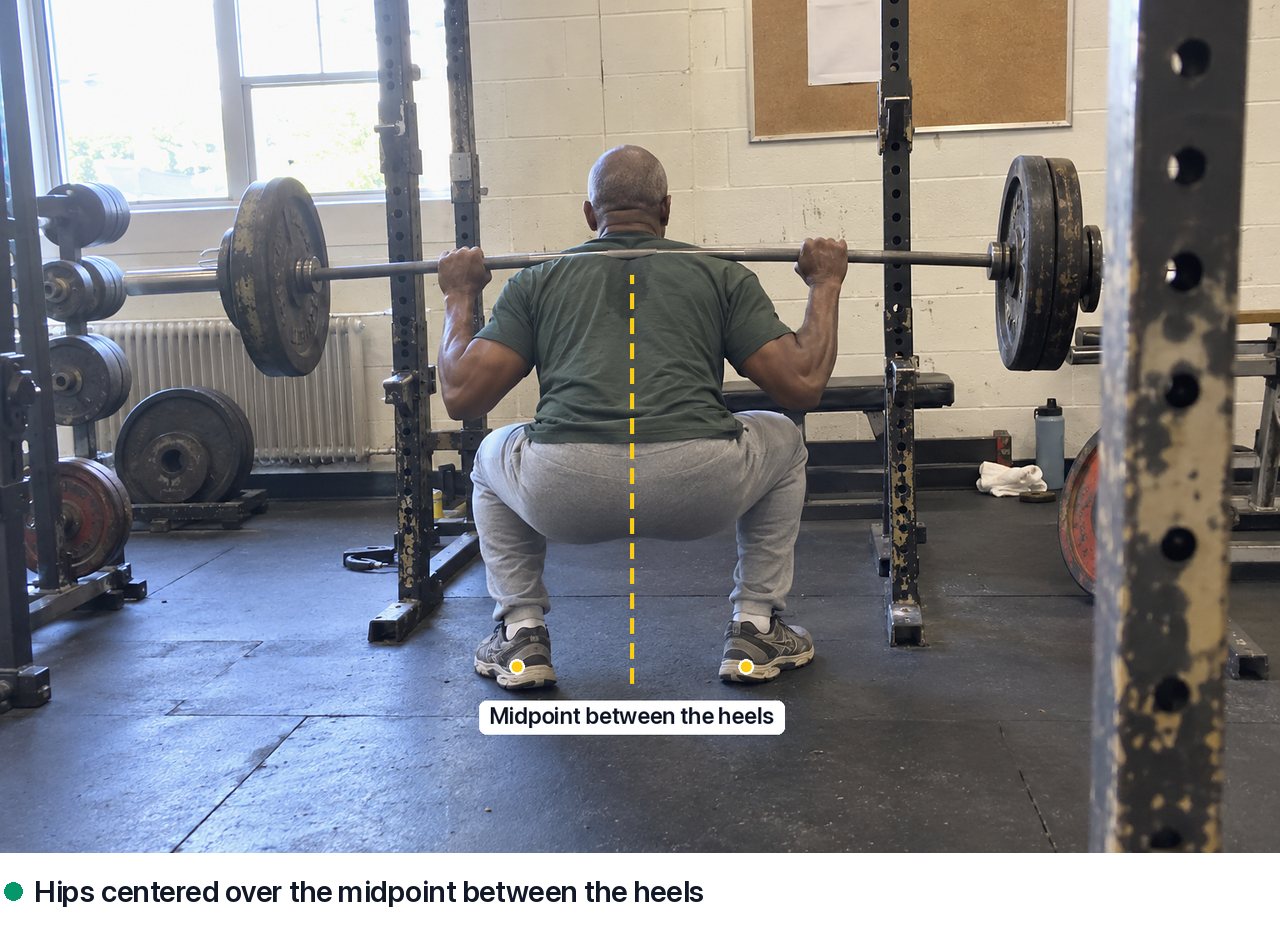
Film from directly behind,5 at hip height, with your feet and the whole bar in frame and your top tucked in. Picture a vertical line through the midpoint between your heels. One study measured it the same way, from the middle of the hips to the middle of the ankles.6 Pause the video at the bottom and halfway up. If your hips are shifted to one side of the line, or one hip sits closer to the floor, that's a hip shift.1 Note whether it shows on every rep or only the deepest or heaviest ones.
Is a hip shift in the squat bad?
Usually not. Healthy lifters commonly put slightly more weight on one leg than the other,7 and a small, consistent shift isn't worth chasing.3 Look into it if the shift is large, grows as the weight goes up, or started with pain or after an injury.
In a study of 17 trained lifters, the difference in load between their feet averaged about 4%, held steady when they were retested and didn't grow over hard sets of eight.7
If it hurts, train in a pain-free range, reduce the load or swap the variation.8 See a doctor or physical therapist if hip pain stops your normal activities, gets worse, keeps coming back or hasn't improved after two weeks. Get urgent help if your hip is hot and swollen, or you can't put weight on your leg.9
What causes a hip shift in the squat?
Coaches see many possible causes.1 If you're wondering why you lean to one side when you squat, test these three.
Your stance or toe angle doesn't suit your hips. Stance width and toe angle change how your hips and knees move and how much load they take.10 Hip sockets vary in shape, which affects how deep you can squat, and stretching can't change that bony limit.5 Some lifters get stuck partway down with their toes pointing forward and squat deeper with them turned out.11
You squat deeper than you control. A simple coaching standard is to squat as low as you comfortably can while staying tight and balanced.12 If the shift appears only in the last few inches, test your depth.
An old injury or a sore joint. After knee surgery, college athletes in one study squatted with their hips closer to the uninjured leg and put less load through the injured one. Both moved toward even as they recovered.6 If your shift started with pain, have it assessed rather than trying to cue it away.3
How to fix a hip shift in the squat
Treat each fix as a test: change one thing, film a light set from behind and keep the change if your hips stay closer to the line. Do it in warm-ups and lighter sets, because holding yourself straight under a near-maximal bar rarely works.1 Stop any test that hurts.
1. Test your stance width and toe angle
Cue: Sit down between your feet.1
Drill: Start from the stance you'd use to jump straight up, with your toes turned out 15 to 30 degrees.13 Film three slow bodyweight squats there, then a little wider, then with your toes turned out more. Keep the stance where you reach depth without pain and your hips stay closest to the line. Avoid extremes such as a narrow stance with the toes turned far out.10 Squat stance widths: pros and cons covers what each width changes.
Next filmed set: At the same depth, check whether the shift starts later, looks smaller or is gone.
2. Squat to a box at the depth you control
Cue: Touch the box lightly, then stand straight up.
Drill: Set a box just above the depth where your shift starts, with the safety bars just below the box. Lower slowly, touch without sitting or rocking, and stand. Strength coaches use this progression, starting just above the fault and lowering the box gradually.14 When every rep stays centered, lower it about an inch.
Next filmed set: Check that your hips stay on the line at the box. Once it reaches your target depth, do a set without it.
3. Slow down with a lighter weight
Cue: Stay heavy through the whole of both feet.12
Drill: Take a weight well below your working sets. Lower for five seconds and stand for five, correcting any drift toward one foot as you feel it.12 Add weight over the next sessions, staying just below the load where the shift shows up.3
Next filmed set: Film a tempo set and a normal-speed set at the same weight. If the shift shrinks when you slow down, keep tempo sets in your warm-up.
See your squat on video
Video shows side-to-side faults you may not notice while you lift.14 CueForm doesn't flag a hip shift yet, so film one set from directly behind and check it yourself against the midpoint between your heels. CueForm's front or rear view checks your knee tracking, and a side view checks your depth. Get a squat form check for knee tracking or depth.
If a knee drifts in as your hips move, see how knee valgus affects squat form. For setup and the rest of the lift, see the barbell back squat guide.
FAQ
Can stance width cause a hip shift?
It's worth testing first. A narrower stance needs more ankle bend at the same depth, and lifters with stiff ankles or long thighs may do better with a wider one.15 If your shift changes when you change your stance on video, stance is part of it.
Is a hip shift the same as knee cave?
No. Knee cave is a knee moving inside the line of its foot. A hip shift is your hips moving sideways over your feet. Both show best from directly in front or behind,5 so one video can catch both.
Why can't I feel my hip shift?
Your sense of straight adapts. A coach who corrects hip shifts finds that lifters often feel crooked once they squat centered, because the shifted position has come to feel normal.1 Trust the video over the feeling, and film again every few weeks.
Sources
-
Juggernaut Training Systems. Fixing hip shift in the squat (opens in a new tab). Video, 2016. ↩
-
Sayers MGL et al. The effect of increasing heel height on lower limb symmetry during the back squat in trained and novice lifters. BMC Sports Science, Medicine and Rehabilitation, 2020. ↩
-
Calgary Barbell. Should your deadlift be hard off the floor? FCF No. 208 (opens in a new tab), squat review at 10:49 to 13:34. Video, 2022. ↩
-
Sato K, Heise GD. Influence of weight distribution asymmetry on the biomechanics of a barbell back squat. Journal of Strength and Conditioning Research, 2012. ↩
-
Myer GD et al. The back squat: a proposed assessment of functional deficits and technical factors that limit performance. Strength and Conditioning Journal, 2014. ↩
-
Song Y et al. Medial-lateral hip positions predicted kinetic asymmetries during double-leg squats in collegiate athletes following anterior cruciate ligament reconstruction. Journal of Biomechanics, 2021. ↩
-
Hodges SJ, Patrick RJ, Reiser RF. Effects of fatigue on bilateral ground reaction force asymmetries during the squat exercise. Journal of Strength and Conditioning Research, 2011. ↩
-
Helms E, Morgan A, Valdez A. The Muscle and Strength Pyramid: Training, 2nd edition. Muscle and Strength Pyramids, 2019. "Adherence", p. 21. ↩
-
Lorenzetti S et al. How to squat? Effects of various stance widths, foot placement angles and level of experience on knee, hip and trunk motion and loading. BMC Sports Science, Medicine and Rehabilitation, 2018. ↩
-
Squat University. How to squat for your anatomy (toes out?) (opens in a new tab). Video, 2022. ↩
-
Alan Thrall. How to squat: any style (opens in a new tab). Video, 2020. ↩
-
Juggernaut Training Systems. How do you find your right squat stance? (opens in a new tab) Video, 2025. ↩
-
Kushner AM et al. The back squat part 2: targeted training techniques to correct functional deficits and technical factors that limit performance. Strength and Conditioning Journal, 2015. ↩
-
Demers E et al. The effect of stance width and anthropometrics on joint range of motion in the lower extremities during a back squat. International Journal of Exercise Science, 2018. ↩