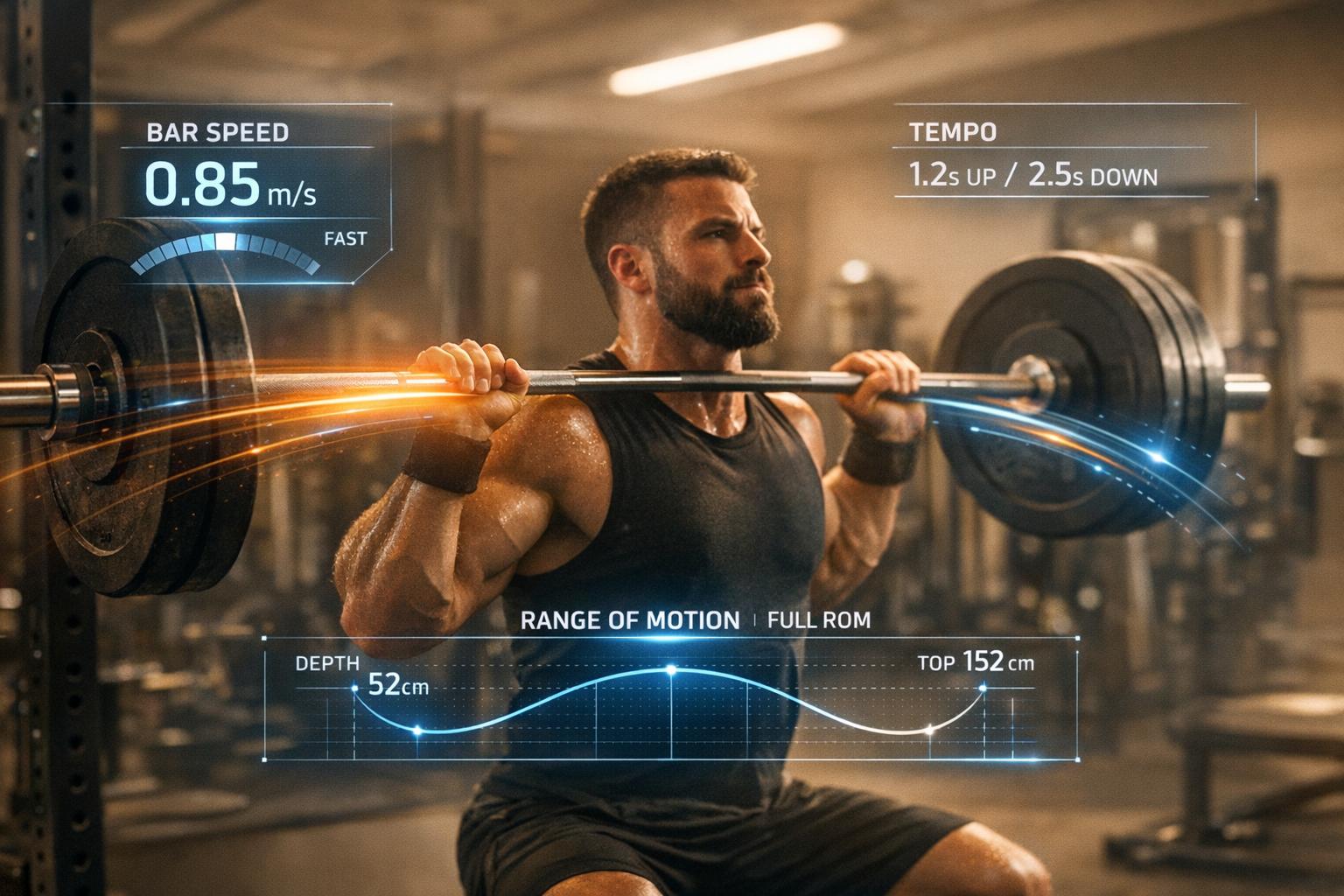
Real-Time Metrics: Bar Speed, Tempo, Range
Want to improve your workouts? Start tracking bar speed, tempo, and range of motion. These metrics go beyond sets and reps, giving you a clearer picture of how well you're performing each lift. Here's what you need to know:
- Bar Speed: Measures how fast you move the weight, helping you adjust loads and track fatigue. Faster reps often mean you're ready to lift heavier.
- Tempo: Controls the timing of each lift phase (e.g., lowering, pausing, lifting). Slower tempos build muscle, while explosive tempos boost power.
- Range of Motion (ROM): Ensures consistent movement depth for accurate progress tracking and better strength development.
Using tools like CueForm AI or video analysis, you can monitor these metrics in real-time to fine-tune your training. Even a small improvement in bar speed (0.05 m/s) can signal a 2.5% strength gain. Tracking ROM consistency and velocity loss also reduces injury risk while improving rep quality. Ready to take control of your workouts? Let the data guide you.
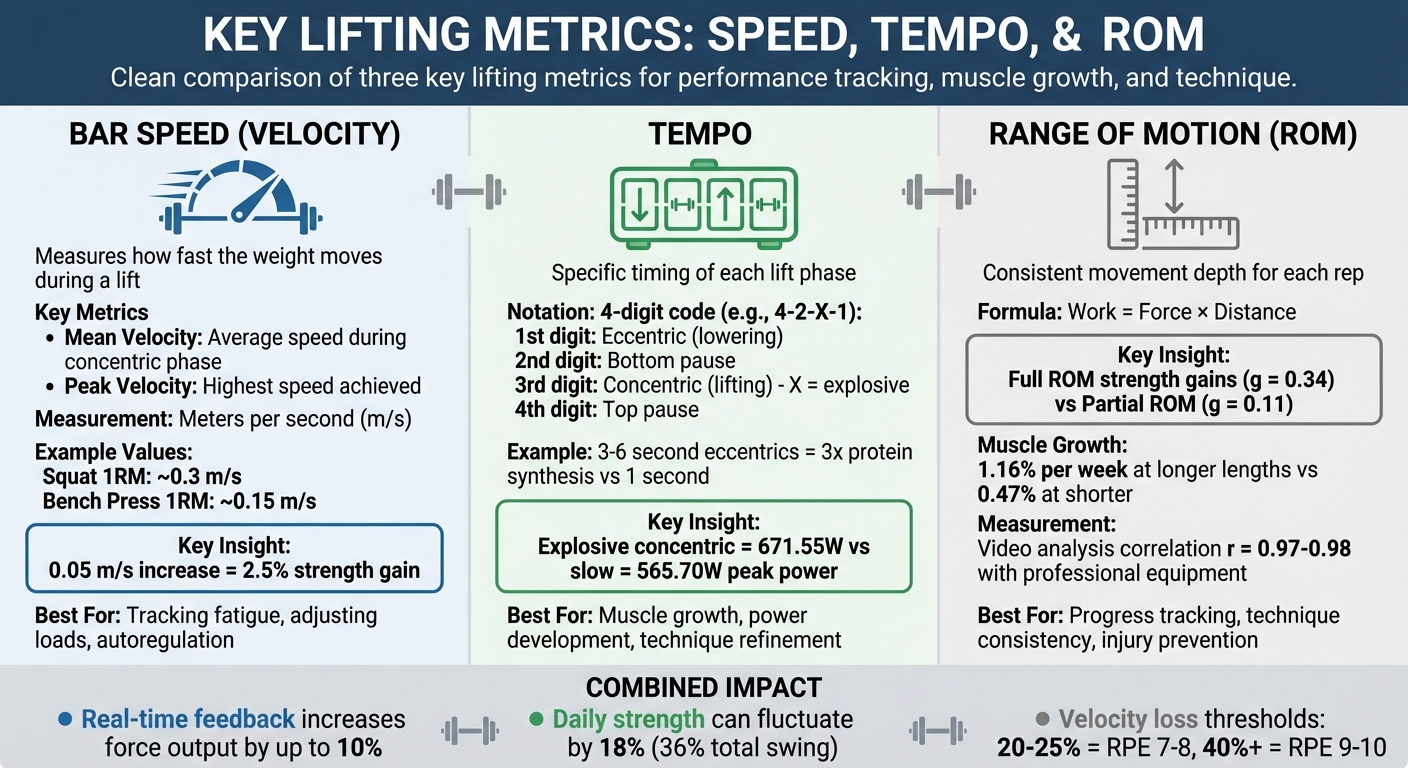
Real-Time Lifting Metrics Comparison: Bar Speed, Tempo, and Range of Motion
What The Bar Speed Tells You About Your Lift
Bar Speed: Definition and Measurement
Let’s dive into bar speed - one of the most important metrics for evaluating training quality.
Bar speed, or barbell velocity, measures how quickly the weight moves during a lift. While sets and reps give you a sense of training volume, bar speed offers a more precise look at how effectively you’re performing.
Tracking bar speed provides key insights into your effort and readiness. When you lift with maximum intent - actively trying to move the bar as fast as possible - you recruit more motor units and increase force production[1][3][8].
Bar speed is typically measured in two ways: mean velocity and peak velocity. Mean velocity reflects the average speed during the entire concentric phase of a lift, making it a reliable indicator for tracking strength and fatigue in exercises like squats, bench presses, and deadlifts[1][6]. Peak velocity, on the other hand, captures the fastest moment during a lift and is especially useful for explosive movements like power cleans or snatches[1][6].
Mean Velocity
Mean velocity calculates the average speed of the barbell throughout the concentric phase of a lift. This measurement is especially helpful for monitoring fatigue and gauging how close you are to failure. For example, comparing your best rep velocity today to your 30-day average can reveal whether you’re fully recovered or feeling fatigued[1][3]. If your warm-up sets feel slower than usual, it might be a sign to adjust your training load[8][10].
Peak Velocity
Peak velocity measures the highest speed achieved during the concentric phase of a lift. This metric highlights the explosive burst of power often seen midway through a movement. It’s particularly valuable for power-focused exercises like Olympic lifts or plyometric drills, where rapid acceleration is crucial[6].
How to Use Bar Speed Data
To make the most of bar speed data, incorporate autoregulation - adjusting your training based on real-time performance. Start by establishing a 30-day baseline for your mean velocity[1][3]. On days when your lifts are faster than average, it’s a good sign you’re well-recovered and might be ready to push for extra reps or increase the load. On the flip side, if your bar speed is significantly slower (around 15% below your baseline), it may be wise to scale back intensity to avoid overtraining[8].
Within a single set, velocity loss thresholds can guide when to stop. For instance, if your fastest rep is 0.60 m/s and you set a 20% velocity loss limit, you’d end the set when your speed drops to about 0.48 m/s[1][10]. This approach allows you to fine-tune your workout on the fly, aligning perfectly with the concept of real-time performance metrics. In fact, studies show that real-time velocity feedback can increase force output by up to 10%[10].
For accurate data, always perform each rep with maximum effort[11].
Tempo in Strength Training
Tempo refers to the specific timing of each phase of a lift, detailing how long each part of the movement should take [13][14]. Unlike bar speed, which measures how quickly you move the weight, tempo focuses on deliberate control, allowing you to fine-tune each phase of the lift. This controlled approach is key for targeting specific training outcomes.
Tempo is typically written as a four-digit code, such as 4-2-X-1. Here’s what each number represents:
- First digit: The eccentric phase (e.g., 4 seconds lowering the weight).
- Second digit: The pause at the bottom (e.g., 2 seconds).
- Third digit: The concentric phase, with "X" indicating an explosive movement.
- Fourth digit: The pause at the top (e.g., 1 second) [13][14][15].
This notation gives you precise control over the movement, ensuring each phase is performed with intention and precision [13][14].
"The reason why we as coaches use tempo is to specifically control the athlete. Tempo is an important tool which can not only help the athlete learn the movement but also develop appropriate motor patterns and body control."
- James FitzGerald, Founder, OPEX Fitness [13]
By controlling tempo, you can uncover weaknesses that might otherwise go unnoticed. For example, slowing down the descent in a squat can expose issues like poor midline stability or improper knee alignment [14][18]. This level of focus not only improves movement quality but also reduces the risk of injury by using lighter, submaximal loads that are easier on your joints and central nervous system [14]. In essence, tempo bridges the gap between proper form and performance, helping you analyze and refine each phase of the lift.
Eccentric Tempo
The eccentric phase, or the lowering portion of a lift, is particularly effective for building muscle. Research shows that extending the eccentric phase to 6 seconds can triple protein synthesis compared to a 1-second rep [14]. Slower eccentrics increase the time your muscles spend under tension, creating more mechanical stress while using less metabolic energy. This means you can achieve significant muscle stimulation with lighter weights (40–65% of your one-rep max) [14][18].
Additionally, heavy eccentric training can reduce the sensitivity of the Golgi Tendon Organs, which act as a safety mechanism to limit excessive force. Over time, this desensitization allows you to handle heavier weights [18].
For muscle growth, aim for eccentric phases lasting 3–6 seconds, paired with an explosive lift on the way up [15][18]. It’s important to remember that a slow tempo is a deliberate strategy, not a sign of fatigue or struggling with the weight [15][16]. While slower eccentrics are ideal for hypertrophy, the concentric phase requires a different focus to maximize power.
Concentric Tempo Control
The concentric phase, or the lifting portion of the movement, is all about generating power and speed. While slow eccentrics are great for muscle growth, explosive concentric actions (denoted as "X" in tempo notation) are essential for improving peak power, bar velocity, and neural efficiency [17][19].
Studies show that using a regular eccentric tempo (e.g., 2 seconds down, explosive up) can produce significantly higher peak power - 671.55 watts - compared to a slow eccentric tempo (6 seconds down, explosive up), which yields 565.70 watts during a bench press [20]. Similarly, peak bar velocity drops from 0.79 m/s with a regular tempo to 0.69 m/s with a slower eccentric [20]. This is because faster eccentric phases better utilize elastic energy and the stretch-shortening cycle, leading to greater power output during the lift [20].
If your goal is maximal strength, faster eccentric tempos (1–2 seconds) allow you to handle heavier weights [15][19]. For power-focused training, prioritize moving the weight as quickly as possible during the concentric phase, and avoid overly slow eccentrics that can diminish elastic energy [17][20]. Ultimately, aligning your tempo with your specific training goal - whether it’s building muscle, increasing strength, or enhancing explosive power - is crucial for success.
Range of Motion: Why Consistency Matters
Range of motion (ROM) isn't just about how low you squat or how far you lower the barbell - it's about doing it the same way every single time. If your ROM changes from one rep to the next, it not only complicates tracking your progress but also alters the exercise itself.
Here’s the deal: Work equals Force times Distance. Adding more weight to the bar but cutting your squat depth doesn’t necessarily mean you’re doing more work. The total work depends on both the weight and the distance the bar travels. So, keeping your ROM consistent is key to accurately measuring progress.
But it’s not just about numbers. Strength development is deeply tied to the specific joint angles you train. Research shows that if your ROM varies, you’re training different parts of the movement, leaving some ranges underdeveloped [22]. Full-ROM training, on the other hand, has been shown to be more effective. A meta-analysis found that full-ROM training increased strength (g = 0.34) more than partial-ROM training (g = 0.11) [21].
"If you squat to a particular depth one day, then the next day you add a little bit of weight but squat to a different depth... you have changed not only the minimum force needed to perform the work but also the distance part of the work equation."
Training with a consistent, full ROM also helps build resilience. It exposes your muscles, joints, and connective tissues to a broader range of stimuli [22]. For muscle growth, the stretched position of a movement - like the bottom of a squat or bench press - has been shown to be especially effective. Training at longer muscle lengths can result in about 1.16% muscle growth per week, compared to just 0.47% at shorter lengths [22].
Measuring ROM Consistency
To keep your ROM consistent, start with physical markers. For squats, use a visual checkpoint, like ensuring your hip crease goes below your knee. Tools like boxes, benches, or safety pins in a power rack can also help. If your glutes touch the marker at the same height every rep, you know your depth is consistent [23].
For more precise tracking, technology can step in. Linear Position Transducers (LPTs) are the gold standard - they attach to the barbell and measure displacement with incredible accuracy. However, they’re pricey, often costing around $2,000 [12]. A more budget-friendly option is using smartphone apps with video analysis. In a 2017 study, the PowerLift app showed a correlation of r = 0.97–0.98 with professional-grade transducers, proving that you don’t need expensive equipment to track barbell movement accurately [12].
If you’re using video analysis, proper setup is essential. Place your phone side-on to the barbell at waist or chest height, ensuring the weight plates stay in the frame throughout the set. Use a tripod to avoid camera shake, and make sure there’s good contrast between the plates and the background. Avoid bright lights directly behind you, as they can interfere with the clarity of the footage [4].
Identifying Technique Breakdowns
Inconsistent ROM is often the first sign that something’s off - whether it’s fatigue or poor technique. For example, reducing squat depth mid-set could mean the weight is too heavy or that you’re too fatigued to maintain proper form [1][24]. This is especially important because strength can fluctuate by as much as 18% above or below your tested 1-rep max on any given day - a potential 36% swing overall [9][24].
Velocity-Based Training (VBT) tools can help make these breakdowns measurable. As bar speed slows and ROM shortens, VBT data can indicate when to stop a set or lower the weight. This helps you avoid compromised reps, which can lead to poor form and increase the risk of injury.
"The velocity of the bar is an objective measurement of any variation in the quality of our training between sessions... This shows up in changes to range of motion and changes to how fast the bar is moving."
Common technique issues include cutting squat depth as fatigue sets in, bouncing the bar off your chest during a bench press, or starting deadlifts from higher positions as the set progresses. These compensations reduce the total work performed and train movement patterns you’re not aiming for. By consistently monitoring your ROM - whether through video, physical markers, or VBT devices - you can catch these issues early and maintain quality in every rep.
sbb-itb-c91a623
Using Metrics for Velocity-Based Training (VBT)
Velocity-Based Training (VBT) shifts away from relying on fixed percentages of your one-rep max (1RM). Instead, it uses real-time bar speed to guide adjustments. This approach factors in how your performance can vary daily. The speed of the bar becomes a clear indicator of how ready you are to train and how much effort you're putting in. For example, if your warm-up sets are faster than your 30-day average, it’s a sign to add more weight. On the flip side, slower speeds suggest lingering fatigue and a need to reduce the load [1].
"Velocity is the missing metric... With velocity data you have an objective record of the quality of every rep and every set."
- Metric VBT [1]
The science backs this up. In a six-week study focusing on jump performance, athletes who received real-time feedback for each rep saw their jump height improve by 14%, compared to just 6% for those without feedback [2].
Velocity Zones and Targets
Using real-time adjustments in VBT becomes even more effective when paired with personalized velocity zones. While traditional velocity zones are often used - like "Strength-Speed" at 0.5–0.75 m/s or "Power" at 0.75–1.0 m/s - they aren’t one-size-fits-all. Factors like limb length, range of motion, and the specific exercise impact bar speed. For instance, a squat 1RM typically moves at around 0.3 m/s, whereas a bench press 1RM might only reach 0.15 m/s [26].
"The velocity zones are the biggest misdirection in all of velocity based training literature."
- VBT Coach [1]
Rather than sticking to generic zones, focus on customized targets informed by your own data. Here’s how velocity ranges generally align with different training goals:
| Velocity Loss (%) | Estimated RPE | Training Goal |
|---|---|---|
| 10–20% | RPE 5–6 | Power, Speed, Minimal Fatigue |
| 20–25% | RPE 7–8 | Strength, Hypertrophy, Moderate Fatigue |
| 40%+ | RPE 9–10 | Maximum Exertion, High Fatigue |
Velocity loss measures the percentage drop from your fastest rep (usually the first or second) to your last rep in a set. For example, a 20–25% velocity loss corresponds to an RPE of 7–8, while a 40% loss signals RPE 9–10. By setting a limit - say, stopping at a 25% drop - you can avoid excessive fatigue, maintain quality reps, and reduce the risk of injury. If your first rep is 0.6 m/s, this means halting the set once speed slows to 0.45 m/s.
Load-Velocity Profiling
Another key aspect of VBT is load-velocity profiling, which personalizes training even further. A load-velocity profile (LVP) maps the relationship between weight and speed, showing how velocity decreases as load increases. This profile helps estimate your 1RM, monitor progress, and adjust weights without needing to test your true max [25].
To create your profile, gather velocity data from at least three sets across varying loads, ensuring at least one set surpasses 75% of your 1RM for accuracy [25]. Use the best rep (highest mean velocity) from each set, excluding any reps with poor form.
When you plot the data, it forms a near-linear trend. The point where this line intersects with your Minimum Velocity Threshold (MVT) - the speed of your last successful rep before failure - provides an estimated 1RM (e1RM). This estimate is typically accurate within ±5%, and with consistent tracking, it can improve to ±2.5% [25].
What makes load-velocity profiling so effective is its ability to track progress over time. If your profile shifts upward and to the right, it shows you're either lifting the same weight faster or moving heavier loads at the same speed - both clear indicators of improvement [1]. On the other hand, a downward shift could signal fatigue or overtraining [25].
You can build your profile during regular sessions by collecting data from warm-up sets. Compare today’s best rep velocity with your 30-day rolling average to account for daily variations in performance [1]. Faster-than-average warm-ups suggest it’s a good day to push harder, while slower ones indicate the need for recovery.
Finally, the load-velocity profile also highlights the point of maximum power, which usually occurs between 30% and 70% of your 1RM [1]. This range is ideal for explosive training and dynamic effort work, helping you fine-tune adaptations for strength, power, or speed development.
Tracking Metrics with CueForm AI

Video Analysis for Metrics Tracking
CueForm AI takes velocity-based training to the next level by incorporating automated video tracking into your workout routine. Using advanced computer vision, it monitors barbell movement across more than 60 exercises, all through your smartphone - no extra gear or complicated setup required [4]. The system automatically identifies circular weight plates, calibrated for standard 45cm Olympic plates, to calculate distance and scale. This eliminates the need for marking range of motion or attaching additional equipment [4].
The platform measures key metrics like mean and peak velocity, power output, range of motion, and tempo (including eccentric and pause phases) in real time. A dual-algorithm system ensures immediate feedback during your set while refining the analysis afterward to exclude non-lifting movements [27][6][5]. You’ll hear real-time audio cues through headphones or speakers, and post-set data provides precise insights. This tracking helps you adjust on the fly by signaling deviations from your performance baseline, making it a valuable tool for autoregulation.
For the most accurate results, set up your smartphone on a tripod at waist height (or chest height for overhead exercises) and record in HD at 60fps [4]. Position the camera side-on to the barbell at an angle between 0º and 25º from the bar’s end, ensuring a high contrast between the weight plates and the background [4]. Correct camera placement is essential for reliable data and supports the autoregulation strategies mentioned earlier.
Personalized Feedback for Improvement
CueForm AI goes beyond just delivering numbers - it provides tailored insights to help you fine-tune your training. The platform generates 1RM estimates, load-velocity profiles, and 6-week readiness indicators, comparing your current performance to your historical averages [27][6]. By tracking velocity loss thresholds, adjustable between 5% and 45%, it helps you gauge proximity to failure and avoid overtraining [5]. For instance, a 0.05 m/s increase in mean velocity often correlates with a 2.5% gain in 1RM [7].
Visual tools like bar path tracking and video playback let you analyze your technique frame by frame, making it easier to catch and correct any form issues [27]. Plus, the conversational AI coach allows you to ask follow-up questions and refine the feedback based on your personal goals, transforming raw data into practical advice you can use in your next session.
Programming Workouts Using Real-Time Data
Autoregulation with Velocity Thresholds
Your daily strength can fluctuate a lot depending on factors like recovery and stress levels [24][8]. Instead of sticking to fixed percentages, let your warm-up performance guide your workout adjustments.
Here’s how it works: compare the velocity of your best warm-up rep to your 30-day average. If it’s above 95% (green light), you’re good to go. If it falls between 90–95% (amber light), consider reducing the load or volume slightly. If it’s below 90% (red light), it’s time to scale back and deload [1][8]. This "traffic light" system aligns your training with how your body feels on that specific day - not just what’s on your program.
Velocity loss thresholds are another tool to refine your sets. For example, stop a set when the bar speed drops by 20–30% from the fastest rep (30% for back squats, 35% for bench press). This prevents excessive fatigue and keeps your training focused [24]. CueForm AI can notify you the moment you hit that threshold, making adjustments seamless [5]. Over time, tracking these velocity trends can make your programming even more precise.
Progress Monitoring and Trends
Tracking bar speed over time provides a clear picture of your progress. For instance, a 0.05 m/s increase in mean velocity could indicate a 2.5% improvement in your 1RM [7]. By monitoring how fast you move a specific load - like 225 lbs on the bench press - you gain an objective marker of progress that’s far more sensitive than waiting for your next max test.
CueForm AI takes this a step further by comparing your current performance against your 6-week averages and 30-day trends. It shows whether you’re "trending faster", "stable", or "trending slower" [6]. This insight helps you make smarter decisions about your programming. If your velocities are consistently improving, it’s a sign you’re ready to increase the load. If they’re stagnating or dropping, it might be time for a deload week or a tweak to your training variables, such as volume or exercise selection. Plus, CueForm’s load-velocity profiling can estimate your 1RM without the fatigue or risk of maxing out, giving you a dependable benchmark for planning your next training phase [24][6].
Conclusion
Tracking every rep with real-time metrics like bar speed, tempo, and range of motion transforms strength training into a data-driven process. Instead of just focusing on rep count and load, these metrics provide a clear picture of the quality of each movement. This matters because your daily physical readiness can vary by up to 18% [8]. With velocity data, you can adapt your training on the spot - pushing harder when you're at your best and easing off when fatigue sets in. It’s a smarter way to align your effort with your body’s performance.
For example, even a small increase of 0.05 m/s in mean velocity can indicate a 2.5% to 5% improvement in your one-rep max (1RM) [28][7]. Keeping an eye on range of motion consistency ensures your technique stays sharp as you lift heavier weights, while using velocity loss thresholds helps manage fatigue and lowers the risk of injury.
CueForm AI builds on these principles by offering precision without the need for expensive equipment. Powered by advanced computer vision, it uses your smartphone camera to track barbell movement across more than 60 exercises. The platform provides real-time audio feedback, automatic load-velocity profiling, and 6-week performance comparisons [4][5][6]. Whether you’re managing fatigue with velocity loss thresholds or estimating your 1RM from lighter lifts, CueForm AI turns basic video into actionable insights, helping you fine-tune your training with accuracy and ease.
FAQs
How does tracking bar speed enhance my strength training?
Tracking bar speed offers instant feedback on how quickly you're moving the weight, allowing you to gauge your effort and performance with accuracy. By keeping an eye on bar speed, you can tweak your load, tempo, or technique to make sure every rep matches the intensity needed to hit your training goals.
This method helps you train smarter, boosting strength and power development while lowering the chances of overtraining. Adding bar speed tracking to your workouts keeps you on course, ensuring steady progress toward your fitness targets.
Why is tempo important in strength training?
Tempo refers to the speed at which you execute each phase of a lift - lowering (eccentric), pausing, lifting (concentric), and holding at the top. It directly impacts time under tension (TUT), which is the duration your muscles stay engaged during a set. Adjusting your tempo (e.g., 2-0-1-0) allows you to align your training with specific goals like building strength, increasing muscle size, boosting power, or improving endurance.
For instance, faster, explosive tempos activate more muscle fibers, making them ideal for power-focused training. On the other hand, slower tempos with extended pauses enhance control and stability, which can be particularly useful for refining technique. Tempo adjustments also let you modify your workouts without changing the weight, offering a flexible way to progress and customize your program.
With video-based AI coaching, CueForm AI takes this a step further by analyzing your tempo in real time. It provides instant feedback, helping you maintain the right pace to match your goals. This not only optimizes your results but also lowers the risk of injuries.
Why is it important to maintain a consistent range of motion during strength training?
Maintaining a steady range of motion is key to training muscles effectively across their full functional span. This approach enhances force production, boosts joint stability, and promotes muscle growth and strength gains.
Using a full and consistent range of motion ensures balanced muscle activation, helps prevent imbalances or injuries, and makes your workouts more effective in the long run.