Real-Time Feedback: AI in Powerlifting
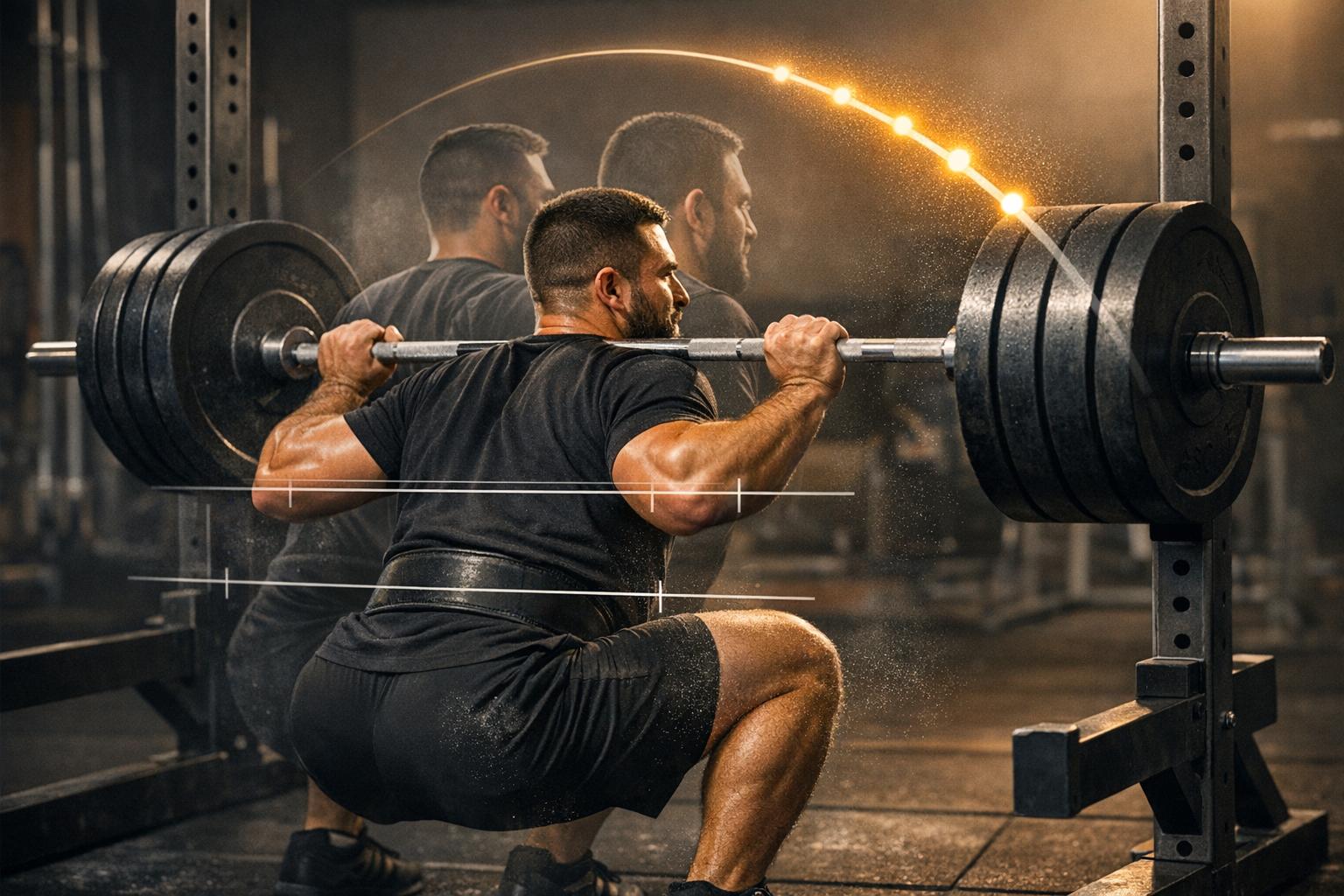
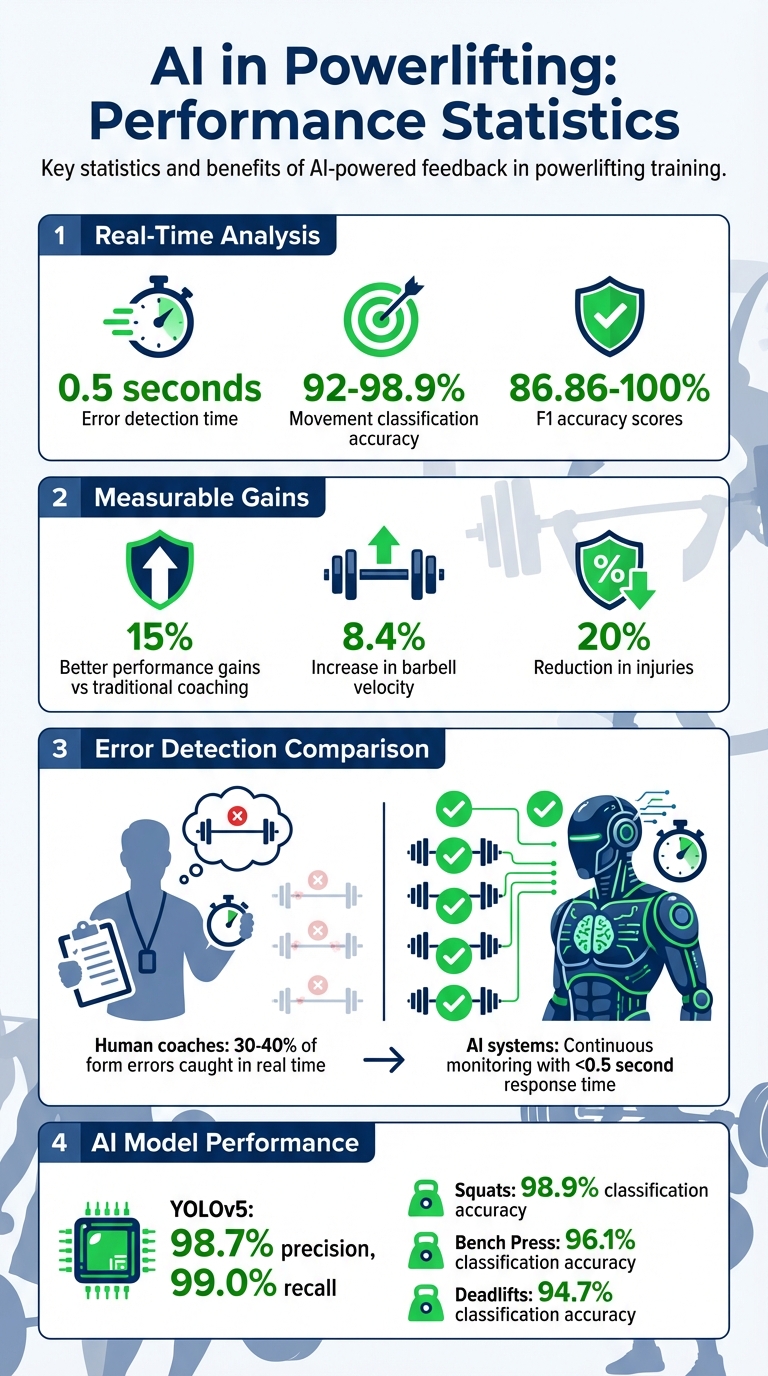
AI is changing how powerlifters train. It provides instant, precise feedback on form and technique using tools like MediaPipe and YOLOv5. This technology identifies errors like improper squat depth or bar path issues in under 0.5 seconds, helping lifters improve performance and reduce injuries by up to 20%.
Key points:
- AI tracks body movements via smartphone or webcam.
- Detects issues like knee valgus, spinal flexion, or bar drift.
- Boosts barbell velocity by 8.4% and improves lifts by 15%.
- Systems like CueForm AI offer simple, actionable cues tailored to each lifter.
AI ensures safer, smarter training by catching errors human coaches might miss, making it a valuable tool for both beginners and seasoned athletes.
AI Powerlifting Feedback: Key Performance Statistics and Benefits
How AI Technology Enables Real-Time Feedback
Computer Vision and Motion Tracking
AI-powered feedback kicks off with computer vision. Tools like MediaPipe map 33 key body landmarks as (x, y, z) coordinates, while YOLOv5 tracks objects, such as a barbell, in real time[8][9][2][6].
The best part? This cutting-edge technology doesn't require fancy equipment. A basic smartphone camera is enough to get started[1][8]. The system processes each frame of video, extracts the necessary landmark data, and sends it into an analysis pipeline for further evaluation[7].
Once tracking is fine-tuned, the focus shifts to analyzing these metrics to assess performance and technique in real time.
AI-Driven Technique Analysis
With accurate body tracking in place, AI takes the next step: breaking down technique. By calculating joint angles and spotting form issues, these systems provide detailed feedback. For instance, during a squat, the AI measures the angle between the hip, knee, and ankle to evaluate depth and alignment[8]. If the knee angle strays from the ideal range - say, 70–90 degrees - it flags the movement as incorrect[8].
But it doesn’t stop there. AI systems powered by Convolutional Neural Networks (CNNs) go beyond simple calculations, classifying movements with up to 92% accuracy[8]. These models can pinpoint specific issues like back rounding, uneven weight distribution, or even "stripper squats" (where the hips rise too quickly)[2]. Advanced models, including vision-language systems, even tackle challenges like occluded views or inconsistent camera angles, ensuring a more reliable analysis[2].
What makes this technology so powerful is its ability to provide instant, actionable feedback. If the system detects a problem - like knees caving in or a rounded back - it translates that into coaching cues such as "spread the floor" or "chest up" and delivers them on the spot[2][8]. This real-time guidance allows lifters to adjust their form rep by rep, without waiting for a coach to step in.
Research on AI Feedback in Powerlifting
YOLOv5 and MediaPipe Implementation (2023)

In 2023, Yeong-Min Ko and colleagues introduced a real-time AI system aimed at improving posture during the Big Three powerlifting exercises: squats, bench presses, and deadlifts. This system combined YOLOv5 for detecting individuals with MediaPipe for precise pose estimation, showcasing how advanced AI can operate on everyday devices like the iPhone 12 Pro. The YOLOv5 model achieved impressive metrics, with a precision of 0.987 and a recall of 0.990. A Random Forest algorithm further classified squats with 98.9% accuracy, bench presses with 96.1%, and deadlifts with 94.7%.
What made this system stand out was its ability to provide actionable feedback. For instance, it flagged common errors such as knee collapse during squats or improper grip in bench presses. The system was trained using datasets from Google and Roboflow and was optimized to function on consumer-grade devices, including Mac M1 and Windows 11 systems. These findings, published in IEEE Access [10], laid a solid foundation for future advancements, paving the way for the 2024 IMPECT-POSE study.
IMPECT-POSE Study (2024)
Building on earlier work, the 2024 IMPECT-POSE study pushed AI feedback technology even further. Researchers integrated MediaPipe's 33-body-landmark tracking with deep learning models to classify powerlifting movements and detect form errors with remarkable precision. A Neural Network model achieved 98.9% accuracy in movement classification, while CNN-based models, trained on Kaggle datasets, reached 92% accuracy in identifying correct form.
These systems went beyond basic error detection by measuring joint angles - like hip, knee, and ankle alignment during squats - and comparing them to predefined safety thresholds (e.g., 70–90° for squat depth). This approach allowed the AI to catch errors early and provide immediate, meaningful feedback. Additionally, the use of SqueezeNet enabled real-time processing with accuracy comparable to AlexNet but with 50× fewer parameters, making it highly efficient for real-time applications [11][8].
Performance Benefits of AI Feedback in Powerlifting
Injury Prevention and Form Correction
AI systems offer more than just technical assessments - they play a critical role in improving performance by addressing form issues that human coaches often miss. Studies reveal that coaches spot only about 30–40% of form errors in real time, especially when managing large groups of athletes, sometimes exceeding 50 individuals [2]. AI bridges this gap by continuously analyzing body positions and joint movements, identifying problems like neck misalignment, excessive leaning, or inadequate squat depth before they escalate into injuries [1][3].
What sets AI apart is its ability to provide targeted, single-point corrections, which help lifters focus on fixing one problem at a time without feeling overwhelmed. For instance, if your knees tend to collapse inward during a squat, the AI might suggest a specific adjustment like "push your knees outward", instead of overwhelming you with multiple instructions.
This approach has proven effective. A March 2025 study involving 77 participants and 8,151 squats showed notable technique improvements when AI feedback was used. These enhancements were independently confirmed by professional weightlifting coaches [7]. Such immediate, actionable feedback creates a strong foundation for better strength and efficiency in lifting.
Performance Enhancement
AI feedback doesn't just prevent injuries - it also drives measurable performance improvements. Research highlights that real-time feedback can increase barbell velocity by 8.4%, with visual cues proving more effective than verbal ones [4]. Frequent, real-time corrections help lifters build technical precision and improve bar speed by offering immediate, clear, and actionable guidance [4][5][7].
This creates a fast and effective feedback loop, where movements are corrected and reinforced on the spot. With F1 accuracy scores ranging from 86.86% to 100%, AI provides a reliable, data-backed foundation for continuous progress [7][5]. By delivering precise feedback, it ensures lifters can refine their technique and achieve consistent improvements over time.
sbb-itb-c91a623
Using AI to Detect Proper Exercise Form Tutorial
CueForm AI: AI-Powered Feedback for Powerlifters
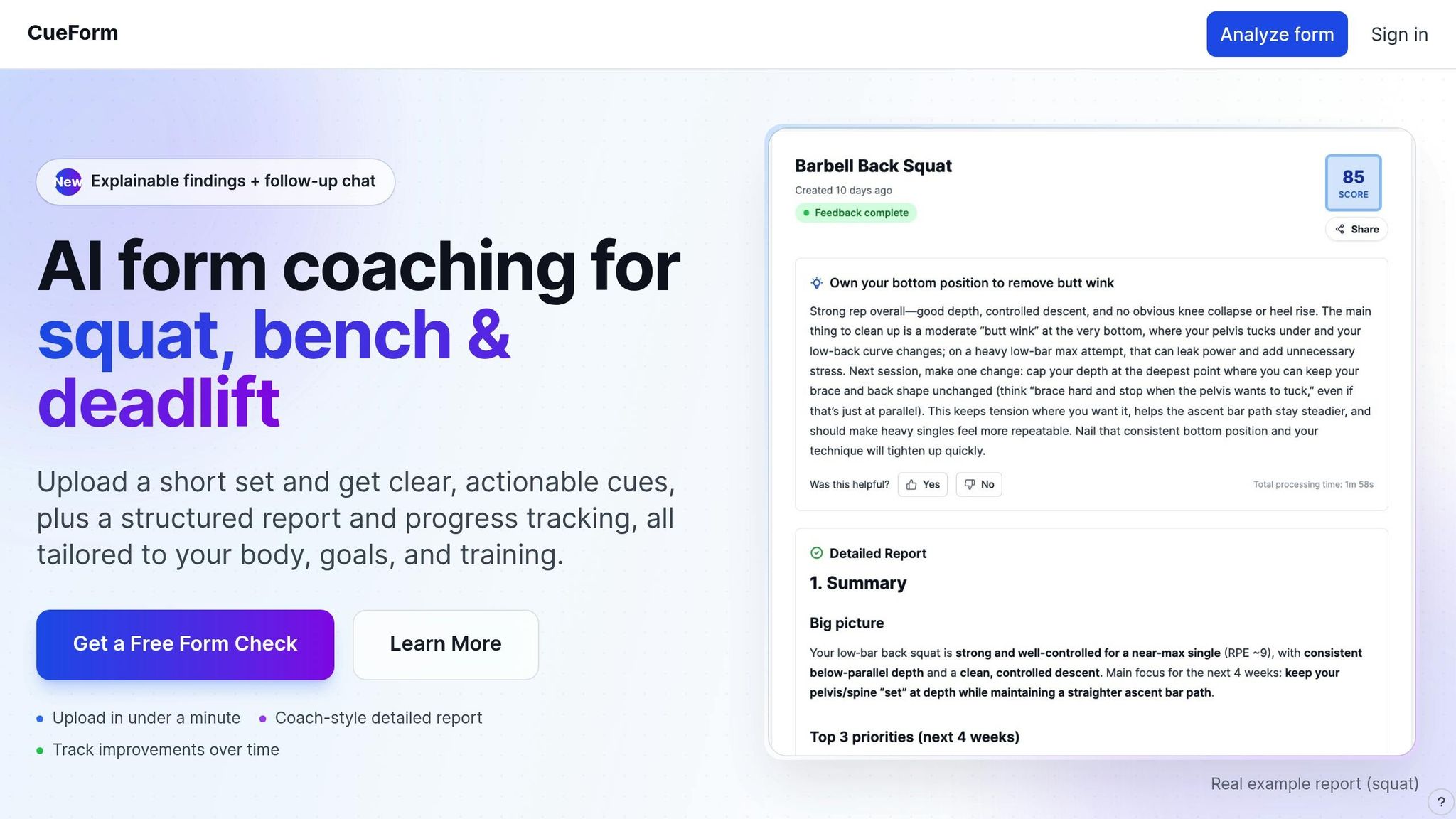
CueForm AI uses advanced technology to refine your powerlifting technique, offering a practical and detailed approach to improving your form.
How CueForm AI Works
CueForm AI simplifies the process into four steps: choose your lift, upload a video with a clear angle, provide details about your anatomy and goals, and get a detailed report with actionable cues. By using sophisticated computer vision and pose estimation tools, the system identifies technique flaws, analyzing elements like bar path, body posture, and joint positions.
What makes CueForm AI stand out is its "Findings" feature, which lays out the metrics and issues it detects - such as knee tracking problems or deviations in bar path. After reviewing the feedback, you can engage with the AI coach to clarify suggestions or request alternative cues. If the system misunderstands your stance or goals, you can correct this and re-run the analysis for tailored feedback. Flexible pricing plans ensure accessibility for lifters at all levels.
Key Features of CueForm AI
CueForm AI is specifically designed for "The Big 3" powerlifting exercises: squats, bench press, and deadlifts. Each lift gets its own specialized analysis:
- Squats: Evaluates depth, knee alignment, bar path, balance, and hip hinge mechanics.
- Bench Press: Focuses on bar path consistency, shoulder blade retraction, elbow positioning, and touch point precision.
- Deadlifts: Assesses start position, hip hinge mechanics, bar path tracking, and lockout form.
Pricing is simple and flexible. The Free plan ($0/month) includes unlimited basic feedback, detailed findings, limited AI coaching, and progress tracking. The Starter plan ($10/month or $89/year) adds unlimited detailed reports, extended AI coaching, and access to enhanced analysis models. Both plans allow you to track your progress over time, helping you measure improvements in your form alongside your lifting stats.
What truly sets CueForm AI apart is its conversational coaching feature. If a recommended cue doesn’t work for you, you can inform the AI coach and receive an adjusted progression. This back-and-forth approach mimics the feedback loops supported by research, offering personalized guidance that evolves with your lifting style.
Conclusion: The Future of Powerlifting with AI
AI-driven feedback is transforming powerlifting, making expert-level coaching available right from your smartphone. Studies show that athletes using AI systems achieve 15% better performance gains and experience 20% fewer injuries compared to relying solely on traditional coaching methods [2]. This marks a major improvement in both safety and training outcomes.
What makes AI stand out is its precision. While even the most experienced coaches catch only 30–40% of form errors in real time [2], AI systems can analyze and diagnose issues in less than 0.5 seconds [7]. This includes spotting subtle problems like uneven depth or dynamic knee valgus - issues that are often missed during live coaching sessions.
CueForm AI is a prime example of this technological shift, blending real-time analytics with accessible coaching tools. As strength coach Zach Lush explains:
The AI is a tool, not a replacement for coaching judgment... It's like having an assistant coach who never gets tired and never misses a rep [2].
With its conversational feedback feature, CueForm AI tailors its guidance to each lifter’s unique needs, considering their anatomy, goals, and lifting style. This creates a personalized training experience that evolves with the athlete. These advancements highlight the potential of AI to elevate powerlifting to new heights, combining safety with effectiveness.
The future of powerlifting doesn’t force a choice between human coaches and AI - it’s about blending the strengths of both. AI takes care of repetitive tasks like monitoring form and tracking metrics, allowing coaches to focus on strategy, motivation, and advanced adjustments. For solo lifters training at home, AI offers a safety net, preventing poor habits from leading to chronic injuries. Given that the AI fitness market is expected to surpass $23.98 billion by 2026 [12], it’s clear that AI is reshaping the standard for training.
Whether you’re a seasoned powerlifter chasing personal records or a beginner learning the basics, AI feedback systems provide round-the-clock expert analysis at a fraction of the cost of traditional coaching. The evidence is clear: AI-powered training is making powerlifting safer, smarter, and more accessible than ever before.
FAQs
How can AI enhance powerlifting performance and ensure safety?
AI is transforming powerlifting by offering real-time feedback on form and technique, helping lifters fine-tune their movements and avoid injuries. This kind of immediate analysis allows athletes to spot and correct mistakes as they happen, making every lift safer and more efficient.
By examining critical factors like bar path and joint angles, AI delivers tailored, actionable tips to improve technique. The result? Better movement patterns, enhanced performance, and training sessions that are both productive and secure.
How does AI provide real-time feedback in powerlifting?
AI leverages computer vision and machine learning to evaluate critical elements of your movement, including body alignment, joint angles, and motion patterns. By analyzing this information, it provides instant, tailored coaching tips designed to fine-tune your technique, boost performance, and lower the chance of injuries.
This approach is especially useful for spotting minor form issues during exercises like squats, bench presses, and deadlifts. It offers practical guidance to help you improve movement efficiency and maximize strength training outcomes.
Can AI replace a human coach in powerlifting?
AI has become an impressive tool in powerlifting training, offering real-time feedback on form, technique, and overall performance. Take CueForm AI, for example - it analyzes videos of squats, bench presses, and deadlifts to provide lifters with personalized, actionable tips. These insights help improve movement quality, lower the risk of injuries, and enhance performance. What’s even more impressive is its ability to spot subtle mistakes that might slip past even the most trained human eye.
That said, AI doesn’t replace the value of a human coach. Coaches bring something to the table that AI can’t: they understand context, offer emotional support, and craft individualized training plans. Rather than seeing AI as a substitute, it’s better to view it as a partner - a tool that works alongside coaches and athletes to push results to the next level.