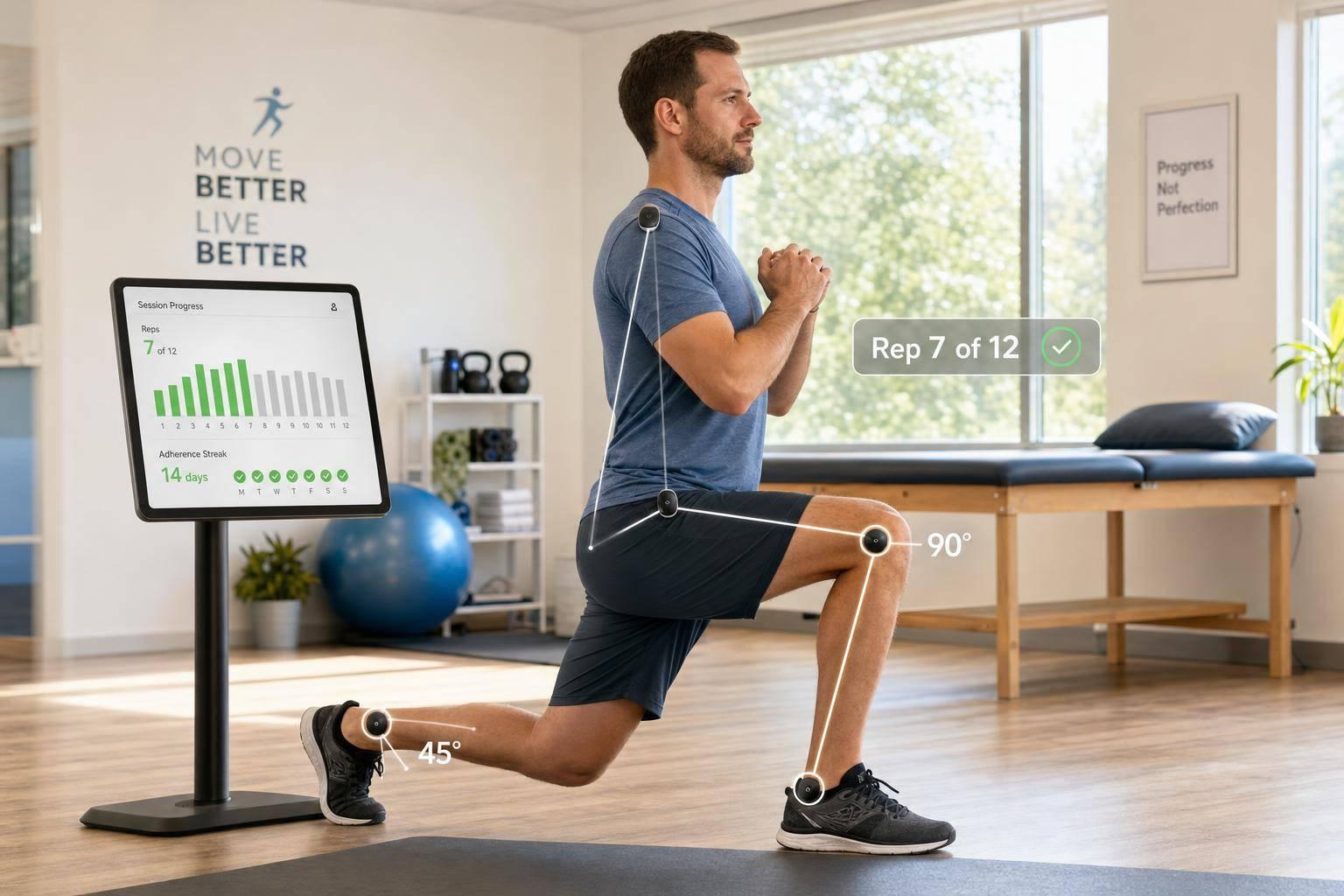
What Studies Show on Motion Tracking Rehab
Here’s the short answer: motion tracking rehab tools can help you move better during exercise and may help you stick to rehab more often. But they do not tell you if tissue is healed, how hard you’re bracing, or whether you’re ready for near-max lifting.
If I boil the article down, the research points to 4 main ideas:
- Best use case: rep-by-rep form feedback for squat, bench press, and deadlift work
- What it tends to help: joint position, depth, symmetry, tempo, and visible faults
- Where it looks stronger: home rehab follow-through, with reports like 91.09% completion in telerehab and 85.99% vs. 59.78% adherence after knee replacement in one study
- Main limit: it works better for movement quality than for judging pain source, tissue status, or heavy-load readiness
Put another way: if you want help spotting common squat form mistakes like knee cave, back rounding, shallow depth, or side-to-side drift, these tools can help. If you want a system to tell you whether a heavy rep is safe, the research does not support that.
What I’d take from the evidence:
- Use motion feedback as a coaching aid
- Trust it more at moderate loads
- Treat flags as a cue to adjust load, tempo, or setup
- Don’t treat it as a diagnosis tool
| Area | What studies lean toward |
|---|---|
| Form during sets | Often improves with live feedback |
| Self-correction | Better error awareness during reps |
| Home rehab follow-through | Often higher than standard home programs |
| Heavy barbell decisions | Data is still thin |
| Injury prediction / failed-rep prediction | Not supported |
Bottom line: motion tracking looks most useful in the middle phase of rehab, when your goal is to clean up reps, stay on plan, and build confidence before loading gets heavy.
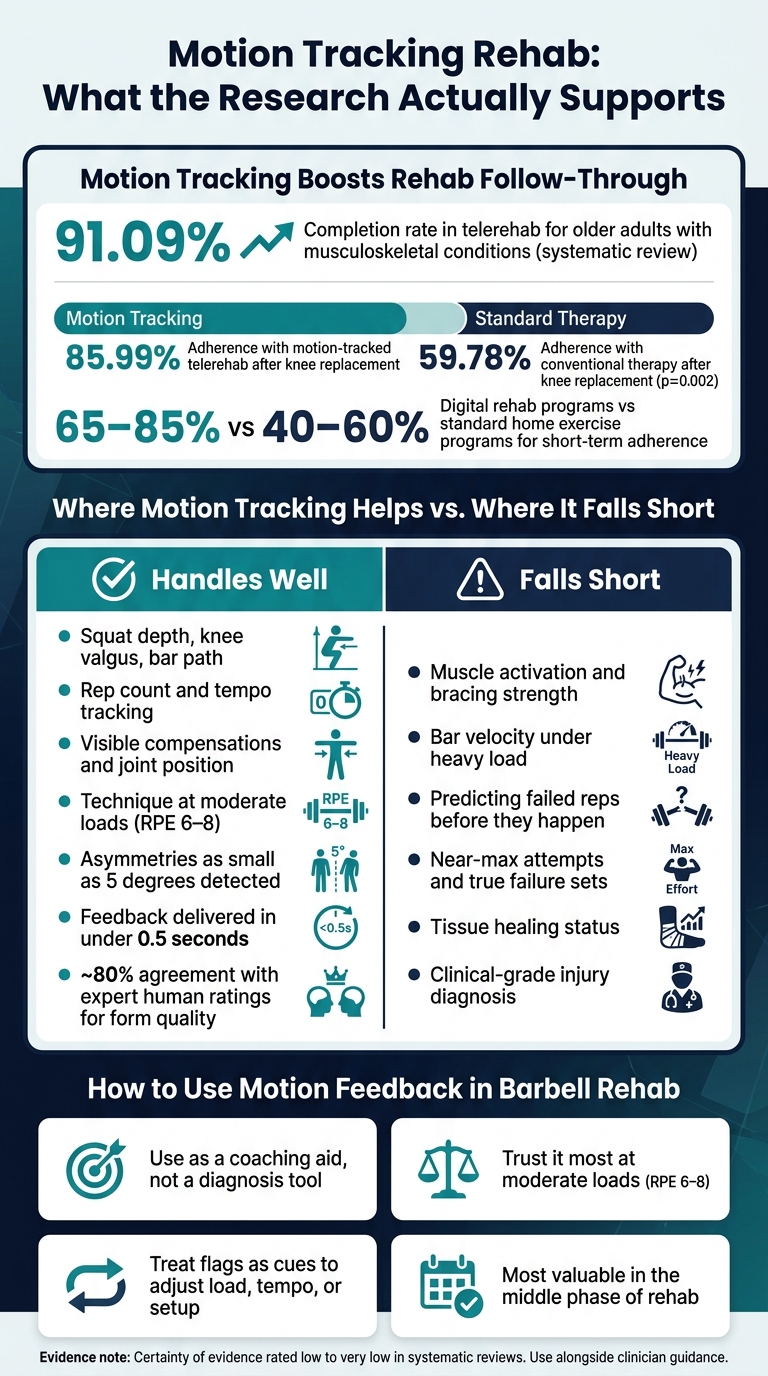
Motion Tracking Rehab: What the Research Actually Supports
Assoc Prof Ang Wei Tech on NTU's motion capture system to aid in physiotherapy, athletics
Motion tracking systems used in rehab research
Rehab studies use a few different motion tracking setups to measure how people move during exercise. The big tradeoff is precision vs. practicality. That matters because the evidence only means so much if the system can't reliably detect the movement it's supposed to correct. In plain English: the tool shapes what researchers can study in a lab, and what people can use at home.
Marker-based optical systems
Marker-based optical systems are still the reference standard for validation, but their high cost and lab-only setup make them hard to use outside controlled settings. [1]
Markerless cameras, wearables, and hybrid setups
Markerless camera systems use pose estimation to track body landmarks frame by frame from a smartphone camera. Wearable inertial measurement units (IMUs) measure acceleration and rotation on specific body segments without a camera. Hybrid setups combine both methods when one system on its own misses part of the picture.
These are the setups that make movement tracking workable for clinics and home rehab programs. [1]
What these systems measure in practice
For squat, bench press, and deadlift rehab, the most useful outputs are joint angles, depth, symmetry, and visible technique faults. That includes issues like:
- a rounded back on a deadlift
- inward knee collapse during a squat
- one shoulder rising faster than the other in a bench press [1]
Accuracy, portability, and home-use tradeoffs
Accuracy depends a lot on camera angle and distance. A side view can miss parts of squat mechanics, while angled setups tend to work better. Markerless systems usually show an average error of under about 10 degrees for most joints, though that error can increase at the shoulder and hip.
That makes these tools a good fit for technique feedback and movement tracking. But they aren't built to measure muscle activation, bracing, or bar speed. Those limits matter when studies test whether feedback changes form, adherence, and recovery.
What studies show about form changes and movement quality
Motion tracking research often shows that real-time feedback can improve exercise form, especially when the goal is to fix visible faults during a set. That said, results can change based on the exercise, the camera setup, and how the cue is given. For lifters, the main question is simple: does the feedback keep each rep closer to the target mechanics?
Less compensation during rehab exercise
Motion tracking systems can flag compensatory patterns like knee valgus, lumbar flexion, and side-to-side asymmetry. In practice, immediate visual or audio feedback can help people adjust technique during the set instead of hearing about it after the session ends.
That matters a lot in rehab, where repeatable technique from rep to rep is often the whole point. AI systems can also catch subtle movement issues, including asymmetries as small as 5 degrees, which are often missed by the human eye. Automated systems can provide feedback in less than 0.5 seconds. [1]
Better movement awareness and self-correction
Motion feedback can help lifters notice errors during a set and fix them on the spot, so more reps stay closer to the target pattern. That's useful in rehab and technique work, where low-quality reps can work against the goal.
It also helps with rep counting in a more meaningful way. Instead of counting every rep, systems can count only the repetitions that meet the required depth and movement-quality standard. Motion tracking can also help identify left-right imbalances by following patterns like side-to-side differences. [1]
Technique changes in resistance training tasks
Studies report better joint angles, symmetry, and timing during resistance training tasks, especially when the fault is easy to see. In plain terms, these tools tend to do best with things like squat depth and knee tracking because they compare joint positions against a benchmark for a "good" rep.
AI-powered tracking has also been reported to achieve about 80% agreement with expert human ratings for form quality. [1]
What studies show about adherence and recovery support
Studies usually separate adherence from recovery. And right now, the evidence is stronger on the adherence side.
That matters. It’s one thing to do cleaner reps. It’s another to keep showing up, stick with the plan, and finish rehab the way it was prescribed. A lot of research looks at that exact point: does motion feedback help people stay on track between visits?
Features linked to better adherence
Across studies, the same features show up again and again. Real-time feedback helps people correct what they’re doing in the moment. Clear prompts make the exercise easier to follow. Progress tracking gives people a sense that their work is adding up. Remote check-ins add accountability. And simple gamification can make the process feel less flat.
Home-based systems stand out because they cut out one of the biggest problems in rehab: friction between appointments.
| Intervention Feature | What Studies Link It To |
|---|---|
| Real-time visual feedback | Higher adherence |
| Structured coaching prompts | Cleaner execution |
| Progress tracking | Sustained motivation |
| Remote accountability | Lower drop-off |
| Gamified tasks | Higher engagement |
Why home-based feedback may help consistency
Home-based feedback removes travel and scheduling barriers. That sounds simple, but in rehab, simple often matters most. If getting the session done is easier, people are more likely to stay consistent between visits.
The payoff is consistency, not just cleaner reps.
A systematic review of real-time telerehab for older adults with musculoskeletal conditions found a mean intervention completion rate of 91.09% [5]. Telerehab after total knee arthroplasty showed adherence of 85.99% versus 59.78% in conventional therapy (p=0.002) [2]. That’s a meaningful gap, and it points to a clear adherence edge.
For lifters, the same kind of setup can help keep squat, bench, and deadlift work on schedule between coached sessions. For injured lifters, that matters because home video review can support squat, bench press, and deadlift practice between sessions.
Recovery outcomes that improve most often
The physical outcomes that appear most often in motion-tracking rehab studies are movement accuracy, confidence under load, and pain reduction. Some studies also report a more confident return to loading, especially when feedback helps people trust their movement again.
That trust piece matters more than it may seem. When people can see progress, fear of loading often drops. And when fear drops, progression gets easier.
Long-term recovery gains are less consistent in the research. Mid-term adherence is still where digital rehab shows the clearest upside. The next step is to ask how much of that evidence carries over to squat, bench press, and deadlift rehab. That’s where lifting-specific evidence becomes the next filter: what transfers cleanly to squat, bench press, and deadlift rehab, and what doesn’t.
How to read this evidence for squat, bench press, and deadlift rehab
For lifters, the main question is simple: what actually carries over to barbell rehab? That’s the lens to use here. The next step is to separate what the research backs from what people often assume these tools can do.
Where the evidence applies to lifting
In practice, rehab feedback is mostly used to cut down on visible form issues. Motion tracking can flag squat depth, knee valgus, bar drift, and uneven shoulder height during a bench setup [1]. Those are the same kinds of movement errors rehab tries to clean up before load goes up.
It also tracks tempo and rep count with good consistency [1]. That matters when a rehab plan calls for controlled reps, especially when a slower eccentric is part of the prescription.
Accuracy still changes based on the app and the setup, so it makes more sense to treat these tools as coaching feedback, not as a risk screen.
Where direct evidence is still limited
The picture gets thinner once loads get heavy. Current motion tracking cannot detect muscle activation, bracing strength, or bar-velocity loss under heavy loads [1]. So the evidence points to movement quality, not load tolerance.
There’s also no validated research showing these systems can predict a failed rep before it happens [1]. Phone-based pose tracking can spot visible compensations, but it is not a clinical-grade diagnostic tool [1]. That gap matters a lot when lifters decide how much faith to put in the feedback once the bar gets heavy.
| What Motion Tracking Handles Well | Where It Falls Short |
|---|---|
| Squat depth, knee valgus, bar path | Muscle activation, bracing strength |
| Rep count and tempo | Bar velocity under heavy load |
| Visible compensations and joint position | How close a rep is to failure |
| Technique at moderate loads (RPE 6–8) | Near-max attempts and true failure sets |
Use motion feedback to clean up rep quality before you add more weight. The evidence supports rebuilding movement quality during the return-to-loading phase. For injury prediction under heavy load, the research just isn’t there yet.
What this means for lifters in rehab
How to use motion feedback without reading too much into it
In rehab, motion tracking works best as a rep-by-rep coaching tool. It can spot when a squat starts shifting to one side, when bar path drifts, or when range of motion gets smaller from set to set. That early warning matters in rehab, because small compensations can stick if no one catches them.
So what does the research support? Use flagged changes as a prompt, not a diagnosis. Motion tracking can’t tell you whether tissue has healed or whether you’re ready for near-max loads. If the system flags a deviation, take it as a cue to lower the load, slow the ramp-up, or check in with a clinician.
Limits of the evidence
The research on motion tracking in rehab looks promising, but it’s still thin. Many studies use small groups, short follow-up periods, and a broad mix of devices and testing methods. The outcome measures also vary a lot from trial to trial, and direct rehab data for heavy barbell lifts is still limited.
A systematic review of biofeedback-assisted telerehabilitation rated the certainty of evidence as low to very low, even when results leaned in favor of the intervention.[13][3][14] That puts a ceiling on how much we should read into the results.
Main takeaways
Across current studies, the pattern is pretty clear: motion tracking tends to help with earlier detection of form breakdown and better movement quality.[6][7][8][10][12] Visual feedback also improves exercise execution, and digital rehab programs often help people stick with the plan in the short term - about 65% to 85% versus 40% to 60% in standard home exercise programs.[4][9][11]
For lifters coming back from injury, that matters most in the middle stretch of rehab, when showing up and moving well matters more than piling weight on the bar. One practical example is CueForm AI, which reviews squat, bench press, and deadlift videos and gives tailored cues between clinic visits. That can help keep movement quality in check as loads go up bit by bit. It works best as part of a clinician-guided plan, not as a substitute for one.
FAQs
When should I use motion tracking in rehab?
Use motion tracking in rehab when you need objective, rep-by-rep feedback on range of motion and form quality. That kind of feedback helps you catch alignment problems early and fix them in real time, instead of waiting until the set is over.
It works best when the video is clean, the camera angle is well framed, and the patient is wearing fitted clothing. If someone is working near their max or showing more complex compensation patterns, treat motion tracking like a second set of eyes. It can help a lot, but clinical judgment should still make the final call.
Can motion tracking tell if I’m ready to lift heavy again?
Motion tracking can help show whether you may be ready to lift heavier, but it should be a screening tool, not the final call.
By tracking bar path, symmetry, and joint angles, CueForm AI can show whether your movement stays steady under load. If your technique stays consistent - without repeated compensations or too much velocity loss - that may suggest you’re handling your current weight well.
But there’s a catch: it can’t measure pain or overall fatigue. So while the data can point you in the right direction, your own judgment still matters.
What setup gives the most accurate feedback at home?
Use a clean, controlled setup. Put your smartphone 6 to 12 feet away at hip or chest height on a stable surface or tripod so the video stays steady.
For squats and deadlifts, film from the side. For the bench press, use a front view or a 45-degree angle. Keep your full body in frame, use bright, even lighting, and wear fitted clothing that stands out from the background.