
How Warm-Ups Prevent Lifting Injuries
Warm-ups are not just a pre-workout routine - they're your first line of defense against lifting injuries. Skipping them increases your risk of muscle tears, joint strain, and poor performance. A proper warm-up:
- Prepares muscles, joints, and the nervous system for heavy loads.
- Reduces muscle injury risk by 30–50%.
- Boosts strength output by 5–10% and range of motion by 10–20%.
- Improves joint lubrication and muscle elasticity.
Key steps for an effective warm-up include light cardio, dynamic stretches, activation drills, and progressive sets tailored to your lifts. Avoid static stretching before lifting, as it can temporarily reduce strength. Instead, focus on dynamic movements that mimic your workout.
For squats, target ankle, hip, and spine mobility. For bench presses, prioritize shoulder stability. For deadlifts, practice the hip hinge and activate your core. These steps not only lower injury risks but also improve form and performance.
Use tools like CueForm AI to analyze and refine your technique during warm-ups, catching small issues before they lead to problems. Warm-ups aren't optional - they're essential for safe and effective training.
Common Lifting Injuries and What Causes Them
Injuries Lifters Face Most Often
Strength training is generally considered safe, with powerlifting showing an injury rate of about 1.0–4.4 injuries per 1,000 training hours [2]. However, there are a few injuries that tend to show up repeatedly, regardless of experience level.
| Injury Site | Common Exercises | Primary Cause |
|---|---|---|
| Lower Back | Deadlifts, Squats, Rows | Lumbar rounding under load |
| Shoulder | Bench Press, Overhead Press | Improper elbow positioning and scapular instability |
| Knee | Squats, Lunges | Knee valgus (caving inward) |
| Biceps | Heavy Deadlifts (mixed grip), Rows | Sudden overload on the tendon |
| Hip | Deep Squats | Mobility restrictions causing impingement |
Lower-back injuries top the list and often involve the L4–L5 and L5–S1 discs, resulting from spinal rounding under heavy loads. Shoulder injuries, such as rotator cuff tears, impingement syndrome, or biceps tendinitis, are usually tied to elbow flaring during bench presses or poor overhead mobility. Knee injuries, like valgus collapse (knees caving inward), are often linked to limited ankle or hip mobility, which disrupts proper squat mechanics.
These patterns highlight the importance of addressing mobility and stability through warm-up routines to reduce injury risks.
Why These Injuries Happen
Interestingly, the weight itself is rarely the direct cause of lifting injuries.
"The weight didn't cause the injury - the position did." - Lift5x5 Team [8]
Cold muscles are less elastic and more prone to micro-tears [1][5]. Tendons and ligaments, which adapt more slowly than muscles - at about 25% of the rate [7] - often become the weak link when lifters skip proper preparation and push their limits too quickly.
Failing to warm up leaves muscles and the nervous system unprepared to handle the demands of heavy lifting. Without a gradual ramp-up, the brain struggles to activate the high-threshold motor units essential for heavy compound movements. This can reduce power output by 10–15% and increase the risk of form breakdown [3]. For example, poor ankle dorsiflexion forces the knees to compensate during squats, a common factor behind valgus collapse and lower-back rounding. Addressing these issues in a warm-up can prevent them from turning into injuries.
"A large share of deadlift back injuries happen on the first cold set." - PoinT GO Sports Science Lab [3]
Starting heavy without warming up is a recipe for trouble. Up next, we’ll look at how warm-ups can prepare your muscles, joints, and nervous system to handle these challenges effectively.
The Science Behind Warm-Ups and Injury Prevention
What Warm-Ups Do for Muscles and Tissue
When your muscles warm up by just 1–2°C, amazing things happen. The contraction and relaxation cycles speed up, resistance drops, and the risk of tears decreases. For tendons and ligaments, even a 1°C rise in temperature makes collagen about 13% more flexible, allowing these tissues to stretch and absorb force more effectively without breaking [3]. These changes are like giving your body a safety net, especially when lifting heavy weights.
This isn’t just about avoiding injuries - it’s about performing better too. For every 1°C increase in muscle temperature, anaerobic power improves by 4–6% [3]. Plus, proper warm-ups can cut the risk of acute muscle injuries by 30–50% [3]. Beyond the muscles, warm-ups also prepare your joints and nervous system to handle the demands of heavy lifting.
How Warm-Ups Prepare Joints and the Nervous System
Dynamic movement during warm-ups does more than just get your blood flowing - it also stimulates the release of synovial fluid. This fluid acts like a lubricant for your joints, reducing friction and helping them move smoothly under heavy loads [5][2]. At the same time, warm-ups enhance nerve conduction, which is critical for quick and precise muscle activation.
This is especially important for heavy lifts that push above 85% of your one-rep max (1RM). These lifts rely on Type II motor units, which need to fire instantly and in the correct sequence. A good warm-up trains your nervous system to recruit the right muscles at the right time, improving neuromuscular efficiency by about 7.9% [3]. The result? Better technique, more stability, and a lower chance of losing form when it matters most.
With your muscles and nervous system primed, the next step is choosing the right type of warm-up.
Dynamic vs. Static Warm-Ups
Dynamic stretching - think leg swings, arm circles, and hip rotations - does exactly what you need before lifting. It raises your core temperature, boosts blood flow, and helps you practice the movement patterns you’ll be using. On the other hand, static stretching, where you hold a position for 60 seconds or longer, can actually work against you.
"Static stretching of 60 seconds or more produces an average 5.5% loss in maximum strength, equivalent to 5.5 kg on a 100 kg 1RM squat." - PoinT GO Sports Science Lab [9]
Research from EMG studies backs this up, showing a 5–10% drop in motor unit activation after static stretches that last over 30 seconds [9].
"You don't want a floppy muscle-tendon unit at the bottom of a heavy squat. You want a stiff, responsive one that returns elastic energy." - Grov Insights [5]
So, save those long static stretches for after your workout. If you must do them before lifting, keep them under 30 seconds and follow up with dynamic movements to re-engage your muscles [9]. Dynamic warm-ups are the key to getting your body ready for the demands of heavy lifting while reducing the risk of injury.
The Perfect Warm-Up For Muscle Growth and Strength (Science Explained)
What a Good Lifting Warm-Up Includes
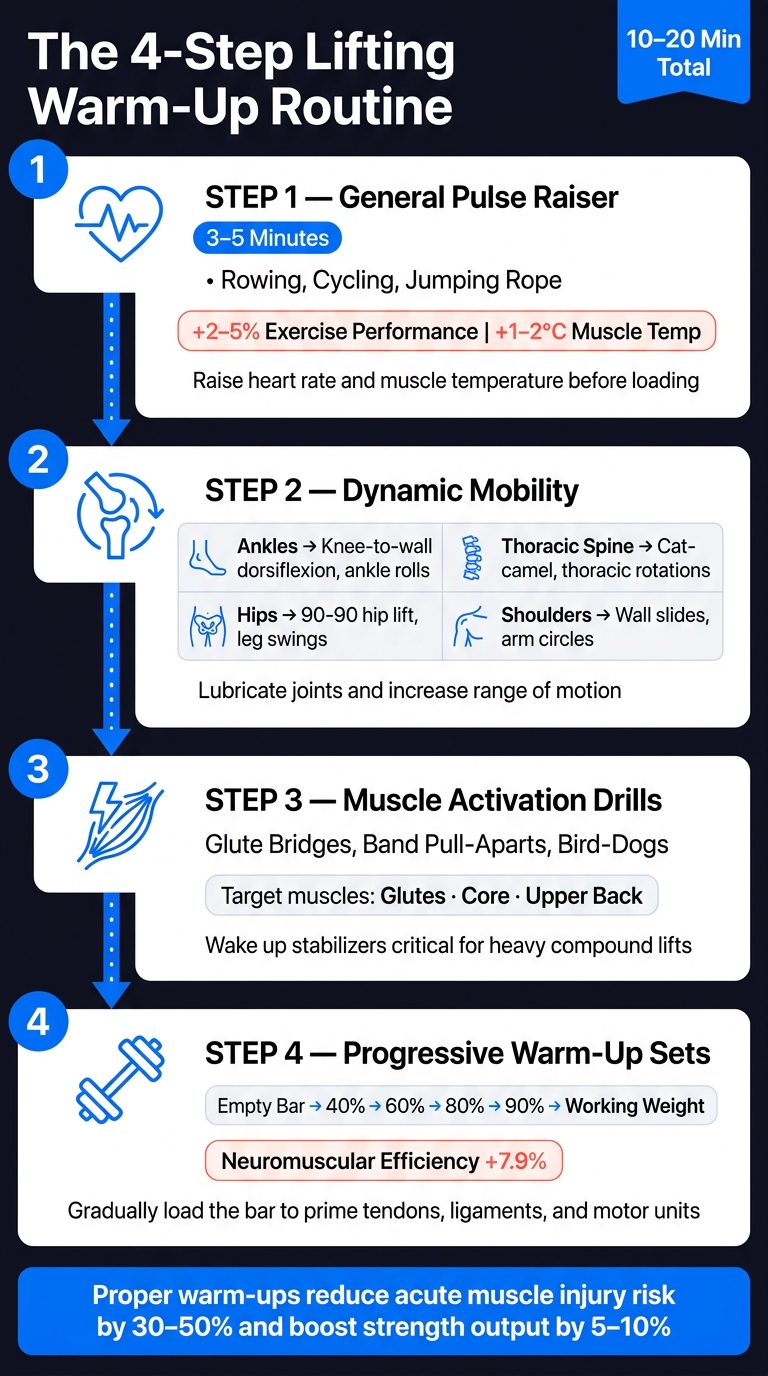
The 4-Step Lifting Warm-Up Routine to Prevent Injuries
A solid warm-up for lifting includes four essential steps: a pulse raiser, dynamic mobility exercises, activation drills, and progressive sets. These steps work together to prepare your body for the demands of heavy lifting.
General Pulse Raiser
Kick things off with 3–5 minutes of light cardio to get your heart rate up and your muscles warm. Activities like rowing, cycling, or jumping rope are perfect for this. The goal is to raise your muscle temperature by 1–2°C, which can boost your exercise performance by 2–5% and make your muscles more elastic, reducing the risk of injury [4][1].
"The warm-up is not a formality, it is the first training stimulus of every session." - Gary McGrath, National Education, Training, and Development Manager, CFMWS [4]
Dynamic Mobility for Key Lifting Joints
After your pulse is up, move on to dynamic mobility exercises. These target the joints you'll be using during your lifts. Think leg swings, ankle dorsiflexion drills, hip 90-90s, and thoracic rotations. These movements help lubricate your joints by stimulating the secretion of synovial fluid, which reduces stiffness and enhances range of motion [5][2].
| Joint Target | Drills | Benefit |
|---|---|---|
| Ankles | Knee-to-wall dorsiflexion, ankle rolls | Improves squat depth and upright posture |
| Hips | 90-90 hip lift, leg swings | Enhances hinge mechanics, reduces strain |
| Thoracic Spine | Cat-camel, thoracic rotations | Supports bar position, prevents lumbar strain |
| Shoulders | Wall slides, arm circles | Protects rotator cuff during pressing |
This step ensures your joints are ready to handle the load without discomfort or restriction.
Muscle Activation and Stability Drills
Next, focus on activating stabilizing muscles. This step is often skipped but is crucial for heavy lifting. Perform one or two sets of exercises like glute bridges, band pull-aparts, or bird-dogs. These drills wake up key stabilizers such as the glutes, core, and upper back, ensuring your body is stable and ready to handle the weight [1][3].
Progressive Warm-Up Sets
The final step is to ease into your working weight by progressively loading the bar. Start with an empty barbell and gradually increase the weight while reducing the number of reps. This process not only prepares your tendons and ligaments but also allows you to fine-tune your technique and ensure you're ready for the main lifts.
"Warm-up sets are your final chance to scan today's form. As you climb from empty bar to 70 percent, you must verify knee valgus, hip shift, and bar path." - PoinT GO Sports Science Lab [3]
A common progression might look like this: Empty Bar → 40% → 60% → 80% → 90% of your training weight, with fewer reps at each step. Take short breaks between sets to assess your readiness. The entire warm-up routine should take around 10–20 minutes [1][3].
Warm-Up Routines for the Main Lifts
Warming up properly before lifting isn't just about breaking a sweat - it's about protecting your body from unnecessary strain. Tailoring your warm-up to each lift ensures you're targeting the right muscles, joints, and movement patterns to perform safely and effectively.
Warm-Up for Squats
Squats require mobility from head to toe, especially in the ankles, hips, and spine. Stiffness in any of these areas can throw off your form and increase the risk of injury.
Begin with ankle dorsiflexion drills if you struggle to hit depth without compensations like heel lifting or knee caving. Spend about 3 minutes on these mobility exercises before moving to hip-focused work. The 90/90 band hip internal rotation drill is a great choice for improving hip control and depth. Add glute bridges (15 reps) and cat-cow stretches to activate your posterior chain and loosen up your spine.
Once your joints feel ready, try position stretching by holding the bottom of a squat with an empty bar. Then, gradually increase the weight. Here's a sample ramp-up progression for a working set of 308 lbs (140 kg) for 3 reps:
| Set | Load | Reps | Purpose |
|---|---|---|---|
| 1 | 44 lbs / 20 kg (empty bar) | 10 | Pattern rehearsal & technique check |
| 2 | 132 lbs / 60 kg (~43%) | 5 | Core engagement |
| 3 | 198 lbs / 90 kg (~64%) | 3 | Balance and velocity check |
| 4 | 242 lbs / 110 kg (~79%) | 2 | Nervous system activation |
| 5 | 275 lbs / 125 kg (~89%) | 1 | Motor unit recruitment |
| Work | 308 lbs / 140 kg | 3 | Main working set |
(Source: [3])
"A large share of deadlift [and squat] back injuries happen on the first cold set." - PoinT GO Sports Science Lab [3]
With your squat mechanics dialed in, it’s time to shift focus to preparing for the bench press.
Warm-Up for Bench Press
The bench press places a lot of stress on the shoulders, an area where many lifters fall short in preparation. The rotator cuff, made up of four small muscles, plays a key role in stabilizing the shoulder joint during each rep. If these muscles aren’t warmed up, it can lead to issues like impingement or even tears.
Start by improving thoracic mobility and scapular stability. Use a foam roller for T-spine extensions to open up your upper back. Then activate your rear delts and mid-back with 2 sets of 15 band pull-aparts and 2 sets of 15 face pulls. Add serratus wall slides to engage the serratus anterior, which helps prevent scapular winging.
Research suggests that 5–10 minutes of targeted shoulder prehab done 3–4 times a week can significantly reduce shoulder injuries [11]. When it’s time to bench, keep your elbows at a 45–60 degree angle from your torso. This adjustment reduces stress on the shoulder joint. Gradually ramp up your weight, starting with the empty bar and working through 50%, 70%, 85%, and 92% of your working load, decreasing reps as the weight increases [3][12].
While shoulder prep is vital for the bench press, deadlifts require a different approach focused on the hip hinge and core strength.
Warm-Up for Deadlifts
Deadlifts are notorious for cold-start injuries, making a solid warm-up essential. The key is to practice the hip hinge pattern and activate the muscles that stabilize your spine, particularly your lats and core.
"One of the top priorities to focus on when warming up prior to performing your deadlift in training is to spend time in the ACTUAL hip hinge (deadlift) position itself." - Matthew Ibrahim, Lead Performance Coach [13]
Start with cable pull-throughs or medicine ball hug good mornings to rehearse the hinge under light load. Next, activate your lats with band straight-arm pull-downs - this helps keep the bar close to your body during the pull, reducing strain on your lower back. Finish with alternating bird dogs and dead bugs to engage your core stabilizers.
For ramp-up sets, begin at 40% of your working weight and progress to around 90%, cutting reps as the weight increases [3][1]. If you notice the bar speed slowing down significantly, consider adjusting your working weight for the day rather than pushing through [10].
Using CueForm AI to Improve Your Warm-Up

A well-structured warm-up is essential for preparing your body for heavier lifts, but spotting subtle flaws in your technique during these lighter sets can be tricky. Even with a solid warm-up routine, minor issues in form often go unnoticed until the weights increase. That’s where CueForm AI steps in to fill the gap.
CueForm AI analyzes videos of your squat, bench press, and deadlift, offering personalized feedback with clear, actionable cues. Instead of guessing whether your knees are caving in or your hips are shifting, you’ll receive objective insights to address these issues. Essentially, it turns your warm-up sets into a diagnostic tool, making them far more than just a routine part of your workout.
The true advantage lies in catching these technical breakdowns early - before they escalate into injury risks under heavier loads. For instance, if your knees show a valgus pattern during a 70% warm-up set, that’s a red flag. Ignoring it as you increase the weight could lead to serious problems. Identifying and addressing these issues during lighter sets allows you to make adjustments or even modify your working weight, significantly lowering your injury risk.
With CueForm AI, you can upload your video and get tailored advice from the AI coach. Let’s say the analysis spots a hip shift during your deadlift warm-up. You’ll receive detailed recommendations on potential causes, activation drills to address the issue, and setup tweaks to improve your lift. The feedback is customized to fit your unique movement patterns and training goals.
CueForm AI is free to get started, offering unlimited quick form checks and progress tracking at no cost. For those looking for deeper insights and extended coaching features, the Starter plan is available for $10/month or $89/year. This tool is a game-changer for lifters who want to train smarter and minimize the risk of injury.
Conclusion: Warm Up Right, Lift Safer
Skipping a warm-up isn't just risky - it can directly impact your performance and safety. Research shows that proper warm-ups can cut acute muscle injury rates by 30–50%[3]. By raising muscle temperature, loosening connective tissue, and prepping your nervous system, a good warm-up ensures you're ready for the heavy demands of lifting.
The science behind this is simple: cold, stiff muscles are far more prone to injury. A proper warm-up increases muscle-tendon flexibility by 10–20%[1], giving your body the elasticity it needs to handle exercises like squats, bench presses, and deadlifts without strain.
"When your preparation meets the demands of training, you don't just lift better that day. You create the conditions for long-term progress, resilience, and consistency in the gym." - Jarrod Nobbe, Strength Coach[6]
Warm-up sets also act as a safeguard for your technique. Starting with lighter weights allows you to refine your form, build solid motor patterns, and catch potential issues before they become problems. This makes warm-ups an essential part of injury prevention.
Modern tools can take your preparation even further. For example, CueForm AI evaluates your warm-up videos to identify and correct technique flaws early on, helping you avoid injuries and improve your form. So, take your warm-up seriously - it’s the key to staying consistent, avoiding setbacks, and making steady progress. Warm up smart, lift safe, and keep your goals within reach.
FAQs
How long should my warm-up be before lifting?
A proper warm-up typically lasts between 10–20 minutes. Begin with 5–8 minutes of general movement to get your body ready. This could include light cardio like jogging, cycling, or dynamic stretches. Then, dedicate 3–5 minutes to specific exercises that target the muscles you'll use during your workout. The aim is to increase your body temperature and engage your muscles without overexerting yourself.
For an extra layer of safety and to refine your technique, consider using CueForm AI. This tool can analyze your form and provide personalized feedback before you start lifting, helping you avoid injuries and perform at your best.
What should I do if I feel pain during my warm-up sets?
If you experience pain during your warm-up sets, stop right away. Warm-ups are designed to reveal any potential problems before moving on to heavier lifts. Treat this as a warning to adjust your technique rather than forcing your way through. Tools like CueForm AI can evaluate your form, pinpoint errors that might be causing discomfort, and guide you toward safer movement patterns for effective training.
How can I tell if my warm-up fixed my form issues?
When starting your warm-up sets, use them as an opportunity to assess your form. Pay attention to key elements like a steady bar path, stable hips, and controlled knee movement. If you spot any issues - like uneven movement, poor posture, or irregular bar speed - it might be a sign that your technique needs tweaking. For deeper insights, CueForm AI can evaluate your form and offer tailored tips to help you improve your movement.