
Research: Warm-Ups Reduce Joint Injuries
Warm-ups are a game-changer for preventing joint injuries. Research shows that proper dynamic warm-ups can reduce ACL injuries by up to 82% and knee injuries by 78%. They improve muscle flexibility, joint mobility, and body awareness, significantly lowering the risk of strains and sprains during heavy lifting.
Here’s what you need to know:
- Dynamic warm-ups are better than static stretching for injury prevention.
- Programs like FIFA 11+ and PEP cut lower limb injuries by 33%–52%.
- Even 7–10 minutes of warm-up boosts performance and joint safety.
- Warm-ups improve blood flow, muscle elasticity, and neuromuscular control.
- Structured routines like ramp-up sets prepare your body for heavy lifts.
For optimal results, warm up at least twice a week for 8–12 minutes, combining light cardio, dynamic stretches, and progressive weight sets. Tools like CueForm AI can also help refine your technique and prevent injury by analyzing your form in real time.
Bottom line: Warming up isn’t just a pre-workout ritual - it’s your first line of defense against injuries.
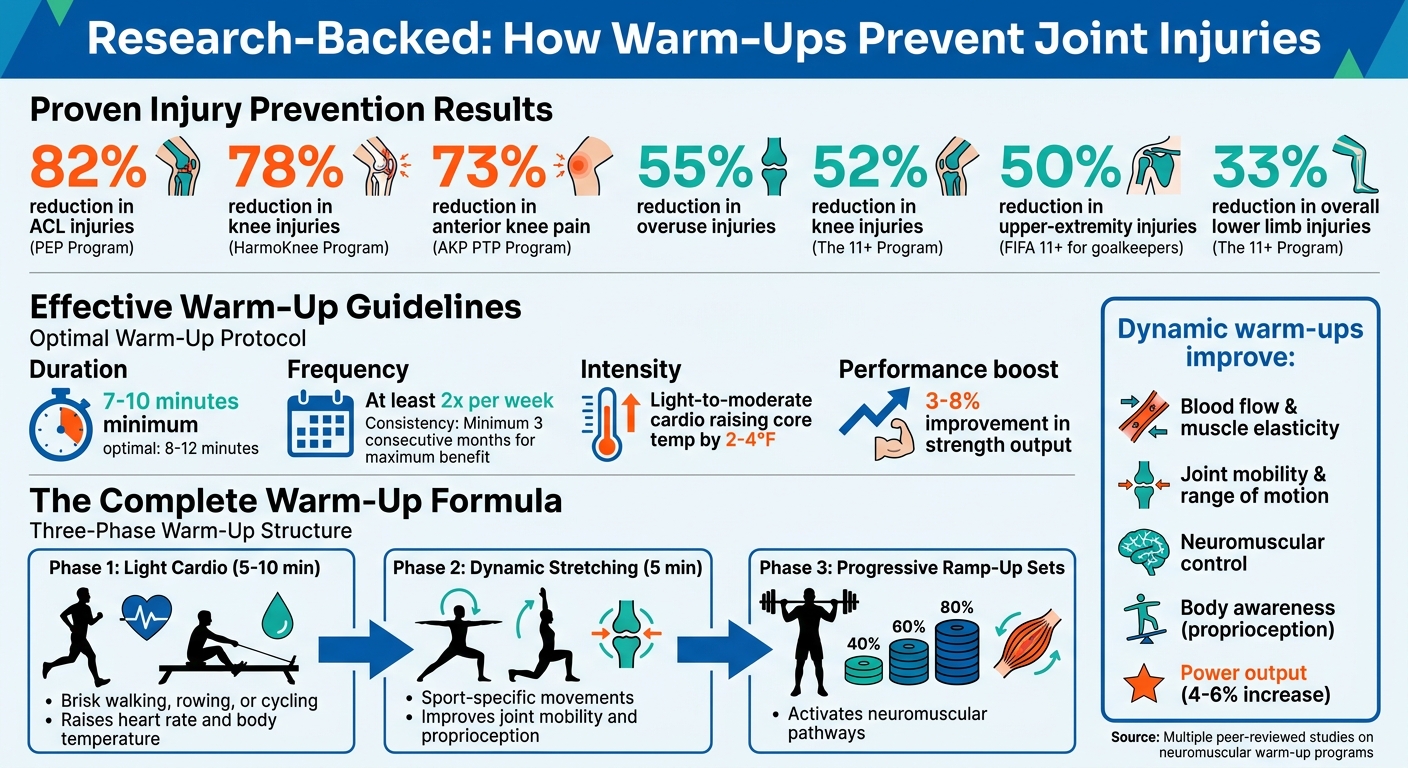
Warm-Up Programs Reduce Joint Injuries: Key Statistics and Research Findings
How Warm-ups Prevent Injuries & What Components To Include
sbb-itb-c91a623
How Warm-Ups Protect Joints During Lifting
Warm-ups set off a series of physical changes that help shield your joints from injuries. By getting your muscles and nervous system ready for the strain of heavy lifting, they lower the risk of strains and sprains.
Increased Blood Flow and Muscle Elasticity
When you warm up, your heart rate rises, and your muscles heat up. This boosts tissue flexibility and cuts down the chances of injuries like sprains and strains [1] [7]. Warmer muscles are more elastic, which makes them better equipped to handle the stress of lifting heavy weights.
There’s more to it than just flexibility. These warm-ups also get your cardiovascular system in gear, which is crucial for heavy lifting. Dynamic warm-ups involving movements at 45%–90% of your one-rep max can improve muscle power through something called post-activation potentiation. This process not only enhances your peak strength but also increases how many reps you can handle [4] [5]. Together, these benefits support better joint mobility and control, helping you lift safely.
Better Joint Mobility and Body Awareness
Warm-ups also play a key role in improving joint range of motion and body awareness. They enhance proprioception - your body’s ability to sense where your joints are - which helps you maintain proper alignment during heavy lifts and reduces your injury risk [1]. Dynamic movements activate your nervous system, speeding up nerve signals and improving the coordination of muscle fibers. This leads to better joint stability during lifts. For instance, research shows that dynamic warm-ups can reduce joint stress, especially in the knees, by improving how your body moves [1]. A great example is the FIFA 11+ program, which cut upper-extremity injuries in soccer goalkeepers by 50% through structured dynamic warm-ups [1].
Although static stretching held for under 60 seconds can help with flexibility without affecting strength, dynamic stretching is generally a better choice before lifting. It prepares your muscles, nerves, and cardiovascular system all at once [1] [4]. Combining active range-of-motion exercises with agility and balance drills ensures your body is ready to lift heavy weights while keeping your joints safe.
What the Research Shows About Warm-Ups
Neuromuscular Warm-Ups and Joint Injury Prevention
Recent research highlights the effectiveness of neuromuscular warm-ups over static stretching when it comes to injury prevention. These dynamic routines, which blend strength, balance, and agility exercises, offer significant protection against joint injuries.
"Neuromuscular training programmes are hypothesized to improve joint sense, stability, and reflex protection, ultimately preventing lower limb injuries." - BMC Medicine [6]
Programs like "Prevent Injury and Enhance Performance" (PEP) have shown remarkable results, reducing ACL injuries by 82% in female soccer players [6]. Similarly, "The 11+" program cut overall lower limb injuries by 33% and knee injuries by 52% in amateur athletes [6]. Teenage athletes using the "HarmoKnee" program saw a 78% reduction in knee injuries, while the "Anterior Knee Pain Prevention Training Programme" (AKP PTP) decreased anterior knee pain by 73% [6]. These statistics demonstrate the wide-ranging benefits of neuromuscular warm-ups across different sports and age groups.
The reason these programs are so effective lies in their ability to address multiple injury mechanisms simultaneously. They prepare joints for the multi-joint and multiplanar movements required during intense physical activities. Research also indicates that consistent use of these warm-ups for at least three consecutive months maximizes their protective effects [6]. This evidence points to their potential application in strength training-specific routines as well.
Findings from Strength Training Research
When it comes to strength training, the benefits of neuromuscular warm-ups are just as compelling. Studies reveal that warm-ups incorporating resistance loads between 45% and 90% of your one-rep max can enhance 1RM performance in exercises like squats and leg presses [5]. This improvement stems from better joint preparation to handle high mechanical stress.
In basketball, where 63.7% of injuries involve the lower limbs, research shows that neuromuscular warm-ups significantly reduce injury rates. Out of 7 studies, 5 confirmed their effectiveness in lowering overall lower extremity injuries [3]. Programs that integrate dynamic stretching, strength exercises, balance drills, and sport-specific movements outperform traditional warm-up methods. Additionally, neuromuscular warm-ups have been shown to cut overuse injuries by 55% in certain groups [6], proving their ability to protect against both acute injuries and repetitive strain on joints.
Effective Warm-Up Methods for Strength Training
Dynamic Warm-Up Exercises for Main Lifts
An effective warm-up involves three key phases: general cardio, dynamic mobility exercises, and specific ramp-up sets using the target lift [8][9]. This step-by-step process prepares your joints and nervous system for action without overexerting you before the main workout.
For squats, start with 10–12 reps of forward/backward and side-to-side leg swings to loosen up. Follow this with 15–20 bodyweight squats, pausing briefly at the bottom of each rep. Add in hip circles and walking hip cradles to further open up your hips and ensure your knees and hips are ready to move [8][9].
When warming up for the bench press, focus on engaging your shoulders and upper back. Begin with arm circles in both directions, then do 15–20 band pull-aparts to activate your upper back. Include wall slides to improve shoulder mobility, and finish with 10 push-ups to wake up your stabilizer muscles [8][9].
For deadlifts, the goal is to activate your posterior chain and improve spinal mobility. Perform 15 glute bridges to engage your glutes, 10 bird dogs per side for core stability, 10–12 cat-cow cycles to loosen your spine, and unweighted hip hinges to practice proper movement patterns [8][9].
After completing these dynamic exercises, move on to ramp-up sets of your main lift. Start with 2 sets of 5–10 reps using just the empty bar. Gradually increase the weight: aim for 5 reps at 40% of your working weight, 3 reps at 60%, and 2 reps at 80% [9]. This gradual progression gets your muscles and nervous system ready without tiring you out [8].
How Long and How Hard to Warm Up
Once you’ve selected your warm-up exercises, it’s time to fine-tune the duration and intensity. Spending 8–12 minutes on your warm-up is ideal for most training sessions [8]. This typically includes 5–10 minutes of light cardio followed by around 5 minutes of dynamic stretching. Studies show that 15 minutes of low-intensity cardio can boost leg press performance by 3–4%, while 20 minutes of moderate cardio combined with ramp-up sets can improve results by over 8% [8].
Intensity matters just as much as duration. Choose light-to-moderate cardio activities like brisk walking, rowing, or cycling that raise your core temperature by 2–4°F. This increase in body temperature can enhance power output by 4–6% [9]. Dynamic stretches should be smooth and controlled, using only your bodyweight to avoid unnecessary strain.
For ramp-up sets, keep rest periods between 45–90 seconds to ensure your muscles stay warm [8][9]. Each set should feel quick and controlled, helping you reinforce proper movement patterns without exhausting yourself.
As you progress in your strength training journey, a well-structured warm-up becomes even more essential. For instance, a lifter squatting 450 lbs experiences significantly higher joint stress than someone lifting 150 lbs, making incremental warm-up sets critical [8]. Derek Sople, P.T., D.P.T., O.C.S. from Mass General Brigham Sports Medicine emphasizes:
"DWs appear to be best performed just before athletic activity, at least twice a week, and should be performed for at least 7 to 10 minutes in duration" [1].
Using CueForm AI for Warm-Up and Form Analysis
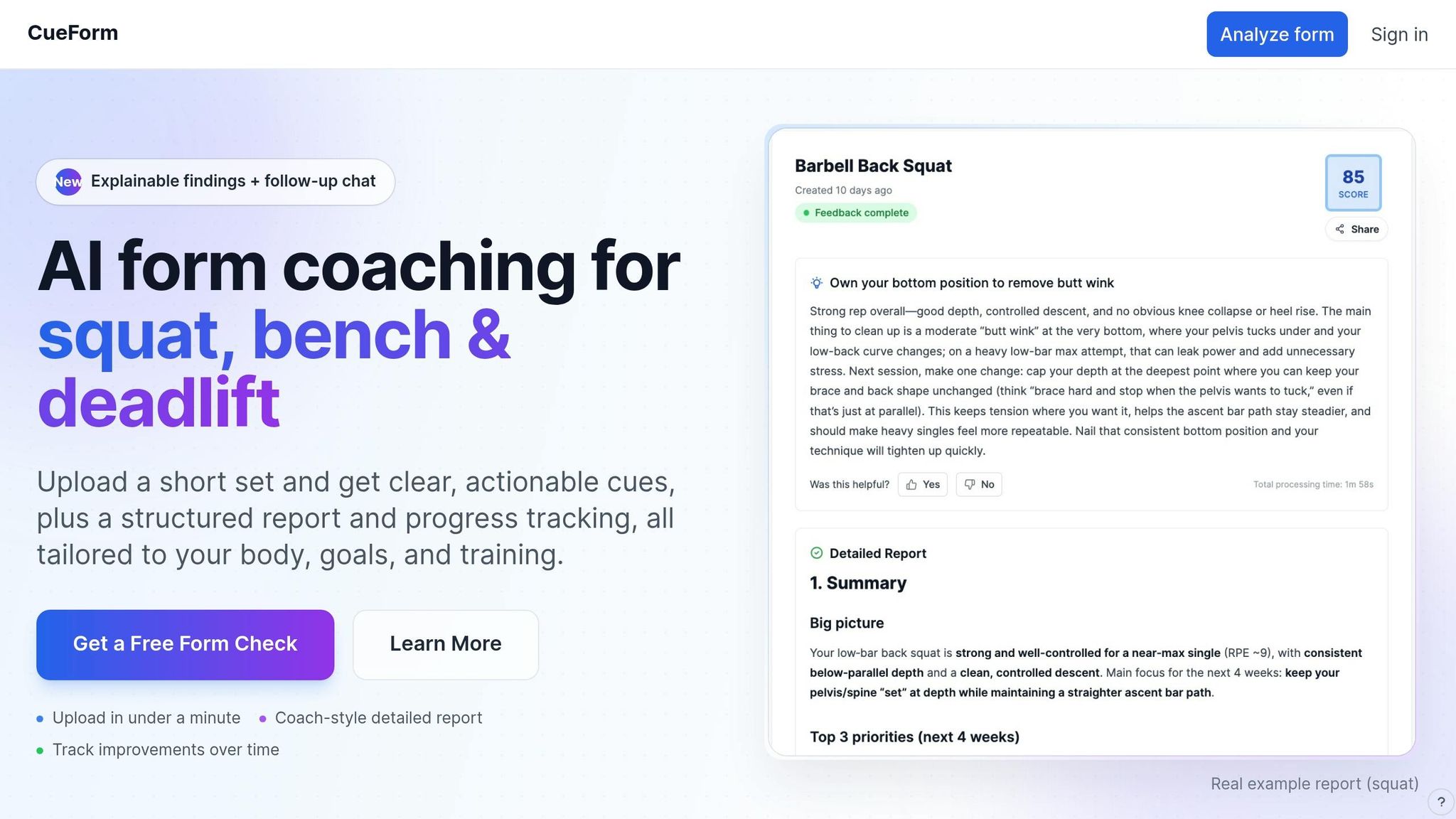
Getting Feedback on Warm-Ups and Lifting Form
Warm-ups are essential for preparing your body, but technology like CueForm AI takes it a step further by fine-tuning your technique. By recording your warm-up sets, you can spot technical issues before they become bigger problems. CueForm AI uses computer vision and pose estimation to map your body's movement. It tracks key points - like your shoulders, elbows, hips, knees, and ankles - creating a digital representation of your form and calculating joint angles with impressive precision [11]. This allows it to flag risky patterns such as knee valgus (knees caving inward), lumbar flexion (lower back rounding), or heels lifting during squats [11].
The process is simple: upload a clear video of your warm-up set, and the AI compares your movements to biomechanical models of proper lifting technique. For squats, it evaluates depth, knee alignment, bar path, and hip hinge. For the bench press, it monitors bar path, shoulder retraction, and elbow positioning. And for deadlifts, it checks your start position, hip hinge, back alignment, and lockout [10]. Based on its analysis, the platform provides actionable cues like "chest up" or "push through heels", which you can immediately apply to improve your form [10][11].
CueForm AI’s "Findings" feature breaks down the metrics and specific issues it detects, eliminating the guesswork behind its recommendations [10]. If a cue doesn’t feel right or you need more clarity, the chat function lets you ask follow-up questions, such as "What should I focus on feeling?" or request alternative suggestions [10].
Custom Injury Prevention Recommendations
Generic advice often fails to account for individual differences in anatomy or training history. CueForm AI bridges that gap by letting you input personal details - your goals, body proportions (like femur-to-torso ratio), and training plan. This ensures the feedback is tailored to your unique lifting style [10][11]. It’s especially helpful if you’re managing past injuries or working around mobility limitations.
The AI focuses heavily on injury prevention by identifying technical flaws that could lead to joint damage. For example, it detects knee valgus, which stresses the ACL and medial knee structures, or "butt wink" (lumbar flexion), which shifts the load from muscles to spinal discs and ligaments [11]. During barbell exercises, it tracks bar path and flags asymmetries or weight shifts that might indicate compensations [11].
CueForm AI offers two plans to suit different needs. The Free plan provides unlimited quick feedback with essential suggestions and limited AI chat access. For $10/month or $89/year, the Starter plan includes unlimited detailed reports and an extended chat feature for deeper analysis [10].
This personalized, tech-driven approach enhances your warm-up routine while reinforcing the importance of proactive measures in reducing the risk of joint injuries.
Conclusion
Studies confirm that warm-ups play a critical role in reducing joint injuries. Programs like FIFA 11+ and PEP have been shown to lower overall lower limb injuries by 33%, cut overuse injuries by 55%, and reduce ACL injury risk by an impressive 82% [2].
Dynamic warm-ups take the lead over static stretching by improving nerve conduction, motor unit activation, and proprioception, all without the fatigue that static holds can cause [1]. For strength training, incorporating high-load dynamic warm-ups and progressive ramp-up sets has been linked to increased lifting velocity and better one-repetition maximum performance [4][5].
To see measurable results in injury prevention, aim to perform warm-ups at least twice a week for a minimum of three months [2][1].
On top of these proven methods, modern tools can help optimize warm-up routines. CueForm AI, for instance, provides valuable insights by analyzing your movement patterns during warm-ups. Whether you choose the free plan for quick feedback or the $10/month Starter plan for detailed analysis, this tool helps identify risky movements before they become a problem. By combining evidence-based warm-up techniques with advanced form analysis from CueForm AI, athletes can better protect themselves from injuries while boosting their overall performance.
FAQs
What’s the quickest warm-up that still protects my knees?
A warm-up that’s easy on your knees doesn’t have to take long - just 5 minutes is enough to get you ready for action. Start with some light jogging to get your blood flowing. Then, mix in technique drills like cutting and jumping to prepare your body for dynamic movements. Balance exercises, such as using a wobble board, can help improve stability. Finally, include strength exercises that focus on your quadriceps and hamstrings. These steps are not just about warming up - they can also play a role in reducing the risk of knee injuries during training.
Should I warm up differently for squats, bench, and deadlifts?
Absolutely. Tailoring your warm-up to match the specific demands of each lift - like squats, bench presses, or deadlifts - can make a big difference. Research shows that customized warm-ups not only help improve performance but also lower the risk of injury. By focusing on the muscles and movement patterns involved in a particular exercise, you're setting yourself up for safer and more effective training sessions.
How can I tell if my warm-up sets show risky form issues?
When you're warming up, it's the perfect time to catch and address potential form problems before they lead to injuries. Keep an eye out for poor joint alignment, unusual strain or discomfort, jerky or uncontrolled movements, and difficulty maintaining proper form, even with lighter weights. These are all red flags that something might be off.
To tackle this, focus on controlled and deliberate movements during your warm-up. Recording your sets for video analysis can also be incredibly helpful. Tools like CueForm AI can take this a step further by providing tailored feedback, making it easier to identify and fix form issues early. By addressing these problems upfront, you can significantly lower your risk of injury during strength training.
Related Blog Posts
Plans
Choose the plan that best fits your needs.
Free
Try it out
Starter
Perfect for fitness enthusiasts