Deadlift Grip: Which Grip to Use and How to Stop the Bar Slipping
The three main deadlift grips are double overhand, mixed and hook grip,1 and the standard advice is to start with double overhand and switch when the bar begins to slip.2 The deadlift grip types differ in which way each palm faces and where your thumb sits.3 The choice matters because your back won't pull a weight off the floor that your hands can't hold.4
Double overhand deadlift grip
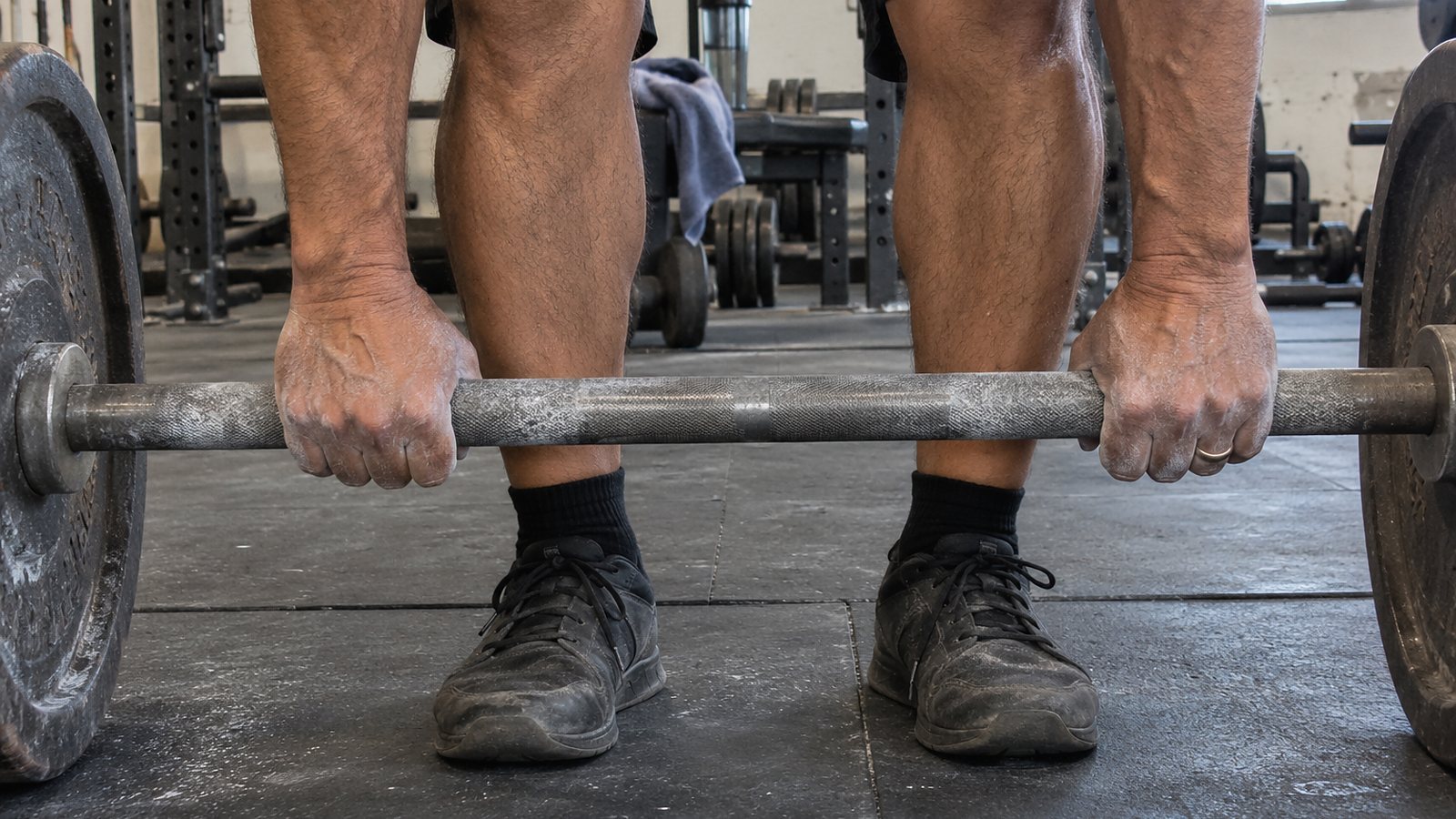
Double overhand means both palms face your shins and both thumbs wrap around the bar. It's the simplest grip, and the NSCA's textbook starts the deadlift with it.2 It's also the first to fail as the weight climbs, because the bar can roll down into the fingers of both hands at once and pull them open.5
Use it for as much of your training as it holds. Pulling double overhand builds stronger hands and keeps the load even on both shoulders, and many newer lifters can hold their heaviest sets this way.6
To keep the bar from slipping:
- Set your hands just outside your legs, close enough that your thumbs don't rub your thighs as you pull.7
- Grip the bar low in your fingers, near the calluses at their base,5 not deep in your palm. A bar set high in the palm slides down into the fingers anyway and folds the skin as it goes.8
- Chalk your hands before your heavier sets.9
- Skip gloves. They put loose material between your hand and the bar and make the bar thicker to hold.10
Mixed grip deadlift
A mixed grip deadlift turns one palm toward your shins and the other away. It's also called the alternate grip or reverse grip, and it's the grip powerlifters use most.1 It holds more than double overhand because the bar can't roll out of both hands: as it rolls toward the fingers of one hand, it rolls into the palm of the other.5
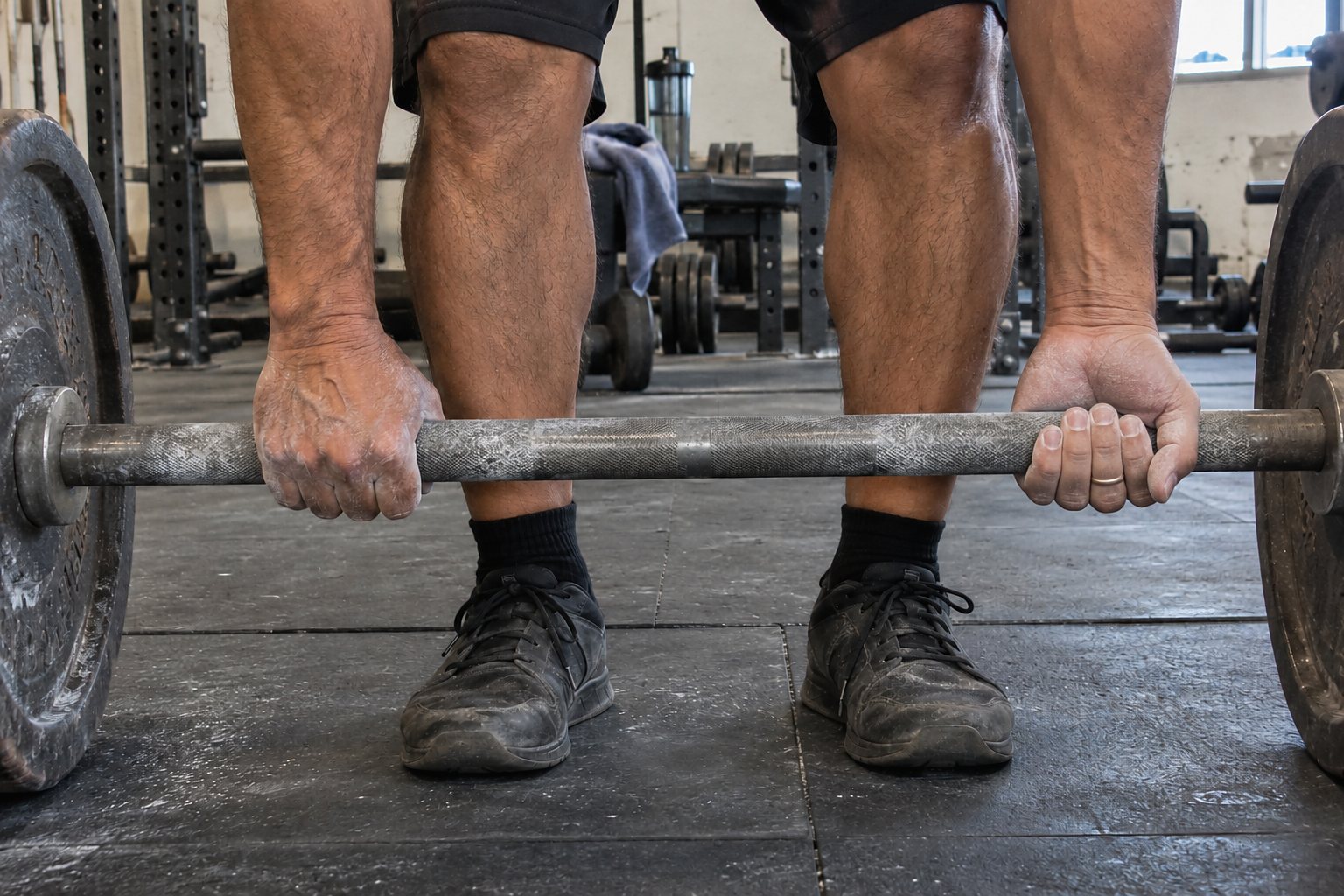
To set it up:
- Turn your non-dominant hand under. Most lifters prefer it that way.6
- Set the bar low in both hands, near the calluses at the base of your fingers.5
- Straighten both elbows before the bar leaves the floor.2 Squeeze the bar hard with your hands, but don't pull with your arms.5
- To keep both sides even, swap hands on alternate sets.5
Hook grip deadlift
A hook grip deadlift keeps both palms facing your shins, like double overhand, but your thumb goes under your index and middle fingers.3 The weight of the bar squeezes your fingers onto your thumb, which holds more securely than grip strength alone.11 The hook comes from weightlifting.1 Because both hands face the same way, it also keeps both sides even.5
The trade-off is comfort: the hook hurts at first, and lifters with short fingers may not be able to cover the thumb well enough to set it.5 Austin and Mann advise against it if you already have thumb problems.1
How to hook grip a deadlift
- Reach down with both palms facing your shins.
- Wrap your thumb around the bar first.1
- Wrap your index and middle fingers over your thumb, then close the rest of your hand.3
- Let the bar settle low, in the bend of your fingers, before you pull.11
- Hook every set from your first warm-up, so your thumbs get used to the pressure before the heavy sets.12
If thumb pain gets worse or keeps coming back, stops you doing everyday things, or hasn't eased after two weeks, go back to a mixed grip or straps and see a doctor or physical therapist. Get urgent help for severe pain, a snap or pop when it started, a thumb you can't move or hold things with, or lost feeling in your hand.13
Which deadlift grip is best?
The best deadlift grip is the one that holds your heaviest sets. Grip type doesn't change how fast the bar moves: in 29 trained lifters pulling 50% to 90% of their max, peak bar speed was similar with all three grips.14 The same lifters rated the mixed grip the easiest at every load, and the double overhand and hook grips drew more forearm muscle activity.14
Choose by what you train for and what your hands tolerate:
- For general strength: pull double overhand for as long as it holds, then use straps or a mixed grip for the heaviest sets.6
- For powerlifting: use a mixed or hook grip for heavy sets.1 The IPF allows any grip in the deadlift,15 but lifting straps aren't among its permitted personal equipment, and tape on the thumbs can't be used to help hold the bar.16 Check your federation's rulebook.
- If you also clean or snatch: learn the hook grip, since it's the usual grip for heavy cleans and snatches.3
How to improve grip strength for deadlifts
Use chalk for deadlift sets before you decide your grip is weak. Chalk adds friction between your hands and the bar and soaks up sweat, and it can raise the weight you can hold so much that grip may not be your limit at all.17
If the bar still slips, train the grip the deadlift uses: support grip, which keeps your hands from being pulled open. Hand grippers train crushing grip, which carries over only a little.18
- Warm up double overhand. Take every warm-up set double overhand and save the mixed grip for the heavy sets. Your hands get more work, and your grip builds quickly.6
- Add timed holds at the top. After your deadlifts, pick a weight you can hold at lockout for 15 to 20 seconds. Hold it as long as you can, rest 3 to 5 minutes, and do 3 or 4 sets, two or three times a week. Add weight once you pass 20 seconds. Use your usual heavy grip.18
- Add variety if you want it. Hangs from a pull-up bar, one-handed barbell holds and farmer's walks also work your grip.18
When to use deadlift straps
Deadlift straps loop around your wrists and the bar, so the bar can't roll out of your hands.5 They let you hold more weight or hold it for more reps.19 In one study, 20 men lifted about 10% more on a one-rep max with straps than without.20 In others, straps reduced grip fatigue over sets of 4 reps at 80% of max,21 and helped trained women do more reps at the same weight.22
Use straps for back-off sets and higher-rep work, where your grip tires before your back and hips do.19 If you compete, do some of your heavy training without them so your grip is ready for the platform.19 Rippetoe warns that straps used too often on light sets can keep your grip from getting stronger,23 though no research has yet shown long-term effects of training with straps, either way.24
Check the rest of your pull
Grip is one part of the deadlift, and the rest happens where you can't watch it while you pull. Film one set from the side at hip height, with the plates and your whole body in frame. CueForm doesn't check your grip, but it checks your back position off the floor, the start of the pull and your lockout from that one side video. Check your deadlift from one side video.
The barbell deadlift guide covers the rest of the lift, from setup to lockout.
FAQ
Is mixed grip deadlift bad?
No. It's the grip powerlifters use most.1 The usual worry is imbalance: lifters tend to shift slightly toward the overhand side, though Greg Nuckols doesn't think that matters much if the deadlift isn't your only back exercise. To even it out, turn your left hand under on half your sets and your right on the rest.5
Is mixed grip bad for your biceps?
The underhand arm is the one to watch. Lock both elbows before the bar leaves the floor, squeeze with your hands and keep your upper arms relaxed rather than rowing the bar.5 Tension in that arm can also push its end of the bar forward.6 To keep both palms facing you instead, use a hook grip or straps.
Does hook grip hurt?
Yes, at first, because your thumb is pinned between your fingers and the bar on every rep. It gets more comfortable the more often you hook,5 and athletic tape around the thumb helps if the discomfort is distracting or the skin starts to tear.12 The IPF allows two layers of tape around each thumb in competition.16
Hook grip or mixed grip?
Mixed grip if you want the easiest secure grip: trained lifters rated it the easiest at every load.14 Hook grip if your fingers are long enough to cover your thumb and you can put up with the early discomfort. It may hold even more than a mixed grip, and it keeps both hands the same.5
Sources
-
Austin D, Mann B. Powerlifting: The Complete Guide to Technique, Training, and Competition, 2nd edition. Human Kinetics, 2022. Chapter 6, "Grips", p. 114. ↩
-
Caulfield S, Berninger D. Exercise technique for free weight and machine training. In: Haff GG, Triplett NT, eds. Essentials of Strength Training and Conditioning, 4th edition. Human Kinetics, 2016. Chapter 15, "Deadlift", p. 389. ↩
-
Caulfield S, Berninger D. Exercise technique for free weight and machine training. In: Haff GG, Triplett NT, eds. Essentials of Strength Training and Conditioning, 4th edition. Human Kinetics, 2016. Chapter 15, "Handgrips", p. 352. ↩
-
Rippetoe M. Starting Strength: Basic Barbell Training, 3rd edition. The Aasgaard Company, 2011. Chapter 4, "The Deadlift", p. 130. ↩
-
Nuckols G. How to deadlift: the definitive guide. Stronger by Science, updated 2024. Section "Gripping the bar". ↩
-
Rippetoe M. Starting Strength: Basic Barbell Training, 3rd edition. The Aasgaard Company, 2011. Chapter 4, "The Deadlift", p. 129. ↩
-
Rippetoe M. Starting Strength: Basic Barbell Training, 3rd edition. The Aasgaard Company, 2011. Chapter 4, "Learning to Deadlift", step 2, p. 135. ↩
-
Rippetoe M. Starting Strength: Basic Barbell Training, 3rd edition. The Aasgaard Company, 2011. Chapter 4, "The Deadlift", pp. 130–131. ↩
-
Austin D, Mann B. Powerlifting: The Complete Guide to Technique, Training, and Competition, 2nd edition. Human Kinetics, 2022. Chapter 6, "Equipment", p. 122. ↩
-
Rippetoe M. Starting Strength: Basic Barbell Training, 3rd edition. The Aasgaard Company, 2011. Chapter 4, "The Deadlift", p. 132. ↩
-
Rippetoe M. Starting Strength: Basic Barbell Training, 3rd edition. The Aasgaard Company, 2011. Chapter 6, "Using the hook grip", p. 237. ↩
-
Rippetoe M. Starting Strength: Basic Barbell Training, 3rd edition. The Aasgaard Company, 2011. Chapter 6, "The Power Clean", pp. 240–241. ↩
-
NHS. Thumb pain. Reviewed June 2025. ↩
-
Pratt J, Hoffman A, Grainger A, Ditroilo M. Forearm electromyographic activity during the deadlift exercise is affected by grip type and sex. Journal of Electromyography and Kinesiology, 2020. ↩
-
International Powerlifting Federation. Technical Rulebook, section 4.3, "Deadlift", rule 1. Effective 1 March 2026. ↩
-
International Powerlifting Federation. Technical Rulebook, section 3, "Personal equipment", and section 3.11, "Medical tape". Effective 1 March 2026. ↩
-
Nuckols G. How to deadlift: the definitive guide. Stronger by Science, updated 2024. Sections "What's the point of chalk and baby powder?" and "Improving grip strength for the deadlift". ↩
-
Nuckols G. How to deadlift: the definitive guide. Stronger by Science, updated 2024. Section "Improving grip strength for the deadlift". ↩
-
Nuckols G. How to deadlift: the definitive guide. Stronger by Science, updated 2024. Section "When should you deadlift with straps?". ↩
-
Jukic I, García-Ramos A, Malecek J, Omcirk D, Tufano JJ. The use of lifting straps alters the entire load-velocity profile during the deadlift exercise. Journal of Strength and Conditioning Research, 2020. ↩
-
Jukic I et al. Ergogenic effects of lifting straps on movement velocity, grip strength, perceived exertion and grip security during the deadlift exercise. Physiology & Behavior, 2021. ↩
-
Trahey KM et al. The effect of lifting straps on deadlift performance in females. Journal of Strength and Conditioning Research, 2023. ↩
-
Rippetoe M. Starting Strength: Basic Barbell Training, 3rd edition. The Aasgaard Company, 2011. Chapter 4, "The Deadlift", p. 130. ↩
-
Martins R et al. Are lifting straps a game changer for resistance training or an overrated tool? An exploratory review of current evidence and future research directions. International Journal of Sports Physiology and Performance, 2026. ↩