Bench Press Grip Width: How Wide to Grip and How to Hold the Bar
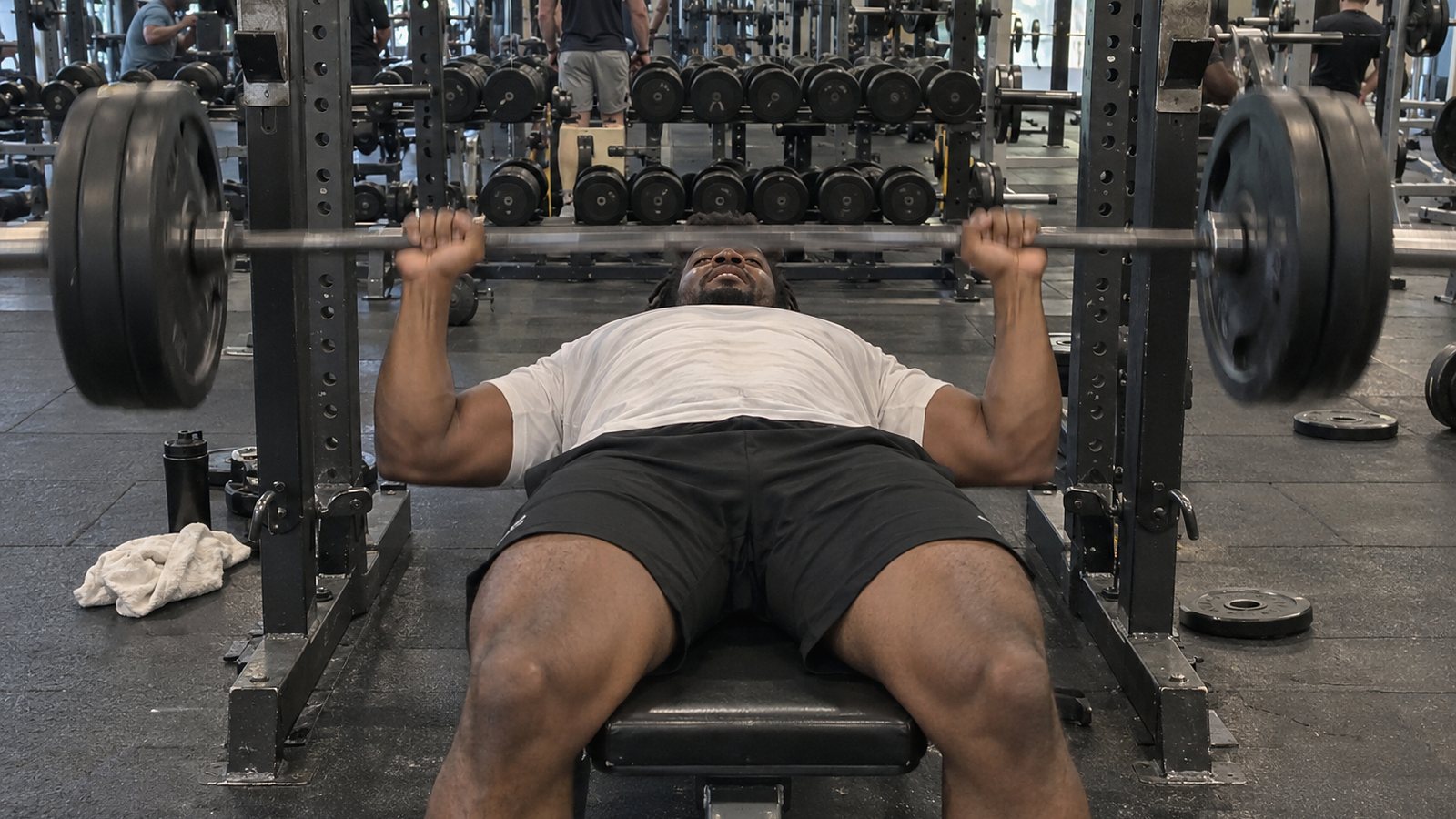
A good starting bench press grip width puts your forearms vertical when the bar touches your chest,1 usually a little wider than shoulder width.2 From there, a wider grip shortens the distance the bar travels,3 and a closer grip lengthens it and gives your triceps more of the work.4
However wide you grip, hold the bar low in your palm with your thumbs wrapped around it.5
How to find your bench press grip width
Use an empty bar,6 and check your grip at the bottom of the press, with the bar on your chest.
- Start with your hands a little outside your shoulders. For most people, 22 to 24 inches (56 to 61 cm) between the index fingers puts the forearms vertical at the bottom.1 A shoulder-width grip on the bench press is closer than that: your elbows end up outside your hands through most of the press.4
- Lower the bar to your chest and pause. Use your usual touch point and elbow position.
- Check your forearms from your feet. Have a partner stand at the foot of the bench, or film one rep from there. Your forearms should be vertical and parallel to each other.2 If your elbows sit outside your wrists, your grip is too close. If your wrists sit outside your elbows, it's too wide.
- Move one finger width at a time. Adjust in or out, then lower and check again. Look from the side as well: the forearm should be vertical from every angle.7
- Note where your hands sit against the ring marks. A standard power bar has a ring scored into the knurling near each end, 32 inches (81 cm) apart.8 Use the rings to put your index fingers in the same place every set.
Vertical forearms put your elbows directly under the bar, so the force from your arms goes straight into the bar instead of trying to rotate around your elbows.7
Does grip width matter?
Yes, within limits. Moving your hands in or out changes how far the bar travels, which muscles do more of the work, and how the press feels on your shoulders, elbows and wrists. Within about 22 to 28 inches (56 to 71 cm) between the index fingers, though, the right width is largely personal preference.9
Bench press grip: how to hold the bar
A proper bench press grip sets the bar on the heel of your palm, directly over the bones of your forearm. That way the force from your arms reaches the bar without being channeled through your wrists.10
Most people grip with their knuckles in line with the bar. That leaves the bar 1 to 2 inches behind the wrist, which levers the wrist back.5 To set it right:
- Place your index fingers at your chosen width.
- Turn your thumbs down toward your feet, so the bar settles into the heel of your palm.
- Wrap your thumbs around the bar, lay your fingers over it and squeeze.5
Squeeze the bar as hard as you can before you unrack,11 and keep squeezing through the set. A grip that loosens lets the bar roll back toward your fingers, which can change your elbow and shoulder position mid-set.9
Thumbs around the bar, not a thumbless grip
Keep your thumb around the bar on every bench press. Lifters who use a thumbless grip, also called the suicide grip, are often trying to set the bar over the forearm, but a thumbs-around grip gets the bar into the same position.12 Your thumbs also let you squeeze the bar harder, and a hard squeeze helps you press.13 Don't use the thumbless grip.
Close grip vs wide grip bench: close, medium or wide?
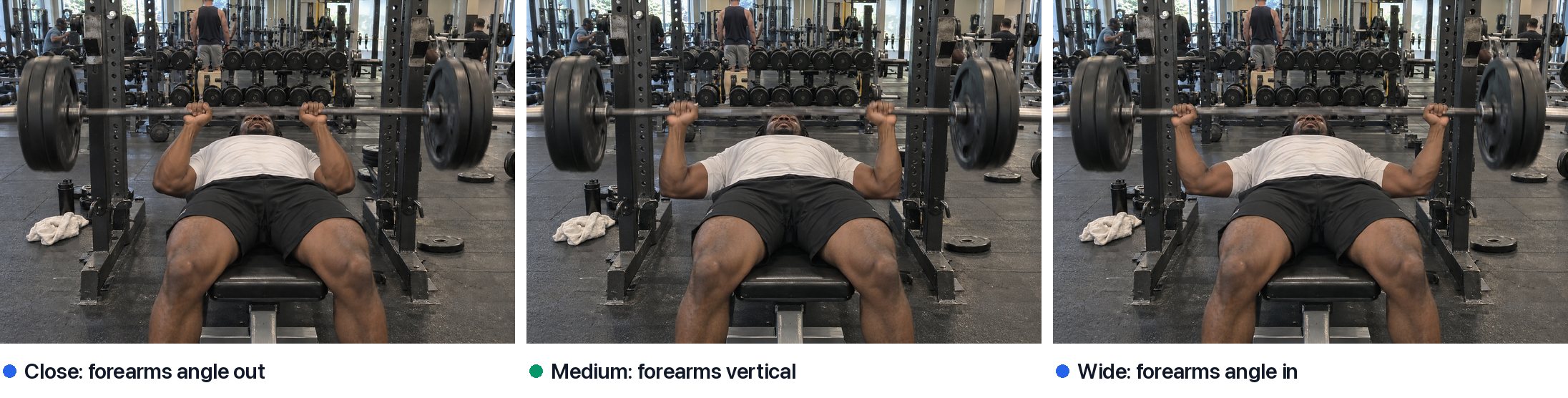
Medium. With a medium grip, your forearms are vertical at the bottom. Most people pick a medium grip when they first bench, and it gives all the muscles around the shoulder a share of the work.14 For building muscle, Greg Nuckols suggests a moderate grip as a default, which for most people puts the little fingers around the rings. It gives a slightly longer range of motion than a wide grip.15
Close. A close grip makes the bar travel further3 and gives your triceps more of the work.4 Most lifters press less with it. In a study of 14 trained men, maxes with a shoulder-width grip were about 5% lower than with medium or wide grips.16 Nuckols notes that a close grip may also be rougher on the elbows.15
The close-grip bench press is a separate exercise, used to build strength at lockout.17 For it, bring your hands only a little closer than your normal grip, no closer than push-up width with your elbows tucked.18
Your strongest grip right now is probably the one you've used most, so give a new width time. To try one, work up to about 80% of your max with your usual grip. Then do two or three singles with your hands 1 to 2 inches wider, and two or three 1 to 2 inches closer. If one feels nearly as strong, use it for about half your pressing for a month or two, and keep it if you get stronger with it.15
Bench press wide grip: what it changes
A wide grip shortens the press. In that study of 14 trained men, a grip of about 1.7 times shoulder width moved the bar the shortest distance of the three grips.3 Your touch point also moves a little higher on your chest, which makes the press a bit easier on the front of your shoulders.15 Most world-class bench pressers use a wide grip, many of them at the 81 cm limit,15 but a wide grip takes practice before it feels strong.14
A wide grip bench press works the same muscles as any bench press: your chest, front shoulders and triceps.2 The balance shifts, though. In theory, the wider your grip, the more of the load falls on your chest,19 and the less work your triceps do before lockout.9 When researchers measured muscle activity, chest activity stayed about the same across grip widths, while triceps activity was lower with a wide grip.20
A wide grip bends your wrists more toward your thumbs.21 If your wrists hurt on the thumb side, bring your grip in a little.22 If any grip makes your shoulders hurt, change the width, shorten the range of motion or reduce the load until it's pain-free.23
See a doctor or physical therapist if shoulder pain gets worse, hasn't improved after two weeks, or makes it very hard to move your arm. Get urgent advice for sudden or very bad pain, an arm you can't move, a shoulder that has changed shape or is badly swollen, pins and needles that don't go away, or pain that started after an injury.24
Grip width in powerlifting
In IPF competition, your hands can be no more than 81 cm apart, measured between your index fingers. Both index fingers must be inside the 81 cm marks, and at the widest grip they must touch the marks. A reverse grip isn't allowed.25 Competition bars carry machined marks 81 cm apart for this.26 Your thumbs must wrap around the bar.27
The limit only matters if you'd grip wider than 81 cm. If you compete in another federation, check its rulebook before the meet.
See how your grip affects your press
Your grip is hard to judge while you bench, because your eyes stay on the ceiling, not the bar.28 Film one set from the side at bench height, with your wrists, the bar and your chest clear of the plates. CueForm doesn't measure grip width, but it shows what your grip does to your press: whether your wrists bent back, where the bar traveled and whether it reached your chest. Check your bench press from one video.
The barbell bench press guide covers the rest of the lift.
FAQ
How wide should your arms be on a bench press?
Wide enough that your forearms are vertical with the bar on your chest, seen from your feet and from the side.7 Your elbows then sit directly under the bar. On the way down, keep your upper arms around 45 to 60 degrees from your torso, tucked enough that the bar touches your lower chest.29
What is the ideal grip width for bench press?
It depends on your goal. Start where your forearms are vertical at the bottom, which for most people is 22 to 24 inches (56 to 61 cm) between the index fingers.1 For building muscle, Nuckols suggests a moderate grip. For the heaviest single, most top bench pressers grip wide, near the 81 cm limit.15
Is wide grip bench easier?
Easier than a close grip, but not clearly easier than a medium one. In one study, trained men's maxes with wide and medium grips were almost the same, and about 5% higher than with a shoulder-width grip.16 A second study found the same pattern for six-rep maxes.30 A wide grip shortens the press,3 but it takes practice.14
Is the thumbless grip safe?
No. Without your thumbs around it, the bar is only balanced on your palms, over your face and throat, with nothing securing it in your hands.12 Keep your thumbs wrapped around the bar on the bench press. IPF rules require a thumbs-around grip.27
Sources
-
Rippetoe M. Starting Strength: Basic Barbell Training, 3rd edition. The Aasgaard Company, 2011. Chapter 5, "Learning to Bench Press", p. 185. ↩
-
Caulfield S, Berninger D. Exercise technique for free weight and machine training. In: Haff GG, Triplett NT, eds. Essentials of Strength Training and Conditioning, 4th edition. Human Kinetics, 2016. Chapter 15, "Flat Barbell Bench Press", p. 371. ↩
-
Larsen S, Gomo O, van den Tillaar R. A biomechanical analysis of wide, medium, and narrow grip width effects on kinematics, horizontal kinetics, and muscle activity on the sticking region in recreationally trained males during 1-RM bench pressing. Frontiers in Sports and Active Living, 2021; 2: 637066. Results, "Barbell kinematics" (vertical displacement). ↩
-
Nuckols G. How to bench press: the definitive guide. Stronger by Science, updated 2023. Section 3, "Biomechanics: Elbow extension". ↩
-
Rippetoe M. Starting Strength: Basic Barbell Training, 3rd edition. The Aasgaard Company, 2011. Chapter 5, "Hands and grip", p. 191. ↩
-
Rippetoe M. Starting Strength: Basic Barbell Training, 3rd edition. The Aasgaard Company, 2011. Chapter 5, "Learning to Bench Press", p. 184. ↩
-
Rippetoe M. Starting Strength: Basic Barbell Training, 3rd edition. The Aasgaard Company, 2011. Chapter 5, "Elbows", Figure 5-13, p. 194. ↩
-
Rippetoe M. Starting Strength: Basic Barbell Training, 3rd edition. The Aasgaard Company, 2011. Chapter 5, "The Bench Press", p. 183. ↩
-
Rippetoe M. Starting Strength: Basic Barbell Training, 3rd edition. The Aasgaard Company, 2011. Chapter 5, "Hands and grip", p. 192. ↩
-
Rippetoe M. Starting Strength: Basic Barbell Training, 3rd edition. The Aasgaard Company, 2011. Chapter 5, "Learning to Bench Press", pp. 185–186. ↩
-
Nuckols G. How to bench press: the definitive guide. Stronger by Science, updated 2023. Section 2, "Setup: Unracking". ↩
-
Rippetoe M. Starting Strength: Basic Barbell Training, 3rd edition. The Aasgaard Company, 2011. Chapter 5, "Hands and grip", pp. 189–190. ↩
-
Rippetoe M. Starting Strength: Basic Barbell Training, 3rd edition. The Aasgaard Company, 2011. Chapter 5, "Hands and grip", pp. 190–191. ↩
-
Rippetoe M. Starting Strength: Basic Barbell Training, 3rd edition. The Aasgaard Company, 2011. Chapter 5, "Hands and grip", p. 193. ↩
-
Nuckols G. How to bench press: the definitive guide. Stronger by Science, updated 2023. Section 4, "How do I choose a grip width? What are the pros and cons to each?". ↩
-
Larsen S, Gomo O, van den Tillaar R. A biomechanical analysis of wide, medium, and narrow grip width effects on kinematics, horizontal kinetics, and muscle activity on the sticking region in recreationally trained males during 1-RM bench pressing. Frontiers in Sports and Active Living, 2021; 2: 637066. Abstract and Results (1-RM by grip width). ↩
-
Austin D, Mann B. Powerlifting: The Complete Guide to Technique, Training, and Competition, 2nd edition. Human Kinetics, 2022. Chapter 5, "Close-Grip Bench Press", p. 92. ↩
-
Helms E, Morgan A, Valdez A. The Muscle and Strength Pyramid: Training, 2nd edition. Muscle and Strength Pyramids, 2019. "Sample Programs: Bench Press Variants", p. 216. ↩
-
Nuckols G. How to bench press: the definitive guide. Stronger by Science, updated 2023. Section 3, "Biomechanics: Horizontal flexion". ↩
-
Saeterbakken AH, Stien N, Pedersen H, Solstad TEJ, Cumming KT, Andersen V. The effect of grip width on muscle strength and electromyographic activity in bench press among novice- and resistance-trained men. International Journal of Environmental Research and Public Health, 2021; 18(12): 6444. Muscle activity by grip width. ↩
-
Nuckols G. How to bench press: the definitive guide. Stronger by Science, updated 2023. Section 1, "Anatomy: Wrist". ↩
-
Nuckols G. How to bench press: the definitive guide. Stronger by Science, updated 2023. Section 4, "What should I do about wrist pain?". ↩
-
Helms E, Morgan A, Valdez A. The Muscle and Strength Pyramid: Training, 2nd edition. Muscle and Strength Pyramids, 2019. "Adherence", p. 21. ↩
-
NHS. Shoulder pain. Reviewed May 2023. ↩
-
International Powerlifting Federation. Technical Rulebook, section 4.2, rule 5. Effective 1 March 2026. ↩
-
International Powerlifting Federation. Technical Rulebook, section 2.3, "Bars and discs", item (a) 6. Effective 1 March 2026. ↩
-
International Powerlifting Federation. Technical Rulebook, section 4.2, rule 2. Effective 1 March 2026. ↩
-
Rippetoe M. Starting Strength: Basic Barbell Training, 3rd edition. The Aasgaard Company, 2011. Chapter 5, "Learning to Bench Press", p. 187. ↩
-
Nuckols G. How to bench press: the definitive guide. Stronger by Science, updated 2023. Section 4, "How much should I tuck my elbows?". ↩
-
Saeterbakken AH, Stien N, Pedersen H, Solstad TEJ, Cumming KT, Andersen V. The effect of grip width on muscle strength and electromyographic activity in bench press among novice- and resistance-trained men. International Journal of Environmental Research and Public Health, 2021; 18(12): 6444. Six-repetition maximum loads by grip width. ↩