Bench Press Arch: Should You Arch Your Back When You Bench?
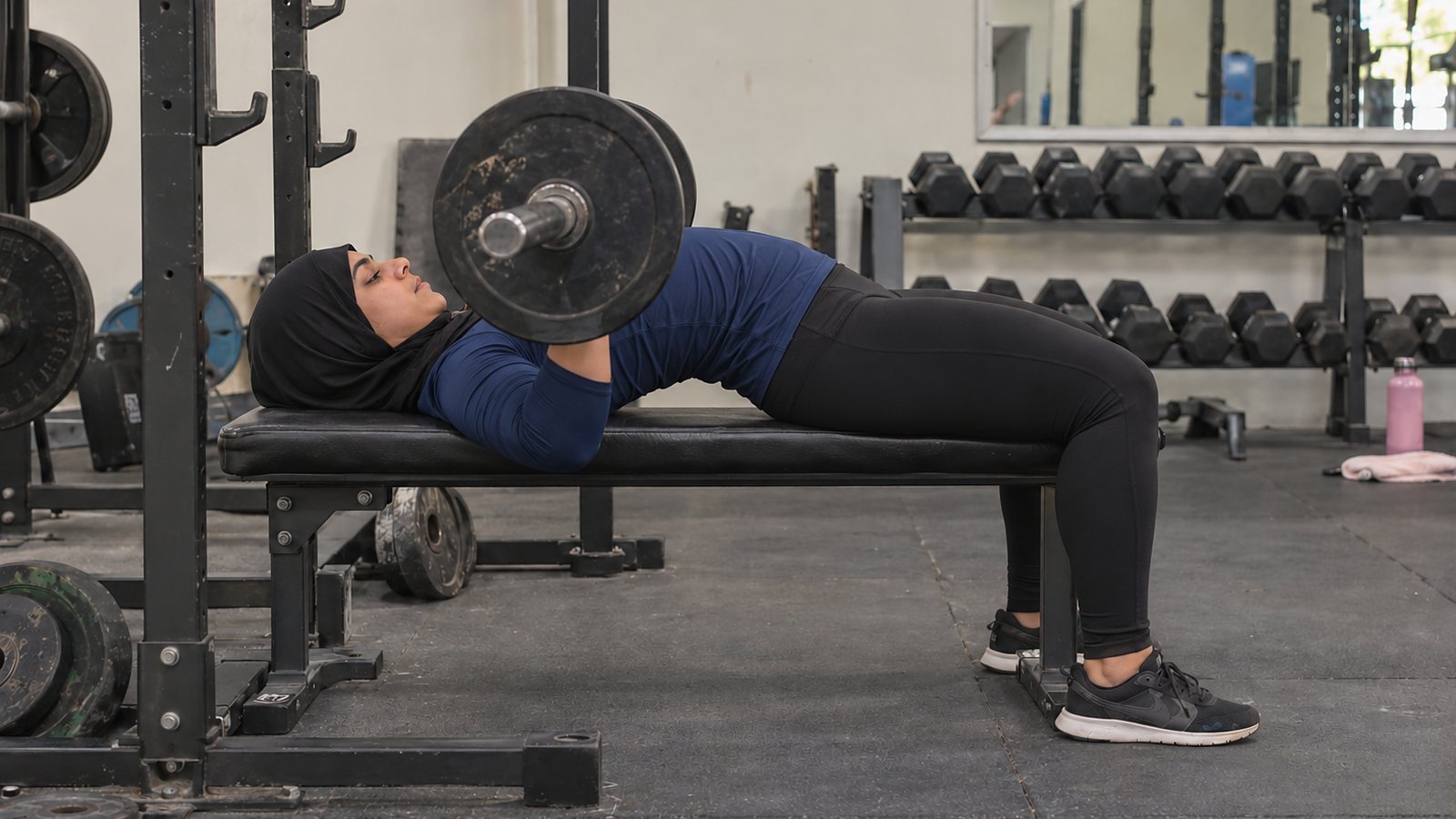
A bench press arch is lifting your chest and pulling your shoulder blades back and down so your back curves off the bench, while your head, shoulders and hips stay down.1 It's a technique choice with limits, not a requirement.
Should you arch your back when benching?
You don't have to. Powerlifters often bench with an arch because it shortens the distance the bar travels,2 and Greg Nuckols recommends that most people arch at least a little.3 A flat back is a sound choice too. Austin and Mann's powerlifting guide teaches a straight-line bench press set up with little to no arch.4
So are you supposed to arch your back when bench pressing? If you want to lift the most weight, a moderate arch helps.5 If you're learning the lift, training mainly for muscle or working around a sore back, a flatter back makes sense. Either way, the back arch during bench press should stay the same from the first rep to the last.6
Why do people arch their back when bench pressing?
Lifting your chest does three things:
- It shortens the press. As your rib cage rotates up, the bar has less distance to travel.7 In a study of 15 trained lifters, most of them competitive powerlifters, the bar traveled 3 to 5 cm less with an arched back than with a flat one.8
- It steadies your upper back. With your shoulder blades pulled together, your upper back makes a flat, solid platform to push against the bench.9 The more of your back is on the bench, the more of your force reaches the bar.10
- It puts your shoulders in a better position. As your chest rises, your shoulders rotate back under the bar, which shortens the lever between the bar and your shoulders.11 In a study of 20 experienced lifters, a standard flat-back press put about 8% more load on the shoulders over each lift than the arched technique.12
Is arching bad for your back?
Not necessarily. Most of the height that lifts your chest comes from extending your upper back, not your lower (lumbar) spine.13 In a small study of 18 powerlifters, arch height wasn't linked to a history of back pain.14 If arching hurts, flatten it.
Getting your chest higher is why an arch works, so push your chest up rather than only arching your lower back.15
A tight arch can make your back or hips cramp, especially while it's new. If you aren't benching to lift as much as possible, a slightly looser set-up usually stops it.16
If arching hurts, don't push through it. Flatten your back, reduce the load or swap in a similar press that is pain-free.17 Rippetoe suggests benching with your feet up for lifters whose lower back hurts when it arches, though you'll lift less that way.18 See a doctor or physical therapist if back pain doesn't improve after a few weeks, stops your day-to-day activities or is worse at night. Get urgent help if it comes with pain, tingling, weakness or numbness in both legs, numbness around your genitals or bottom, or changes in bladder or bowel control.19
For warm-ups, spotting and other basics, see these bench press safety tips.
Flat back vs arched back bench press
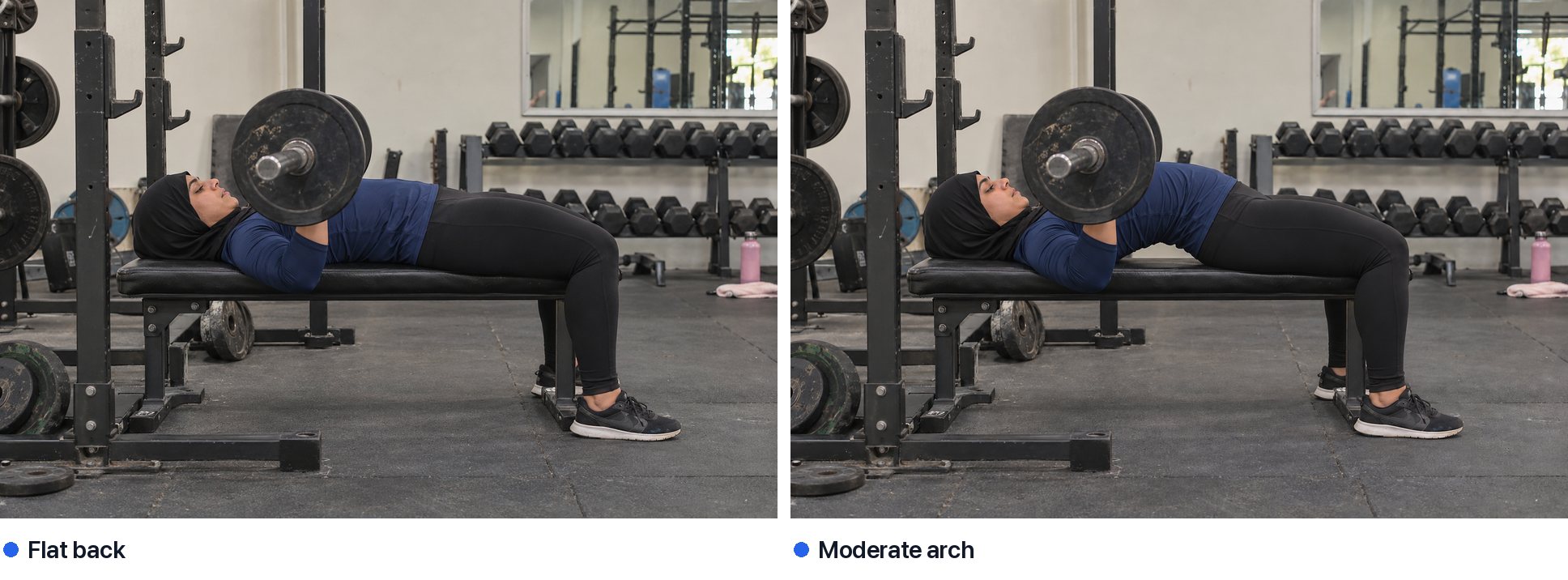
Both are good ways to bench. In that study of 15 trained lifters, the arch let them lift more,5 while the flat back moved light weights faster.20 Power output was the same with both.21 The authors suggest using both styles, depending on what you're training for.22
A flatter back makes sense if you're:
- Learning the press. Starting Strength sets new lifters up with the lower back in its natural curve, and adds the arch later.23
- Benching around back pain. If an arch hurts, a flatter set-up you can press without pain is the better choice.17
- Training mainly for muscle. A flat back gives you a longer range of motion on every rep,8 and chest muscle activity was similar with both styles.24 If lifting the most weight isn't the goal, a looser set-up is fine.16
How to arch your back on the bench press
Set the arch before you unrack, in this order.
- Set your shoulder blades. Lying under the bar, pull your shoulder blades together and down, as if pinching a hand between them.25 This puts more of your back on the bench.26
- Lift your chest. Keep your shoulder blades pinned and raise your chest toward the bar.25 Push your chest up instead of only arching your lower back.15
- Bring your feet back. Walk your feet back and out to the sides, so they land somewhere between your knees and hips. That keeps a good arch while your whole foot stays on the floor.27 Plant your heels flat.28
- Keep your hips down. Settle your hips back on the bench before you unrack. If you can't hold the arch with them down, it's too big: lifting your hips is bridging, not arching.29
- Lock it in. Take a big breath before you unrack.26 As you lower the bar, try to pull it apart to keep your upper back tight.30
The arch should look the same on every rep. If your shoulders shrug forward, the bar has further to travel on each rep, so reset your shoulder blades and chest between sets.6
Keeping your arch through the set
Leg drive holds the arch up. Your legs push along the bench toward your head, which keeps your chest high as the bar comes down.31 Three things can go wrong:
- Your hips lift off the bench. Lifting your hips shortens the press and takes work away from your chest, shoulders and triceps.29 Push the floor away toward the head of the bench as you press, and keep that push on your hardest reps instead of raising your hips.
- Your feet move. A foot slip collapses the arch your legs were holding.32 Feet tucked back with the heels up set you up to bridge the heavy reps.33 Plant both heels flat before you unrack, and keep them there.
- Your shoulders come forward. Pull the bar apart as you lower it, with your shoulder blades pinned to the bench.30
To practice holding it all, pause each rep on your chest with your whole body tight, then press without a heave. Staying tight through the pause is a skill even competitive powerlifters work on.34 On your next filmed set, check that your hips, shoulders and feet stay put from the first rep to the last.
Is arching allowed in powerlifting?
Yes. Under IPF powerlifting rules, your head, shoulders and buttocks stay on the bench, and your feet stay flat on the floor, for the whole lift.35 Raising your head, shoulders or hips, or lifting your feet, is a no lift.36 You can stand your feet on plates or blocks up to 30 cm high.37
One rule limits extreme arches. At the bottom, the undersides of your elbows must come down level with or below the tops of your shoulders.38 The IPF added that requirement in 2023, which limits how much a very big arch can shorten the press.39 If you compete in another federation, check its rulebook.
See your set-up on video
Your arch is hard to judge while you bench, because your eyes stay on the ceiling.40 Film one set from the side at bench height, with your hips, shoulders and feet clear of the rack and plates. CueForm doesn't measure your arch, but it shows whether your hips stayed on the bench and your feet stayed still, two things a good arch depends on. Check your bench press set-up from one video.
The barbell bench press guide covers the rest of the lift.
FAQ
Is arching on the bench press cheating?
No. Rippetoe treats the arch as a reasonable way to bench more, and draws the line at bridging: lifting your hips off the bench to meet the bar.41 An arch does shorten the press,8 so compare your numbers only with lifts done the same way.
Why do powerlifters arch their backs?
To lift the most weight the rules allow.2 In a study of mostly competitive powerlifters, maxes were about 4 kg higher with an arch than with a flat back, a small difference.5 A bigger arch is useful for a competitor, but it depends on how far your spine can extend, and that takes stretching to improve.13
Should I arch my back on incline bench press?
Yes. Set up the incline like the bench press: shoulder blades squeezed together, chest up, and your back arched as a brace between the seat and your shoulders.42 Keep your hips on the bench. Lifting them flattens your torso and cancels out the incline.43
How much should you arch?
Enough to lift your chest while your head, shoulders and hips stay on the bench. Rippetoe teaches the arch by imagining a hand pushed under your lower back, then a fist, with your butt still on the bench.44 Start there. A bigger arch is mostly useful to competitors.13
Sources
-
Rippetoe M. Starting Strength: Basic Barbell Training, 3rd edition. The Aasgaard Company, 2011. Chapter 5, "Elbows", p. 194. ↩
-
Bartolomei S, Caroli E, Coloretti V, Rosaci G, Cortesi M, Coratella G. Flat-back vs. arched-back bench press: examining the different techniques performed by power athletes. Journal of Strength and Conditioning Research, 2024; 38(7): 1200–1205. Introduction. ↩
-
Nuckols G. How to bench press: the definitive guide. Stronger by Science, updated 2023. Section 2, "Setup: Getting tight and getting an arch". ↩
-
Austin D, Mann B. Powerlifting: The Complete Guide to Technique, Training, and Competition, 2nd edition. Human Kinetics, 2022. Chapter 5, "Mechanics of the Straight-Line Bench Press", p. 80. ↩
-
Bartolomei S, Caroli E, Coloretti V, Rosaci G, Cortesi M, Coratella G. Flat-back vs. arched-back bench press: examining the different techniques performed by power athletes. Journal of Strength and Conditioning Research, 2024; 38(7): 1200–1205. Results, one-repetition maximum. ↩
-
Rippetoe M. Starting Strength: Basic Barbell Training, 3rd edition. The Aasgaard Company, 2011. Chapter 5, "Upper back", p. 204. ↩
-
Rippetoe M. Starting Strength: Basic Barbell Training, 3rd edition. The Aasgaard Company, 2011. Chapter 5, "The Bench Press", p. 182. ↩
-
Bartolomei S, Caroli E, Coloretti V, Rosaci G, Cortesi M, Coratella G. Flat-back vs. arched-back bench press: examining the different techniques performed by power athletes. Journal of Strength and Conditioning Research, 2024; 38(7): 1200–1205. Results, barbell displacement. ↩
-
Rippetoe M. Starting Strength: Basic Barbell Training, 3rd edition. The Aasgaard Company, 2011. Chapter 5, "Upper back", p. 202. ↩
-
Austin D, Mann B. Powerlifting: The Complete Guide to Technique, Training, and Competition, 2nd edition. Human Kinetics, 2022. Chapter 5, "Principles for All Styles of Bench Press", p. 79. ↩
-
Rippetoe M. Starting Strength: Basic Barbell Training, 3rd edition. The Aasgaard Company, 2011. Chapter 5, "Elbows", p. 196. ↩
-
Cudlip AC, Maciukiewicz JM, Pinto BL, Dickerson CR. Upper extremity muscle activity and joint loading changes between the standard and powerlifting bench press techniques. Journal of Sports Sciences, 2022; 40(9): 1055–1063. ↩
-
Nuckols G. How to bench press: the definitive guide. Stronger by Science, updated 2023. Section 4, "How can I improve my arch?". ↩
-
Marotta N, de Sire A, Bartalotta I, et al. Role of the flexion relaxation phenomenon in the analysis of low back pain risk in the powerlifter: a proof-of-principle study. Journal of Sport Rehabilitation, 2024; 33(5): 333–339. ↩
-
Nuckols G. How to bench press: the definitive guide. Stronger by Science, updated 2023. Section 2, "Setup: Getting tight and getting an arch" (push the chest up, not only the lower back). ↩
-
Nuckols G. How to bench press: the definitive guide. Stronger by Science, updated 2023. Section 4, "What should I do about my back/hips cramping?". ↩
-
Helms E, Morgan A, Valdez A. The Muscle and Strength Pyramid: Training, 2nd edition. Muscle and Strength Pyramids, 2019. "Adherence", p. 21. ↩
-
Rippetoe M. Starting Strength: Basic Barbell Training, 3rd edition. The Aasgaard Company, 2011. Chapter 5, "Feet", p. 210. ↩
-
Bartolomei S, Caroli E, Coloretti V, Rosaci G, Cortesi M, Coratella G. Flat-back vs. arched-back bench press: examining the different techniques performed by power athletes. Journal of Strength and Conditioning Research, 2024; 38(7): 1200–1205. Results, mean and peak barbell velocity. ↩
-
Bartolomei S, Caroli E, Coloretti V, Rosaci G, Cortesi M, Coratella G. Flat-back vs. arched-back bench press: examining the different techniques performed by power athletes. Journal of Strength and Conditioning Research, 2024; 38(7): 1200–1205. Results, mean and peak power. ↩
-
Bartolomei S, Caroli E, Coloretti V, Rosaci G, Cortesi M, Coratella G. Flat-back vs. arched-back bench press: examining the different techniques performed by power athletes. Journal of Strength and Conditioning Research, 2024; 38(7): 1200–1205. Practical applications. ↩
-
Rippetoe M. Starting Strength: Basic Barbell Training, 3rd edition. The Aasgaard Company, 2011. Chapter 5, "Learning to Bench Press", p. 185. ↩
-
Bartolomei S, Caroli E, Coloretti V, Rosaci G, Cortesi M, Coratella G. Flat-back vs. arched-back bench press: examining the different techniques performed by power athletes. Journal of Strength and Conditioning Research, 2024; 38(7): 1200–1205. Results, muscle excitation of the pectoralis major. ↩
-
Rippetoe M. Starting Strength: Basic Barbell Training, 3rd edition. The Aasgaard Company, 2011. Chapter 5, "Upper back", p. 203. ↩
-
Austin D, Mann B. Powerlifting: The Complete Guide to Technique, Training, and Competition, 2nd edition. Human Kinetics, 2022. Chapter 5, "Mechanics of the Straight-Line Bench Press", p. 80. ↩
-
Nuckols G. How to bench press: the definitive guide. Stronger by Science, updated 2023. Section 2, "Setup: Foot position". ↩
-
Rippetoe M. Starting Strength: Basic Barbell Training, 3rd edition. The Aasgaard Company, 2011. Chapter 5, "Feet", p. 209. ↩
-
Rippetoe M. Starting Strength: Basic Barbell Training, 3rd edition. The Aasgaard Company, 2011. Chapter 5, "Lower back, hips, and legs", p. 207. ↩
-
Austin D, Mann B. Powerlifting: The Complete Guide to Technique, Training, and Competition, 2nd edition. Human Kinetics, 2022. Chapter 5, "Performing the Straight-Line Bench Press", p. 81. ↩
-
Rippetoe M. Starting Strength: Basic Barbell Training, 3rd edition. The Aasgaard Company, 2011. Chapter 5, "Lower back, hips, and legs", pp. 206–207. ↩
-
Rippetoe M. Starting Strength: Basic Barbell Training, 3rd edition. The Aasgaard Company, 2011. Chapter 5, "Feet", p. 208. ↩
-
Rippetoe M. Starting Strength: Basic Barbell Training, 3rd edition. The Aasgaard Company, 2011. Chapter 5, "Feet", p. 209. ↩
-
Rippetoe M. Starting Strength: Basic Barbell Training, 3rd edition. The Aasgaard Company, 2011. Chapter 5, p. 201. ↩
-
International Powerlifting Federation. Technical Rulebook, section 4.2, rule 2. Effective 1 March 2026. ↩
-
International Powerlifting Federation. Technical Rulebook, section 4.2.1, rules 2 and 9. Effective 1 March 2026. ↩
-
International Powerlifting Federation. Technical Rulebook, section 4.2, rule 3. Effective 1 March 2026. ↩
-
International Powerlifting Federation. Technical Rulebook, section 4.2, rule 8, and section 4.2.1, rule 11. Effective 1 March 2026. ↩
-
Bartolomei S, Caroli E, Coloretti V, Rosaci G, Cortesi M, Coratella G. Flat-back vs. arched-back bench press: examining the different techniques performed by power athletes. Journal of Strength and Conditioning Research, 2024; 38(7): 1200–1205. Introduction (the 2023 IPF elbow rule). ↩
-
Rippetoe M. Starting Strength: Basic Barbell Training, 3rd edition. The Aasgaard Company, 2011. Chapter 5, "Learning to Bench Press", p. 187. ↩
-
Rippetoe M. Starting Strength: Basic Barbell Training, 3rd edition. The Aasgaard Company, 2011. Chapter 5, "Lower back, hips, and legs", p. 207. ↩
-
Rippetoe M. Starting Strength: Basic Barbell Training, 3rd edition. The Aasgaard Company, 2011. Chapter 7, "Bench Press Variations", pp. 312–313. ↩
-
Rippetoe M. Starting Strength: Basic Barbell Training, 3rd edition. The Aasgaard Company, 2011. Chapter 7, "Bench Press Variations", p. 311. ↩
-
Rippetoe M. Starting Strength: Basic Barbell Training, 3rd edition. The Aasgaard Company, 2011. Chapter 5, "Lower back, hips, and legs", pp. 207–208 and Figure 5-26. ↩