AI vs. Wearables: Best for Strength Training Metrics?
AI platforms outperform wearables for tracking strength training metrics. Here's why:
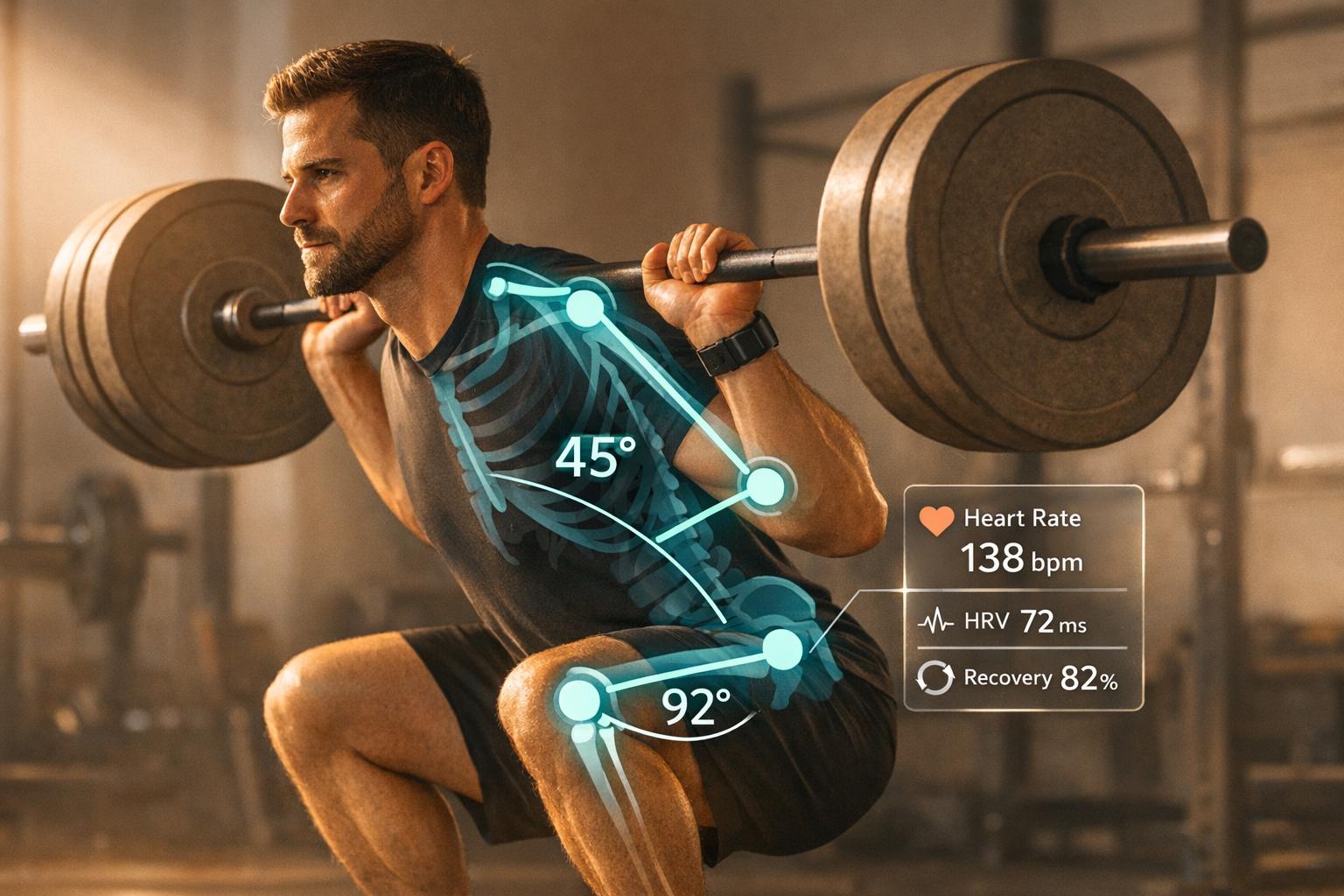
- AI platforms use video analysis to provide real-time feedback on form, joint angles, and movement quality. They excel at preventing injuries by identifying risky patterns and offering actionable advice for improving technique.
- Wearables focus on internal metrics like heart rate, recovery, and muscle fatigue using sensors. While convenient, they struggle with complex lifts and cannot analyze detailed biomechanics.
Key Takeaways:
- AI is best for refining technique and reducing injury risk.
- Wearables are better for tracking recovery and physiological data.
- Combining both tools offers the most complete picture of performance.
Quick Comparison:
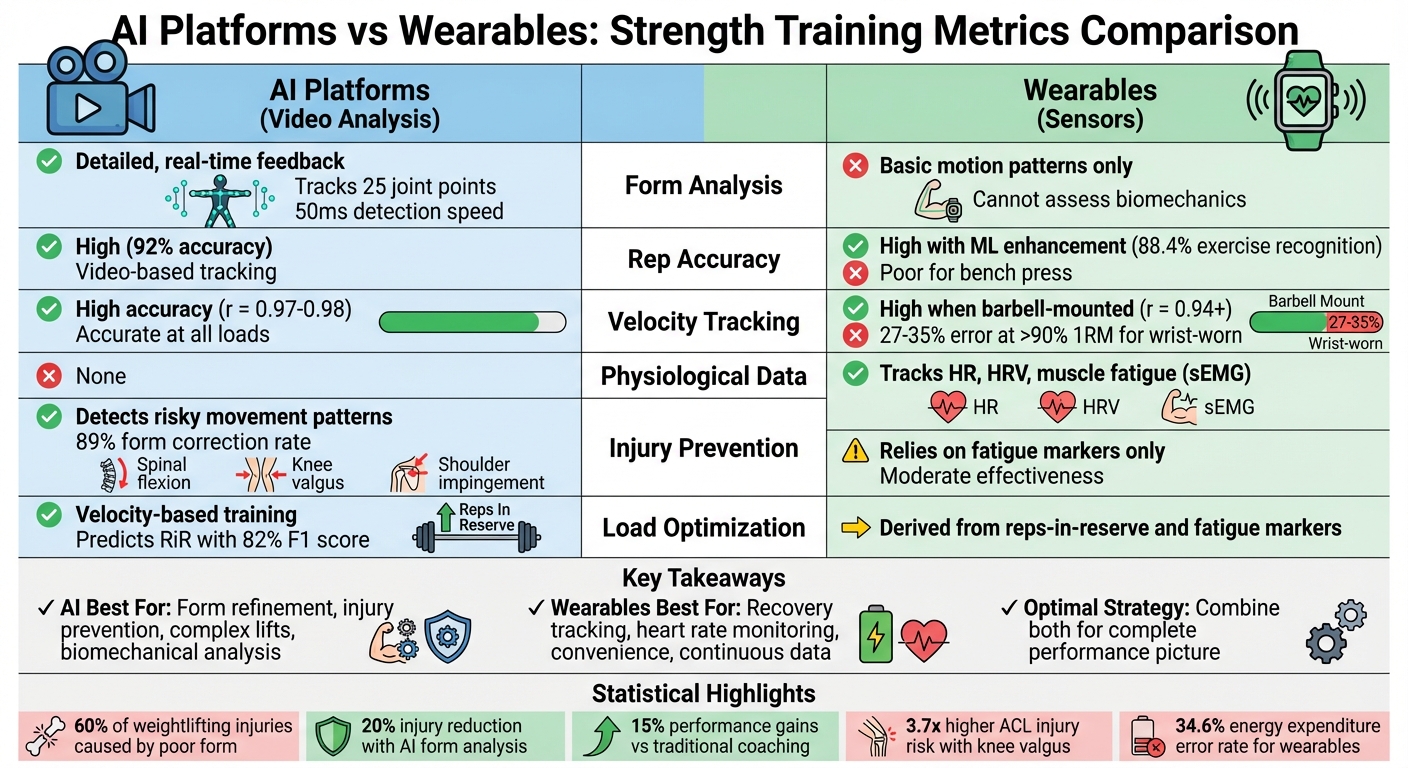
| Metric | AI Platforms (Video) | Wearables (Sensors) |
|---|---|---|
| Form Analysis | Detailed, real-time feedback | Limited, basic motion tracking |
| Rep Accuracy | High | High, but varies by exercise |
| Velocity Tracking | Accurate for all loads | Inconsistent at high weights |
| Physiological Data | None | Tracks HR, HRV, muscle fatigue |
| Injury Prevention | Detects risky movement patterns | Relies on fatigue markers |
If you prioritize safety and technique, AI platforms like CueForm AI are the clear choice. Wearables add value for recovery and overall fitness monitoring. Together, they provide a well-rounded approach to strength training.
AI Platforms vs Wearables for Strength Training: Complete Metric Comparison
How AI Platforms Track Strength Training Metrics
Video-Based Form Analysis
AI platforms like CueForm AI utilize computer vision to meticulously evaluate your lifting technique. By uploading or recording a video of exercises like squats, bench presses, or deadlifts, the system analyzes your movements frame by frame. Pose estimation technology identifies joint positions and calculates critical angles. Advanced platforms take it a step further, sampling 5–10 frames per rep and using AI models to assess movement quality [7].
These systems tailor their analysis to align with your training goals. For instance, the squat depth considered ideal for Olympic lifting (a deep "ass-to-grass" position) differs from the "hip crease below knee" standard used in powerlifting. To ensure safety, the platform assigns a score ranging from 0 to 100, deducting points for issues like –30 for excessive spinal flexion or –10 for slight heel lift. A score below 70 suggests reviewing your form, while anything under 50 indicates you should reduce weight or seek professional coaching [7].
Instead of overwhelming you with technical data, these platforms provide actionable feedback. For example, rather than pointing out an incorrect knee angle, the system might suggest cues like "spread the floor with your feet" to address knee valgus. It can even differentiate between technique flaws and mobility restrictions, such as identifying that lifting your heels during squats might stem from limited ankle dorsiflexion [7].
This level of detailed analysis highlights AI's potential to play a larger role in injury prevention.
Personalized Feedback for Injury Prevention
One of the standout features of AI platforms is their ability to identify risky movement patterns before they lead to injuries. They can detect issues like excessive spinal flexion (a common cause of disc injuries), knee valgus collapse (which stresses the ACL and MCL), and shoulder impingement. This early warning system is especially valuable, given that poor form accounts for 60% of weightlifting injuries among high school athletes [7][8][10].
In team settings, even experienced coaches can only monitor a fraction of athletes at a time. As Zach Lush, a certified functional strength coach, notes:
"In a team setting, I can watch maybe 5-6 athletes closely during a lift session. The rest? I'm catching major breakdowns at best. The athletes who need the most eyes on them... are often the ones training alone." [7]
AI bridges this gap by acting as "scalable eyes", providing consistent oversight for every rep. Studies show that AI-based form analysis can reduce injury rates by 20% and boost performance gains by 15% compared to traditional coaching. For example, athletes with dynamic valgus (knees caving inward) are 3.7 times more likely to experience ACL injuries than those with neutral knee alignment [7].
Progress and Goal Tracking
Beyond form analysis, AI platforms track your progress over time, monitoring key metrics like range of motion, bar path, and rep tempo. If the system detects a decline in these areas, it might recommend adjusting your training - such as a form-focused deload. For instance, if your rep tempo varies by more than 25%, it could indicate central nervous system (CNS) fatigue, signaling that it’s time to wrap up your session [7].
These platforms also allow for interactive coaching. You can consult an AI coach to ask follow-up questions, fine-tune your technique, or refine your overall training strategy. By combining detailed tracking with personalized advice, AI helps you stay on track toward your fitness goals.
How Wearables Track Strength Training Metrics
Sensor-Based Tracking
Wearable devices use Inertial Measurement Units (IMUs) - a combination of tri-axial accelerometers and gyroscopes - to capture movement during strength training exercises. These sensors measure acceleration, angular velocity, and orientation, turning raw data into actionable insights [11][12].
The process begins with workout segmentation. For example, systems like LiftRight use signal processing to break a session into sets and individual repetitions by identifying "V-like" patterns in movement angles. Key metrics are then calculated:
- Repetitions: Detected through peaks and troughs in orientation data.
- Range of Motion (ROM): Measured as the angular distance a limb travels during each lift phase.
- Velocity: Determined by dividing ROM by the time spent in that phase.
This velocity data enables Velocity-Based Training (VBT), allowing athletes to adjust loads in real time based on daily performance [12]. LiftRight and similar systems excel at dividing workouts into sets and repetitions, reliably identifying key phases of movement.
In addition to tracking motion, wearables monitor the body's physiological responses. Sensors like Photoplethysmography (PPG) and Electrocardiography (ECG) measure heart rate and heart rate variability (HRV) to assess intensity and recovery status. Meanwhile, surface electromyography (sEMG) tracks muscle activity, helping to detect fatigue by analyzing shifts in the power spectrum [5][6].
However, while these sensors are effective for simpler movements, their accuracy diminishes with more complex exercises.
Performance with Complex Lifts
When it comes to multi-joint, complex exercises, wearables face notable challenges. As Slobodan Milanko from Old Dominion University explains:
"The primary challenge in accurately monitoring weight training performance lies in the complex nature of various muscle involvement and body movement." [12]
Sensor placement becomes a critical factor. Wrist-worn devices, for instance, are less accurate than sensors attached directly to equipment like barbells when measuring movement velocity during exercises such as squats [13]. Complex, full-body movements lack the uniformity of cardio exercises, making it harder for wearables to capture precise data. Proper sensor positioning is essential to target specific muscle groups, but even then, analyzing form or technique remains a limitation. Wearables cannot identify biomechanical issues like poor back alignment or improper knee positioning during lifts [12][16]. Carol Maher, a professor at the University of South Australia, highlights this issue:
"One downside is that the devices are not accurate for certain types of activities, such as lifting weights and yoga, which can lead to frustration." [16]
Another hurdle is energy expenditure tracking during resistance training. For example, the Polar Vantage V showed a mean absolute percentage error (MAPE) of 34.6% ± 32.6% in energy expenditure estimates. A systematic review of 42 wearables found that MAPE exceeded 30% across all brands [15]. Additionally, PPG sensors often struggle with accuracy during heavy lifting due to motion artifacts caused by intense physical movements [5][14].
Health & Fitness In 2026: AI, GLP-1s, Wearables And What Actually Matters
AI vs. Wearables: Comparing Key Metrics
This section dives into a side-by-side comparison of AI platforms and wearables in tracking strength training metrics. While both technologies measure performance, they do so in distinct ways. AI systems rely on video analysis through a phone's camera, while wearables use sensors on the wrist or barbell to gather data. These differences shape the kind of insights each method provides.
Take repetition counting, for instance. Both systems perform well, though accuracy varies depending on the exercise. Wearables, however, can falter in some cases. A study showed smartwatch apps correctly identified exercises in 88.4% of sets, but accuracy dropped significantly for bench press repetition counts [19]. On the other hand, AI models employing gradient-boosted classifiers can deliver real-time feedback on exercise form [3].
Now let’s talk velocity tracking, another key metric. The PowerLift app demonstrated an impressive correlation (0.97–0.98) with gold-standard linear transducers when measuring barbell velocity during squats and bench presses [2]. Wearables, when mounted directly on the barbell, can achieve similar accuracy - like the Beast sensor, which also showed a correlation of r = 0.97–0.98. However, wrist-worn devices often show greater variability, with error rates spiking to 27–35% at loads above 90% of a lifter's one-rep max [17].
Form analysis is where AI platforms shine. Using computer vision, these systems monitor joint angles and range of motion, flagging errors like "bad range" or "too fast" movements [3]. Wearables, in contrast, can only track basic motion patterns and lack the capability to assess detailed biomechanical issues. As researchers William Coates and Johan Wahlström from the University of Exeter observed:
"Nearly all commercially available resistance tracking apps only record trivial data... a level of functionality not far from that of a pen and paper" [4].
AI systems take this further by using supervised machine learning to classify form as "Good" or "Poor" without requiring multiple sensors [3].
Comparison Table: AI vs. Wearables
Here’s a quick breakdown of how AI platforms and wearables stack up:
| Metric | AI Platforms (Video/App) | Wearables (IMU/Sensors) | Accuracy Insight |
|---|---|---|---|
| Rep Accuracy | High (video-based) | High (ML-enhanced) | AI models achieve ~92% accuracy [18] |
| Form Analysis | Detailed (computer vision) | Basic (motion patterns) | AI identifies errors like "bad range" [3] |
| Velocity | High (r = 0.97+) | High (r = 0.94+) | Wearables struggle at >90% 1RM [17] |
| Load Optimization | Based on velocity loss | Derived from reps-in-reserve and fatigue markers | AI predicts RiR with ~82% F1 score [18] |
| Physiological Data | None | HR, HRV, sEMG | Wearables track recovery metrics [1] |
| Injury Prediction | High (form deviation) | Moderate (fatigue markers) | AI detects "unnatural movement" [3] |
Wearables excel at tracking physiological data - like heart rate, heart rate variability, and muscle fatigue through surface electromyography (sEMG) [1]. Meanwhile, AI platforms focus on external movement patterns to catch errors before they lead to injury. For example, a December 2025 study revealed that a neural network running on an iPhone 16 could accurately predict "Repetitions in Reserve" (RiR) with an F1 score of 0.82. This system even provided haptic feedback when users approached failure, all with an inference latency of just 23.5 milliseconds [18].
Platforms like CueForm AI highlight how video-based analysis can deliver detailed, personalized feedback, helping users improve performance while reducing the risk of injury.
Strengths and Limitations of Each Approach
AI Platforms: Precision and Personalization
AI platforms use vision-based systems to track 25 joint points in real time, analyzing angles, velocities, and center-of-mass displacement to pinpoint exactly where your form falters [20]. These systems are impressively fast, detecting deviations within 50 milliseconds. For example, they can identify the exact moment lumbar flexion begins during a squat descent [18][20].
The feedback you get is not just numbers - it’s actionable advice. Instead of vague data, you might receive cues like, "Shift your weight back" or "Knee valgus exceeds 15°" [20]. One study showed that novice lifters using AI feedback corrected 89% of measurable joint deviations over eight weeks, compared to just 37% for those relying on mirrors [20]. Dr. Lena Torres, a biomechanist at the University of Colorado, highlights this advantage:
"AI mirrors don't teach form - they teach form awareness. They make the invisible visible: the millisecond delay between hip extension and knee lockout, the subtle pelvic rotation during overhead press." [20]
That said, these platforms do have limitations. Proper camera positioning is crucial for accurate feedback. While platforms like CueForm AI let users upload videos from their phones, recording during high-intensity workouts can be inconvenient. This is where wearables come into play, offering a different approach.
Wearables: Accessibility and Continuous Monitoring
Wearables excel in convenience and real-time tracking. By simply wearing a smartwatch or attaching a sensor to your equipment, you eliminate the need for elaborate camera setups or video uploads. These devices also track recovery metrics like heart rate and variability [1], making them versatile tools for monitoring progress.
The technology has come a long way. For instance, a smartwatch-based system demonstrated 88.4% accuracy in recognizing specific strength exercises across 363 sets [19]. Some wearables even integrate AI models to predict Repetitions in Reserve (RiR) in real time, achieving an F1 score of 0.82, and provide haptic feedback when you're nearing failure [18].
However, wearables face challenges with complex movements. Exercises that involve mainly translational wrist motion, like the shoulder press, can reduce accuracy [3]. When tracking mean velocity with heavy loads above 90% of 1RM, accelerometer-based wearables show error rates between 27% and 35% [17]. One study found that while wearables accurately counted reps for squats and deadlifts, their performance for bench press reps was poor (p = 0.01) [19]. This highlights the trade-off between precision and ease of use.
Conclusion: Which is Best for Strength Training Metrics?
AI platforms are the frontrunners when it comes to strength training metrics. If you're aiming to refine your form, prevent injuries, and perfect complex lifts, video-based analysis offers a level of precision that's hard to beat. Tools like CueForm AI analyze full-body biomechanics, detect subtle compensation patterns, and provide actionable insights - capabilities that wearables simply can't replicate. Research shows that many gym injuries stem from form errors [3], underscoring the importance of accurate form analysis for safe and effective training.
While AI platforms shine in biomechanical tracking, wearables have their strengths in monitoring internal load. They excel at tracking metrics like heart rate, heart rate variability, and recovery status - areas where AI platforms typically fall short [6]. However, wearables struggle with exercises that require detailed biomechanical feedback. Their limitations become apparent with complex, multi-joint movements, where accuracy often drops. This gap highlights why biomechanical analysis should take precedence in strength training.
Experts back these findings:
"AI-driven tracking systems use advanced computer vision and AI techniques to thoroughly analyze video or sensor data in order to provide precise and reliable feedback on user performance." [9]
The best strategy combines both tools: use AI for detailed technique analysis and wearables to monitor cardiovascular intensity and recovery. As discussed, precise biomechanical tracking is essential for reducing injury risk and optimizing performance. For those serious about lifting and improving their training outcomes, AI platforms provide the in-depth, actionable insights needed to elevate their workouts.
FAQs
How can AI help prevent injuries during strength training?
AI platforms are transforming strength training by helping reduce the risk of injuries. These systems use advanced computer vision and machine learning to monitor your movements and analyze your exercise form. They can spot issues like poor posture, improper joint alignment, or unsafe techniques. For instance, they might catch knee valgus during squats or excessive spinal rounding in deadlifts - two common mistakes that can lead to injuries.
What sets these platforms apart is their ability to provide real-time feedback. By giving you corrective cues as you train, they help you maintain proper biomechanics and steer clear of injury-prone habits. This not only keeps you safer but also makes your workouts more effective.
Why do wearables struggle with tracking complex strength training exercises?
Wearable devices often struggle when it comes to tracking complex strength training exercises. Why? Because accurately analyzing the intricate movements involved in these workouts is no easy task. Issues like sensor placement, variations in how people move, and the inability to pick up on subtle deviations in form can all throw off their accuracy.
This lack of precision becomes a problem when trying to measure critical metrics like barbell velocity or joint angles during advanced lifts. Without reliable data, wearables fall short in offering the kind of detailed feedback athletes need to fine-tune their performance or minimize the risk of injury during high-skill exercises.
Why should you combine AI and wearables for strength training?
Combining AI with wearable technology is changing the game for strength training. Wearables monitor crucial metrics like movement patterns, speed, and fatigue, giving you real-time insights into your performance.
What makes this even better? AI steps in to analyze that data, offering customized feedback on your form, effort, and technique. This dynamic duo helps you train smarter, minimize injury risks, and get the most out of every single rep.