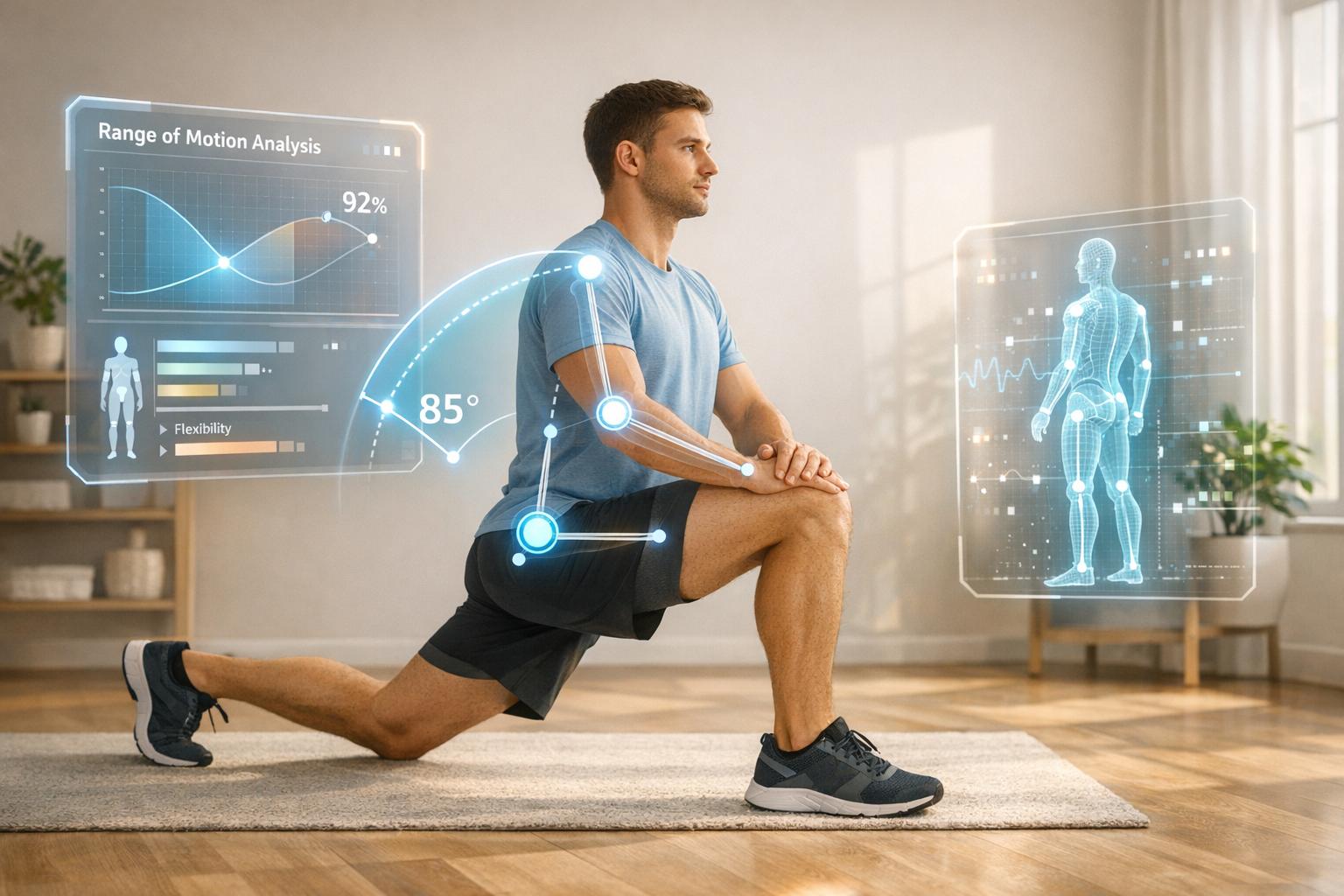
AI in Range of Motion Testing: How It Works
AI is transforming how we measure and analyze joint movement. By using computer vision and pose estimation, AI-powered tools deliver precise, objective range of motion (ROM) assessments directly from video footage. This approach eliminates manual errors, speeds up analysis, and makes advanced motion tracking affordable - accessible with just a smartphone. Key benefits include:
- Accurate Measurements: AI tracks body landmarks to calculate joint angles with high precision, rivaling costly lab systems.
- Real-Time Feedback: AI tools provide instant cues to correct form during exercises like squats or bench presses.
- Low Cost: Smartphone-based platforms cost less than 1% of traditional motion analysis systems.
- Personalized Coaching: Interactive AI coaches offer tailored guidance and track progress over time.
AI-powered ROM testing is reshaping strength training by offering fast, reliable, and affordable movement analysis for athletes and patients alike.
How AI Works in Range of Motion Testing
Computer Vision and Pose Estimation
AI determines your body’s position by identifying key landmarks on your body. Tools like Google’s MediaPipe (BlazePose) can track up to 33 body landmarks in real time, while others, such as OpenPose, focus on 18 to 25 keypoints, including joints like shoulders, elbows, hips, and knees [2][8]. Once these landmarks are identified, the AI calculates joint angles by measuring distances between key segments, such as the shoulder and elbow. It can even transform 2D video captured by a single camera into 3D space using temporal models and biomechanical constraints, enabling depth-aware movement analysis [2][7][8].
This technology processes video at speeds of over 30 frames per second, providing immediate angle measurements as you move [2][7]. For best results, wear light-colored, form-fitting clothing that contrasts with your background to improve body segmentation [2]. These precise calculations set the stage for real-time, actionable insights during your workout.
Real-Time Data Analysis and Feedback
AI systems analyze your movements as they happen. By comparing live data against biomechanical models, they can instantly spot form issues and notify you of corrections needed during exercises [8][7][6].
For example, platforms like CueForm AI (https://cueform.ai) use this technology to provide detailed feedback for exercises such as squats, bench presses, and deadlifts. You simply record or upload a video of your workout, and the system delivers specific cues to help you improve your form and reduce injury risk. It also provides precise range of motion (ROM) measurements for each joint involved in the movement.
BlazePose includes a "visibility index" (ranging from 0 to 1), which reflects the AI’s confidence in its measurements [2]. If poor lighting or an obstructed view affects the analysis, the index will drop, signaling that the data may be less accurate.
AI Coaches for Personalized Guidance
Beyond real-time analysis, AI-powered coaches offer tailored, interactive guidance to refine your training. These systems monitor your progress over time, delivering cues specific to your technique and identifying trends that might indicate overtraining or potential injury risks [6][7].
CueForm AI’s conversational coach takes this a step further by allowing you to ask questions and receive personalized responses about your technique. Instead of just automated feedback, you can engage in a back-and-forth dialogue - asking why a particular cue matters or how to adjust based on your body type. This interactive element makes the AI feel more like a knowledgeable trainer.
"Handheld smartphone video can therefore deliver accurate, scalable, and low-burden biomechanical measurement, enabling greatly increased monitoring of movement impairments." [4]
- J.D. Peiffer et al., Portable Biomechanics Laboratory
The AI adapts to your unique needs, whether you’re recovering from an injury, addressing imbalances between your left and right sides, or simply trying to perfect your squat depth. For optimal results, position your camera about 5 to 6.5 feet away and ensure your entire body remains visible throughout the movement [2][1].
Step-by-Step Guide: Using AI for ROM Testing in Strength Training
Step 1: Record Your Exercise Video
Start by setting up your smartphone or webcam at chest height, about 13 feet (4 meters) away from your workout area. Make sure your entire body is clearly visible in the frame. Wear light-colored, form-fitting clothes that stand out against your background to help the AI track your joints accurately. Adjust the camera angle to best capture your movements - like a side view for exercises such as squats or deadlifts. For exercises like bench presses, you may need a slightly different angle to focus on your shoulder and elbow movements. Use bright, natural lighting, and perform your movements slowly to avoid motion blur. For exercises like squats, holding onto a stable object can help maintain balance during the recording process [2].
Once your video is recorded properly, you're ready to move on to the AI analysis stage.
Step 2: Upload Video to an AI Platform
After recording, upload your video to CueForm AI. The platform is designed to analyze movements like squats, bench presses, and deadlifts, providing precise range-of-motion (ROM) measurements for different joints. A study using a 13-foot setup with a Logitech C922 webcam showed that this method delivers highly reliable results for tracking spine and neck movements [2].
Step 3: Review Personalized Feedback
Once your video is processed, you'll receive detailed ROM data, including joint angle ranges, and specific cues to improve your form. CueForm AI compares your performance against established benchmarks, flagging any deviations that might reduce efficiency or increase injury risk. The platform also provides a "visibility index" (scored from 0 to 1) to indicate how confident it is in its measurements. If the index falls below 0.5, it may suggest issues with tracking accuracy [2][9]. Research from Stanford University involving 31 adults found that AI-based ROM measurements strongly align with traditional goniometer readings for joints like the shoulder, hip, knee, and ankle (P<0.001) [6].
Step 4: Engage with the AI Coach
CueForm AI goes beyond simple feedback by offering an interactive coaching experience. You can ask follow-up questions about your technique, such as why a specific adjustment is important, how to modify movements for your body type, or what to focus on in future sessions. This conversational feature helps you better understand and apply the feedback. Additionally, the AI coach can identify asymmetries between your limbs in muscle activation or joint movements, helping you address any imbalances effectively [3].
Step 5: Monitor Progress Over Time
Track your improvements in ROM and technique across multiple sessions to see how far you've come. CueForm AI stores your workout history, making it easy to compare current performance with past sessions. This allows you to spot meaningful changes, like deeper squats or improved elbow angles during bench presses. Studies have shown that AI-based motion analysis can accurately detect imbalances, such as peak knee extension moment asymmetries, and provide clinicians with quick insights into musculoskeletal dynamics - all at a fraction of the cost of traditional methods [3]. This makes it a practical tool for anyone looking to improve movement quality without needing access to expensive lab equipment.
Human Movement Analysis using AI Technology to Inform Clinical Decision Making in the Rehabilitation
Accuracy of AI-Powered ROM Tools
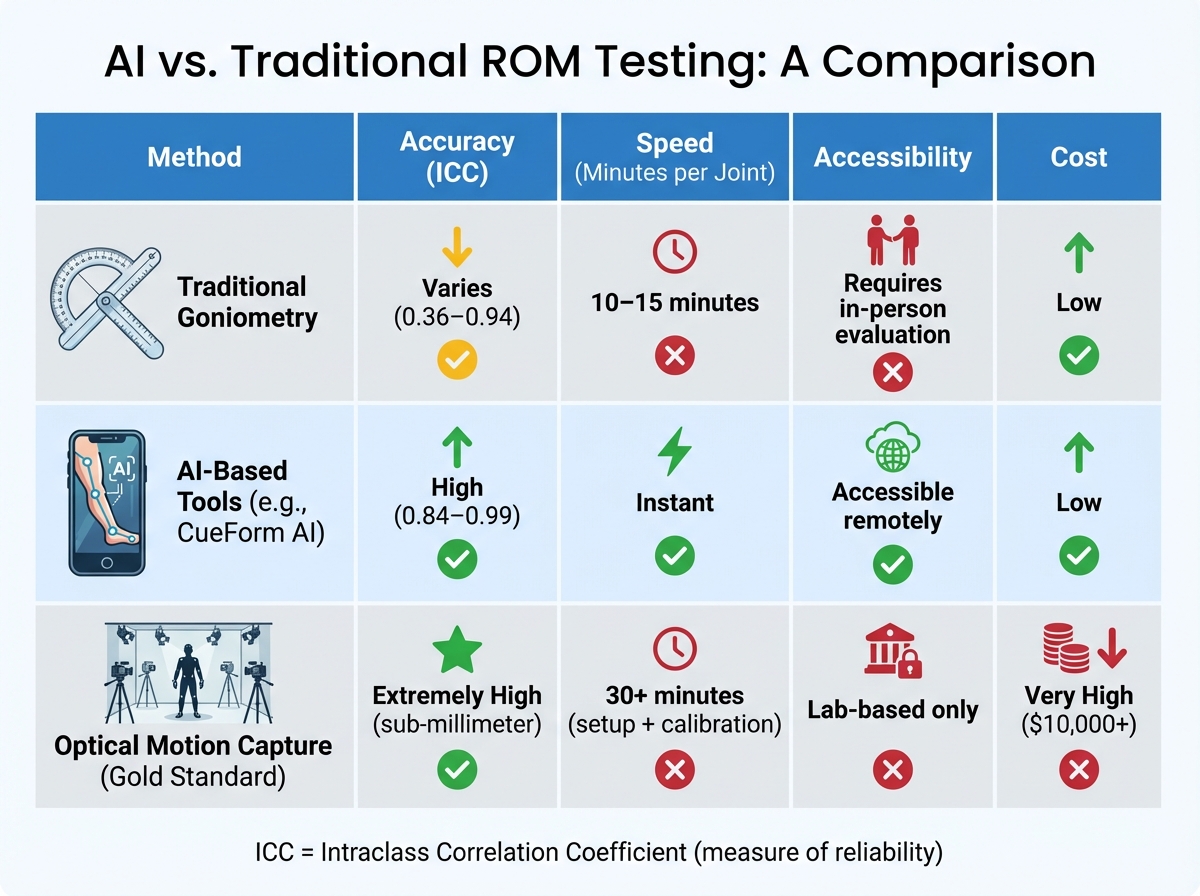
AI vs Traditional ROM Testing Methods Comparison
AI-powered range of motion (ROM) tools are proving to be far more reliable than traditional methods. They provide objective, consistent measurements while reducing the risk of human error.
Traditional goniometers, for example, often show inconsistent reliability. Their intraclass correlation coefficients (ICC) range from 0.36 to 0.91 for elbow joints and 0.76 to 0.94 for shoulder joints, depending largely on the skill of the evaluator [10]. On the other hand, AI systems have demonstrated correlation coefficients between 0.84 and 0.99 when tested against gold-standard optical motion capture systems [8][10].
"The reliability and objectivity of active RoM examinations were improved by the measurement tool compared with examiners."
– Christoph Schiefer, Institute of Occupational Medicine [12]
However, certain environmental factors - like lighting, camera distance, and body positioning - can influence the accuracy of AI measurements. For example, systems such as Microsoft Kinect v2 typically maintain average displacement errors under 10 millimeters for most joints, though errors at the wrist may exceed 15 millimeters [11]. AI tools excel in measuring simpler movements like shoulder and elbow flexion, but they may struggle with more complex motions, such as wrist pronation or shoulder internal rotation [10]. These nuances highlight the differences between AI-based systems and traditional methods.
AI vs. Traditional ROM Testing: A Comparison
| Method | Accuracy (e.g., ICC) | Speed (Minutes per Joint) | Accessibility | Cost |
|---|---|---|---|---|
| Traditional Goniometry | Varies (0.36–0.94) [10] | 10–15 | Requires in-person evaluation | Low |
| AI-Based Tools (e.g., CueForm AI) | High (0.84–0.99) [8][10] | Instant | Accessible remotely | Low |
| Optical Motion Capture (Gold Standard) | Extremely High (sub-millimeter) [10] | 30+ (setup + calibration) | Lab-based only | Very High ($10,000+) [8] |
One of the biggest advantages of AI tools is their speed. Traditional methods require manual alignment and documentation, taking anywhere from 10 to 15 minutes per joint. In contrast, AI platforms analyze video in real time, providing immediate feedback. This efficiency makes AI tools especially convenient for home use, allowing athletes or patients to monitor their progress without needing to visit a clinic or invest in costly lab setups.
Conclusion
AI has completely changed how we approach range of motion testing in strength training. What once required costly equipment and time-consuming manual measurements can now be done with something as simple as a smartphone camera. This quick and efficient analysis allows athletes to track their performance on a session-by-session basis, bringing a new level of precision to their training routines [5].
Take platforms like CueForm AI, for example. They turn video recordings into useful insights, spotting common form mistakes and providing personalized feedback to help you train more safely and effectively. On top of that, you can consult with an AI coach to fine-tune your technique, ensuring you’re working through a full, safe range of motion while building strength.
One of the standout benefits here is accessibility. Studies show that older adults using smartphone-based AI tools for assessments and tailored programs have seen improvements in balance and arm strength with as little as 1.5 sessions per week [13]. If this technology can deliver such measurable results for a group with an average age of 72, imagine the potential it holds for serious lifters aiming to boost performance and avoid injuries.
AI-driven range of motion testing gives you the kind of objective data and real-time feedback that used to be limited to elite sports labs. The tools are available, they’re accurate, and they’re ready to help you train smarter and safer. This technology is reshaping the way we think about strength training.
FAQs
How does AI enhance range of motion testing accuracy?
AI brings a new level of precision to range of motion (ROM) testing by using computer vision and deep learning to study joint movements. These advanced systems can automatically measure joint angles with incredible accuracy, removing the risk of human error and delivering consistent results every time.
Unlike traditional tools like goniometers, AI-based methods not only match but often surpass the precision of manual testing. This makes them an excellent choice for more reliable performance evaluations and minimizing inconsistencies in measurements.
What do I need to use AI for range of motion testing?
All you need is a device with a camera, like a smartphone, tablet, or computer. There's no need to invest in extra sensors or specialized equipment - AI technology can evaluate your range of motion using video recordings or live streams. This makes it easy to use whether you're at home, in a gym, or even in a clinical environment.
How can AI-based range of motion testing help reduce workout injuries?
AI-driven range of motion (ROM) testing offers a precise way to pinpoint mobility limitations and spot issues with form. Catching these problems early allows you to adjust your technique and enhance joint function, which can go a long way in lowering the chances of workout injuries.
These tools deliver tailored insights, steering you toward safer and more efficient workout routines. The result? Better performance without compromising your body’s well-being.