Study Summary: AI Form Feedback in Weight Training
If you lift alone, this type of tool can help you spot obvious issues in the squat, bench press, and deadlift. But the current evidence points to a clear limit: these systems work best when the camera is set up well, the view is clear, and the mistake is easy to see.
Here’s the short version:
- Best use: checking visible form faults like shallow squat depth, knee cave, deadlift bar drift, and uneven bench press movement
- Main limit: camera setup changes results a lot
- Accuracy range: as high as 95.5% in one tested setup, but as low as 0% in a poor side-view setup
- Joint-angle error: often under 10°, but up to 15° at the shoulder and hip
- What it can’t read well: bracing, bar speed, fatigue, or whether you’re close to a failed rep
- Best fit: technique work and moderate sets, not max-effort attempts
I’d read this space in a simple way: AI lifting feedback is a form check, not a coach in the rack and not a spotter. It can point out what the camera sees. It cannot deal with what the camera misses.
Quick comparison:
| Area | What current tools do well | Where they fall short |
|---|---|---|
| Form checks | Spot big visible faults | Miss small changes when tracking error is high |
| Rep review | Give post-set notes and cues | Real-time prompts may come too late |
| Camera tracking | Works well in some angles and distances | Falls apart with bad placement, blocked views, or gym traffic |
| Lift safety | Warn with text, visuals, or audio | Cannot stop a failed rep or replace safeties |
So if you want a plain takeaway, it’s this: use AI feedback as a support tool between coached sessions, and keep your expectations in line with what a phone camera and pose model can actually measure.
What Research Shows About Feedback in Resistance Training
Visual and Verbal Feedback in Squat and Bench Training
Visual, verbal, and auditory cues can help lifters clean up technique and stay more consistent in squat and bench work. They’re especially good at helping people spot obvious mistakes early, before those mistakes turn into habits.
A 2025 systematic review in Frontiers in Sports and Active Living found that camera-based apps can catch major form faults such as shallow squat depth, bar path drift, knee valgus, and uneven shoulder rise during the bench press [1]. At the same time, the review pointed out a key limit: feedback quality changes from one platform to another, and many tools still need more testing against motion-capture systems such as Vicon [1].
Auditory Cues and Mixed Feedback for Performance and Consistency
Early research on auditory cueing suggests that sound-based prompts can help with tempo and rep counting during compound lifts. That said, accuracy still needs validation against motion-capture systems, and the quality of real-time corrections is not the same across apps [1].
Feedback Modalities and Measured Outcomes
The studies below show where feedback helps and where it starts to fall apart.
| Feedback Modality | Exercise Context | Outcome Measured | Main Finding |
|---|---|---|---|
| Markerless Pose Estimation (Visual) | Squats & Push-ups | Detection Accuracy and Mean Detection Rate | 95.5% accuracy at a 45° diagonal angle, about 6 to 7 feet away; drops to 0% from a direct side view; approximately 61.5% for squats and 61.1% for push-ups across tested camera configurations [1] |
| Markerless Pose Estimation (Visual) | Strength-lift test sessions | Joint Angle Precision | RMSE under 10° for most joints, but up to 15° at the shoulder and hip [1] |
| AI Form Analysis (Visual/Text) | Squat, Bench, Deadlift | Technical Fault Detection | Reliably catches major faults like depth, bar path, and knee valgus; cannot detect loss of bar speed, bracing quality, or how close a set is to failure [1] |
| Real-Time Audio/Visual Cues | Compound Lifts | Movement Consistency | Useful for tempo and rep counting; cannot predict failed reps [1] |
Some of the limits are hard to ignore. Joint-angle error can reach 15 degrees at the shoulder and hip, which makes small form fixes much harder [1]. Camera setup also plays a huge role. Angle and distance often matter more than the software itself, which has direct implications for how AI feedback tools should be set up and used [1]. That gap in accuracy is exactly why the next section turns to detection and classification.
Using AI to Detect Proper Exercise Form Tutorial
How Well AI Detects Movement and Classifies Form Errors
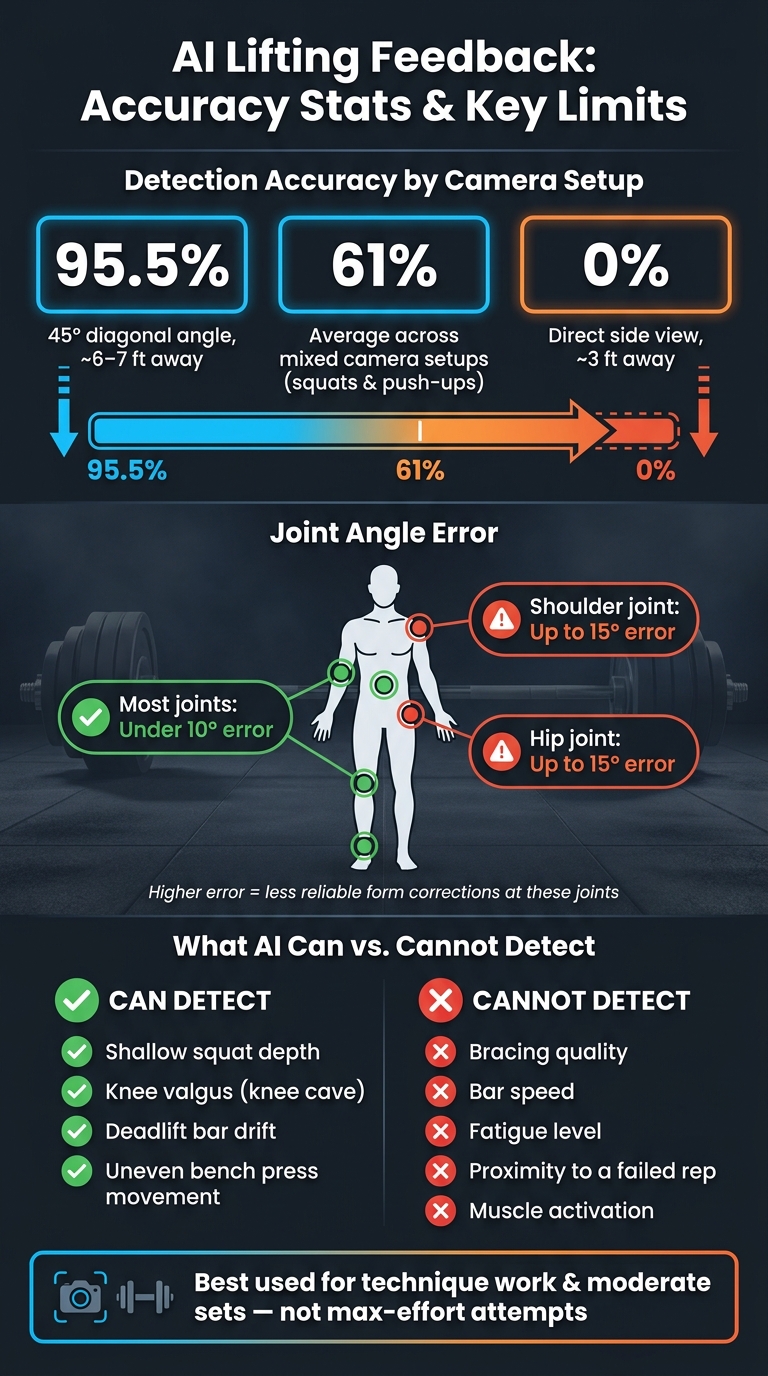
AI Lifting Feedback: Accuracy Stats & Key Limits at a Glance
Markerless Tracking for Bar Path, Joints, and Lift Phases
Once a feedback system can tell that a rep happened, the next step is movement accuracy. That part matters because every form cue depends on it. If the tracking is off, the coaching will be off too.
A 2024 study found that most tracked joints had less than 10 degrees of error. That sounds pretty solid at first glance. But there’s a catch: error rose to 15 degrees at the shoulder and hip joints. [1]
Form Classification Models for Common Lifting Faults
These models are best at spotting big, easy-to-see mistakes. Think:
- shallow depth
- deadlift bar drift
- knee valgus
- uneven bench path
What they can’t do is measure bracing, bar speed, or how close you are to failure. That’s a big line in the sand. The software is matching joint positions against a rep template, not reading effort or what’s going on inside the body. [1]
What Current Accuracy Numbers Mean in a Gym Setting
Those accuracy numbers need a little reality check. Squat-detection accuracy can hit 95.5% - but that result came from a 45-degree diagonal angle at about 6 to 7 feet away. Move the camera to a direct side view from about 3 feet, and accuracy can fall to 0%. [1]
That’s a huge swing. In a real gym, camera setup isn’t always clean or repeatable. Racks get in the way. Spotters step in. Other lifters pass through the frame. So in practice, placement may matter more than the model itself. Detection is only the first hurdle; after that, the hard part is deciding how and when the system turns what it sees into a form correction. [1]
AI Posture Correction, Cue Timing, and Where Products Are Headed
Real-Time Prompts vs. Post-Set Coaching Reports
Spotting a form issue is one thing. Fixing it at the right moment is the hard part.
Real-time prompts can show up a rep too late when processing slows down. Post-set review is often the clearest coaching format because it looks at the full set in one pass [1].
That timing decision also changes the kind of feedback a system can give.
Visual Overlays, Text Cues, and Audio Prompts
Current systems turn pose tracking into a few common output types [1]:
- Visual overlays
- Joint flags
- Bar-path visuals
- Short text cues
- Spoken prompts
Real-time visual cues can help in the moment, but during heavy sets they can also pull your focus in two directions. That’s the trade-off. Post-set feedback is usually easier to read, think through, and use on the next set.
You can already see these formats in video-based coaching tools like CueForm AI.
CueForm AI as a Practical Example of Video-Based Strength Coaching
CueForm AI reviews uploaded squat, bench press, and deadlift videos and returns personalized cues, plus chat-based follow-up if you want clarification. The free tier gives you quick feedback and limited follow-up chat. Paid access adds more detailed reports and more chat use.
Like most tools in this space, the output is only as good as the input. Clean camera angles and steady gym conditions still matter a lot.
Limits in Gym Settings and Key Takeaways
Technical Limits: Camera Angle, Lighting, Occlusion, and Generalization
The big issue isn’t whether these tools can spot form problems in ideal conditions. It’s whether they still work in an actual gym.
And that’s where things get messy.
Camera placement matters more than most people think. Across mixed camera setups, mean detection rates are about 61% for both squats and push-ups [1]. That’s a pretty clear sign that these systems are sensitive to day-to-day gym conditions, not just software quality [1].
In a crowded gym, one blocked view or one poorly placed phone can make the analysis close to useless. Markerless pose tracking has its own measurement error too. At the shoulder and hip, that error can reach 15 degrees, which makes it fine for spotting broad visual mistakes but not for tight measurement [1].
There’s another gap here. These tools don’t measure muscle activation, bar speed, or bracing [1]. And those are often the signals that matter most when the weight gets heavy. A lift can look okay on video while the strain underneath tells a very different story [1].
Coaching Limits: Useful Guidance, but Not a Safety Device
Even if the system sees the lift well, there’s still a bigger question: does the feedback arrive in time to help?
AI form feedback is a pattern-matching tool, not a spotter. Its alerts are visual or audio prompts. They can warn you, but they can’t grab a barbell or help you finish a rep in the middle of a bad set [1].
That’s why, for near-max attempts or sets taken to failure, you still need physical safeties like rack pins or safety bars [1]. In practice, AI feedback fits best with technique work and moderate-intensity sets, where the goal is to clean up movement rather than manage risk under heavy load [1].
Key Takeaways from the Current Evidence
The clearest point from the current evidence is simple: AI form feedback works best for visible technique faults. Once the camera angle is poor, the view gets blocked, or the lift moves into high-load territory, reliability drops [1].
It also helps to read reported accuracy claims with some caution. Independent testing matters more than self-reported performance numbers [1].
Used with those limits in mind, AI form feedback can be a solid technique check between coached sessions. It works best as a support tool, not as the final word on form.
FAQs
How should I set up my camera for better feedback?
Place your smartphone at torso or waist height, about 6 to 12 feet away, so your full body and movement stay in frame.
For squats, a side view or 45-degree rear oblique angle works best. Set your phone on a stable surface, use bright, even lighting, and wear fitted clothing so your form is easy to see. Skip backlighting, and make sure your whole body stays visible from head to foot during every rep.
Can AI feedback help beginners more than advanced lifters?
Yes. AI feedback often helps beginners more than advanced lifters, though both can benefit from objective analysis and real-time corrections.
Research suggests beginners may see larger gains in movement quality, with form improvements of up to 47% after 200 sets. That matters because new lifters usually need simple, clear guidance more than anything else. When feedback turns complex biomechanical data into plain, actionable cues, it becomes much easier to build good habits early.
When should I trust AI feedback and when should I not?
Trust AI feedback as a helpful screening tool for repeatable movement patterns, like shallow squat depth, drifting bar paths, or knee valgus. It works best when your video is clean, unobstructed, and shows your full body in steady lighting.
That said, AI is not a substitute for human coaching or a safety system. Be extra careful with near-max lifts, and don’t rush to change your technique after one rep. It’s smarter to wait until the same pattern shows up across multiple sets.