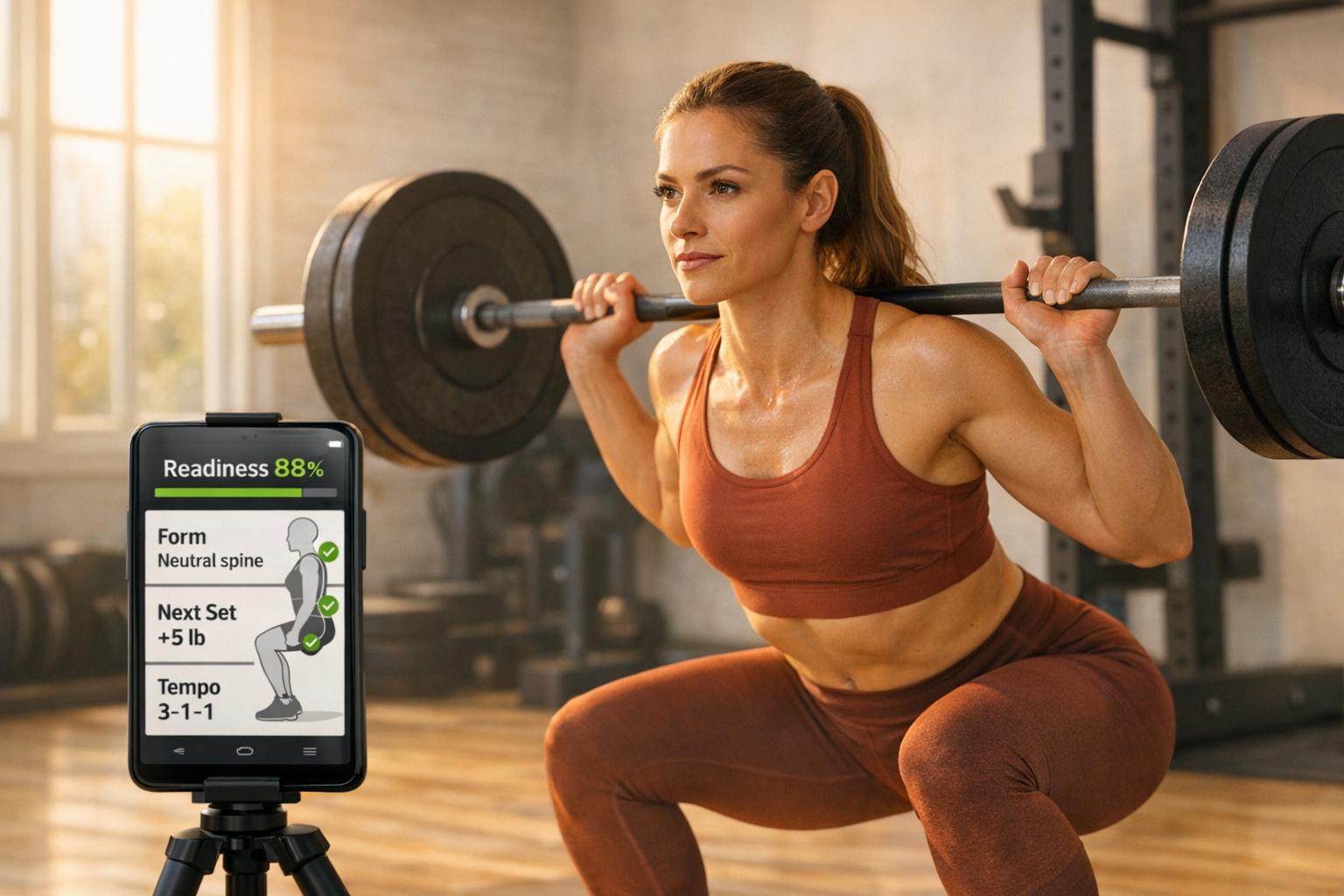
How AI Adapts Workouts to Your Strength Goals
AI is transforming strength training by offering personalized, real-time guidance that adjusts to your body’s needs. Unlike generic workout plans, AI tools analyze your form, recovery, and readiness to create tailored programs that evolve with your progress. Here's how it works:
- Video Analysis: AI evaluates your squat, deadlift, and bench press form, identifying issues like knee cave or bar path inconsistencies with high accuracy.
- Custom Goals: Programs adjust for strength, muscle growth, or injury prevention, considering your experience, equipment, and daily recovery metrics.
- Real-Time Feedback: AI provides instant cues during workouts to correct form and prevent injuries.
- Progress Tracking: It monitors your strength and technique improvements over time, updating your plan to keep you on track.
This dynamic approach ensures your workouts are safe, effective, and aligned with your goals - whether you're a beginner or an advanced lifter.
Get Fit Smarter: AI Tools That Adapt Your Workouts Based on Recovery!
sbb-itb-c91a623
How AI Evaluates Your Current Strength Level
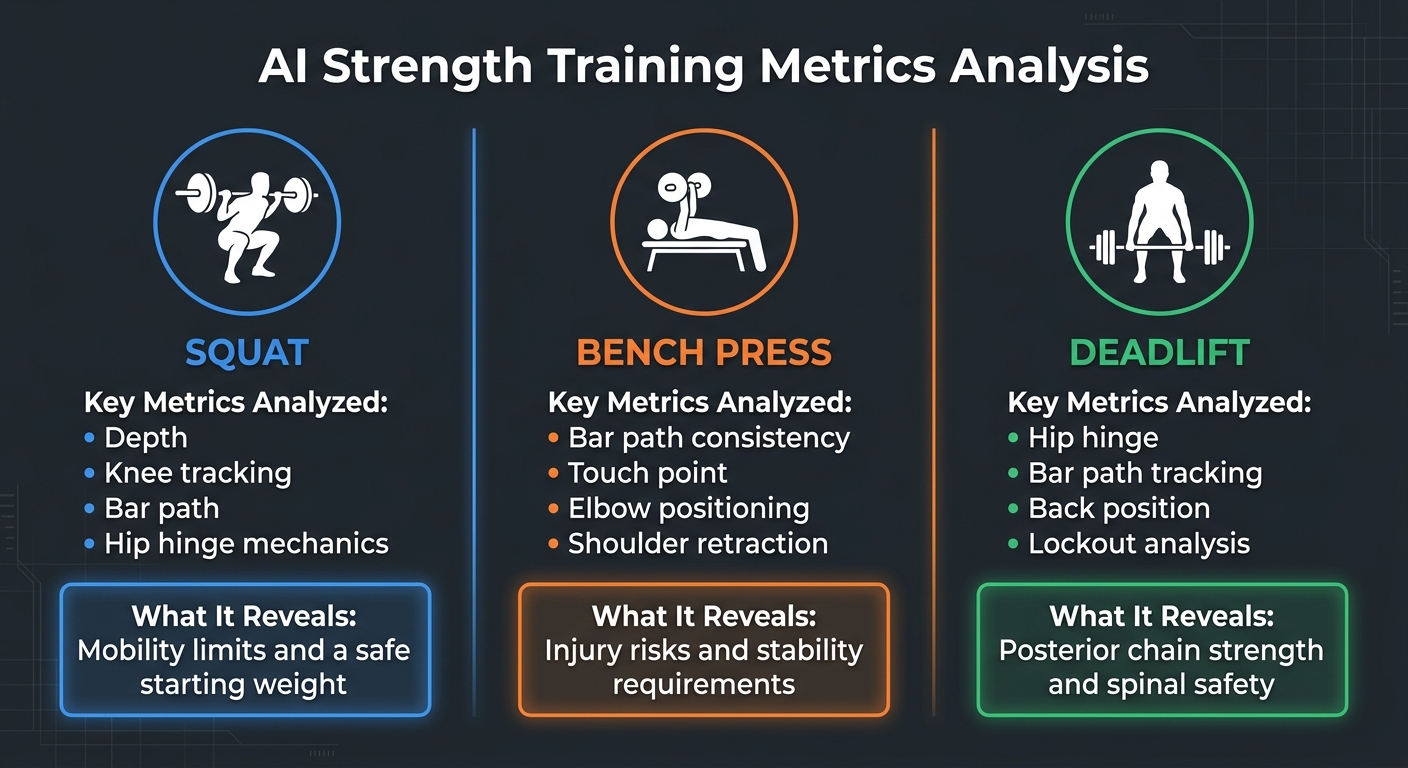
AI Strength Training Metrics: What AI Analyzes for Squat, Bench Press, and Deadlift
AI begins by assessing your starting strength and how efficiently you move. This isn't just about how much weight you can lift - it’s about evaluating how well your body handles the load. This detailed process helps create a workout program that aligns perfectly with your goals. By analyzing your form alongside performance data, AI develops a comprehensive view of your current abilities.
Why Video Analysis Matters
Video analysis is at the heart of AI-based strength evaluation. When you upload a video of your squat, bench press, or deadlift to CueForm AI, the platform breaks each lift into its main components. For example, it looks at the hip hinge and lockout in deadlifts, bar path and touch points in bench presses, and squat depth with knee tracking. Using precise physics-based data - like bar path, joint angles, and body positions - the AI identifies exactly where your form may falter. For instance, it might detect a knee cave during a squat or an inconsistent touchpoint on the bench press.
Nathan Kiely, Athletic Performance Coach for the Brisbane Broncos NRL, highlights the value of this objectivity:
"VueMotion helps inform our coaching interventions and aids us in tracking technical and performance changes with objectivity."[10]
The system also takes into account your unique anatomy, training history, and goals to offer personalized feedback. For the most accurate results, make sure your videos are filmed from a clear side angle that captures your full range of motion and bar path.
What Metrics AI Measures
Once the video analysis is complete, AI translates your performance into measurable metrics. It evaluates load and technique scores to determine a safe starting weight while analyzing your range of motion to uncover any mobility challenges. It also tracks stability and bar path consistency to ensure efficient force transfer.
| Lift Type | Key Metrics Analyzed | What It Reveals |
|---|---|---|
| Squat | Depth, knee tracking, bar path, hip hinge mechanics | Mobility limits and a safe starting weight |
| Bench Press | Bar path consistency, touch point, elbow positioning, shoulder retraction | Injury risks and stability requirements |
| Deadlift | Hip hinge, bar path tracking, back position, lockout analysis | Posterior chain strength and spinal safety |
These metrics lead to what CueForm describes as "explainable findings" - clear, actionable data points that guide each coaching adjustment. This transparency ensures you not only know what to fix but also understand why these changes are critical for hitting your strength targets.
How AI Helps You Set Strength Goals
After assessing your current strength, AI steps in to create tailored goals that align with your long-term progress. These recommendations are designed to suit your specific needs, whether you're aiming to build strength, refine your technique, or avoid injuries. The system collects detailed input, such as your training priorities (strength, hypertrophy, or conditioning), injury history, available equipment, and how much time you can dedicate to each session. This information allows the AI to craft a program uniquely suited to you, rather than offering generic advice.
Depending on your primary focus - muscle growth, form improvement, or injury prevention - AI adjusts key variables like training volume, technique guidance, and load management. For hypertrophy, the system emphasizes volume, aiming for 10 to 20 sets per muscle group weekly [1]. If you're working on form, AI might use computer vision to monitor your movements and provide real-time feedback on exercises like squats, bench presses, and deadlifts [9]. For injury prevention, AI employs autoregulation, adapting your training load based on daily readiness indicators like heart rate variability and sleep patterns instead of sticking to a rigid plan [3]. Research shows that your ability to generate force can vary by over 10% daily due to factors like stress, nutrition, and rest [3].
Adjusting Goals for Different Fitness Levels
AI also tailors its recommendations based on your fitness level and experience. Beginners often receive plans that focus on mastering proper form, building consistent habits, and progressing gradually [8]. Intermediate lifters are guided with balanced volume and intensity, emphasizing progressive overload. Advanced athletes benefit from more complex programming, including higher training density and adjustments for factors like travel, stress, and long-term performance trends [3][8].
The system even adapts to the equipment you have on hand. If you're working out at home with minimal gear, AI selects exercises that match your setup, ensuring your program remains effective despite any limitations [1].
Matching Programs to Your Objectives
AI refines program design further by aligning exercise choices with your personalized goals. For example, if you have lower back issues, the system might modify deadlift progressions or suggest alternative exercises that reduce spinal strain while still targeting the posterior chain. Similarly, if you need to focus on a specific muscle group, such as your shoulders, the algorithm can increase pressing and isolation work to meet your needs [1].
Advanced AI systems continuously learn and evolve based on your performance data [7]. Platforms like CueForm AI even allow you to interact with an AI coach. If a recommended cue or exercise doesn’t feel quite right, you can ask follow-up questions and receive customized advice that suits your anatomy and training context [9].
How AI Creates Your Workout Program
After setting your goals, AI takes over to craft a workout plan tailored to your needs. It selects exercises, determines training parameters, and structures sessions based on proven principles for building strength. This process ensures that every exercise aligns with your goals, training experience, and available equipment.
AI starts by analyzing your training age - essentially, your experience level. For beginners, the focus is usually on compound movements like squats and bench presses, making up about 80% of the program, while isolation exercises fill the remaining 20%. Advanced lifters often see a more balanced split, around 50/50, to target specific muscle groups. The plan also ensures coverage of six key movement patterns: squat, hinge, horizontal push, vertical push, horizontal pull, and vertical pull [5][2].
Next, the system filters through thousands of exercises to match what you have on hand. For example, if you're working out at home with just a barbell and bench, the program avoids recommending machine-based or cable exercises [5][4][2]. Goals also shape the plan - strength-focused routines emphasize heavier weights and longer rest periods (3–5 minutes), while hypertrophy programs lean toward moderate weights and shorter rest intervals (1–2 minutes) to maximize muscle growth [5][2].
How AI Adjusts Sets, Reps, and Weight
AI doesn’t just throw random numbers at you for sets, reps, and weight. Instead, it uses real-time data and your daily readiness to fine-tune these variables. One key metric it tracks is Repetitions in Reserve (RIR) - an estimate of how many reps you could still perform after each set. This helps the system make precise adjustments for future workouts, with accuracy levels as high as 0.88 to 0.91 [3].
Many platforms sync with wearables like Apple Watch, Oura, and WHOOP to gather biometric data such as Heart Rate Variability (HRV), resting heart rate, and sleep quality. This data helps the AI assess your recovery status. For example, programs guided by HRV have shown a 10.1% improvement in VO2max compared to 4.2% with fixed routines [3][7]. The AI adjusts your training load based on these insights.
It also considers factors like your training history, stress levels, nutrition timing, and how much time you have. If your usual 90-minute session gets cut to 45 minutes, the AI trims the workout but keeps the most essential exercises [3][1]. Beginners generally need 8–10 sets per muscle group weekly for growth, while advanced trainees may require 16–20+ sets [5].
"Managing the dose-response relationship between training stimulus and recovery is what separates productive training from stagnation or overtraining."
- Dr. Brad Schoenfeld, Professor of Exercise Science [3]
This dynamic approach ensures your program evolves as you progress.
Using Progressive Overload
To help you build strength, AI incorporates progressive overload - gradually increasing the demands on your body over time. Using autoregulation, the system applies a double-progression model: first increasing reps within a target range (e.g., 6–8) and only adding weight once you consistently hit the upper limit [3][5][2]. Since factors like sleep, stress, and nutrition can cause your strength to vary by 10% or more on any given day [3], rigid progression isn’t always practical.
Here’s an example: If your program prescribes 3 sets of squats at 185 pounds for 6–8 reps, and you initially hit 6, 6, and 5 reps, the AI will keep the weight the same until you can consistently perform 8 reps per set. Only then will it increase the load.
Advanced systems also organize training into mesocycles - phases like foundation (building work capacity), intensification (lifting heavier loads), peak (testing max strength), and recovery (planned deloads) [3]. The AI raises weights when you hit your target reps but may maintain or reduce the load to prioritize recovery when needed.
Tools like CueForm AI add another layer by using computer vision to monitor your form. If your technique falters - say, your knees cave inward during a squat - the AI flags the issue and adjusts future loads to prevent injury [7]. This ensures your form stays solid as your training progresses.
Getting Feedback and Adjustments During Workouts
Once your workout begins, AI steps in to monitor your performance and provide real-time feedback. This ensures you maintain proper form, helping to prevent injuries and make every rep count toward your fitness goals.
Receiving Clear Form Corrections
AI platforms rely on computer vision technology, like MediaPipe, to track your movements by analyzing joint angles and body alignment during each rep [4][11]. This allows the system to spot issues such as knees caving inward during a squat or hips rising too fast during a deadlift. It then delivers instant feedback - through audio cues or visual overlays - to help you correct your form on the spot [4].
For those focused on powerlifting's big three movements, tools like CueForm AI break down each lift into key phases: setup, descent, bottom, ascent, and lockout. Each phase is scored from 1 to 10, making it easy to identify exactly where your technique needs work [11]. Based on this analysis, the AI offers actionable cues like "drive your knees out" or "keep your chest up", which you can apply immediately [9].
Research indicates that AI-powered systems achieve a 98% accuracy rate in identifying form issues using real-time computer vision [4]. Beyond immediate corrections, they also provide interactive support to resolve any confusion.
Asking Questions Through AI Chat
In addition to visual feedback, integrated chat features allow you to dive deeper into form corrections. Sometimes, a cue might make sense in theory but feel unclear in practice. With tools like CueForm AI, you can ask follow-up questions, request alternative cues, or explain your unique anatomy and goals [9]. For example, if you're told to "push your knees out" but aren't sure what that should feel like, you can ask, "What should I feel?" The AI will respond with a detailed explanation tailored to your experience and body mechanics.
This dialogue refines your understanding and helps the system improve future recommendations. If a cue isn’t resonating with you, it can suggest alternatives or adjust its coaching strategy for upcoming sessions [9]. The AI also dynamically modifies your workout based on your performance, recovery, and fatigue levels [6]. For instance, if your reps slow down or your form starts to break, the system might reduce the session’s intensity or suggest adjustments like pause squats [3].
"Autoregulation means adjusting training loads in real time based on your actual performance and readiness, rather than following a predetermined plan regardless of how you feel."
This adaptive approach ensures your workouts remain effective while protecting you from overtraining or injury.
Tracking Your Progress Over Time
AI doesn’t just make real-time adjustments - it also keeps a close eye on your long-term progress. By analyzing both your technique and strength improvements, it creates a detailed profile of your performance and fine-tunes your training program accordingly.
Measuring Technique and Strength Gains
Every training session, AI records your performance data. For technique, CueForm AI breaks each lift into key phases - setup, descent, bottom, ascent, and lockout. It evaluates these phases using measurable criteria like bar path consistency, joint alignment (e.g., ensuring proper knee tracking during squats), and depth assessment[9][4]. This allows you to identify areas where you're improving and spot recurring weaknesses.
On the strength side, the system tracks metrics such as weight lifted, total training volume, and estimated one-rep max (e1RM) trends over 8–12 week periods[3]. Research shows that using objective tracking systems can lead to about 50% greater strength improvements compared to relying on subjective assessments[13]. The AI also factors in daily readiness, as force production can vary by over 10% depending on factors like sleep, stress, and fatigue[3]. To capture these fluctuations, it integrates data from wearables (e.g., Apple Watch), monitoring heart rate variability, sleep quality, and resting heart rate.
Updating Your Program Based on Results
The AI analyzes patterns in your performance and adjusts your workouts accordingly. For instance, if you consistently hit your target reps, it increases load and volume. On the other hand, slower bar speeds or a drop in technique may trigger a reduction in intensity or even a deload week[3][12]. This approach, known as autoregulation, ensures that your training intensity aligns with your current physical state.
Large Language Models (LLMs) are also used to identify complex trends, such as fatigue after heavy sessions or poor recovery due to lack of sleep[3]. A study revealed that lifters using velocity-based training for autoregulation achieved better strength gains while performing less overall training volume compared to those following fixed-load programs[3].
Experts generally recommend refreshing your program every 8–12 weeks to avoid stagnation and maintain engagement, though adjustments may be made sooner if your goals or equipment change[13][14]. Between these cycles, AI recalculates your plan after every workout, ensuring your training stays aligned with your evolving strength and recovery needs.
Conclusion
AI-powered strength training is changing the game for lifters. Instead of sticking to rigid programs that overlook daily readiness or technique issues, tools like CueForm AI provide tailored guidance that evolves with every session and rep. What was once only possible with in-person coaching - real-time form corrections, adaptive load adjustments, and recovery-focused tweaks - is now accessible at your fingertips.
Athletes using AI-driven programming have reported 23% greater strength improvements compared to those on fixed plans[15]. Plus, you get this edge without the hefty price tag of personal coaching. CueForm AI offers instant feedback for free, while its affordable detailed reports deliver 24/7 form analysis and practical advice - all for less than the cost of a single personal training session[9]. From perfecting your technique to fine-tuning every lift, this approach ensures your training aligns with your unique strength journey. With every rep, you're moving closer to your goals, backed by data and precision.
FAQs
How does AI know when to increase or decrease my training weight?
AI fine-tunes your training regimen by using autoregulation and biometric feedback. It evaluates key factors such as recovery, fatigue levels, and performance metrics to tailor your workouts. This approach ensures you're making steady progress while minimizing the risk of overtraining, keeping your sessions both efficient and aligned with your fitness goals.
What’s the best way to record lift videos for accurate form analysis?
To get precise feedback on your form, record short, well-lit videos of your squat, bench press, or deadlift. Make sure your camera is stable and positioned to capture your entire movement from multiple angles, like side and front views. This setup helps the AI accurately track key body points, analyze your technique in detail, and deliver clear, practical tips to enhance your form.
Can AI adjust my program if I’m short on time or not fully recovered?
AI has the ability to adjust your program in real time by leveraging autoregulation and biometric feedback. This means it can tweak the workload and intensity based on your current physical state, ensuring you stay aligned with your goals while minimizing the chances of injury.
Related Blog Posts
Plans
Choose the plan that best fits your needs.
Free
Try it out
Starter
Perfect for fitness enthusiasts