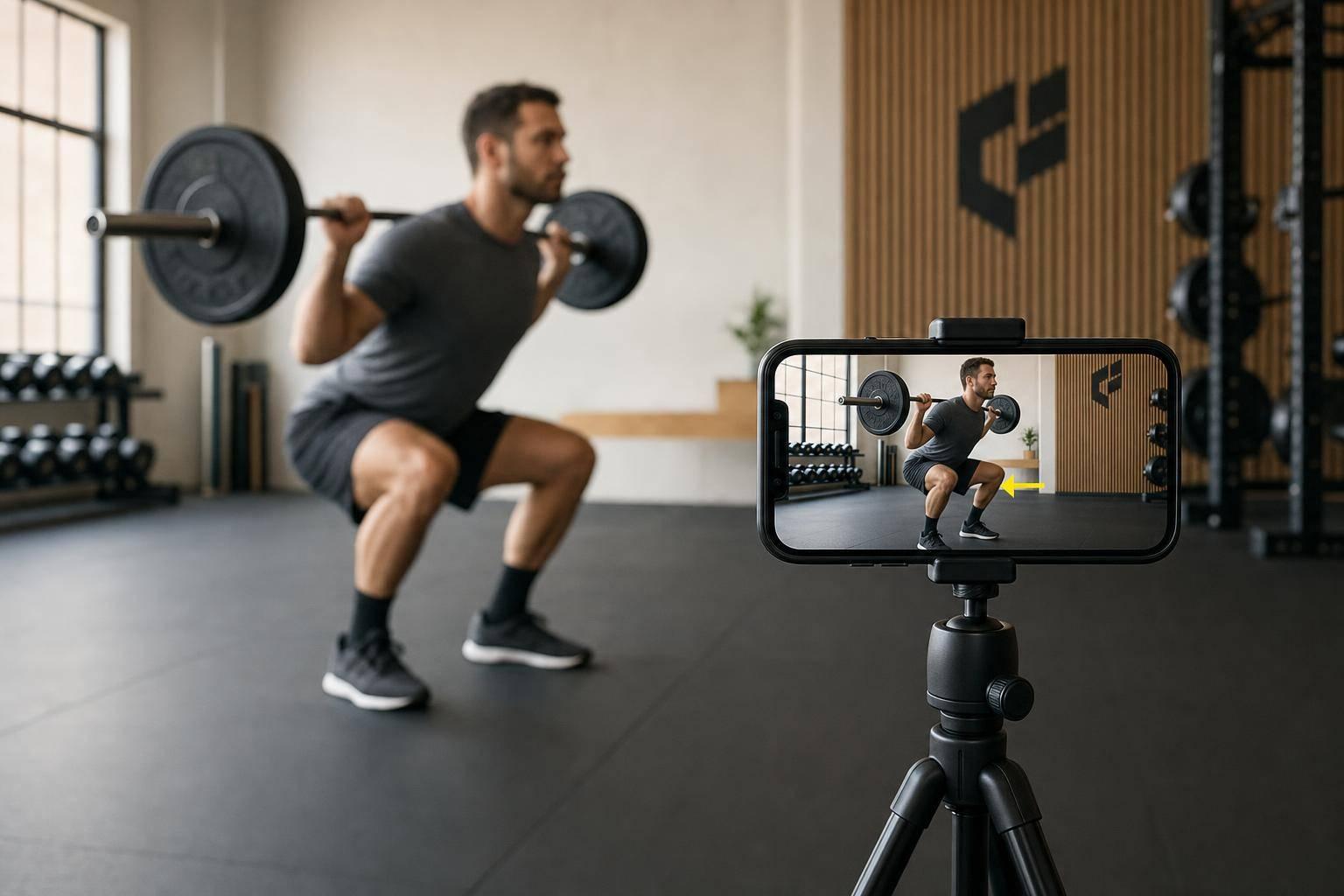
Study Summary: Video Feedback in Strength Form
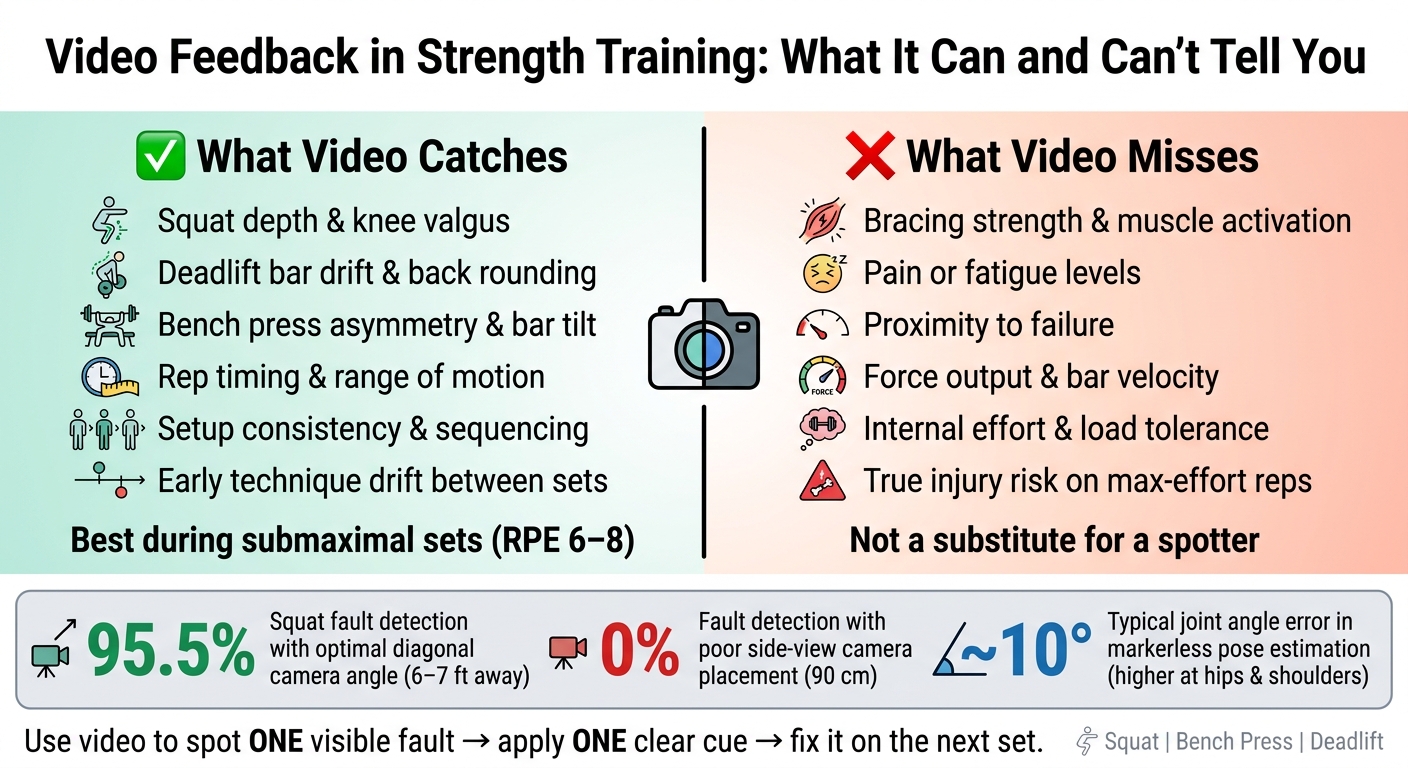
Video can help you fix visible form errors fast - but it cannot tell you how hard you’re bracing, how fatigued you are, or how close you are to failure. If you lift with a phone camera, the main takeaway is simple: use video for technique review, not for judging safety on heavy max-effort reps.
Here’s the short version:
- Best use: spotting visible issues in the squat, bench press, and deadlift
- Works best: during submaximal sets, around RPE 6–8
- Most useful for: squat depth, knee cave, deadlift bar drift, back rounding, uneven bench press rise, and bar tilt
- Big limit: camera angle can change what you see
- Key stat: one 2026 study found squat fault detection went from 0% with a poor side view to 95.5% with a diagonal view from about 6 to 7 feet away
- Another limit: markerless video tools are often within about 10 degrees for many joint measures, but hips and shoulders tend to show more error
- Bottom line: one visible fault + one clear cue is where video helps most
I’d sum up the research like this: video is good for cleaning up what you can see, but not for measuring what you can’t. It helps most when I use it to check one thing, make one fix, and apply that fix on the next set.
| What video helps with | What video misses |
|---|---|
| Depth, bar path, knee tracking, rep timing, setup, ROM | Bracing strength, pain, fatigue, force output, failure risk |
| Spotting drift between sets | Judging if a near-max rep is safe |
| Turning visible errors into cues | Measuring internal effort |
So if I’m using video well, I’m not asking, “Did this clip tell me everything?” I’m asking, “What clear form mistake can I fix next?”
Video Feedback in Strength Training: What It Can and Can't Tell You
Study Snapshot: The Current Evidence Base
Systematic Reviews and Broad Findings
With those limits in mind, the best way to read the evidence is by study type.
Across reviews and intervention studies, video feedback helps most with visible technique fixes. The pattern is steady across the research: video works best for technique review, not load tolerance or failure prediction [1].
The next step is to see whether that still holds when video is used during real training sessions.
Controlled Interventions in Resistance Training
Intervention studies give us a more practical test: does video help lifters clean up technique while they train?
Yes - with one catch. Use it for technique work and early drift detection. The main variable is cue quality. Video works best when feedback is specific and immediate [1].
Camera angle also changes how well errors are spotted. In one 2026 study, squat detection ranged from 0% with a side view at 90 cm to 95.5% with a diagonal view at 200 cm [1]. That’s not a small gap. It means camera setup can decide whether a fault is seen or missed. A diagonal angle from about 6 to 7 feet away worked best.
Applied Studies in Lifting Movements
Applied studies in lifting settings show that video is useful for spotting large, visible faults like squat depth, bar path drift, and knee valgus [1]. Markerless pose estimation uses body landmarks to estimate joint angles from video. In plain terms, it turns a simple clip into joint estimates that can help flag form breakdown fast. Most joints are measured within about 10 degrees, though the shoulder and hip tend to show larger errors [1]. That makes these tools good for form review, but not for precise joint-angle measurement.
That point matters because the next section looks at which errors video can score with confidence and which ones it can’t.
What the Studies Measured and What Video Revealed
How Form Was Scored in Research
The way researchers scored form shaped what video could and couldn't pick up. Most studies didn't rely on casual eyeballing. They used structured methods to judge each rep.
One common method was a rules-based checklist for a correct rep. In plain English, the lift was scored based on whether the movement matched the expected positions and sequence. Some systems used a five-part score from 0 to 100, rating bracing, posture, foot placement, range of motion, and movement efficiency [1]. Other systems used markerless pose estimation to estimate joint angles frame by frame [1].
That matters because each scoring method focuses on different details. So if two studies used different scoring systems, their results don't line up neatly. The scoring method sets the limits of the finding.
Visible Errors Video Can Catch
Video does a good job with faults you can actually see. That includes squat depth and knee valgus, deadlift bar drift and rounding, and bench asymmetry and bar tilt [1].
Still, camera angle changes everything. A fault can look obvious from one view and almost disappear from another. That's one of the big catches with video review: the lens only shows what it's pointed at.
Beyond single errors, video can also track:
- Rep timing
- Range of motion
- Setup consistency
- Whether key steps in the lift happened in the right sequence [1]
Those are the areas where video tends to score best. Internal effort is a different story.
What Video Does Not Directly Measure
Video shows movement, not internal state.
So while footage can show what happened, it can't tell you how hard someone is bracing, whether they're in pain, how fatigued they are, or how close they are to missing a rep. It also can't measure force output or bar velocity unless you add separate tracking tools [1].
| Variable | Measurable via Video | Not Directly Measurable |
|---|---|---|
| Technique | Bar path, joint angles, ROM, knee tracking | Muscle activation, bracing quality |
| Performance | Rep count, tempo, timing | Force output, bar velocity (without specific tools) |
| Safety/Effort | Visible form breakdown (e.g., back rounding) | Pain, fatigue, proximity to failure |
That limit matters when deciding how video fits into training.
Where Video Feedback Helps Most in Practice
Best Use Case: Error Detection Paired With Clear Cues
Video feedback helps most when it takes a visible mistake and turns it into one clear coaching cue. That’s where it tends to shine in training.
In practice, this works best during early skill learning and during submaximal sets, when a lifter is still building sound technique instead of grinding through max-effort reps.
Early Skill Learning and Technique Repetition
If a squat, bench press, or deadlift pattern needs work, repeated video review can help lock in setup, sequencing, and rep execution before bad habits stick.
That matters because small errors often feel normal when you’re lifting. Video gives you a way to see what’s off, not just guess. Then you can tie that fault to a single fix and repeat it on the next set.
Technique Improvements Do Not Automatically Equal Strength Gains
Research does support video feedback for improving movement quality. But the current evidence does not firmly show that better technique automatically leads to more strength or clearly lowers injury risk [1].
That gap matters. Cleaner reps are useful, but they don’t guarantee better results on their own. Those outcomes still depend on the limits covered next.
How AI Video Coaching Fits This Evidence
CueForm AI fits this same visible-fault, cue-based use case. It reviews squat, bench press, and deadlift videos, then gives specific technique cues.
The chat feature adds another layer. Lifters can ask follow-up questions, clear up confusion, and sharpen the next adjustment, so each review points to one clear next cue.
Limits, Comparison Table, and Final Takeaways
What Video Alone Cannot Tell You
Video has clear upsides, but it also has blind spots.
A camera can only show what it sees. If the angle is off, visible faults can disappear from view. That makes camera placement a basic limit of any video review.
Video also works after the fact. It can show visible errors, but it can't stop them while you're lifting.
Comparison Table: Study Types, Benefits, and Limits
The table below pulls the evidence into one place: study type, practical upside, and the main limit.
| Study Type | Focus/Lift | What Video Improved | Key Limit | Practical Takeaway |
|---|---|---|---|---|
| Systematic Review | Camera-based movement analysis apps | Video can help with visible technique review | Accuracy not fully validated against gold standards | Use as a supplement, not a standalone coach |
| Observational Study | Squats | Defined optimal camera angles for 95.5% accuracy [1] | Detection drops to 0% with poor placement [1] | Camera setup matters more than the software |
| Validation Study | 3D pose estimation | Joint angles within about 10 degrees of Vicon [1] | Higher error at complex joints like shoulders and hips | Reliable for gross fault detection, not clinical data |
How to Apply This Evidence in Real Training
The best use of video is simple: pair one visible fault with one clear cue.
Use video review to spot things you can actually see, like squat depth, bar path drift, or knee cave. Then connect that to one correction for the next set. That's usually where video helps most. Not with ten things at once. Just one problem, one fix.
And don't treat video like a spotter. It isn't one. Video feedback fits best during submaximal work, around RPE 6–8, when you still have enough attention left to clean up movement.
Key Takeaways
Research supports video feedback for visible technique errors, clear cues, and submaximal lifting, but it cannot show internal effort, fatigue, or true load tolerance.
FAQs
What camera angle works best?
For the best results with CueForm AI, set your smartphone at hip or bench height and place it 6 to 12 feet away. Make sure your full body stays in frame.
For camera angles, a few setups work best:
- Squats: a 45-degree rear oblique angle
- Deadlifts: a 45-degree front oblique angle
- Bench press: a 45-degree side angle
A side view can also work well for squats and deadlifts if you want to check depth and bar path. For bench press, a front view helps with symmetry and elbow position.
When should I use video review?
Use video review on a regular basis to check your lifting technique with less guesswork, track progress, and spot repeat form issues like knee valgus, spinal rounding, or an inconsistent bar path. The main value is in seeing patterns over time, not nitpicking every small rep-to-rep change.
If you want feedback you can trust more, record from the same angle each session. Clear, well-lit footage that shows your full body and the barbell makes a big difference. Even then, video works best as a helpful second set of eyes.
Can video tell if a heavy rep is safe?
Video analysis can flag technical breakdowns and form issues that may increase injury risk. But for heavy, near-max lifts, it shouldn't be the only thing deciding whether a rep was safe.
Tools like CueForm AI work best as a second set of eyes. They can miss things like pain, fatigue, and a bad setup, so they're better for screening than acting as the final word on safety.