How AI Reduces Joint Stress in Strength Training
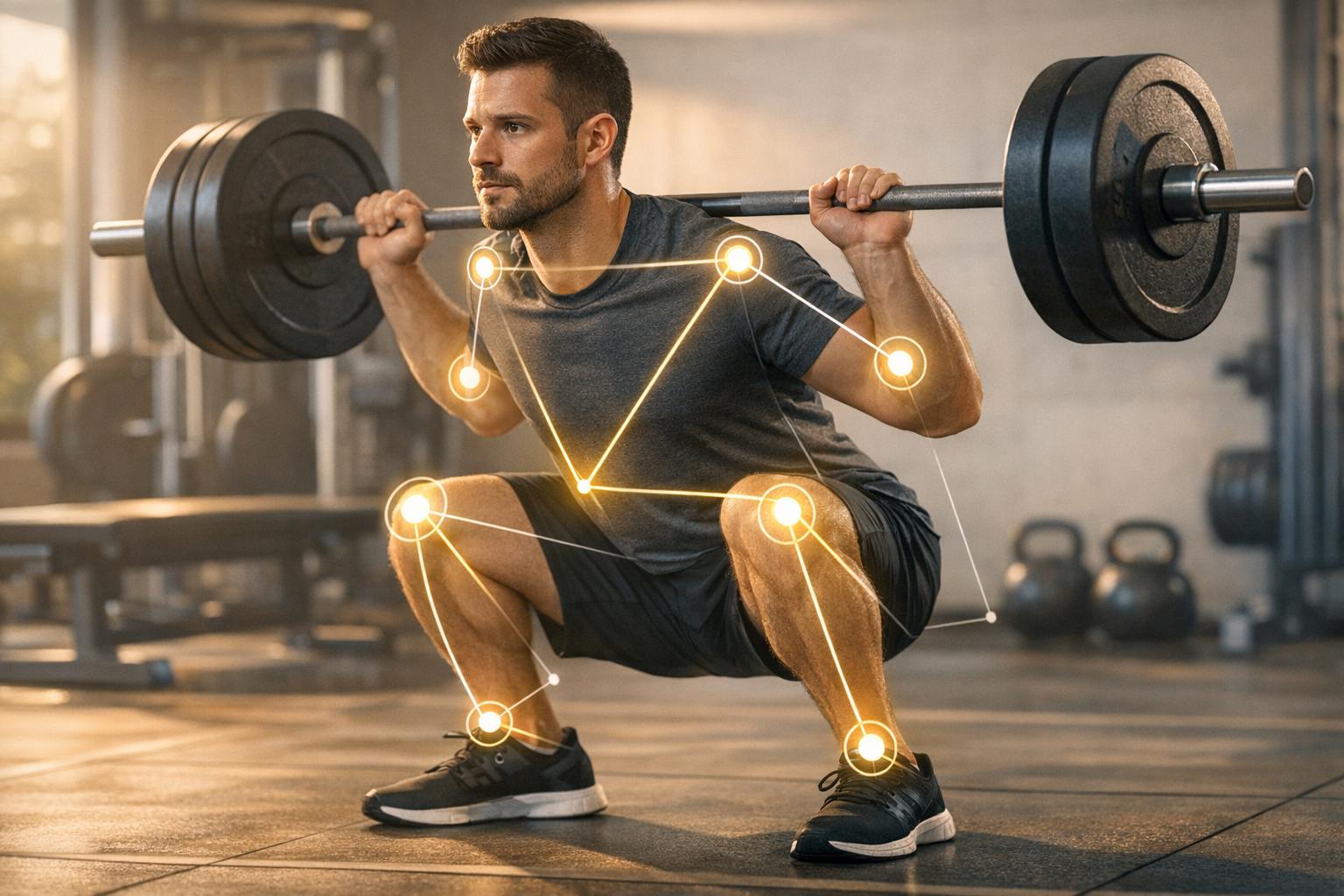
Poor form during strength training can lead to joint stress, injuries, and hindered progress. AI tools like CueForm AI analyze your technique in real-time, helping you lift safer and more effectively.
- AI uses computer vision to track 33 body landmarks with over 95% accuracy.
- It identifies issues like knee valgus, spinal rounding, or poor elbow positioning.
- Users upload workout videos, and the platform provides actionable cues like "drive hips back" or "tighten core."
- Research shows lifters improve technique by 10% after 10 sets and 34% after 200 sets.
- CueForm AI focuses on squats, bench presses, and deadlifts, offering detailed feedback and metrics.
By correcting form, you reduce joint stress, avoid injuries, and improve long-term performance. Plans start free, with premium options at $10/month or $89/year for advanced features.
Train smarter, protect your joints, and lift with confidence using AI tools.
Using AI to Detect Proper Exercise Form Tutorial
What Is Joint Stress in Strength Training?

Joint Stress Points and Technical Causes in Squat, Bench Press, and Deadlift
Joint stress happens when the weight you’re lifting shifts away from your muscles and onto your bones, tendons, ligaments, and cartilage - structures that aren’t built to handle heavy loads [2]. This often occurs when your joints are out of alignment or when your form breaks down during an exercise [2].
"When your form suffers, you may be overcompensating with other parts of your body - taxing muscles, tendons, and bones unexpectedly or beyond their capacity." - Tonal Team [3]
When the forces on your joints go beyond safe limits, it can speed up wear and tear [8]. A study conducted in July 2025 by the University of Vienna's Neuromechanics Research Group used 3D motion capture to analyze 29 elite powerlifters. They discovered that during squats performed at 90% of their one-rep max, the patellofemoral joint (where the kneecap meets the thigh bone) endured forces up to 26.7 times the lifter’s body weight. Alexander Pürzel, the lead researcher, cautioned: "If joint contact forces during exercises are beyond the physiological limits of joint structures, the training might exacerbate existing joint pathologies or even result in serious injuries" [8].
Let’s dive into how poor form can amplify this stress.
How Poor Form Creates Joint Stress
When your joints are misaligned, poor technique shifts the load away from your muscles and onto vulnerable parts of your body. For example, during a squat with improper form, your glutes and hamstrings might not engage fully, leaving your knee ligaments and spinal discs to absorb forces they aren’t built to handle [9][11]. Common issues like rounding your back, lifting too much weight, or having muscle imbalances can force your body into unsafe compensations [5].
Even how fast you move matters. Dropping too quickly or bouncing at the bottom of a squat generates shear forces that can strain your cruciate and collateral ligaments [9]. Among elite lifters, injuries related to technique are common: 22% to 32% of injuries occur during squats, 18% to 46% during bench presses, and 12% to 31% during deadlifts [9].
Joint Stress Problems in Squats, Bench Press, and Deadlifts
Each lift comes with its own set of risks, depending on how the movement is performed. For instance, in squats, knee valgus (knees caving inward) combines knee flexion with hip adduction and internal rotation of the femur, putting intense strain on the knee [9]. Leaning too far forward during squats shifts the load from your legs to your lower back [9].
| Exercise | Common Joint Stress Point | Technical Cause |
|---|---|---|
| Squat | Knees (ACL/Meniscus) | Knee valgus, shallow depth, or knees extending too far past toes [2][7] |
| Bench Press | Shoulders (Rotator Cuff) | Poor scapular retraction, improper elbow flare, or inconsistent bar path [1][6] |
| Deadlift | Lower Back (Lumbar) | Spinal rounding, improper hip hinge, or overextending at the top [2][6] |
In the bench press, using a grip wider than 1.5 times shoulder width increases torque on the shoulders and places undue stress on the acromioclavicular joint [9]. This exercise is also the leading cause of pectoralis major tears [9]. For deadlifts, rounding the lower back or losing the natural lumbar curve exposes spinal discs to extreme compression and shear forces [10][11]. Additionally, when the bar drifts away from your shins, the increased moment arm forces your lower back to work harder than it should [9][10]. Addressing these technical flaws is critical to avoiding injuries and maintaining long-term progress in your training.
How AI Detects and Reduces Joint Stress
AI platforms like CueForm use computer vision to monitor 33 key body landmarks during each repetition of your workout[2][4]. By analyzing these points, the system calculates joint angles, movement paths, and spinal alignment to see how stress is distributed across your skeletal system[2].
When you upload a video to CueForm AI, it evaluates your biomechanics to identify movements that could lead to joint strain. For example, it flags issues like knee valgus, excessive spinal flexion, or improper joint alignment. It also detects imbalances in your movements, helping to prevent injuries before they happen[2][3]. This detailed analysis lays the groundwork for personalized corrective feedback.
Video Analysis Technology for Form Feedback
CueForm AI turns your lifts into measurable data. For squats, it evaluates depth, knee tracking, hip hinge mechanics, and the bar's path[1][2]. When analyzing bench presses, it focuses on bar path consistency, shoulder retraction, elbow positioning, and where the bar touches your chest[1]. For deadlifts, it assesses hip hinge mechanics, lumbar spine neutrality, bar path, and lockout completion[1][2].
Using advanced models, the system estimates joint moments to identify areas of high torque, which improves the accuracy of its feedback. Research from Vrije Universiteit Amsterdam supports this, showing that single-camera deep-learning models can estimate muscle forces with a root-mean-square deviation of only 0.4% to 2.1% of maximum force for primary muscles[13].
"Knowledge of the level of muscle forces during sports activities can be essential for injury risk estimation and performance enhancement" - Lisa Noteboom, Department of Human Movement Sciences[13]
For the most accurate results, record your movements from a side angle in good lighting and wear fitted clothing[12][14]. These details directly influence the quality of the feedback you’ll receive.
Immediate Feedback to Adjust Form
Once CueForm AI identifies an issue, it provides actionable cues you can implement right away. For instance, it might suggest corrections like "drive your hips further back", "keep your back neutral", or "drive your knees out"[2][3]. These adjustments help shift the load away from overstressed joints and onto the muscles that should be doing the work.
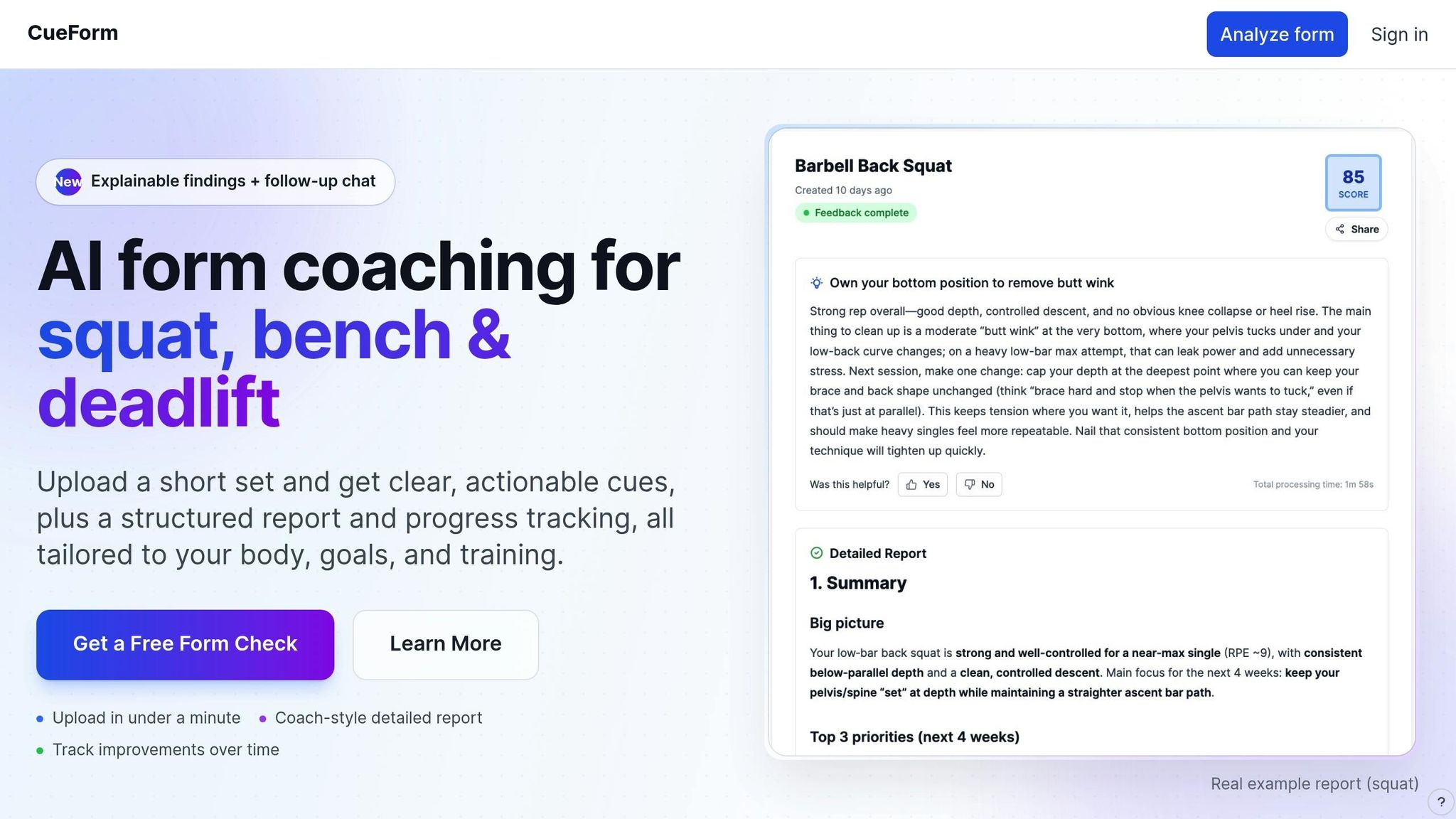
The platform delivers this feedback through concise reports that outline the problems and the steps needed to fix them. You can also interact with the AI coach to ask follow-up questions, such as "What should I feel when I drive my hips back?" This interactive feedback loop - detect, correct, confirm - allows you to refine your technique between sets, preventing bad habits from taking root over time.
sbb-itb-c91a623
Using CueForm AI to Protect Your Joints
How to Upload and Analyze Your Exercise Videos
Getting started with CueForm AI is straightforward. Here’s what you need to do:
- Choose the lift you want to analyze - squat, bench press, or deadlift.
- Upload a clear, full-body video of the movement.
- Share details about your body mechanics, fitness goals, and training plan.
- Receive a detailed report highlighting areas of joint stress.
CueForm AI focuses exclusively on the "Big 3" compound lifts, ensuring its feedback is tailored to these foundational exercises. For the most accurate analysis, record your lifts from a side or front angle, use good lighting, and wear fitted clothing so the AI can precisely assess your joint alignment and movement.
Personalized Cues to Fix Form Issues
Once your video is processed, CueForm AI generates actionable cues you can apply during your next workout. The report not only tells you what adjustments to make but also explains why they’re important and how they should feel when executed correctly. For example:
- Squats: Guidance on knee tracking or improving your hip hinge.
- Bench Press: Adjustments for shoulder blade retraction and elbow positioning.
- Deadlifts: Tips on maintaining a neutral spine and achieving a proper lockout.
"The bad ones - my overhead press and deadlift - highlighted deficiencies I wasn't fully aware of, like depth, wrist position, spine position... and a rounded back." - Skye Lee
The Findings section of the report breaks down metrics and pinpoints issues, offering clear biomechanical explanations for each cue. This helps you understand the reasoning behind the recommendations, making it easier to implement changes that reduce joint strain and improve performance.
Chat with the AI Coach for Ongoing Guidance
If a cue doesn’t make sense or you need more clarification, CueForm AI’s conversational coach is there to help. You can ask follow-up questions like, “What should I feel in my hips during a squat?” or provide feedback if the AI misinterprets your stance or goals. It functions like a virtual personal trainer, tweaking its advice until it matches your unique lifting style and body mechanics.
CueForm AI offers flexible plans to match your training needs. The Free plan includes a limited number of messages with the AI coach, while the Starter plan ($10/month or $89/year) provides a larger message quota for more in-depth guidance. This interactive feature, combined with real-time metrics, helps you refine your form and track your progress over time.
Tracking Your Progress with AI Metrics
After making actionable corrections to your form, keeping tabs on your progress with clear AI metrics ensures you’re maintaining safe techniques and protecting your joints over the long haul.
Understanding Technique Scores and Risk Indicators
CueForm AI assigns a Technique Score for every lift, giving you a measurable way to assess the quality of your movements. This score pairs with Load Lifted data so you can monitor how well you’re maintaining proper form as you gradually increase weight. Plus, the platform saves your form checks, letting you track trends and spot patterns in your technique over time.
The Findings section digs into the details of any flagged issues. It breaks down exactly why a rep was marked and identifies the biomechanical factors involved. For example, if the system spots poor elbow positioning during a bench press, it will highlight the specific angle and explain how that could strain your shoulder joint. This level of detail builds on the real-time feedback you’ve already received, helping you fine-tune your movements consistently.
These metrics don’t just track your progress - they lay the groundwork for preventing injuries before they occur.
How AI Helps Prevent Injuries
AI doesn’t just monitor your progress; it actively works to keep you safe. By analyzing joint alignment and how weight is distributed, it identifies potential risks with over 95% accuracy compared to human trainers [4].
The system continuously evaluates risk factors like knee valgus or hip hinge mechanics during squats, shoulder blade retraction and elbow positioning for bench presses, and spinal flexion or lockout mechanics in deadlifts. By catching these issues early - often before you even feel discomfort - it helps you adjust your form to avoid injuries. This proactive approach ensures you’re not just lifting but lifting smarter and safer.
Conclusion
This guide has explored how AI is reshaping strength training by helping reduce joint stress and improving exercise form. Joint stress doesn’t have to be a given. AI-powered tools can analyze your movements, identifying potential issues like knee valgus or spinal flexion before they lead to injuries. The data speaks for itself, showing clear improvements in form when users consistently apply AI feedback.
Take CueForm AI, for example. It brings this kind of precision within reach without the hefty cost of a personal trainer. Just upload a video of your squat, bench press, or deadlift, and you’ll get personalized cues tailored to your body and goals. The platform offers clear, actionable advice and detailed metrics to help you make safe, effective adjustments. And if a cue doesn’t immediately make sense, the AI coach chat is there to answer your follow-up questions.
You can start with the Free plan, which offers unlimited basic checks at no cost. Or, for $10/month (or $89/year), the Starter plan gives you access to full, detailed reports and extended interactions with the AI coach.
Ready to train smarter and safer? Upload your video to CueForm AI at https://cueform.ai. Whether you’re recovering from an old injury or looking to lift heavier with less risk, AI-driven insights can help you stay strong and injury-free for the long haul.
FAQs
How does AI help improve form and reduce joint stress during strength training?
AI brings a whole new level of precision to strength training by analyzing your exercise form in detail. With advanced computer vision, it tracks key body movements - like joint angles, bar paths, and posture - and compares them against ideal technique standards. This allows it to spot issues such as shallow squat depth, knees drifting out of alignment, or incorrect bar positioning, all of which can increase the risk of joint stress or injury.
Getting started is simple. Upload a video of your lift, and the AI processes it quickly, delivering tailored feedback to help you refine your form. Whether it's improving the depth of your hip hinge or adjusting shoulder alignment, the guidance it provides not only reduces strain on your joints but also helps you perform more efficiently and effectively.
How does AI help prevent injuries during strength training?
AI takes workout safety to the next level by monitoring your exercise form in real-time and spotting technique issues that could lead to injuries. Using advanced computer vision, it tracks things like joint positions, body angles, and movement patterns. Then, it compares your movements to biomechanical standards customized to fit your body’s unique anatomy and mobility. If it notices problems - like your knees caving in too much or your back rounding - it steps in with tailored tips such as, “keep your knees aligned with your toes” or “maintain a neutral spine.”
This system works anytime, whether you're training at home or hitting the gym, and it keeps a record of your progress over time. By catching small mistakes early, AI can help reduce stress on your joints, make your movements more efficient, and lower the chances of both sudden injuries and long-term wear and tear. The payoff? Safer workouts, fewer interruptions to your routine, and the confidence to tackle every rep with proper form.
How do I use CueForm AI to improve my strength training form?
To begin using CueForm AI, start by creating an account or logging into the platform. After you're in, choose the exercise you want to evaluate - whether it’s a squat, bench press, or deadlift.
Next, record a side-view video of your lift for the most accurate analysis and upload it to the platform. You can also add details like your training goals or body measurements to make the feedback more specific to you. In just moments, CueForm AI will provide detailed insights on your form, offering tips to refine your bar path, joint angles, and depth. This guidance can help you lift more effectively while reducing the risk of joint strain.