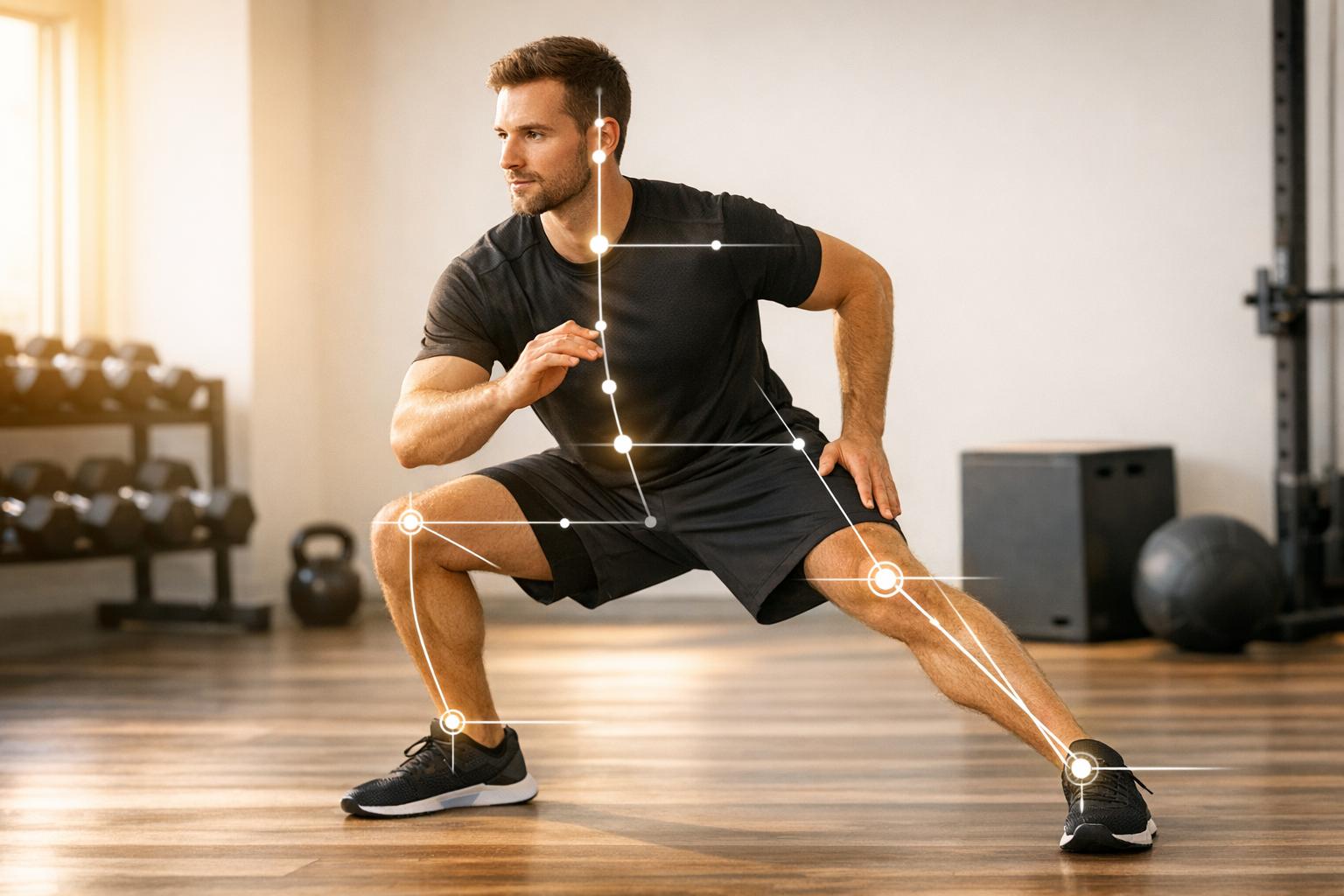
How AI Analyzes Dynamic Stability in Workouts
AI is transforming how we approach strength training by providing precise feedback on dynamic stability - your body's ability to maintain control during movement. Using tools like CueForm AI, you can analyze workout form through video, identify movement issues like knee valgus or spinal misalignment, and receive tailored advice to correct them. Here’s the key takeaway:
- Dynamic stability matters: Poor control can lead to injuries, wasted energy, and compromised performance.
- AI tools offer precision: Apps like CueForm AI track joint angles and movement patterns with lab-level accuracy (±3–5°).
- Personalized feedback: Instead of generic advice, you get specific, actionable insights to improve form and reduce injury risks by up to 50%.
- Progress tracking: AI saves reports and scores, letting you monitor improvements over time.
Creating Your Own AI Fitness Trainer: Analyzing Squats with MediaPipe

What Is Dynamic Stability and Why Does It Matter?
Dynamic stability is all about controlling your center of mass while moving within your base of support. Unlike static balance, which is more about staying steady while standing still, dynamic stability requires constant adjustments from your muscles and nervous system to keep everything aligned during movement [5]. This control is crucial - not just for improving performance but also for avoiding injuries.
When your dynamic stability falters, your body starts wasting energy. For example, if your hips wobble during a squat, your stabilizing muscles have to work overtime, which takes energy away from the actual lift [4]. Studies show that maintaining strong dynamic stability helps reduce these "energy leaks", allowing more of your effort to go into the movement itself rather than compensating for instability [4][2].
While the performance benefits are impressive, the injury prevention aspect might be even more important. When stability breaks down, stress often shifts to areas of your body that aren’t designed to handle it. For instance, if your knee collapses inward during a squat, it places extra strain on the patellar tendon. Similarly, rounding your back during a deadlift overloads your spinal erectors instead of activating your glutes properly [2]. Research backs this up: programs focused on improving movement patterns and biomechanics have been shown to cut injury rates by 23% to 50% [2].
Key Components of Dynamic Stability
Dynamic stability relies on three key factors, and even small missteps in these areas can throw off your workout.
- Core and pelvic control: Your abs, back, and glutes need to work together to maintain a stable spine and prevent your hips from shifting side to side [4][1]. Proper bracing techniques, which create intra-abdominal pressure, are essential for protecting your lower back and ensuring efficient force transfer from your legs to your upper body [1].
- Joint alignment: Your knees should track directly over your toes without collapsing inward (valgus) or bowing outward (varus). At the same time, your spine should retain its natural curves under load. Even minor misalignments can shift stress to the wrong areas, increasing the risk of chronic issues down the line [2].
- Symmetry: Both sides of your body need to share the load equally. If one side compensates for the other, you’re reinforcing bad movement patterns that can lead to muscle imbalances and dysfunction over time [2].
Common Stability Problems in Strength Training
Several common issues can disrupt dynamic stability during strength training, and they often go unnoticed without tools like video analysis.
- Lateral wobble: This side-to-side movement of the hips often occurs during squats or lunges when the hip stabilizers aren’t strong enough to keep the pelvis steady. It not only reduces the efficiency of your lifts but also increases the risk of injury [4].
- Knee valgus: When your knees cave inward during exercises like squats or deadlifts, it puts excessive strain on the inner knee structures and significantly raises the risk of ACL injuries [2].
- Asymmetrical loading: This happens when one side of your body takes on more weight than the other. For example, your right shoulder might dip during a bench press, or one hip might shift further back during a deadlift. These imbalances can create uneven stress patterns, leading to overuse injuries on the overworked side [2].
- Spinal misalignment: Whether it’s rounding (flexion) or over-arching (extension), losing your spine’s neutral position under heavy loads is especially dangerous. It concentrates stress on specific vertebrae and discs, increasing the likelihood of injury [1][2].
This is exactly where AI-powered tools can step in, offering precise insights to identify and address these stability issues. By analyzing your movements in detail, AI can help you refine your technique, improve efficiency, and reduce the risk of injury.
How AI Analyzes Dynamic Stability in Workouts

How AI Analyzes Dynamic Stability in Strength Training Workouts
AI-powered tools are now capable of analyzing your workout form through smartphone videos, offering detailed, data-driven insights into your dynamic stability. This cutting-edge method helps identify how different metrics contribute to your overall movement quality.
Video-Based AI Analysis
Using apps like CueForm AI, you can record or upload a workout video for analysis. These tools rely on pose estimation algorithms, such as MediaPipe or BlazePose, to track 17–33 skeletal keypoints at 30–60 frames per second. The result? A 3D map of your movements that highlights joint angles and tracks patterns. Any deviations - like knee valgus, hip shifts, or spinal flexion - are flagged for correction [2][3].
To ensure accurate results, position your smartphone at torso height, about 6–8 feet away, and make sure the area is well-lit to avoid shadows [2]. These systems boast over 95% accuracy in detecting technique issues compared to human trainers [3].
Key Metrics for Evaluating Dynamic Stability
CueForm AI evaluates your stability using several important metrics:
- Hip wobble percentage: Tracks side-to-side hip movement during exercises like squats or deadlifts. A lower percentage indicates stronger pelvic control, while higher values may signal weaker stabilizing muscles [4].
- Medial-lateral stability margins: Measures how well your center of mass stays aligned within your base of support. This is vital for efficient force transfer and minimizing energy loss [1][4].
- Asymmetry scores: Identifies imbalances in left and right side movements during bilateral exercises. For example, if one hip shifts further back during a deadlift or a shoulder dips during a bench press, the AI flags these as potential risks for compensatory patterns or injuries [2].
- Tripod foot contact and weight distribution: Assesses whether you’re properly distributing weight across your heels, toes, and the balls of your feet to establish a stable base [1][2].
- Knee tracking: Ensures your knees follow a straight path over your toes during squats, avoiding inward (valgus) or outward (varus) deviations [2].
- Spinal neutrality: Checks whether your spine stays in a neutral position under load, avoiding rounding or over-arching that could put stress on specific vertebrae [1][2].
- Bar path trajectory: Monitors whether the weight you're lifting follows the most efficient path, maximizing muscle engagement and reducing wasted effort [7].
CueForm AI delivers its findings in two formats: a quick feedback summary with actionable tips and a detailed report. The detailed version includes a breakdown of specific metrics, your overall technique score, and progress tracking to help you refine your form over time [7].
Step-by-Step Guide to Using CueForm AI for Dynamic Stability Analysis

Recording Your Workout Video
To get the most accurate analysis of your dynamic stability, start by setting up your smartphone for recording. Place it on a tripod at hip level (about 3 feet or 1 meter high) so your entire body is clearly visible. Use natural or diffuse LED lighting, and wear solid-colored, form-fitting clothing to help the AI track your movements effectively. Record in 1080p at 30 frames per second for the best results.
When recording specific exercises, focus on key mechanics:
- Squats: Capture your depth, knee tracking, and hip hinge.
- Bench Press: Emphasize the bar path and elbow positioning.
- Deadlifts: Ensure the video shows your starting position, back alignment, and lockout.
Perform your movements slowly and with control. Rushing through reps can make it harder for the AI to provide accurate feedback.
Uploading and Reviewing AI Feedback
After recording, upload your video to the CueForm AI app for instant analysis. Begin by selecting the exercise you performed - Squat, Bench Press, or Deadlift - and then upload your video. Provide a brief description of your goals and current training focus to receive tailored feedback. The AI will process your video and generate a detailed report, complete with actionable cues like “adjust your knee position” or “focus on bar path consistency.”
The report highlights areas that need attention, such as knee tracking, balance, or inconsistencies in your bar path. You can also review your video frame-by-frame to identify exactly where your form needs improvement. If a specific cue doesn’t seem clear, use the app’s “Chat with coach AI” feature to ask follow-up questions or refine the feedback to suit your needs.
Tracking Your Progress Over Time
CueForm AI makes it easy to track your progress and refine your technique over time. Each set you upload is assigned a technique score, and your videos and reports are saved for future reference. By comparing scores, you can see improvements in areas like joint alignment or stability as you gradually increase the load.
The app also helps you stay consistent by allowing you to set training frequency goals. Regularly reviewing your history can reveal trends in your performance and keep you motivated to meet your stability and training objectives.
Applying AI Feedback to Improve Dynamic Stability
Targeted Exercises for Better Stability
After CueForm AI identifies areas where your stability needs work, you can address them with specific, focused exercises. The AI's "Findings" section links each cue to an underlying issue - like excessive hip wobble or knee valgus - so you know exactly what to target.
For example, if the AI highlights hip stability problems, incorporate exercises that strengthen your glutes and hip flexors between lifts. These can help minimize side-to-side wobbling and improve pelvic control during movements like squats and deadlifts. If core or spinal stability is flagged - such as excessive back rounding - focus on abdominal bracing and thoracic extension exercises to maintain a neutral spine during lifts[4]. For knee alignment issues, the "knees out" cue can help during squats, and slowing down the eccentric phase reinforces proper tracking[2].
You can also apply the AI's "do this next rep" cues in real time during your workout to correct bad habits before they become ingrained. If a cue feels off or unclear, use the "Chat with coach AI" feature to get alternative suggestions or more detailed explanations. Leveraging AI insights has led to a 23% drop in injury-related clinic visits, showing how effective these adjustments can be[2].
To measure your progress, compare your metrics before and after implementing these changes.
Comparing Before and After Metrics
Tracking your progress with data is a great way to confirm the impact of your adjustments. CueForm AI stores all your videos and reports, making it easy to see how far you've come. On average, users improve their technique by 10% after just 10 sets and up to 34% after 200 sets when consistently applying AI feedback[6].
| Metric | Before Score | After Score | Improvement % |
|---|---|---|---|
| Technique Score | 65/100 | 82/100 | 26% |
| Hip Stability (Wobble) | High | Low | N/A |
| Knee Alignment (Valgus) | 12° deviation | 3° deviation | 75% |
| Bar Path Consistency | 72% | 91% | 26% |
| Range of Motion (Depth) | 85% | 100% | 17% |
These numbers represent more than just stats - they show real progress toward safer and more efficient lifting. Improved metrics not only enhance performance but also lower the risk of injury. Regularly reviewing your reports helps you prioritize which stability issues to address next. And if you're unsure about the next steps, the AI chat feature can guide you in refining your approach based on how your body responds to the modifications.
Conclusion
Dynamic stability plays a crucial role in ensuring safe and effective strength training, safeguarding your joints while maximizing muscle engagement. Tools like CueForm AI bring professional-grade biomechanical analysis right to your fingertips, using just a smartphone. This technology can pinpoint issues like knee valgus or spinal flexion - problems that often go unnoticed. Research backs this up, showing that biomechanically focused training programs can significantly lower injury rates[2], and AI-driven feedback has been shown to improve form by an average of 34% after 200 sets[6].
What makes AI analysis so powerful is its precision and consistency. These systems catch crucial details every single time, providing the same high-quality feedback whether it’s your first rep of the day or your last, no matter the time you’re training - be it early morning or late at night.
"Fitness today leverages AI to make solo training as effective as working with an expert coach, ensuring every workout moves you closer to your goals while protecting long-term health."
If you're ready to see the benefits for yourself, try recording one set of a key lift - like a squat, bench press, or deadlift - and upload it to CueForm AI. You'll get instant feedback that you can apply in your next session. Over time, track how your technique score improves. With the Free plan offering unlimited quick feedback and the Starter plan priced at $10/month for detailed reports, there's no reason to hold back. Considering that biomechanical issues are responsible for 70% of non-contact injuries[2], using AI tools could be the key to staying injury-free and making steady progress.
FAQs
How does AI identify and correct knee valgus during exercises?
AI leverages sophisticated computer-vision algorithms to monitor movement by identifying key body landmarks such as the hips, knees, and ankles within video frames. By reconstructing 3D joint positions, it evaluates the knee's alignment and identifies inward deviations - referred to as knee valgus - when they surpass a certain threshold.
When such issues are detected, the AI offers customized feedback aimed at correcting the problem. Suggestions might include cues like “push your knees outward,” “engage your glutes,” or “adjust your stance,” all tailored to match the individual’s anatomy and specific goals. This real-time guidance not only fine-tunes form but also boosts stability and helps lower the risk of knee injuries over time.
How does AI help improve dynamic stability during workouts?
AI improves dynamic stability by delivering real-time, customized feedback on how you move. It evaluates your joint motion and balance to pinpoint areas that need attention, helping you perform better while lowering the chance of injuries.
With AI-powered tools, you get personalized insights designed for your unique body and workout approach, ensuring your form remains steady and effective as you progress.
How can AI help me perfect my workout technique?
AI tools like CueForm make it simpler to fine-tune your squat, bench press, or deadlift technique. All you need is a clear video of your exercise that captures your entire range of motion. Along with the video, share details like your body measurements, training goals, and any mobility challenges. This information helps the AI provide feedback tailored specifically to you.
After you upload your video, the AI evaluates critical aspects of your movement, such as bar path, joint angles, depth, and knee alignment. Based on this analysis, it offers practical tips, like improving squat depth, aligning your knees, or keeping the bar path straight. By implementing these suggestions and recording your progress, you can steadily enhance your form, leading to safer and more efficient workouts.