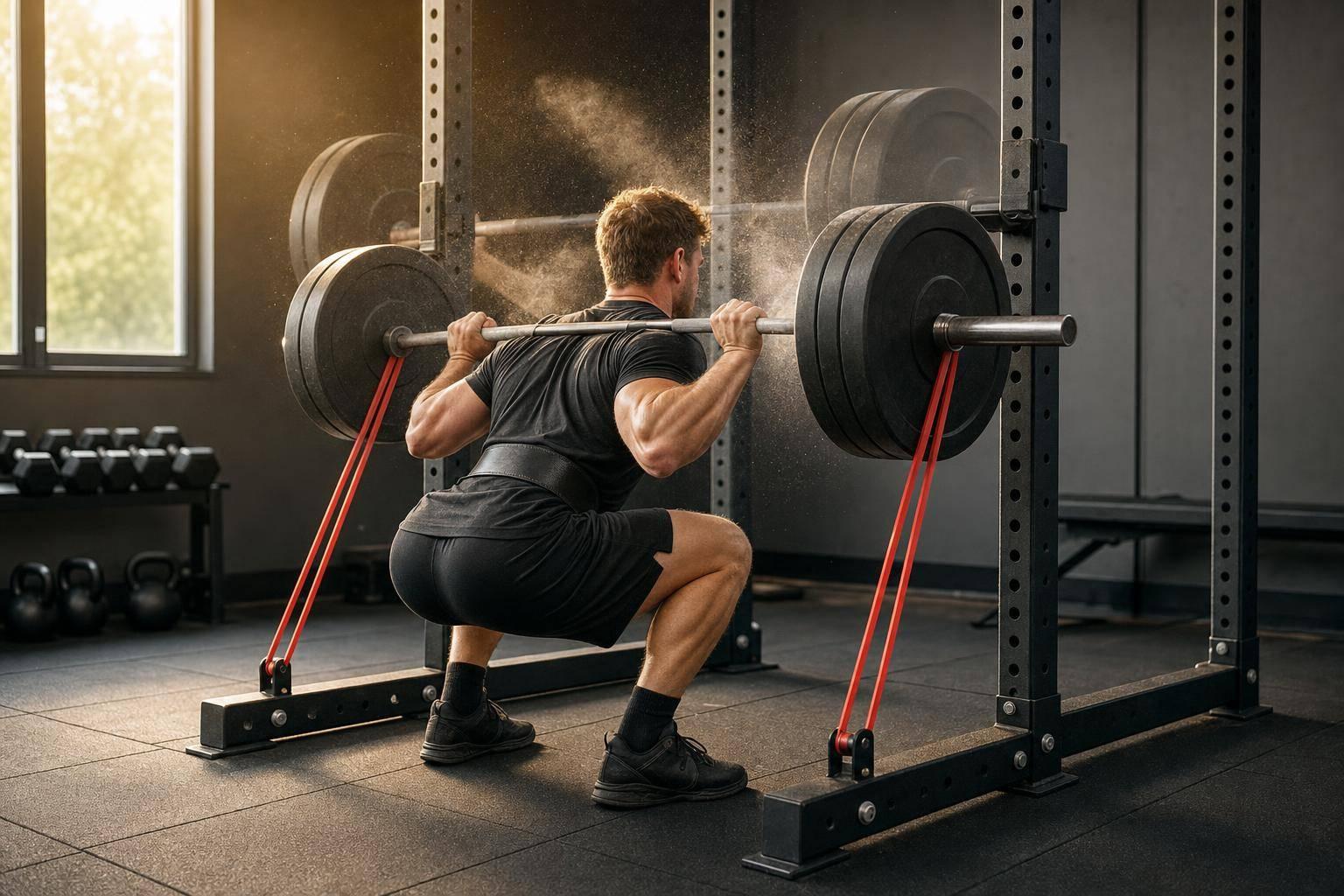
When Dynamic Resistance Helps Squat and Bench
If you want the short answer: use bands and chains for bar speed and lockout work, and use straight weight for most of your strength work.
I’d sum it up like this:
- Straight weight fits most lifters, most of the time
- Bands and chains fit short blocks when I want more speed or more load near the top
- Beginners should stick with straight weight
- Intermediates and advanced lifters can use dynamic resistance in 3–6 week waves
- A common setup is 50–60% 1RM on the bar plus 10–20% added at lockout
- For peaking, hypertrophy, and technique practice, straight weight is usually the better pick
Here’s the main idea in plain English: as I stand up in a squat or press a bench, my leverage gets better. Bands and chains make the lift heavier as I move into that stronger range. That can help me keep pushing instead of coasting near lockout. But it also makes training harder to track, and if I use too much tension, the bottom can get too light.
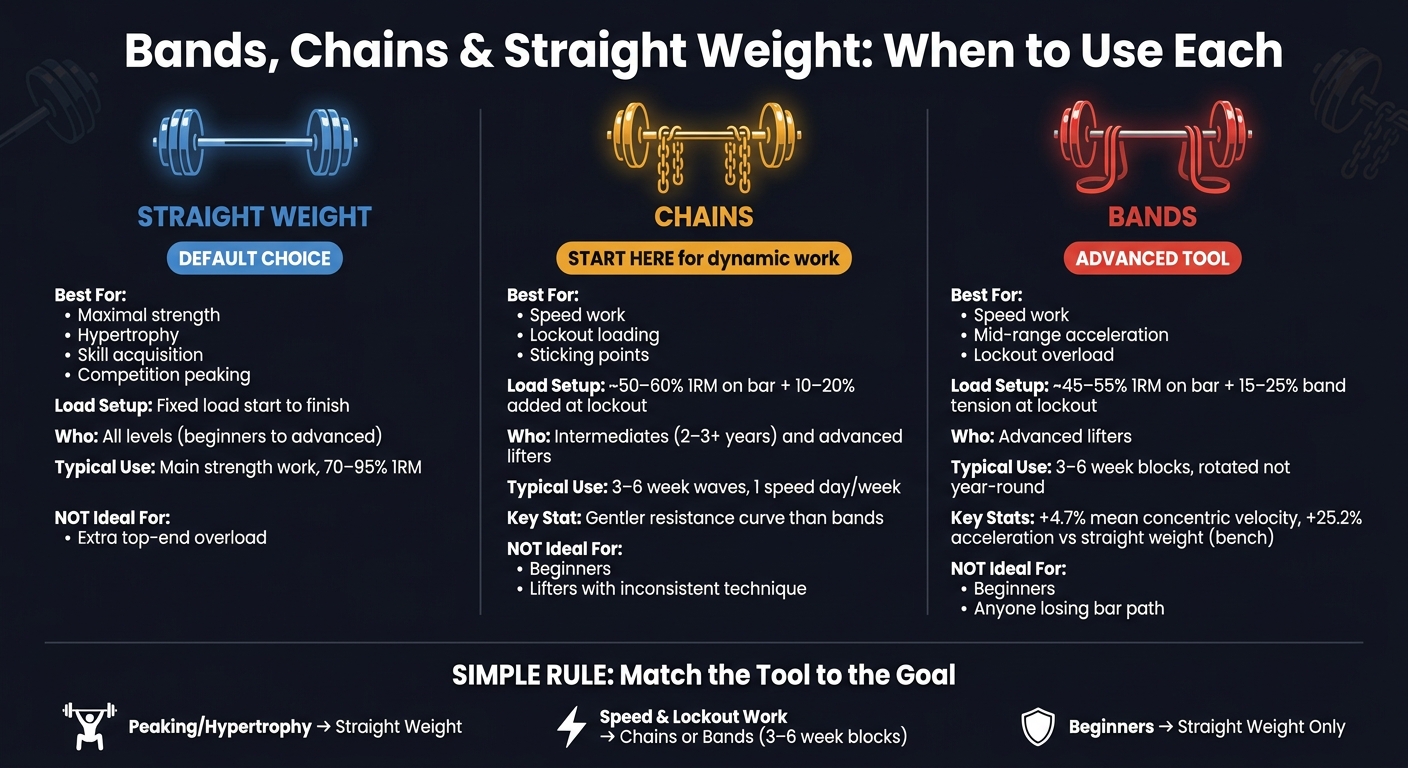
Bands, Chains & Straight Weight: When to Use Each for Squat & Bench
CHAINS VS BANDS FOR SQUATS | Why and When To Use Them
Quick comparison
| Method | Best use | Typical load setup | Best for | Not ideal for |
|---|---|---|---|---|
| Straight weight | Main strength work | Fixed load from start to finish | Skill, hypertrophy, peaking, 1RM prep | Extra top-end overload |
| Chains | Speed work and lockout loading | Usually 10–20% of total load at the top | Intermediates starting dynamic work | Lifters with shaky squat technique |
| Bands | Speed work with more pull at lockout | Usually 10–25% at lockout | Advanced lifters targeting speed or sticking points | Beginners, or anyone losing bar path |
For squat, I’d use dynamic resistance when I want to keep force high through the ascent and cut down on deceleration near the top. For bench, I’d use it when I want more speed through mid-range and more stress into lockout. Research in the article points to ~4.7% higher mean concentric velocity and 25.2% higher acceleration with chains on bench versus straight weight at the same relative intensity.
The bottom line: bands and chains are a tool, not a default. I’d keep heavy days straight weight, add one speed day per week when it fits the goal, and pull them out again before a meet or max test.
When Dynamic Resistance Helps the Squat
Speed Work, Power Output, and Reducing Deceleration at Lockout
For the squat, dynamic resistance helps most when you want to keep force high all the way up. With straight-weight squats, a lot of lifters start to coast near lockout because the bar becomes easier to move. Bands and chains help stop that drop-off by making the top of the rep tougher.
Chains add load as more links come off the floor. Bands add tension as they stretch. In both cases, the top of the squat is harder than the bottom, which pushes you to keep producing force instead of easing off [14][15].
A common setup looks like this:
- 50–60% of 1RM on the bar
- Bands or chains adding about 10–20% at lockout
- 8–10 sets of 2–3 reps
- 45–75 seconds of rest
That setup usually keeps bar speed in the 0.6–0.8 m/s range while still asking for legit effort. The goal is simple: move the bar as fast as possible with clean mechanics [1][6][7][2][8].
Who Benefits Most from Squat Bands and Chains
Bands and chains are best for lifters who already have solid squat mechanics, usually people with 2–3+ years of steady training [10][11]. If your depth, bracing, or bar path still changes from rep to rep, variable loading tends to make those issues bigger, not smaller.
The best time to use a band- or chain-squat block is in the off-season or during early training phases. Short 3–4 week waves tend to work well. Start on the conservative side with bar weight and tension, build across the wave, then switch back to straight weight [13][12]. The bench press follows the same basic idea, but the part of the rep that gets the most useful overload changes.
When Dynamic Resistance Helps the Bench Press
Building Mid-Range Speed and Lockout Strength
The bench press follows the same accommodating-resistance idea as the squat, but the overload tends to show up later in the rep.
With the bench, dynamic resistance does its best work through the mid-range and into lockout. As the bar rises, the lift often gets easier. Bands and chains change that. They keep the load climbing, which forces you to keep driving through the sticking zone where a lot of bench reps slow down or stall.
Research supports that effect. Adding chains to the bench press increased mean concentric velocity by about 4.7% and acceleration by 25.2% versus straight weight at the same relative intensity. [17] That makes this tool a good fit for speed work and lockout training, not something you need on every bench day.
For most lifters, 10–15% at lockout is a solid range. Advanced lifters can go up to 20–25%, but only if the bar path stays steady on every set. [2][20][21]
How Bench Sessions with Dynamic Resistance Are Typically Programmed
A typical speed bench day usually uses:
- 50–60% of 1RM on the bar
- Bands or chains adding about 10–20% at lockout
- 6–9 sets of 2–3 reps
- 45–75 seconds of rest between sets
Each rep should move fast without getting sloppy. Stay in control, keep the upper back tight, and make the press look the same from set to set. [1][16][9]
This kind of session is often paired with one heavier straight-weight bench day each week. The jobs are different. The heavy day builds strength with straight weight. The speed day trains the nervous system to produce force fast through the full concentric portion of the lift.
Studies show steady gains in bar velocity and acceleration, but long-term strength gains from accommodating resistance by itself are modest and mixed. [17][4][18] So it pays to keep the setup conservative. If bar speed drops, the bar path starts drifting, or the bar wobbles, pull back the load or tension. That's the tradeoff - and it's why straight weight still has a big place in bench training.
When Fixed Loading Makes More Sense
Straight weight works for most of the work in most squat and bench programs. Whether it makes sense comes down to the goal, the lifter’s skill level, and where they are in the training cycle.
Best Uses for Straight Weight in Squat and Bench
Novice lifters should use straight weight almost all the time. Bands and chains change how the load feels as the rep moves, and that can make things messy for someone who’s still learning the lift. New lifters need clear feedback. They need to see whether bar path is clean, whether they’re bracing well, whether squat depth is there, and whether bench touch points stay consistent.
For hypertrophy blocks, straight weight is usually the better tool too. It’s simpler to track, compare, and progress from week to week. If the goal is adding muscle, that matters a lot. A meta-analysis found no meaningful muscle-thickness advantage for accommodating resistance.[24]
Competition peaking is another clear case for straight weight. In the last 6 to 8 weeks before a meet or max test, specificity matters most. You want the lift to look and feel like meet day. Bands and chains change the resistance curve, and that can change how a lifter reads effort. Straight weight at 85–95% of 1RM, with top singles and back-off sets, keeps effort tracking honest and helps technique stay sharp under the loads that count.
There’s also a simple downside to using too much accommodating resistance: it can make the lift worse. If band tension or chain weight gets too high, the bottom of the rep can become too light. That often leads to sloppy descents, weak bracing, or rushed touches on bench.[23] Straight weight keeps force demands more even across the full range of motion.
Dynamic Resistance vs. Fixed Loading: A Direct Comparison
The easiest way to choose is to match the method to the goal.
| Training Goal | Dynamic Resistance (Bands/Chains) | Fixed Loading (Straight Weight) |
|---|---|---|
| Maximal strength | Targets sticking points | Best for true 1RM testing |
| Power | Reduces deceleration; improves bar speed at mid and top range | Works well for general power; easier to program with velocity targets |
| Hypertrophy | Complicates load tracking; may reduce sustainable volume | Cleaner tool for progressive overload |
| Skill acquisition | Changes resistance curve during learning | Best for building repeatable motor patterns |
| Competition peaking | Typically removed in final weeks | Matches meet conditions; supports accurate effort tracking |
In most programs, straight weight should do the base work, while dynamic resistance fills a narrow, specific role.
How to Blend Both Methods in One Program
When dynamic resistance matches the goal, treat it like a short training block, not your default setting. Most of your work should still be straight weight. Bands or chains come in for a short stretch with a clear purpose. In practice, that usually means your heavy squat and bench sessions stay straight weight, while bands or chains appear on one speed day per lift each week during selected blocks, not all year.[27][28]
A common 4-day setup is simple: one heavy straight-weight day and one speed day for each lift. The heavy days build lift-specific strength and keep the movement pattern sharp. The speed days focus on bar speed and more load near the top of the lift.[26][25]
A Simple Weekly and Monthly Structure
| Week | Lift | Load Type | Loading | Session Focus |
|---|---|---|---|---|
| 1 | Squat | Straight weight | About 70–80% 1RM | Volume, position, depth |
| 1 | Bench | Straight weight | About 70–80% 1RM | Volume, touch point, bar path |
| 1 | Squat | Chains | ~75% total (about 50% bar + ~25% chains) | Bar speed, drive through ascent |
| 1 | Bench | Bands | ~70% total (about 45–50% bar + ~20–25% bands) | Speed off the chest, acceleration |
| 2 | Squat | Straight weight | Slightly heavier than Week 1 | Heavier specificity |
| 2 | Bench | Straight weight | Slightly heavier than Week 1 | Heavier specificity |
| 2 | Squat | Chains | ~80% total (about 55% bar + ~25% chains) | Speed with added bar load |
| 2 | Bench | Bands | ~75% total (bar up slightly, bands constant) | Mid-range force, bar speed |
| 3 | Squat | Straight weight | Heaviest week | Peak intensity |
| 3 | Bench | Straight weight | Heaviest week | Peak intensity |
| 3 | Squat | Chains | ~85% total (about 60% bar + ~25% chains) | Max speed under load |
| 3 | Bench | Bands | ~80% total (bar up again, bands constant) | Lockout strength, acceleration |
| 4 | Squat | Straight weight | Lower-stress deload | Technique reset, recovery |
| 4 | Bench | Straight weight | Lower-stress deload | Technique reset, recovery |
After three weeks, deload or go back to straight weight before starting the next dynamic block.
How Training Level Changes the Decision
How much dynamic work makes sense depends on training age and how steady your technique is.[27][7]
| Training Level | Suggested Accommodating Resistance Frequency | Recommended Accommodating Resistance % of Total Load | Notes |
|---|---|---|---|
| Beginner | None | 0% | Straight weight only; technique needs to stabilize first |
| Intermediate | Selected 3-week waves | 10–20% (chains preferred) | Add once technique is consistent; chains are a better first tool |
| Advanced | 4–8 week blocks, rotated | 15–25% (bands or chains) | Use on purpose for speed or overload; rotate, don’t run year-round |
Chains are usually the better place to start for intermediates. They add load more gradually, move more smoothly, and are less likely to change the lift pattern than strong bands.[27][3][22] Think of chains as the gentler option. You still get changing resistance, but without the same pull and snap that bands can bring. A practical squat setup leaves one to two links on the floor at the bottom so the chain fully deloads, then adds load in a steady way as you stand up.[19]
Using CueForm AI to Keep Technique Stable as Resistance Changes
As resistance changes, video review can help you spot technique drift before it turns into a habit. Use CueForm AI to compare straight-weight sessions with dynamic sessions and check for shifts in bar path, torso position, or lockout. The coach chat can help you judge whether those changes are fine for the goal of the session or a sign that the load is too aggressive.
Key Takeaways: When to Use Bands, Chains, or Straight Weight
The simplest rule is this: match the tool to the training goal.
Use straight weight as your default. Save bands and chains for speed work, sticking points, or lockout overload.
Dynamic resistance works best when you're trying to fix a specific training problem. It shouldn't become your go-to just because it feels different. In one 8-week block, band-assisted squats improved peak power more than straight-weight squats [12].
Straight weight is what builds your base strength and sharpens skill under the bar. Bands and chains make more sense when the goal is bar speed, getting past a weak range, or adding more load near lockout.
A simple setup looks like this:
- Use 10–20% chain load or 15–20% band tension at lockout
- Run it for 3–6-week blocks
- Then go back to straight weight [5][4][12]
That way, the method stays tied to a clear purpose instead of turning into a habit.
FAQs
How do I know if I’m ready for bands or chains?
You’re ready for dynamic resistance once your technique is dialed in and you can keep your movement quality steady under load.
Bands and chains make the lift heavier at the top. So before you add them, you should show solid control in the standard squat or bench press. That means no form breakdowns like knee valgus or a shaky bar path.
Tools like CueForm AI can help you check that your reps stay consistent before you add variable resistance.
Should I use bands or chains for squat and bench?
Bands and chains change resistance as you move through the lift. That means the load can feel lighter in one part of the rep and heavier in another, which can help you work on sticking points.
For squats, bands around the knees can also help during warm-ups. They give you a simple reminder to push the knees out and keep them tracking well.
At the same time, fixed loading still has a big place in training. It helps build cleaner movement, steadier reps, and a more consistent bar path. CueForm AI can help you see whether bands or chains are improving your mechanics - or just hiding a technique issue that shows up under normal loading.
When should I switch back to straight weight?
Switch back to straight weight when you want cleaner progress tracking or need to lock your technique back in after a stretch of changing loads. Keeping the load the same gives you a more predictable training stress, which helps a lot during strength-peaking phases.
If your range of motion, bar path, or form starts to drift under changing loads, fixed loading can help you regain control and clean up movement quality.