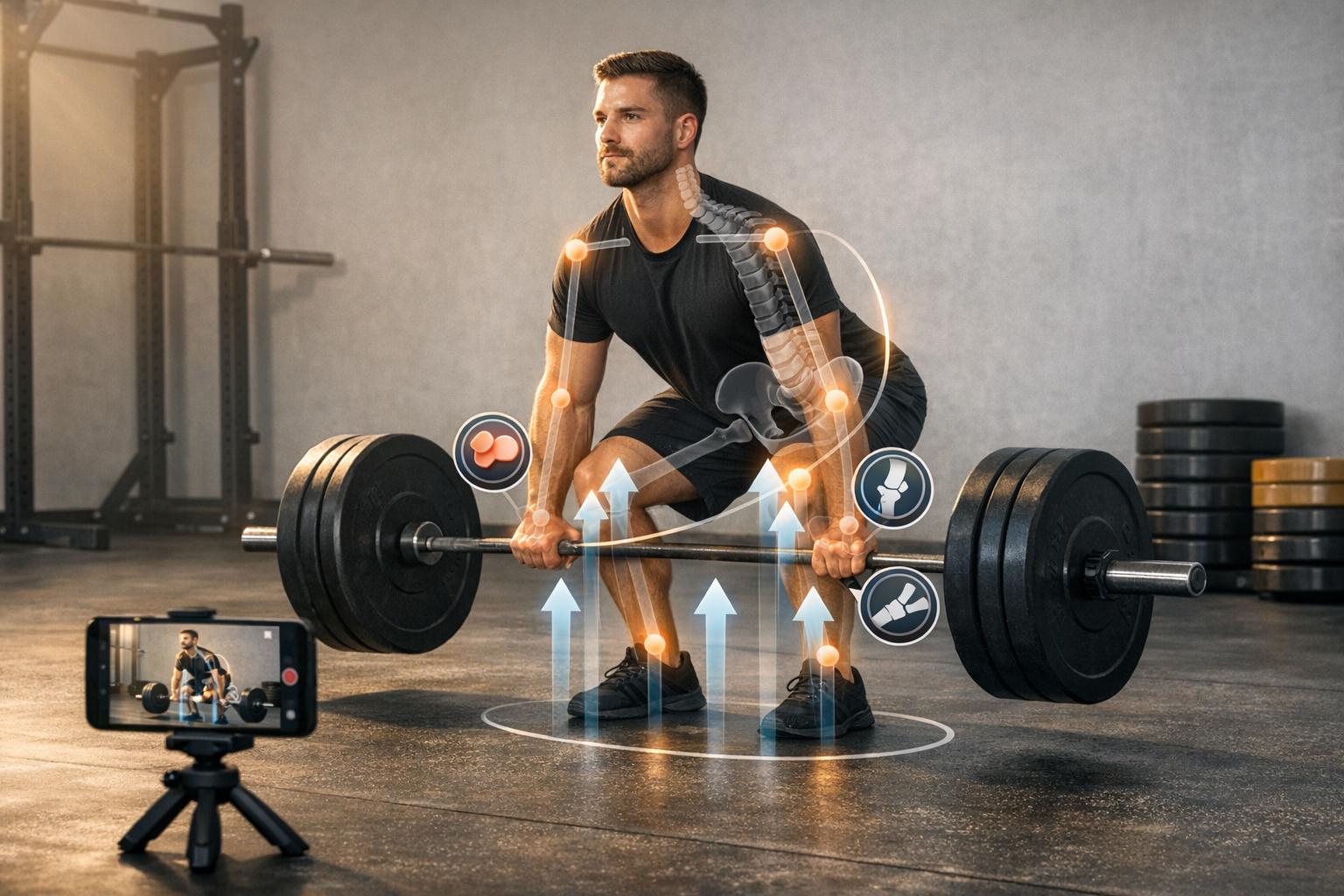
Deadlift Force Analysis with AI Tools
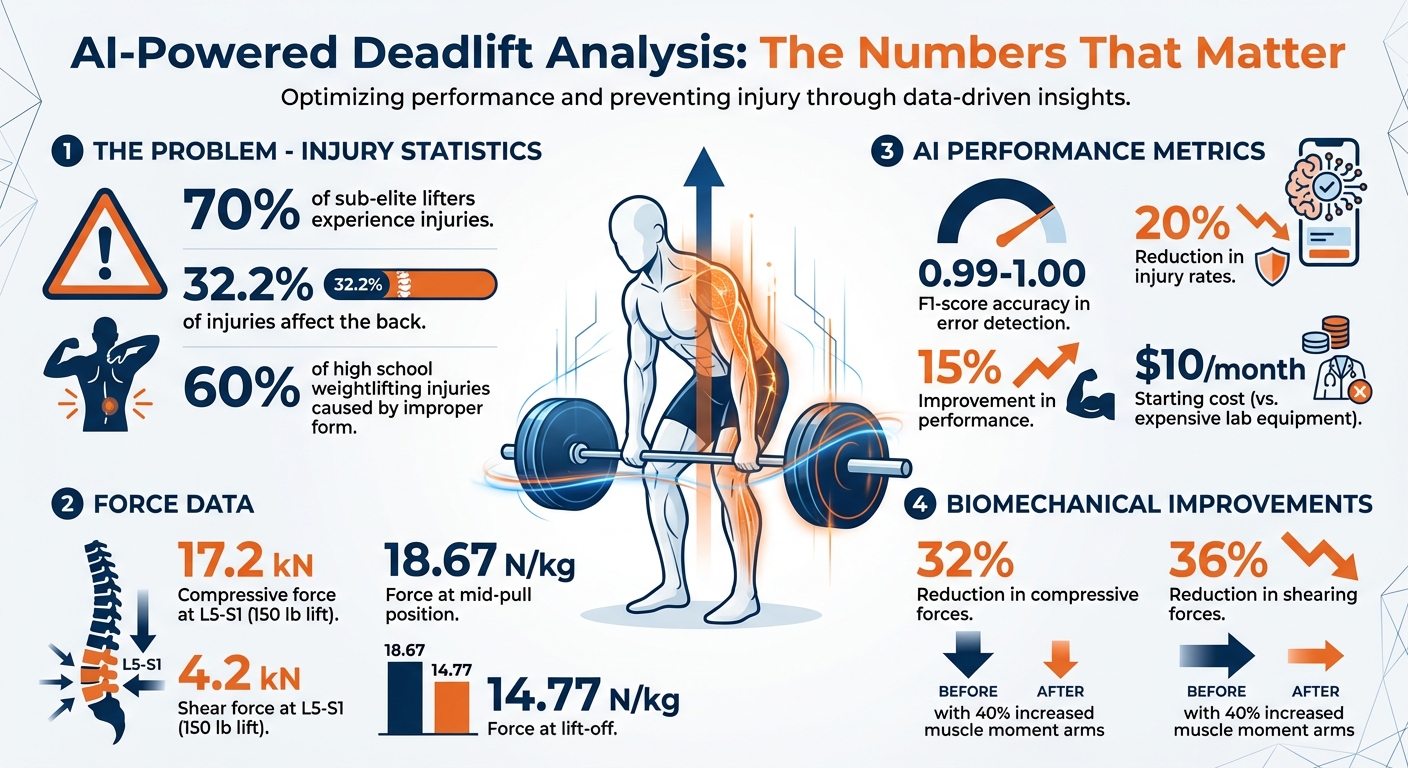
Deadlifts are one of the most demanding exercises, putting extreme stress on the spine and joints. For example, lifting 150 lbs can create 17.2 kN of compressive force and 4.2 kN of shear force at the L5-S1 vertebrae - forces that exceed bone fracture thresholds for many individuals. Improper form increases injury risks, with 70% of sub-elite lifters injured and 32.2% of injuries affecting the back.
AI tools are transforming how we assess deadlift technique. By analyzing video footage with Human Pose Estimation (HPE) models and advanced neural networks, these tools provide instant feedback on form issues like rounded backs, early hip elevation, or uneven bar paths. Platforms like CueForm AI allow lifters to upload videos for detailed feedback, reducing injury risks by 20% and improving performance by up to 15%.
Key highlights:
- Force Analysis: Deadlift force output varies by position, with mid-pull generating 18.67 N/kg compared to 14.77 N/kg at lift-off.
- AI Accuracy: Models achieve F1-scores of 0.99–1.00 in identifying errors.
- Cost-Effective Tools: AI eliminates the need for expensive lab setups, making advanced analysis accessible for as little as $10/month.
AI-powered feedback is changing the game by offering precise, actionable insights that help lifters improve technique and avoid injuries - all from a simple smartphone video.
AI-Powered Deadlift Analysis: Key Statistics and Benefits
Force Output During Deadlifts
Biomechanical Factors That Affect Force
Force output during a deadlift is heavily influenced by joint angles. For example, the mid-pull position, where the bar is just above the knees, generates about 18.67 N/kg, compared to 14.77 N/kg at lift-off. This happens because the muscles are in a position that optimizes their length-tension relationship[8].
Another key factor is muscle moment arms - the perpendicular distance from the joint axis to the muscle's line of action. A study from January 2023 analyzed a 6 ft, 218 lb male performing a 150 lb hex bar deadlift and found that increasing muscle moment arms by 40% reduced maximum compressive forces on the L5-S1 vertebra by 32% and shearing forces by 36%[1]. This demonstrates how small adjustments in muscle positioning can significantly lower the risk of spinal injuries.
Stance choice also plays a role. A wider sumo stance reduces vertical bar displacement and decreases stress on the lower back compared to the conventional stance. Research from 2025 showed that while conventional deadlifts result in greater activation of the biceps femoris, the sumo style activates the vastus lateralis more during the initial lift-off phase[2].
Standard Methods for Measuring Force
To truly understand these biomechanical variables, accurate force measurement is essential. Traditional methods often rely on laboratory-grade tools:
- Force plates are the gold standard for measuring ground reaction forces (GRF), which help calculate total system power. However, they are expensive and typically limited to lab settings[7][2][5][4].
- 3D motion capture systems like VICON or Qualisys use cameras to track markers on the barbell and the lifter’s body. By analyzing displacement-time data, these systems calculate bar force by multiplying the bar's mass by its acceleration. While highly accurate, these systems come with significant costs and require time-intensive data processing. As noted in the Journal of Biomechanics:
Using 3-D motion capture systems is expensive and data processing can be time intensive[5].
- Surface electromyography (sEMG) measures the electrical signals from muscle fibers to track engagement in key areas like the lower back, glutes, and hamstrings[4][2]. In December 2024, researchers validated a wearable sensor called "Motion Tape" that monitors muscle engagement and reveals asymmetries across loads ranging from 95 lbs to 135 lbs[4]. However, traditional sEMG sensors have limitations. According to Sensors:
Providing information on muscle engagement is critical for form analysis, but sEMG sensors are not designed to be worn by athletes because of their form factor and issues with movement artifacts[4].
To address these challenges, more accessible solutions are gaining traction. Inertial Measurement Units (IMUs), which attach to the barbell or body, offer a practical alternative. These sensors measure displacement and velocity, providing data in real-world training environments without the hefty price tag of lab equipment[5][4]. However, barbell-only IMUs fall short when it comes to analyzing the lifter's form, as they lack data on body movement.
These measurement tools not only enhance technique but also help minimize injury risks, offering athletes a way to fine-tune their performance through data-driven insights.
How AI Tools Improve Deadlift Force Analysis
Video Analysis for Personalized Feedback
AI tools have made force analysis more accessible by allowing lifters to upload smartphone videos instead of relying on costly lab equipment. These systems use Human Pose Estimation (HPE) models like MoveNet or MediaPipe to extract joint coordinates from standard video footage, tracking 17 keypoints such as hips, knees, and shoulders[3].
With the help of Convolutional Neural Networks (CNNs), the AI analyzes spatial features in each frame to identify issues like a rounded back or improper bar path. Meanwhile, Long Short-Term Memory (LSTM) networks evaluate the timing of movements to catch problems like premature hip elevation or uneven lifting tempo[3]. These models have achieved impressive accuracy, with F1-scores of 0.99 for identifying deadlift styles and 1.00 for spotting execution errors[3].
What sets this technology apart is its ability to turn raw data into practical advice. By using musculoskeletal modeling tools like OpenSim, these systems estimate the internal muscle forces needed to produce the observed joint movements. Single-camera AI models have shown strong correlations (0.71–0.92) with traditional marker-based lab systems in estimating muscle forces for key movements[10].
Finding Form Breakdowns and Inefficiencies
Using video-based joint tracking, AI tools can identify specific errors that hinder force production. For example, they monitor the bar path to ensure it moves vertically and stays close to the lifter's center of mass[9]. They also measure joint angles throughout the lift to catch issues like excessive spinal flexion or overextension at lockout[9]. Temporal metrics, such as bar velocity and the coordination between hip and shoulder movement, help detect patterns like early hip elevation, often called the "stripper squat"[3].
These tools go further by analyzing load distribution and foot stability, highlighting inefficiencies in control. When recorded from a side view, they can accurately detect problems like back rounding and poor hip hinge mechanics[3]. Feedback is delivered in the form of clear, coach-style cues like "spread the floor" or "chest up first", prioritizing advice based on injury prevention[9]. Research shows that training programs informed by machine learning assessments can reduce injuries by 20% and boost performance by 15%[6].
Example: CueForm AI
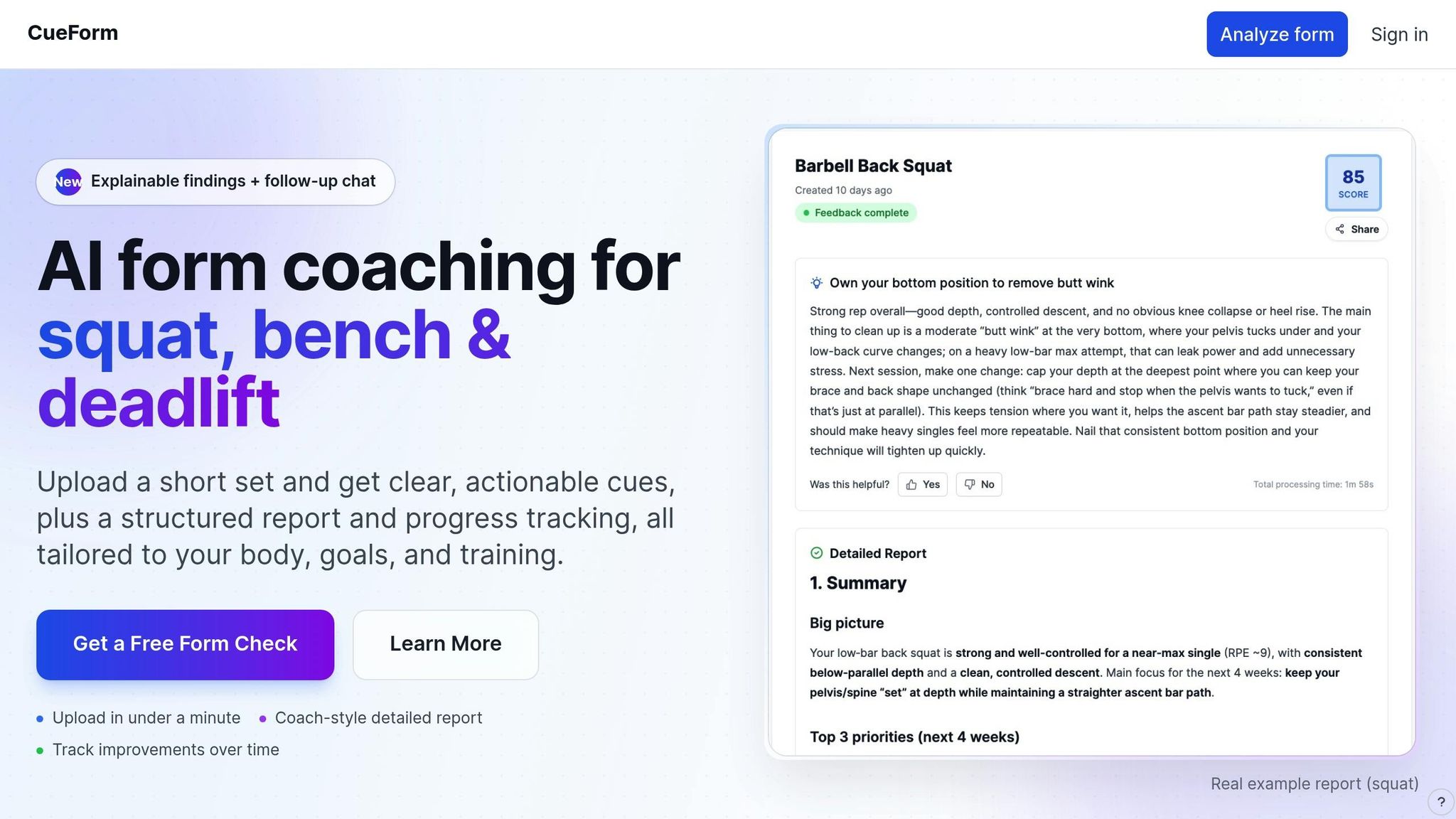
CueForm AI is a prime example of how this technology empowers lifters to make immediate improvements. With a simple video upload, the platform analyzes key aspects of the deadlift, such as bar path, hip hinge mechanics, and lockout completion. It identifies specific issues like early hip elevation or spinal flexion and explains the metrics behind each finding. Instead of generic tips, CueForm AI delivers personalized cues tailored to the lifter's unique movement patterns.
The platform also includes an integrated AI coach to answer follow-up questions and refine techniques based on individual goals - whether for powerlifting competitions or general fitness. CueForm AI offers a Free tier for unlimited quick checks, while its Starter plan, priced at $10/month or $89/year, provides unlimited detailed reports and extended AI chat features[9]. This approach eliminates the need for expensive lab setups or personal coaching, making advanced analysis accessible to anyone looking to improve their technique and reduce the risk of injury.
Training my deadlift bot with MediaPipe and OpenCV
sbb-itb-c91a623
Benefits of Using AI for Deadlift Force Analysis
AI-powered tools for deadlift force analysis bring more than just performance insights - they also help refine technique, reduce the risk of injury, and make expert-level feedback more accessible.
Better Technique and Performance
AI tools provide detailed performance metrics that go beyond what traditional coaching can offer. While seasoned coaches might spot 30–40% of form errors during a session, AI breaks down every repetition with frame-by-frame precision[6]. It can identify subtle issues like a 5° hip imbalance or a 10° spinal deviation and analyze key metrics such as bar velocity and tempo consistency. These insights are then used to generate a technique score, which can lead to measurable performance improvements - up to 15% in some cases[6]. This means when you increase the weight on the bar, you're doing so with proper mechanics, not compensating for poor form.
Lower Risk of Injury
Improper form is a leading cause of injuries in weightlifting, accounting for 60% of all weightlifting-related injuries among high school athletes. For CrossFit participants, back injuries make up 32.2% of all reported cases[6][3]. AI tools help tackle these issues by identifying risky movement patterns before they result in injury. Studies show that training programs guided by AI assessments can reduce injury rates by 20%[6].
One of the standout features of AI is its ability to catch errors that human coaches might miss, such as excessive spinal flexion, premature hip elevation, or incomplete hip extension. Zach Lush, a certified CFSC and MPM coach, highlights this advantage:
In a team setting, I can closely monitor 5-6 athletes while the AI flags critical form breakdowns.[6]
This level of oversight ensures that lifters receive immediate feedback on potentially harmful patterns, giving them the chance to correct mobility or technique issues before they lead to pain or injury. The injury-prevention benefits of AI tools are a perfect match for the convenience they bring to training.
Convenience and Accessibility
AI platforms remove many of the traditional obstacles to getting high-quality coaching. For example, reviewing a video submission typically takes a coach 5–10 minutes, but AI delivers feedback instantly[11]. This real-time analysis allows lifters to make adjustments during their workout instead of waiting days for feedback. Plus, AI tools are available around the clock, so you can train whenever it suits you and still get expert-level insights.
The scalability of AI is another game-changer. Research shows that AI enables coaches to manage over 100 athletes simultaneously, far surpassing the typical limit of 30[6][11]. For individual lifters, this means access to advanced biomechanical analysis without needing expensive lab equipment or having to work around a coach's schedule. For example, CueForm AI offers a Free tier for quick feedback and a Starter plan priced at $10/month or $89/year, providing detailed reports at a fraction of the cost of traditional coaching[9].
Conclusion
Understanding force output during deadlifts goes beyond simply aiming to lift heavier - it’s about lifting in a way that’s both smarter and safer. By analyzing force, you can spot issues like asymmetries, form breakdowns (think rounded backs or early hip rise), and even determine which deadlift variation suits you best.
Thanks to AI tools, the barriers to this kind of detailed analysis are practically gone. What once required expensive lab equipment and expert evaluations can now be done with something as simple as your smartphone camera. These tools can catch subtle form issues - like slight asymmetries or incomplete hip extension - that even seasoned coaches might overlook in the moment. And the best part? You get real-time, objective feedback.
The numbers back this up. AI-driven training programs have been linked to a 20% drop in injury rates and up to a 15% boost in performance gains [6]. It’s worth noting that poor form contributes to 60% of weightlifting injuries among high school athletes [6], while back injuries make up 32.2% of injuries in certain high-intensity training groups [3]. This data underscores how AI analysis can play a key role in injury prevention.
Tools like CueForm AI are making this technology more accessible than ever. With options for free quick feedback and flexible plans, CueForm AI offers personalized cues tailored to your anatomy and goals, tracks your progress through technique scores, and even allows you to chat with an AI coach for follow-up questions. No appointments. No waiting. Just instant, actionable insights at your fingertips.
FAQs
How can AI help improve my deadlift form and prevent injuries?
AI takes your deadlift training up a notch by closely analyzing your form and pinpointing issues like poor hip hinging or unsafe back alignment. It delivers tailored feedback and practical tips to help you fix these mistakes, refine your technique, and minimize injury risk.
By catching form problems early, AI tools not only enhance your performance but also ensure your workouts stay safe and effective. Plus, they provide customized advice aligned with your unique goals, so you can lift with greater precision and confidence.
What makes AI tools better than traditional methods for analyzing deadlift performance?
AI tools bring a fresh approach to analyzing deadlift performance, offering real-time, personalized feedback by breaking down videos of your lifts. This allows you to identify and adjust technique flaws on the spot, boosting both the effectiveness of your training sessions and your safety.
What sets AI apart from traditional coaching is its ability to track joint movements, bar paths, and body angles with incredible accuracy, even from a simple video. These systems provide consistent, unbiased evaluations of your form, which can help minimize the risk of injuries tied to poor technique. On top of that, AI tools deliver customized tips and guidance tailored to your biomechanics and fitness goals. This makes them a great addition to in-person coaching or a solid alternative for those training remotely.
How does CueForm AI analyze deadlift videos to provide personalized feedback?
CueForm AI leverages advanced computer vision and machine learning to break down deadlift videos captured on a smartphone. By analyzing key body landmarks and joint movements frame by frame, it assesses the quality of your lift and pinpoints areas that need improvement, such as your hip hinge mechanics or the alignment of your bar path.
The system compares your movements against ideal biomechanical patterns, factoring in your unique anatomy and personal goals. From there, it offers clear, practical tips to refine your technique - whether that means adjusting your hip position or keeping your spine neutral. Plus, you can chat with the AI coach for extra support, making it an easy and effective tool to fine-tune your lifting form.