Back Rounding in the Deadlift: Why It Happens and How to Fix It
Deadlift back rounding is your lower back losing its shape and rounding as you pull the bar off the floor. It is the most common fault in lifters learning the deadlift,1 and it often starts in the set-up and the first inch of the pull.2 Some strong lifters round their upper back on purpose,3 but lower back rounding that grows as the weight goes up is worth fixing.
What back rounding looks like on video
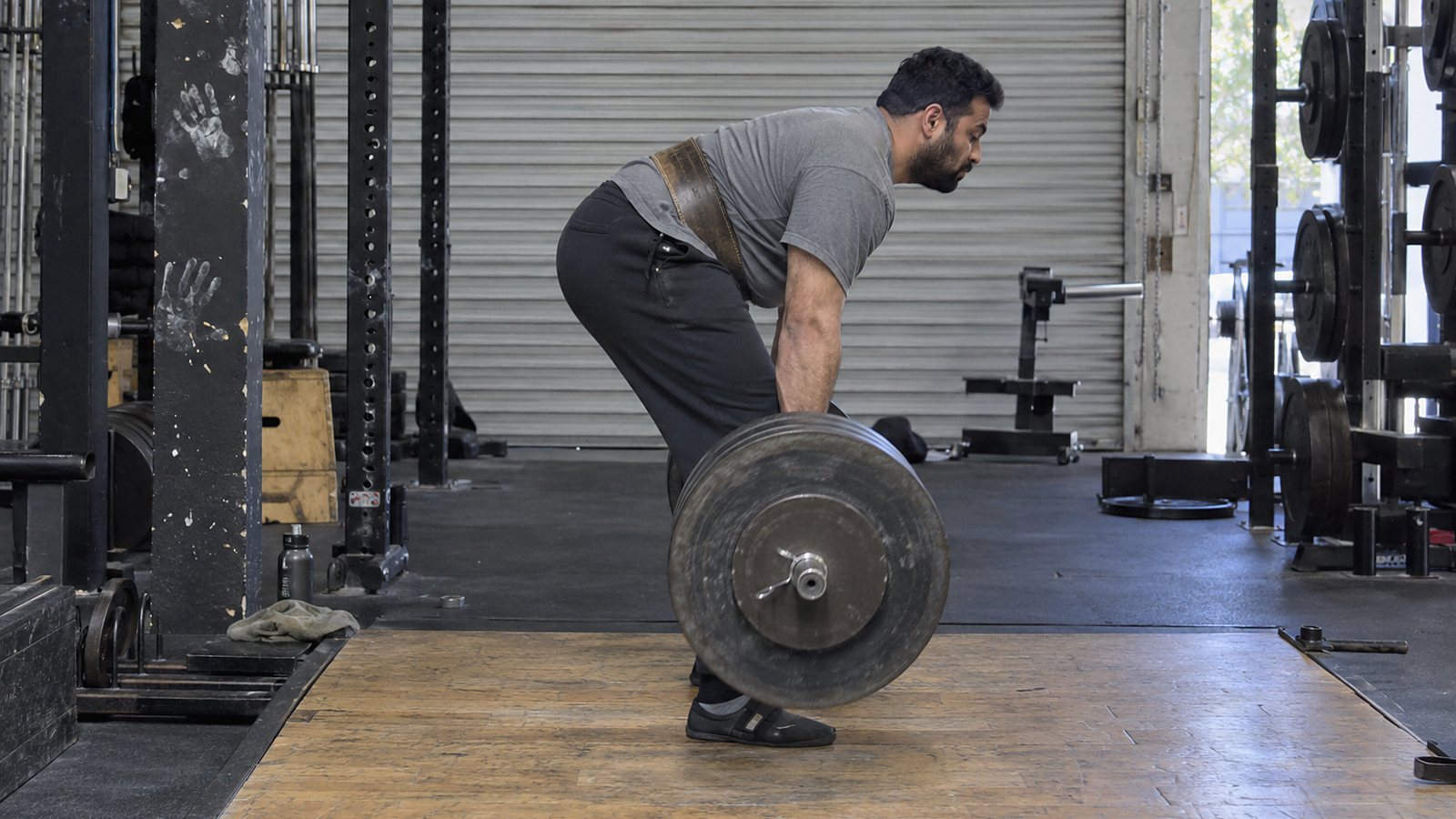
Film from the side at hip height, about 3 meters away, with the plates and your whole body in frame and your torso clear of the plates. Pause the video as the plates break the floor and compare your back with its shape at the end of your set-up. Check your hips too: hips shooting up and a rounding back often come together.4
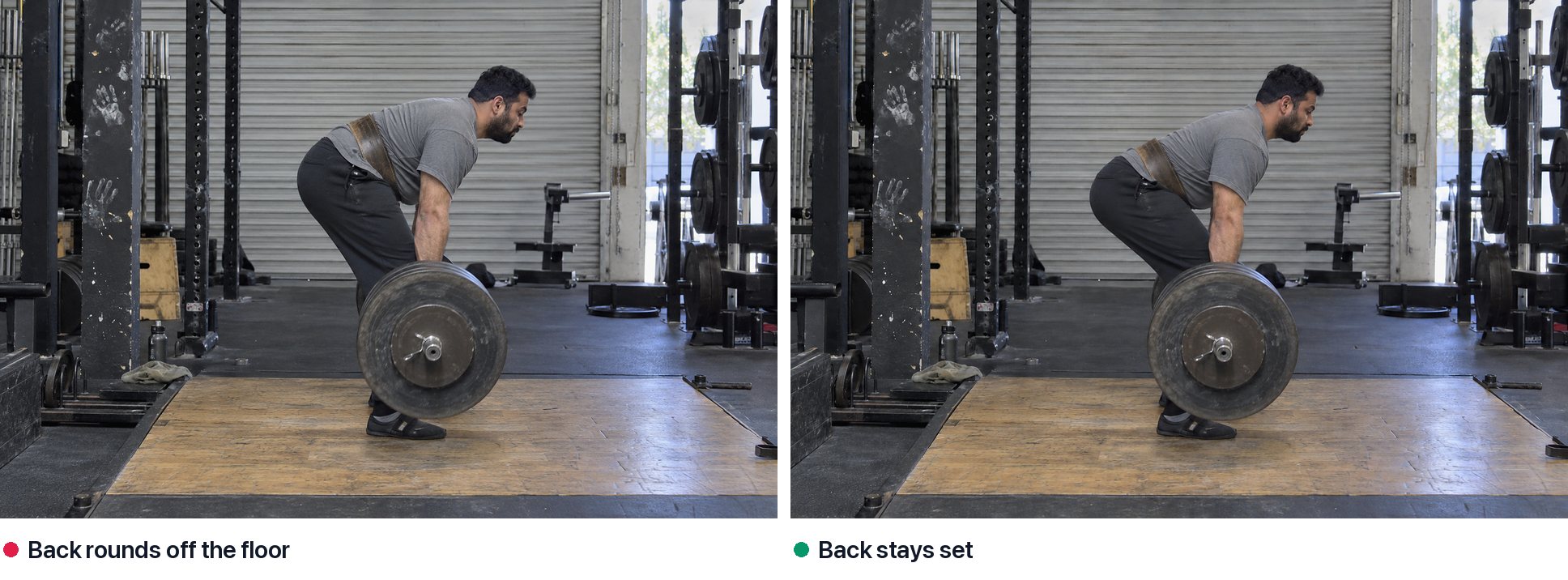
Lower back rounding off the floor
On a rounded rep, the curve above your belt line flattens and bows outward as the plates leave the floor, often with your hips high and the bar drifting off your shins.5 On a set rep, your lower back keeps its set-up shape.
A neutral spine deadlift doesn't need a visible arch. On muscular lifters a set lower back can look flat, and most lifters whose back rounds can't feel it happen.1 Neutral is also a range, so a small move from an over-arched set-up back toward neutral isn't rounding.6
Upper back rounding in the deadlift
Upper back rounding shows between your shoulder blades, with your shoulders rolled over the bar. Some strong competitive deadlifters set it on purpose to bring the bar closer to their hips,3 and the best-known examples keep their lower back extended.6 Check whether yours is set before the bar moves and holds, or keeps rounding as the bar rises.
Is a rounded back deadlift bad?
Not always. Some strong deadlifters pull with a rounded upper back on purpose,3 and research hasn't linked lower back bending during lifting to back pain.7 Lower back rounding that grows as the weight goes up is still worth fixing. A rounded lower back is hard to straighten under a heavy bar, so the pull gets harder to finish.8
The evidence is thin: a review of 11 studies found low-quality evidence that more lower back bending during lifting was not a risk factor for back pain.7 Rounding also grows with load. In 13 trained athletes deadlifting at 60 to 90% of their max, the upper lumbar and lower thoracic spine bent further as the weight went up, and the pelvis tipped back earlier.9
On video, a back that holds its set-up shape is fine, even if it looks flat. One that rounds as the plates leave the floor, or more as the weight goes up, is the one to work on.
Why your back rounds off the floor
How you start each pull, and when the rounding shows up, point to the cause.
You jerk the bar instead of pulling the slack out
Diving at the bar or jerking it off the floor can make your hips rise ahead of your chest and arms, forcing a stiff-legged or rounded-back pull.10 If you aren't tight when the force arrives, your hips shoot up and your back rounds while the bar barely moves.4
Hips shooting up in the deadlift
Many lifters set up with their hips low, as if to squat. The bar can't leave the floor from there, so the hips rise to the real pulling position before the plates break.11 Your knees straighten without lifting anything and your back angle drops toward horizontal, leaving your hips and back to finish the pull from a worse position. Rippetoe treats it as a motor-learning problem, not weak hamstrings.5
The weight is more than the position you can hold
If your lower back rounds only on heavy sets or late in a hard set, the load or fatigue has outrun the position. The spine bends further as the load goes up,9 fatigue slows the bar,12 and a back that rounds mid-set tends to stay round unless you reset it with the bar on the floor.13
If it rounds even on light sets, you may not yet be able to reach the bar with your back set, because your hips don't bend far enough yet or you haven't learned the position.2 Hamstring tension pulling on the pelvis makes the bottom position harder still.1
How to stop your back rounding
Test one fix at a time and film a set after each.
1. Pull the slack out first
Cue: Pull the bar up until it clicks, then push the floor away.
Set up with the bar over mid-foot and your shins touching it. Lift your chest and set your lats by pinching your armpits toward your hips,14 which helps keep the bar against your legs.15 Take a breath and brace your trunk. Take the slack out of the bar by pulling through your arms, chest and shoulders until it clicks, then push your feet into the floor so your hips, shoulders and chest rise together.16
Drill: paused deadlifts. Pull the bar about an inch off the floor, hold it for two counts with your back set and the bar against your legs, then finish the rep. The pause gets you used to the bottom of the pull and builds strength there.17 Three or four warm-up sets of 3 to 5 paused reps are often enough before your heavy sets.18
On your next filmed set: your lower back keeps its set-up shape through the pause, and the bar stays touching your shins.
2. Start with your hips higher
Cue: Bring your shins to the bar, lift your chest, and pull from there.
Stand with the bar over the middle of your feet and grip it. Bend your knees until your shins touch the bar, without moving it or dropping your hips, then squeeze your chest up until your back is set. Your hips will sit higher than feels right,19 but that is where the bar leaves the floor from anyway.11
Drill: Romanian deadlifts. From the top, push your hips back with soft knees and slide the bar down your legs to below your knees with your back flat, then bring your hips forward.20 Lower over about three seconds and pause at the bottom. When you can reach a few centimeters above the floor with your back set, you likely have the control to pull from the floor.2
On your next filmed set: your hips and shoulders rise at the same rate until the bar passes your knees.
3. Build your back at 10% less
Cue: Drag the bar up your legs, touching them the whole way up.
Take about 10% off today's weight and keep the same reps, so your muscles learn to do their jobs in the right order.5 Count only reps that leave the floor like your first, and build back up while your back holds.
Drill: tempo block pulls. With a light bar, lower slowly from the top and note where your lower back starts to round. Stand the plates on firm blocks or mats so the bar starts just above that height. Pull from there, then lower for three seconds until the plates touch the blocks. When every rep holds, take about 2 cm off for the next session, and go back to the last height if your back rounds.2
On your next filmed set: your lower back looks the same on your last rep as on your first as the plates leave the blocks.
Should you feel deadlifts in your lower back?
Yes, you should feel your lower back working when you deadlift. Its muscles hold your spine still while your hips and legs move the bar,21 so they tire and can be sore after a heavier or less familiar session than usual.22 If you feel the lift mostly in your lower back and barely in your glutes and hamstrings, check your technique first.14
Pain is different. If a lift hurts, change the load or the range, for example by pulling from blocks, or swap to a similar movement that is pain-free.23 See a physical therapist or doctor if the pain hasn't eased after a few weeks, stops you doing everyday things or is worse at night. Get emergency help straight away if back pain comes with numbness, tingling or weakness in both legs, numbness around your genitals or anus, or new bladder or bowel changes.24
See it in your own set
Back rounding happens behind you, in the first inch of the pull, where it's hard to see or feel while you lift.1 Set your phone about 3 meters away, side-on to the bar, with the plates, your whole body and the space above your head at lockout in frame. Film from the side at hip height and CueForm shows the reps where your lower back rounded as the bar left the floor, and whether your hips rose before the bar moved. Check your deadlift for back rounding from one video.
The barbell deadlift guide covers the rest of the lift.
FAQ
Should your back be straight when deadlifting?
Not ruler-straight. Hold a neutral spine: the normal curve of your lower back, set before the bar moves and kept to lockout. On muscular lifters that can look flat, and an exaggerated arch isn't the goal either.1 Neutral covers a small range, so a little movement within it is normal.6
Why does my back round only on the last reps?
Fatigue. Bar speed drops as a set goes on,12 and a back that rounds mid-set tends to stay round unless you reset it.13 Let go, stand and set your back before every rep. If the last reps still round, split the same reps into shorter sets, such as 5 sets of 3 instead of 3 sets of 5.17
Is upper back rounding okay?
It can be, if your upper back is set before the bar moves and doesn't round further as you pull. Experienced competitive deadlifters sometimes use it on purpose,6 but it isn't recommended while you're learning the lift.3 If you're newer to deadlifts, set your upper back as firmly as your lower back.
Why does my lower back hurt after deadlifts?
Muscle soreness is common after a heavier, longer or less familiar session than usual. Train lighter for a day or two while it settles.22 Get the pain checked by a physical therapist or doctor if it's severe and sudden, hasn't eased after a few weeks or is worse at night.24 The warning signs above need emergency help.
Sources
-
Rippetoe M. Starting Strength: Basic Barbell Training, 3rd edition. The Aasgaard Company, 2011. Chapter 4, "Back Position", pp. 139–141. ↩
-
Nuckols G. How to deadlift: the definitive guide. Stronger by Science, updated 2024. Section "How to correct mobility issues or spinal flexion issues". ↩
-
Rippetoe M. Starting Strength: Basic Barbell Training, 3rd edition. The Aasgaard Company, 2011. Chapter 4, "Pulling Mechanics", pp. 146 and 169. ↩
-
Nuckols G. How to deadlift: the definitive guide. Stronger by Science, updated 2024. Section "Creating tension instead of jerking the bar". ↩
-
Rippetoe M. Starting Strength: Basic Barbell Training, 3rd edition. The Aasgaard Company, 2011. Chapter 4, "Pulling Mechanics", pp. 163–165. ↩
-
Nuckols G. How to deadlift: the definitive guide. Stronger by Science, updated 2024. Sections "Spine" and "How risky is spinal flexion in the deadlift?". ↩
-
Saraceni N et al. To flex or not to flex? Is there a relationship between lumbar spine flexion during lifting and low back pain? A systematic review with meta-analysis. Journal of Orthopaedic and Sports Physical Therapy, 2020. ↩
-
Rippetoe M. Starting Strength: Basic Barbell Training, 3rd edition. The Aasgaard Company, 2011. Chapter 4, "Pulling Mechanics", pp. 158–159. ↩
-
Shoji K et al. Load-dependent increase in lumbar kyphosis is associated with posterior pelvic tilt during deadlift. Frontiers in Sports and Active Living, 2025. ↩
-
Austin D, Mann B. Powerlifting: The Complete Guide to Technique, Training, and Competition, 2nd edition. Human Kinetics, 2022. Chapter 6, "Deadlift", pp. 113–114. ↩
-
Rippetoe M. Starting Strength: Basic Barbell Training, 3rd edition. The Aasgaard Company, 2011. Chapter 4, "Pulling Mechanics", pp. 166–167. ↩
-
Bakhshinejad JA et al. Effects of intensity and fatigue on the kinetics and kinematics of the barbell squat, bench press, and deadlift in experienced lifters: a systematic review. Sports Medicine – Open, 2025. ↩
-
Rippetoe M. Starting Strength: Basic Barbell Training, 3rd edition. The Aasgaard Company, 2011. Chapter 4, "The Little Details", pp. 171–173. ↩
-
Eugene Teo. How to fix lower back pain after deadlifts, squats and leg exercises (opens in a new tab). Video. ↩
-
Rippetoe M. Starting Strength: Basic Barbell Training, 3rd edition. The Aasgaard Company, 2011. Chapter 4, "Pulling Mechanics", p. 162. ↩
-
Austin D, Mann B. Powerlifting: The Complete Guide to Technique, Training, and Competition, 2nd edition. Human Kinetics, 2022. Chapter 6, "Mechanics of the Conventional Deadlift", pp. 116–117. ↩
-
Calgary Barbell. Fix your elbow position in the squat (opens in a new tab). Video; deadlift form checks from 10:23 and 12:06. ↩
-
Nuckols G. How to deadlift: the definitive guide. Stronger by Science, updated 2024. Section "Bar positioning/finding your balance". ↩
-
Rippetoe M. Starting Strength: Basic Barbell Training, 3rd edition. The Aasgaard Company, 2011. Chapter 4, "Learning to Deadlift", pp. 133–137. ↩
-
Austin D, Mann B. Powerlifting: The Complete Guide to Technique, Training, and Competition, 2nd edition. Human Kinetics, 2022. Chapter 6, "Romanian Deadlift (RDL)", p. 129. ↩
-
Rippetoe M. Starting Strength: Basic Barbell Training, 3rd edition. The Aasgaard Company, 2011. Chapter 4, "The Deadlift", pp. 125–126. ↩
-
Cheung K, Hume P, Maxwell L. Delayed onset muscle soreness: treatment strategies and performance factors. Sports Medicine, 2003. ↩
-
Helms E, Morgan A, Valdez A. The Muscle and Strength Pyramid: Training, 2nd edition. Muscle and Strength Pyramids, 2019. "Adherence", p. 21. ↩