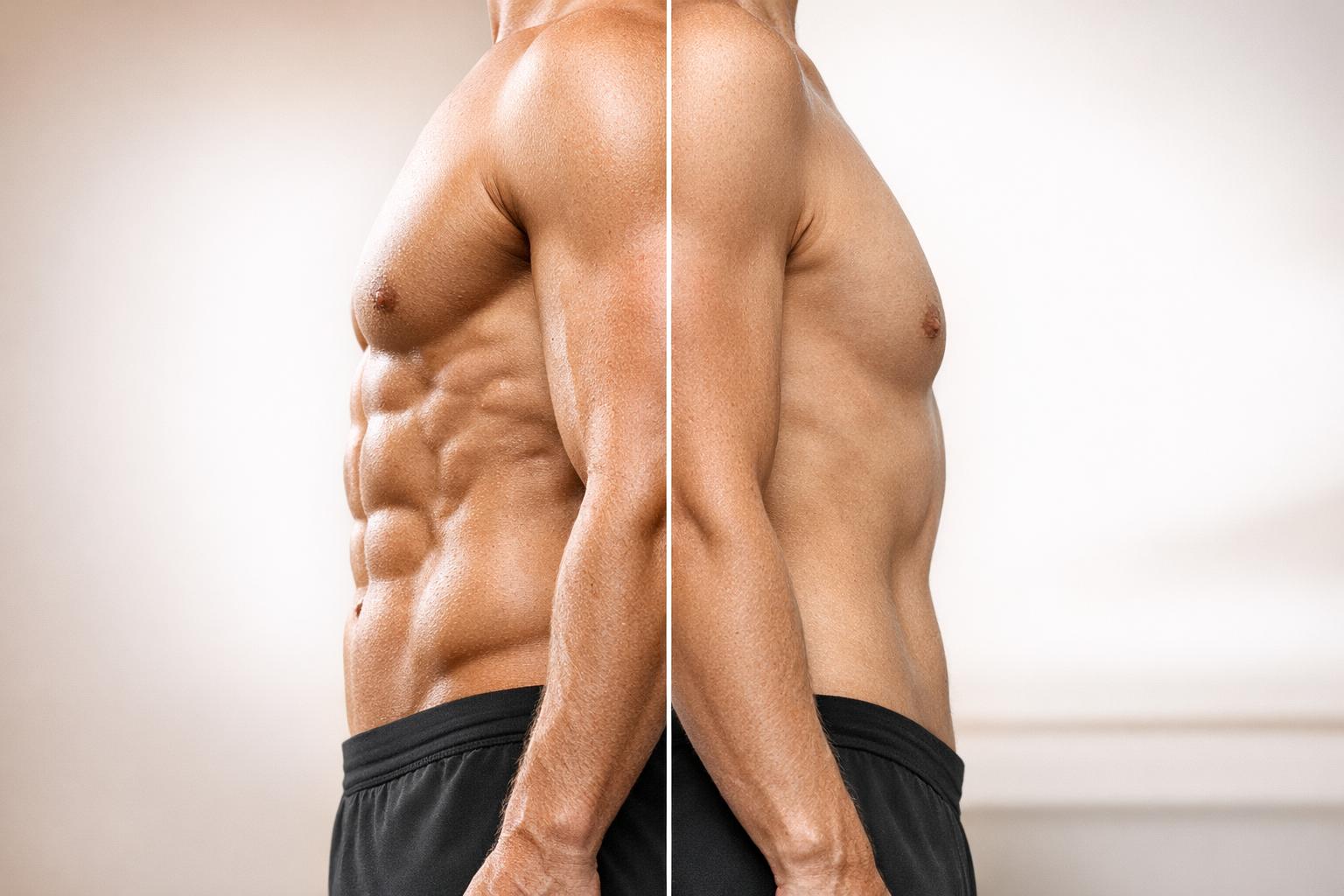
Core Bracing vs. Hollowing: Key Differences
Core bracing and hollowing are two distinct techniques for core stability, each serving different purposes. Bracing involves tightening all your core muscles simultaneously, creating a solid support system ideal for heavy lifting and high-impact activities. Hollowing, on the other hand, focuses on pulling your belly button inward to activate deep stabilizers, making it better suited for rehabilitation and improving motor control.
Key Takeaways:
- Core Bracing: Engages all core muscles, increases spinal stability, and is best for heavy loads and athletic performance.
- Core Hollowing: Targets deep stabilizers, reduces spinal compression, and is ideal for rehab and posture correction.
Quick Comparison:
| Feature | Core Bracing | Core Hollowing |
|---|---|---|
| Primary Action | Tightening entire trunk | Pulling navel inward |
| Muscle Focus | Global + deep muscles (RA, EO, IO) | Deep stabilizers (TrA, IO, LM) |
| Spinal Stability | High (32% more stable) | Moderate (segmental control) |
| Best Use | Heavy lifting, sports, high impact | Rehab, posture, low-load exercises |
Choose bracing for strength and protection under heavy loads, and hollowing for recovery and controlled exercises. Transition from hollowing to bracing as your core strength improves.
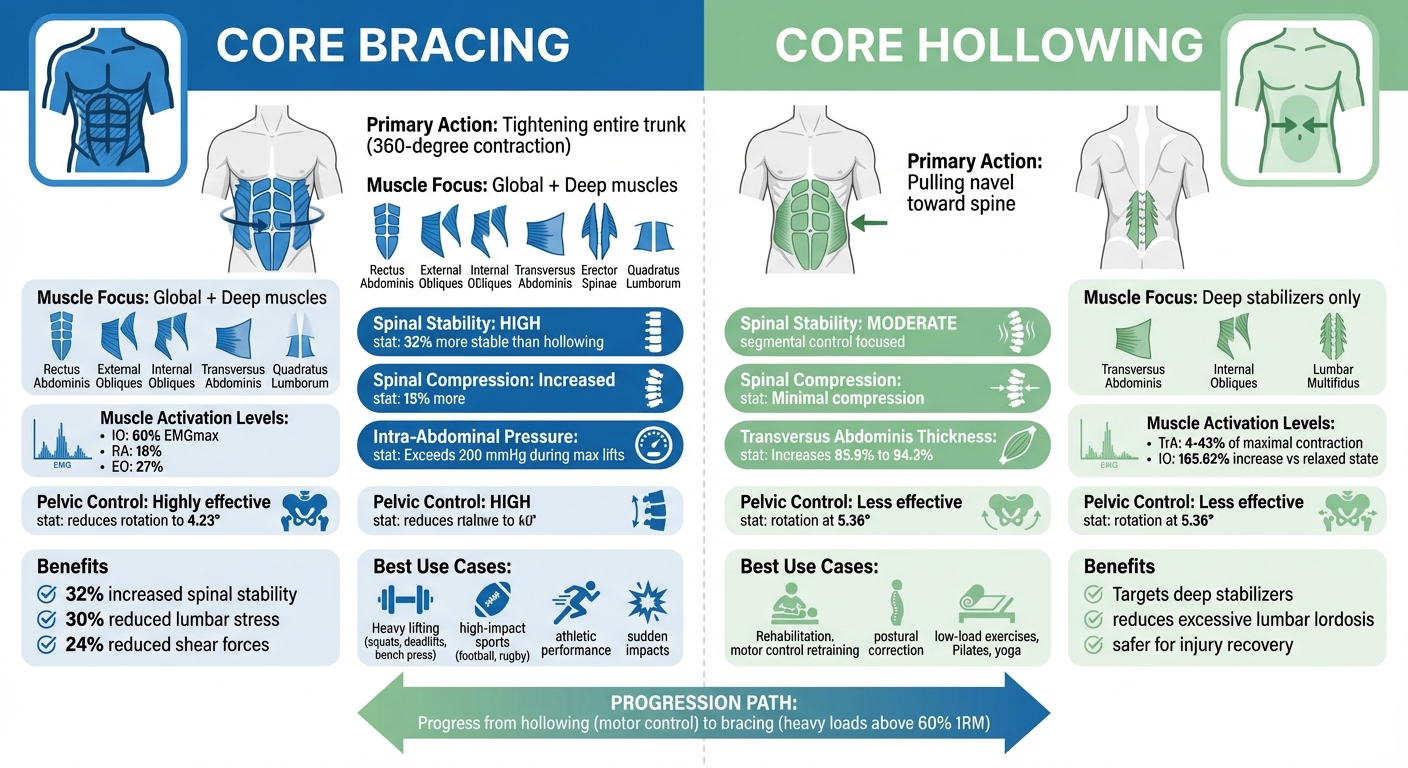
Core Bracing vs Hollowing Comparison Chart
Core Bracing: How It Works and When to Use It
How Core Bracing Works
Core bracing is all about engaging every muscle in your trunk at the same time to create a solid, unyielding support system for your spine [6][7]. Think of it as forming an internal weightlifting belt: your diaphragm presses downward, your pelvic floor pushes upward, and all your abdominal muscles tighten together. This process ramps up intra-abdominal pressure (IAP), making your midsection incredibly rigid and resistant to compression - a crucial factor when stabilizing the spine under heavy loads [9].
Unlike hollowing, which focuses on isolating certain muscles, bracing activates larger, global muscles like the rectus abdominis, external and internal obliques, and spinal erectors all at once [5][9]. To put it into perspective, experienced lifters performing max-effort squats can generate IAP levels exceeding 200 mmHg [9]. This intense pressure is what gives bracing its edge in providing unparalleled spinal stability.
Benefits of Core Bracing
Studies show that core bracing boosts spinal stability by 32% compared to hollowing techniques [8]. It also reduces stress on the lumbar spine by up to 30% and cuts spinal shear forces by about 24% [9]. As biomechanics expert Stuart M. McGill, PhD, explains:
"Bracing creates patterns that better enhance stability." [8]
This method not only protects your spine but also ensures more efficient force transfer. By keeping your core locked in, it prevents energy generated by your legs from being wasted. Plus, it helps stabilize the pelvis by minimizing unnecessary rotation, which is key for maintaining proper alignment during heavy lifts [3].
When to Use Core Bracing
Core bracing shines during heavy compound lifts like squats, deadlifts, bench presses, and overhead presses - any movement that places a significant load on your spine [9]. It’s also a game-changer for high-impact sports such as football, rugby, or Olympic weightlifting, where spinal rigidity is non-negotiable. Research highlights its role in handling sudden disruptions, like slipping or absorbing a hit, as it limits lumbar displacement and enhances trunk stability [4].
For exercises that demand precise pelvic control, such as side-lying hip abduction, bracing is equally effective. It boosts activation in muscles like the quadratus lumborum and obliques, helping to keep your pelvis steady and aligned [3]. Whether you're lifting heavy or dealing with unexpected forces, core bracing is a technique that delivers both protection and performance.
Core Hollowing: How It Works and When to Use It
How Core Hollowing Works
Core hollowing is a technique designed to target the deep stabilizing muscles of your core, like the transversus abdominis (TrA) and internal obliques, while keeping the more superficial muscles, such as the rectus abdominis, less active. The process is straightforward: as you breathe naturally, gently draw your lower abdomen inward without moving your upper stomach, back, or pelvis. This subtle inward motion increases intra-abdominal pressure and tightens the thoracolumbar fascia, which helps stabilize the lumbar spine and sacroiliac joints. Research shows that during hollowing, the thickness of the TrA increases from about 85.9% to 94.3% at rest, while overall muscle activation remains lower (16.4% to 56.6% of maximal contraction) [5].
To perform core hollowing effectively, maintain steady breathing through the diaphragm - avoid holding your breath. Concentrate on pulling the area between your navel and pubic bone inward toward your spine. This focus enhances activation of the pyramidalis muscles and strengthens the abdominal fascia [10].
Benefits of Core Hollowing
Core hollowing is particularly effective at engaging deep stabilizers that are often underutilized. Studies reveal that this technique can boost internal oblique muscle activity by an impressive 165.62% compared to a relaxed state [3]. This makes it especially helpful for individuals dealing with chronic low back pain. Additionally, core hollowing can improve posture by reducing excessive lumbar lordosis and forward pelvic tilt, encouraging a neutral spine position [3][10].
Rick Richey, NASM-CPT, highlights its effectiveness:
"Abdominal hollowing was found superior to abdominal bracing for increasing LPHC stability and leg stiffness in hopping tasks." [1]
Another key advantage is that core hollowing provides stability with less spinal compression compared to bracing. This makes it a safer option for those who need to avoid placing high-pressure loads on their vertebrae. It’s also an excellent choice for early-stage rehabilitation, particularly for non-specific low back pain. By improving muscle thickness and balance, hollowing can help reduce pain and disability.
This precise muscle activation makes core hollowing ideal for controlled, gradual rehabilitation and targeted core exercises.
When to Use Core Hollowing
Core hollowing works best in controlled, low-intensity settings. It’s particularly well-suited for rehabilitation and neuromuscular re-education. You can incorporate hollowing into exercises like static planks, 4-point kneeling drills, or hook-lying positions (lying on your back with your knees bent). It’s also effective for dynamic movements like single-leg hopping, where maintaining segmental stability and leg stiffness is the goal rather than overall spinal rigidity.
Think of core hollowing as a foundational tool. Once you’ve mastered activating your deep stabilizers, you can transition to core bracing techniques for activities that require greater spinal stiffness, such as heavy lifting or high-impact movements.
What's the difference between hollowing and bracing? by Dr Stuart McGill Part 14 of 18
Core Bracing vs. Hollowing: Main Differences
Let’s break down the key distinctions between core bracing and hollowing to help you decide which technique fits your training needs.
Muscle Activation Patterns
The main difference between these two techniques lies in how they activate your muscles. Core bracing triggers a co-contraction of both deep and superficial trunk muscles. This means it engages the rectus abdominis, external obliques, erector spinae, and quadratus lumborum, along with the deeper transversus abdominis and internal obliques [2][7]. It’s a whole-team effort for comprehensive core stability.
Hollowing, on the other hand, zeroes in on the deep stabilizers only - primarily the transversus abdominis, internal obliques, and lumbar multifidus [2][5]. The superficial muscles stay mostly inactive. Studies show that during bracing, the internal oblique reaches 60% of its maximum activation, while the rectus abdominis and external obliques hit 18% and 27%, respectively [7]. In contrast, hollowing increases the thickness of the deeper stabilizers more effectively, as confirmed by ultrasound studies [5].
"Hollowing tends to recruit more of the local muscles, whilst bracing recruits more of the global muscles." - Ioannis Tsartsapakis [5]
These activation patterns explain why each technique affects spinal stability differently.
Effects on Spinal Stability
When it comes to spinal protection under load, bracing is the clear winner. It enhances spinal stability by 32% compared to hollowing, though it also increases lumbar compression by 15% [8]. This stiffening effect is crucial for handling heavy weights and resisting sudden movements [7][4].
"Abdominal bracing was more effective than abdominal hollowing for stabilizing the spine against posterior and rapid loading." - Sumiaki Maeo [7]
Hollowing, in contrast, focuses on localized motor control and segmental stability [7][4]. While the transversus abdominis alone contributes just 0.14% to spinal stability during bracing, hollowing’s targeted approach is ideal for retraining deep muscles and improving core awareness. However, it’s not suited for heavy lifting or tasks requiring significant trunk stiffness [8].
Side-by-Side Comparison
| Feature | Core Bracing | Core Hollowing |
|---|---|---|
| Primary Action | Pushing abdomen out/stiffening entire trunk | Drawing navel toward spine |
| Muscle Focus | Global + Local (RA, EO, IO, TrA, ES, QL) | Deep stabilizers only (TrA, IO, LM) |
| Spinal Stability | High - great for heavy loads and sudden impacts | Moderate - targets segmental control |
| Spinal Compression | Increased compressive load on discs | Minimal compression |
| Pelvic Control | Highly effective (reduces rotation to 4.23°) [3] | Less effective (rotation at 5.36°) [3] |
| Best Use Case | Heavy lifting, strength training, athletic performance | Rehabilitation, motor control retraining, postural correction |
| Muscle Activation Level | IO: 60% EMGmax, RA: 18%, EO: 27% [7] | TrA: 4-43% of maximal contraction [11] |
This comparison highlights how each technique serves different purposes. Whether you’re aiming for strength under load or refining motor control, selecting the right approach is essential for your goals.
How to Choose the Right Technique
Matching Technique to Your Training Goals
The technique you choose should align with your training goals. For heavy lifting, bracing is the go-to method. It creates a solid 360-degree contraction, providing maximum spinal stability to protect your back under heavy loads. Studies show that in experienced lifters, intra-abdominal pressure during maximal squats can exceed 200 mmHg, highlighting the effectiveness of bracing for such efforts [9].
Hollowing, however, serves a different purpose. It’s best suited for rehabilitation, improving motor control, and correcting posture [10]. For those recovering from low back pain or working on activating deep stabilizers like the transversus abdominis and internal obliques, hollowing is ideal. It retrains these muscles without adding extra compressive load to the spine. This technique is particularly effective in activities where dynamic stability is key - think Pilates, yoga, or corrective movement exercises.
For high-impact or contact sports such as boxing or football, bracing is critical to protect the trunk from external impacts. Hollowing, on the other hand, works well for activities focused on posture improvement or core engagement during low-load exercises [10]. Understanding these distinctions can help you progress from foundational motor control exercises to full-body strength training.
Progressing from Hollowing to Bracing
If you're new to core training or recovering from an injury, starting with hollowing is often recommended. This approach helps you build neuromuscular awareness, enabling you to activate your deep stabilizers effectively. Begin with hollowing exercises in low-load positions, such as lying on your back or on all fours, until you can consistently engage your transversus abdominis.
"Initially, you've got to cue abdominal hollowing... then start including bracing into it, where you're creating transverse abdominis activation and co-contraction of a lot of muscles."
– Rick Richey, MS, Faculty at NASM [1]
Once you’re lifting weights that demand higher stability - typically above 60% of your one-rep max - it’s time to transition to bracing [9]. At this stage, the focus shifts from isolated motor control to functional strength and spinal protection. To practice bracing, use the "punch" cue: imagine someone is about to punch you in the stomach. Instead of pulling your navel inward, tighten your entire core outward.
A great example of this progression comes from lifter Frank Hawley. In March 2024, he added over 100 pounds to his deadlift in just three months by switching to a bracing-focused technique. By mastering proper intra-abdominal pressure and using the Valsalva maneuver, he consistently pulled over 600 pounds for several years without back pain or injury [9].
Using CueForm AI for Technique Refinement
Training alone can make it tough to assess your core engagement, but CueForm AI (https://cueform.ai) offers a solution. This platform analyzes your exercise videos to evaluate your core activation and ensure your technique matches your goals. It provides tailored feedback on muscle engagement patterns, helping you avoid common errors like chest breathing or accidental hollowing during heavy lifts.
When transitioning from hollowing to bracing, CueForm AI can track your progress and verify that you’re generating proper intra-abdominal pressure while maintaining spinal alignment. It’s particularly useful for refining your form in complex movements like squats, bench presses, and deadlifts. You can even consult the AI coach for advice on adjusting your technique or knowing when to switch methods as your strength improves. This feedback ensures you’re engaging the right muscles at the right time, making your training safer and more effective.
Conclusion
Key Takeaways
Knowing the distinction between core bracing and hollowing can make a big difference in your training results. Bracing involves a 360-degree contraction of all your abdominal muscles, offering about 32% more spinal stability than hollowing. It also generates intra-abdominal pressure exceeding 200 mmHg during heavy lifts like squats and deadlifts[6][9]. On the other hand, hollowing focuses on activating deep stabilizers like the transversus abdominis, increasing its thickness by as much as 88.4%[5]. This technique is particularly useful in rehabilitation and motor control exercises, where the aim is to improve core awareness without placing too much stress on the spine.
The choice between these techniques depends on your training goals. Bracing is ideal for heavy lifting, contact sports, or any activity requiring maximum force transfer and spinal protection[9][10]. Meanwhile, hollowing works well for rehabilitation, corrective exercises, or helping beginners develop basic core awareness[1][10]. Research backs this up, showing that bracing activates global muscles more effectively than hollowing, reinforcing their unique roles in training[5].
Final Thoughts
Your core strategy should evolve as your training progresses. If you're recovering from an injury or just starting out, hollowing can help you build neuromuscular control. As you move on to heavier weights and more advanced movements, bracing becomes essential for boosting performance and reducing injury risk. Tools like CueForm AI (https://cueform.ai) can help you fine-tune your technique by analyzing muscle activation and spinal alignment. With this kind of personalized feedback, you can perfect your form in exercises like squats, bench presses, and deadlifts, setting the stage for long-term strength and resilience.
FAQs
Why is core bracing more beneficial than hollowing for athletes?
Core bracing, often explained as tightening your core as if you’re preparing to take a punch, offers distinct benefits for athletes compared to hollowing. While hollowing mainly targets the deep stabilizer muscles, bracing activates the larger, more powerful core muscles like the rectus abdominis, external obliques, and erector spinae. This activation creates greater intra-abdominal pressure and enhances spinal stability - key components for activities like heavy lifting, sprinting, or contact sports.
Additionally, bracing boosts stability in the lumbar-pelvic-hip region, helping to control unwanted movements during dynamic actions. This is particularly valuable for high-intensity, load-bearing exercises and sports involving quick directional changes. By improving force transmission and safeguarding the spine, core bracing not only supports better athletic performance but also helps lower the risk of injuries.
What’s the best way for beginners to transition from core hollowing to bracing?
Beginners can shift from core hollowing to bracing by taking it one step at a time. Start by practicing hollowing techniques to activate your deep core muscles. Focus on gently drawing your belly button toward your spine, but avoid overcompressing your rib cage - it’s about subtle activation, not force.
Once this feels natural, add a light tightening sensation, almost like bracing for a soft punch, to engage the larger core muscles. Practice holding this braced position during simple static exercises, such as planks or dead bugs. The key here is to keep your abdomen firm and slightly expanded, rather than pulling it inward.
As you gain confidence, start incorporating light resistance exercises like bodyweight squats or kettlebell deadlifts. The goal is to maintain that braced position throughout the movement, ensuring your core stays stable.
If you need extra help, tools like CueForm AI can offer real-time feedback on your form, helping you refine your technique and build confidence as you progress.
When is core hollowing better than bracing during rehabilitation?
Core hollowing works best during the early stages of rehabilitation, especially when the goal is to activate the deep stabilizing muscles of the core, like the transversus abdominis and lumbar multifidus. This technique enhances spinal stability while keeping larger muscles from over-engaging, which could otherwise increase spinal compression. It's particularly helpful for those recovering from lumbar instability or low-back pain, as it offers a gentle, low-intensity way to rebuild core stability.
Since hollowing creates less intra-abdominal pressure compared to bracing, it's a better option for individuals who can't handle higher spinal loads - such as those recovering from surgery or dealing with acute flare-ups. It helps establish muscle coordination and control, laying the groundwork for more advanced techniques like bracing as recovery progresses.
For additional guidance, tools like CueForm AI can analyze your hollowing exercises via video, providing real-time feedback to ensure proper form and a safe, steady progression during rehabilitation.