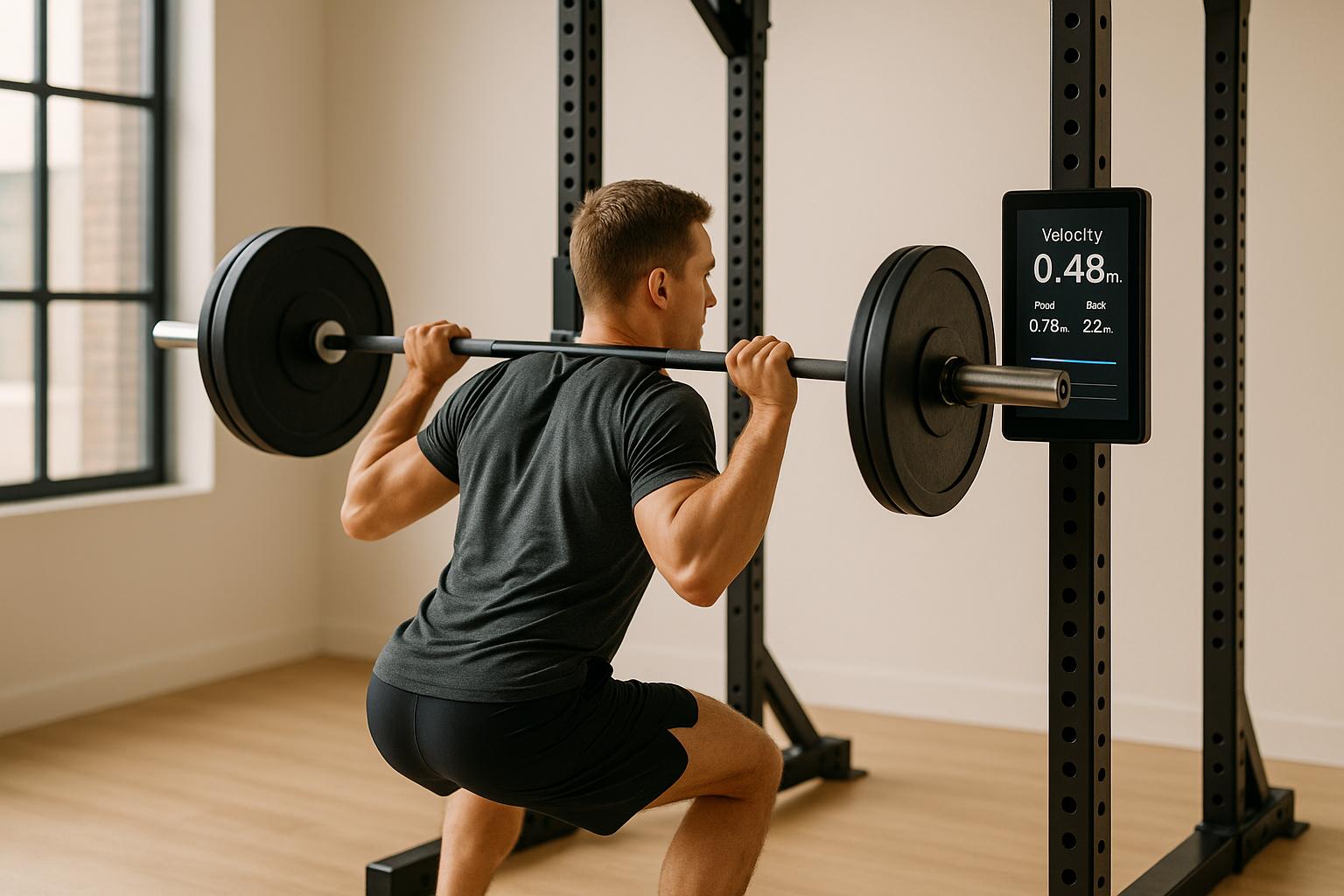
Best Practices for Velocity-Based Training Metrics
Velocity-Based Training (VBT) is a modern strength training method that uses the speed of movement (bar velocity) to guide workout intensity, replacing traditional percentage-based approaches. Here's why it matters and how to use it effectively:
- Why VBT Works: Bar speed decreases as weight increases, offering real-time feedback to adjust loads based on daily performance. This helps prevent overtraining and improves workout quality.
-
Key Metrics:
- Mean Velocity: Average bar speed, indicating performance consistency.
- Peak Velocity: Maximum speed during a rep, useful for power training.
- Rate of Force Development (RFD): Measures how quickly force is generated, critical for explosive movements.
- Load-Velocity Profiles: By plotting bar speed at various loads, you can estimate your one-rep max (1RM) safely and adjust training intensity daily.
-
Velocity Zones for Goals:
- Strength: 0.25–0.50 m/s
- Hypertrophy: 0.50–0.75 m/s
- Power: 0.75–1.00 m/s
- Speed: >1.00 m/s
- Autoregulation: Adjust weights in real time based on bar speed to manage fatigue and maintain performance quality. For example, a 20% velocity drop signals it's time to stop a set during strength training.
- Technology Integration: Tools like CueForm AI provide real-time feedback on bar speed and form, helping athletes optimize their training with precision.
VBT offers a data-driven approach to strength training, ensuring every session is tailored to your readiness and goals.
Key Metrics in Velocity-Based Training
Primary Velocity Metrics
When it comes to velocity-based training (VBT), three key metrics form the backbone of effective programming: mean velocity, peak velocity, and rate of force development (RFD).
Mean velocity refers to the average speed of the barbell during the lifting (concentric) phase of an exercise. This metric is a reliable indicator of performance consistency and training readiness. If your mean velocity remains steady, it suggests you're performing as expected. On the other hand, noticeable drops in mean velocity can signal fatigue or the need for adjustments [1][5].
Peak velocity measures the highest speed reached during any point of a repetition. This metric is particularly useful for evaluating explosive power, offering insights into how effectively your neuromuscular system generates maximum force. For athletes focused on power development, this is a critical number to watch [1][5].
Rate of force development (RFD) tracks how quickly force is produced from the start of a movement. This is especially important for activities requiring rapid bursts of power, like sprinting or jumping. RFD highlights neuromuscular efficiency and plays a key role in explosive performance [1][5].
Each of these metrics serves a distinct purpose, depending on your training goals. For example, mean velocity is often prioritized in strength training, peak velocity is emphasized for power-focused exercises, and RFD is crucial for developing explosive movements. Together, these metrics provide a comprehensive framework for tracking and improving performance.
Using Metrics to Monitor Progress
Velocity metrics are more than just numbers - they turn subjective observations into objective, actionable data, offering a clear picture of your performance over time. Tracking these metrics enables precise adjustments to your training plan.
For instance, monitoring how your mean velocity changes at specific loads can be a tangible marker of progress. Suppose your bench press mean velocity increases from 0.45 m/s to 0.52 m/s at 185 lbs over several weeks. That’s hard evidence of strength gains [1][11].
Velocity metrics also help manage fatigue. A drop in mean velocity during a session can signal accumulated fatigue, prompting you to adjust your training load or volume. Many athletes and coaches use velocity loss thresholds to prevent overtraining and optimize recovery [2][3].
This approach isn't just theoretical. Teams like the University of Maryland, Auburn University, and the Seattle Seahawks have reported better performance and fewer injuries after integrating VBT into their programs [1]. Real-time velocity feedback allows for immediate adjustments, resulting in improved strength gains and reduced risk of overuse injuries.
To ensure accurate data, it's crucial to use the same device, setup, and calibration protocol every session. Consistency in measurement tools and methods eliminates variability caused by equipment differences, ensuring that changes in metrics reflect actual performance improvements. For example, the Perch VBT device has shown impressive reliability, with a mean concentric velocity bias of only 0.01 m/s across various loads in exercises like the back squat and bench press [9].
Velocity metrics also make goal-setting more precise. By using load-velocity profiling, you can target specific velocity zones tailored to your goals, whether it's maximum strength, power, or speed-strength [1][11].
For athletes looking for additional support, tools like CueForm AI offer personalized form analysis and real-time velocity feedback. Simply upload exercise videos, and the platform provides improvement cues and tailored advice, making velocity monitoring accessible for both individuals and teams [3].
Incorporating velocity tracking into your routine ensures every session builds on measurable progress, creating a feedback loop that keeps you moving toward your goals.
Creating and Using Load-Velocity Profiles
How to Develop a Load-Velocity Profile
A load-velocity profile shows how lifting speed decreases as the load increases. It's a useful tool for estimating your one-rep max (1RM) without the risks of maximum-effort testing and allows for precise adjustments to your training on a daily basis [1][2].
To build a reliable profile, you need to test systematically with different loads. Start by choosing a key exercise and performing a thorough warm-up. Then, measure bar velocity at 4–6 different loads, typically between 45% and 95% of your estimated 1RM [6].
Progress through the loads incrementally. Begin with lighter weights, around 45–50% of your estimated max, and increase gradually. At each load, perform 2–3 reps while recording the velocity with a reliable device, like a linear position transducer or an accelerometer-based system. Record either the mean velocity or the mean propulsive velocity, as the latter often provides a more accurate reflection of true movement speed [8].
Once you've gathered the data, plot it on a chart with load percentage on one axis and velocity on the other. You'll typically see a linear trend: as the load increases, velocity decreases. Apply a regression line to define your profile [1][2].
Heavier loads, ranging from 80% to 95% of your estimated max, usually provide better accuracy for predicting your true 1RM. The minimal velocity threshold - typically between 0.15 and 0.30 m/s for most lifts - represents the speed at which your actual 1RM occurs [2].
Platforms like CueForm AI can simplify this process by analyzing bar speed from video uploads while also offering feedback on your technique. This combination ensures accurate measurements and proper form during testing [1].
To keep your profile up-to-date, revisit it every 4–8 weeks. Even a 5% increase in your 1RM could result in a velocity change of around 0.07–0.08 m/s [9]. With an updated profile, you'll be better equipped to adjust your training loads as needed.
Using Profiles for Daily Adjustments
Your load-velocity profile becomes a practical tool for daily training through autoregulation - adjusting weights based on how you're performing in real time, rather than sticking rigidly to preset percentages [2][3].
Use your profile during warm-ups to evaluate your readiness. Compare the velocity you achieve with your established profile. If your speed is slower than expected, it might indicate fatigue or reduced readiness, suggesting a lighter load is in order. On the other hand, if your velocity is higher than expected, you may be ready to handle heavier weights or increased volume [3].
For instance, if you're lifting at 80% of your 1RM and expect a velocity of 0.5 m/s but only hit 0.45 m/s, consider reducing the weight to stay within your target velocity range. This kind of real-time adjustment helps you avoid overtraining while maintaining quality in your sessions [3].
Once your profile is established, estimating your 1RM becomes much simpler. Instead of testing multiple loads during every session, a single warm-up lift can provide enough information to gauge your current max strength. Many collegiate and professional teams have adopted this approach to boost performance and minimize injury risk [1].
Keep in mind that standard error in velocity measurements can range from 0.02 to 0.21 m/s, depending on the exercise and individual [9]. By factoring in this variability alongside the smallest worthwhile change, you can set meaningful velocity thresholds that reflect true performance shifts rather than normal fluctuations [9].
When adjusting your confidence intervals, consider your training phase. During the off-season, use larger intervals (90–95% confidence) to detect broader adaptations. In the competitive season, smaller intervals (around 80% confidence) can help monitor fatigue more closely [9].
Individualized profiles tend to be more effective than group-based methods because they take into account your unique characteristics and training progress [7][9]. This personalized approach has fueled the rise of autoregulation, where daily training loads are adjusted based on real-time velocity data instead of fixed percentages [6][10].
If you consistently miss your velocity targets over several sessions, it might be time to reassess your program or schedule a deload week. This method of daily autoregulation, combined with technology-driven feedback, ensures your training stays both effective and adaptable.
Practical Applications of VBT in Training
Setting Velocity Zones
Velocity zones are a practical way to align your training with specific goals by defining speed ranges that suit your objectives. These zones are based on your load-velocity profile and help develop targeted physical qualities.
For strength building, focus on slower velocities between 0.25–0.50 m/s. At this range, heavier loads challenge your ability to generate maximum force. Power training falls in the moderate range of 0.75–1.00 m/s, where the balance between load and speed is key for explosive performance. If your aim is speed and explosiveness, work at velocities above 1.00 m/s with lighter loads that allow you to accelerate fully [12].
The hypertrophy zone lies between strength and power, at 0.50–0.75 m/s, and supports muscle growth through controlled but challenging loads.
Here’s a quick breakdown of these zones:
| Training Goal | Velocity Zone (m/s) |
|---|---|
| Strength | 0.25–0.50 |
| Hypertrophy | 0.50–0.75 |
| Power | 0.75–1.00 |
| Speed | >1.00 |
Once you establish your velocity profile, you can adjust weights during training to stay within these target zones. For example, if your squat velocity dips below 0.75 m/s during a power session, lowering the weight can help you maintain the explosive effort required.
By using velocity zones, you create precise targets that allow for real-time adjustments. This approach pairs seamlessly with autoregulation strategies, ensuring optimal performance and load management.
Autoregulation and Fatigue Management
Autoregulation, guided by velocity drop-off thresholds, helps you manage fatigue and maintain quality reps. Instead of sticking to a fixed rep count, this method adapts your training volume based on how your body performs in real time.
For strength training, a 20% velocity drop-off signals it’s time to end the set. In power training, stricter thresholds of 10–15% are necessary to preserve the explosive intent that drives power adaptations [13]. For example, if your first squat rep is at 0.50 m/s and drops to 0.40 m/s (a 20% decrease), you should stop the set to maintain performance quality.
Hypertrophy work can handle more fatigue, with drop-off thresholds of 30–40%. This added volume from fatigue increases metabolic stress, which aids muscle growth [13]. On the other hand, speed training demands the most precision, with a 5–10% drop-off ensuring peak velocity and neural adaptations remain intact [13].
Elite organizations like the Australian Institute of Sport have adopted these autoregulation methods, reporting better performance outcomes and fewer injuries by adjusting loads based on real-time velocity data [9].
Real-time feedback is critical for applying these thresholds effectively during training sessions.
Real-Time Feedback for Better Performance
Real-time velocity feedback transforms raw data into actionable insights, allowing athletes to adjust loads instantly and sharpen their focus. Seeing their velocity numbers immediately motivates athletes to push harder, maintain their targets, and improve overall training quality [6].
This immediate feedback creates a cycle of enhanced performance. Athletes with access to real-time data often achieve higher speeds compared to those without it [6], driven by the natural desire to outperform previous efforts. If velocity drops during a set, reducing the weight right away ensures you stay within the target zone.
Platforms like CueForm AI take this a step further by combining velocity tracking with video-based form analysis. Athletes can upload videos of their lifts to receive detailed feedback on both speed and technique. The platform offers specific recommendations on bar path, body alignment, and movement mechanics - factors that directly influence velocity and performance.
Additionally, velocity devices used for exercises like squats and bench presses have a standard error of about 0.01 m/s, making them reliable tools for tracking progress [9]. Real-time feedback also serves as a safety measure: significant drops in velocity can indicate fatigue or form breakdown, allowing you to stop before risking injury. This combination of precision and adaptability ensures safer, more effective training sessions.
sbb-itb-c91a623
Practical Ways to use Velocity Based Training (VBT)
Using Technology for VBT
Modern advancements in technology have made Velocity-Based Training (VBT) more efficient by offering real-time feedback that allows for immediate adjustments during training sessions [2][4][5]. This progress builds on the principles of real-time feedback and autoregulation, making VBT more accessible and effective.
Organizations like the Detroit Lions and Toronto Maple Leafs have reported measurable improvements in performance and reduced injury risks thanks to these technological tools [1]. Their success highlights how technology can amplify the benefits of VBT across various sports and competitive levels.
Using AI for Precision
AI-driven platforms are taking VBT to the next level by combining velocity tracking with detailed movement analysis. A great example of this is CueForm AI, which uses video analysis to provide tailored feedback on key lifts like squats, bench presses, and deadlifts. All you have to do is upload or record a video of your exercise, and the platform delivers specific recommendations on critical factors like bar path, body alignment, and movement mechanics - all of which directly impact velocity and training outcomes.
Why does this matter? Because maintaining consistent form is crucial for reliable velocity data. For instance, if your squat depth varies or your bar path shifts during a bench press, the velocity readings might not accurately reflect your true performance. CueForm AI tackles this issue by analyzing essential movement elements like depth, knee alignment, hip hinge, and bar path.
What makes AI platforms stand out is their ability to deliver personalized suggestions based on your unique anatomy, goals, and training schedule. Instead of generic advice, the system tailors its feedback to your specific needs. For example, if you're working on developing explosive power, the AI can pinpoint inefficiencies in your form that might be holding you back and recommend precise adjustments to optimize your movement.
To put it into perspective, the standard error of measurement for velocity devices is about ±0.04 m/s for exercises like squats and bench presses [9]. This level of accuracy ensures that velocity data is a reliable indicator of your progress. When paired with AI-powered form analysis, you can be confident that any improvements in velocity are genuine, reflecting actual strength and power gains rather than compensatory movement patterns. This combination of precision and personalization makes technology an invaluable addition to your training toolkit.
Adding Tech to Training
Incorporating tools like CueForm AI into your routine can yield impressive results. Start by focusing on VBT-specific exercises like squats, bench presses, and deadlifts. During your warm-up, record videos from the right angle and upload them to the platform for instant analysis. The AI provides detailed feedback on your form while simultaneously tracking velocity metrics, giving you a complete picture of your performance. This dual approach ensures that your velocity data accurately represents your capabilities.
For those training multiple times a week, the Starter plan, priced at $10 per month, offers 100 full video reviews. This affordable option provides professional-level insights without the need for a dedicated coach, making it a practical choice for athletes who want to fine-tune their primary lifts.
By combining velocity data with form analysis, you can make smarter, real-time adjustments. For example, if your squat velocity drops from 0.50 m/s to 0.40 m/s - a 20% decrease - you can determine whether this is due to fatigue or a form breakdown. The AI's insights help you identify the cause, allowing you to either adjust the load or correct your technique as needed.
Both teams and individual athletes can benefit from tracking long-term changes in velocity and form quality [9]. As your technique improves with consistent AI feedback, your load-velocity profile becomes more accurate, leading to better training outcomes. This continuous feedback loop of objective velocity data and personalized form analysis ensures that your training evolves alongside your progress, setting you up for sustained success.
Conclusion
Velocity-based training (VBT) marks a shift from traditional percentage-based methods to a more precise, data-driven approach to strength training. By offering real-time feedback, VBT removes the guesswork from programming, enabling athletes and coaches to make daily adjustments based on actual performance rather than relying on estimated one-rep maxes [2]. Many elite organizations have already reported improved performance outcomes and reduced injury rates thanks to VBT.
What sets VBT apart is its ability to adapt to an athlete’s daily readiness. Unlike static programming, it allows for immediate load changes to align with how the athlete is performing on any given day [2].
Advances in technology have made VBT more accessible, simplifying data collection, analysis, and visualization [3]. Tools like CueForm AI take this a step further by pairing velocity tracking with AI-driven form analysis, helping athletes maintain proper technique while monitoring velocity metrics. These modern tools deliver highly accurate results with minimal error [9].
The real-time feedback provided by VBT doesn’t just enhance performance - it also boosts motivation. Athletes can push themselves harder while making quick, informed program adjustments based on objective data [2][11]. This ensures every session is performed at the right intensity, reducing the risks of both overtraining and undertraining.
For those dedicated to maximizing performance and minimizing injury risks, VBT is quickly becoming a cornerstone of effective strength and conditioning programs. By embracing this data-driven approach, athletes and coaches can ensure that every workout is both productive and safe.
FAQs
How does Velocity-Based Training help improve workout quality and reduce the risk of overtraining?
Velocity-Based Training (VBT) takes your workouts up a notch by offering real-time feedback on how fast you're lifting. This feedback helps you fine-tune the weight and intensity of your lifts to stay within the best performance zones. The result? You push yourself effectively without overdoing it, getting the most out of every session while keeping fatigue in check.
Another perk of VBT is its ability to spot when your body needs a break. A noticeable drop in bar speed during your workout can signal that you're fatigued and might need to scale back the weight or reduce the volume. This method promotes smarter, more tailored training, helping you avoid injuries and burnout while staying on track with your goals.
What’s the difference between mean velocity, peak velocity, and rate of force development in velocity-based training?
Mean velocity represents the average speed at which a barbell or object moves during a lift, calculated from the beginning to the end of the motion. It gives an overall picture of how steadily force is applied throughout the movement.
Peak velocity, in contrast, highlights the highest speed achieved at any point during the lift. This measurement is particularly valuable for evaluating explosive power and the maximum effort exerted in a single moment.
Rate of force development (RFD) focuses on how quickly force is produced, showcasing the speed at which strength is applied. This metric is especially important for activities that demand rapid bursts of power, like sprints or jumps. Combined, these measurements provide a detailed understanding of performance, helping to fine-tune training strategies based on specific objectives.
How can CueForm AI improve the accuracy and results of Velocity-Based Training?
CueForm AI takes Velocity-Based Training to the next level by offering customized feedback on your exercise form for movements like squats, bench presses, and deadlifts. By analyzing video recordings of your workouts, it pinpoints specific areas where your form can improve and provides targeted cues to help you perform better.
This smart approach ensures your training data is not only precise but also practical, minimizing injury risks while boosting your results. With its AI-powered guidance, you can refine your technique and get more out of your strength training sessions.