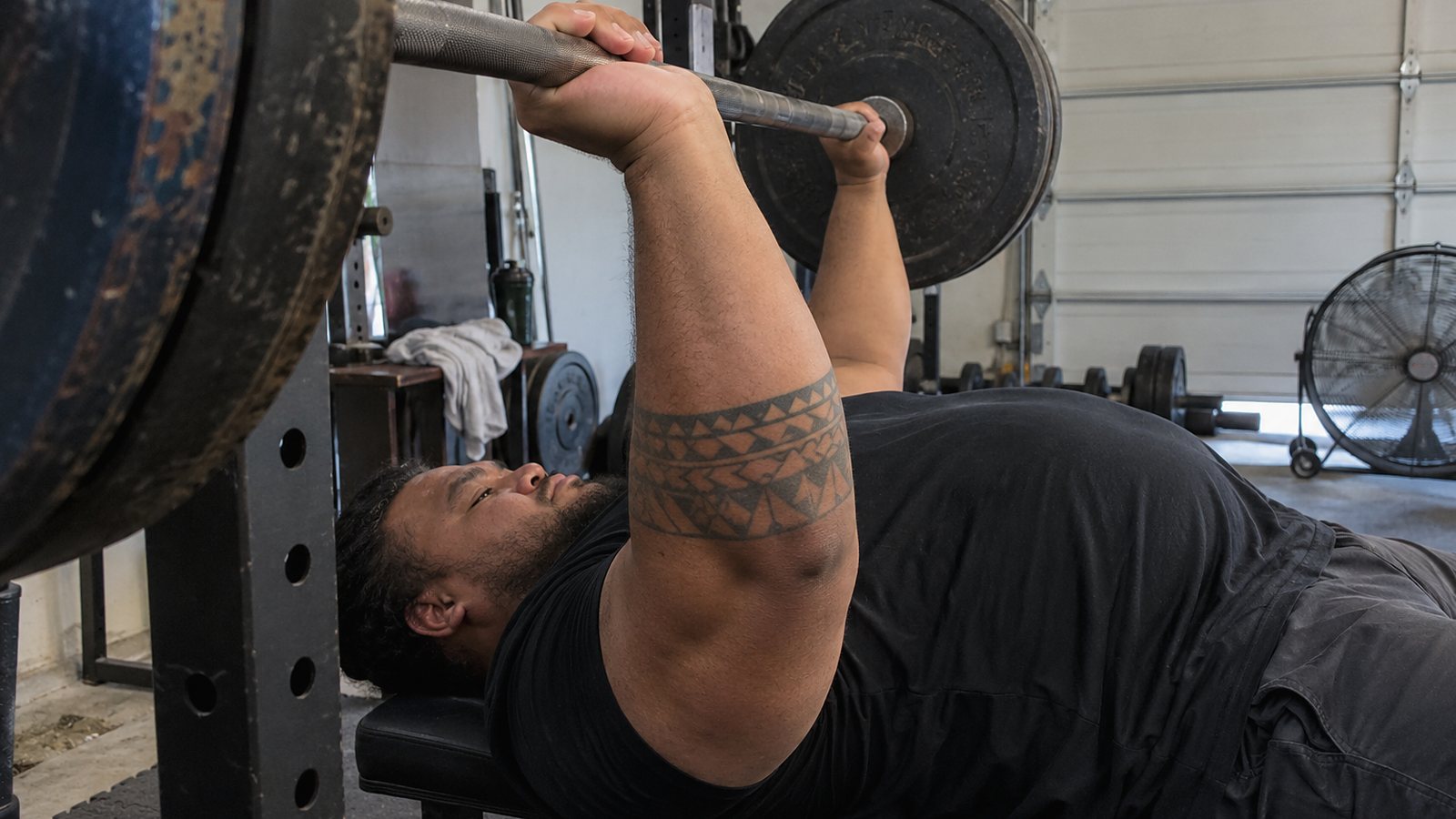
Bench Press Wrist and Elbow Position: Stack the Bar Over Your Forearms
The best bench press wrist position keeps the bar low in your palm and stacked over your forearm,1 with your wrist only slightly bent back.2 Set that way, the force from your arms travels up your forearm bones and straight into the bar instead of through a bent wrist.1
The proper wrist position for bench press also depends on your grip and your elbows. As you lower the bar, your forearms should stay upright under it and parallel to each other.3 If your wrists ache when you bench, a wrist bending back under the bar is the first thing to check.4
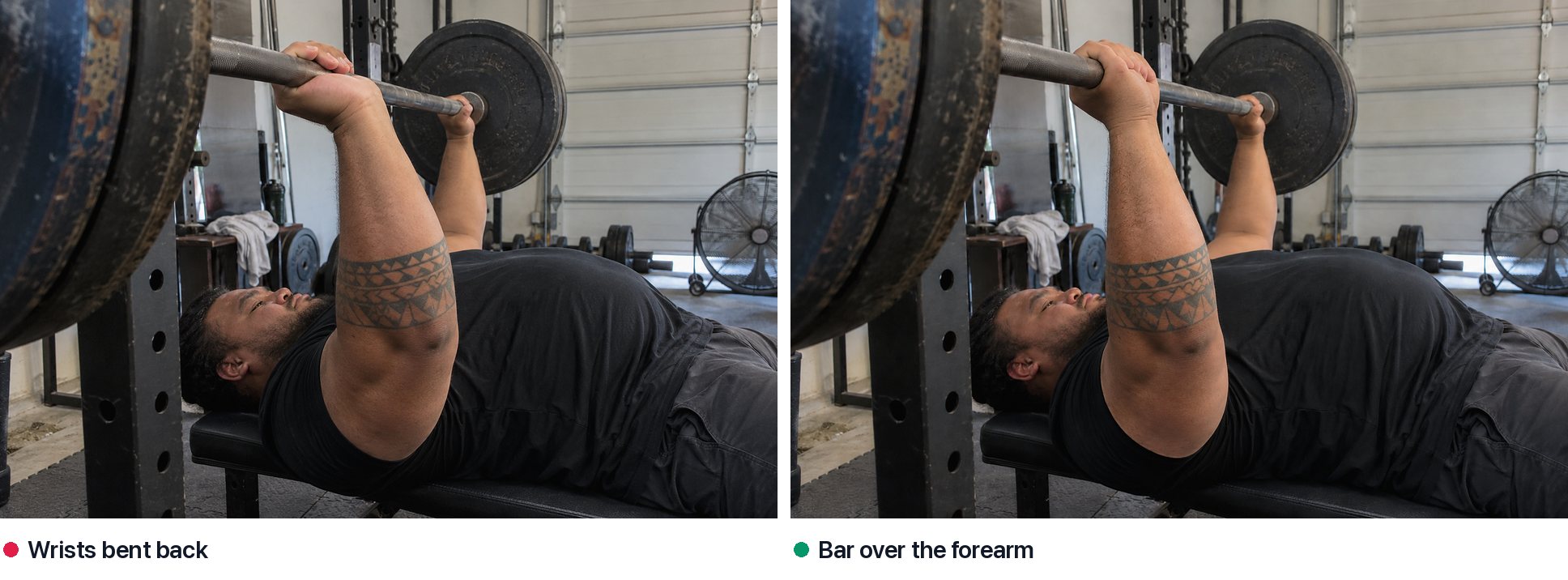
What bent wrists look like on video
Film from the side at bench height, with your wrists and forearms clear of the plates. Watch your hands as you unrack and as each press starts.
A bent wrist folds back toward the forearm, and the bar sits up toward the fingers, behind the line of the forearm. With a stacked wrist on the bench press, the bar sits over the forearm, so at lockout the bar, wrist, elbow and shoulder line up.5 Compare your first and last reps, because a bar that starts low in the palm can roll toward the fingers during the set.6
Does wrist position matter?
Yes. Gripped up near your fingers, the bar sits 1 to 2 inches behind your wrist, and that distance levers the wrist back.7 Over your forearm, your arms push straight into it. A bar that shifts in your hand mid-set can also change your elbow and shoulder position.6
How to keep your wrists straight on the bench press
Three things keep your wrists close to straight: where the bar sits in your hand, how hard you grip it, and the angle of your forearms.
Bar in the heel of the palm. Turn your thumbs down toward your feet before you close your grip, so the bar settles into the heel of your palm, then lay your fingers over it.7 Keep your thumbs wrapped around the bar: you get the same stacked position with them,8 and powerlifting rules require it.9
Squeeze the bar. Grip it as hard as you can before you unrack, and keep squeezing. A hard squeeze tenses the muscles that flex your wrist, which helps stop it bending back,2 and it keeps the bar from rolling toward your fingers during the set.6
Forearms vertical. With the bar on your chest, your forearms should be upright under it.3 A grip that puts them there also gives you the longest range of motion.10 Grip width bends the wrists sideways too: the wider your grip, the more they tilt toward your thumbs.11
Where your elbows should go on the bench press
Your bench press elbow position sets where the bar touches your chest. The bar follows your elbows: flare them toward shoulder height and it touches higher, toward your throat; tuck them toward your sides and it touches lower, toward your belly.12
Most lifters do best with a moderate elbow tuck. Greg Nuckols puts the bench press elbow angle, between upper arm and torso, at around 45 to 60 degrees.13 Mark Rippetoe allows about 45 to 75 degrees, depending on how high you arch your chest.14 Treat these as ranges, not rules.
Avoid the extremes. Elbows pinned to your sides put the bar far down your chest from your shoulders and take work off your chest muscles.14 At the touch, elbows an inch or two in front of the bar are fine; more than that is over-tucking.13 Flared straight out at 90 degrees, they keep the bar over your shoulders but put the touch close to your throat.12
Some elbow flare belongs in a good press: as the bar leaves your chest, let your elbows flare so it travels back over your shoulders, if that feels comfortable.15 From the side and from your feet, your forearms should look close to vertical, with your elbows under the bar.16
CueForm doesn't check elbow position or elbow flare, so judge it on a set filmed from your feet.
Bench press wrist pain: what to change
Start with technique. If your wrists bend back, set the bar lower in your palm and keep it there.4 If they bend sideways toward your thumbs, your grip may be too wide,11 so try bringing it in a little.4 A very close grip can bend them sideways too, so keep your hands far enough apart that your wrists stay straight.17
If a lift still hurts, change the range of motion, reduce the load or swap in a similar movement that is pain-free.18
See a doctor or physical therapist if the pain stops you doing normal activities, keeps getting worse or coming back, or hasn't eased after two weeks of home treatment, or if you have tingling, loss of feeling, or a warm, swollen, stiff wrist. Get urgent help for severe pain, a snap or pop at the time of an injury, a wrist you can't move or hold things with, or one that has changed shape or color.19
Do wrist wraps help bench press?
They make your wrists feel more stable, but they don't add weight to your bench. In a study of 18 trained lifters, flexible and stiff wraps didn't change bench press 1RM, power or bar speed. The lifters rated both wraps as more stable, and less comfortable, than going without.20
Wrist wraps for bench press are support, not a fix: they don't move the bar back into your palm, so set your grip first. If you wear them, wrap high enough to cover the wrist joint and the heel of your hand without covering where the bar sits, and tight enough that your wrist can't bend. Take them off between sets.21 The IPF allows wrist wraps up to 1 meter long and 8 cm wide.22
How to fix bent wrists
Start with where the bar sat in your hand:
- It started low and rolled back during the set: squeeze the bar every rep (fix 1).
- Low in your palm, over your forearm, but your wrists still bend: check your forearm angle (fix 2).
- Up toward your fingers: stack the bar over your forearm (fix 3).
Try one fix at a time with a light weight, and film a set after each. If your wrists hurt, start with the pain section above.
1. Squeeze the bar every rep
Cue: Crush the bar in your hands on every rep so it stays put.
A bar that rolls back toward your fingers during a set comes from a grip that loosens.6 Set the grip low, squeeze the bar as hard as you can before you unrack, and keep squeezing through every rep.2
Drill: a light paused set. Lower each rep to a light touch on your chest, hold until the bar is still with your whole body tight, then press.23 Keep squeezing through every pause.
On your next filmed set: the bar sits over your forearm on the last rep, just as it did on the first.
2. Check your forearm angle
Cue: Set your grip so your forearms are upright with the bar on your chest.
Grip width within a broad range is personal preference, and the grip that puts your forearms vertical at the chest gives you the longest range of motion.10
Drill: one paused rep to find your grip. With a light bar, pause one rep on your chest and look at your forearms, or have someone film you from your feet. Move your hands a thumb-width in or out until your forearms are upright under the bar at the touch. Note where your hands sit against the rings, and use that grip every set.
On your next filmed set: your forearms are upright at the touch, seen from the side and from your feet.
3. Stack the bar over your forearm
Cue: Set the bar on the heel of your palm, right over your forearm.
Most people grip with their knuckles in line with the bar, which leaves it behind the wrist.7 Set your grip before every set, before the bar leaves the hooks. Place your hands, turn your thumbs down toward your feet so the bar settles into the heel of your palm, then wrap your thumbs around, lay your fingers over the bar and squeeze.7
Drill: empty-bar grip practice. Start every bench session with the empty bar,24 and set your grip this way on every warm-up set.
On your next filmed set: from the side, the bar sits over your forearm, not behind it.
See it in your own set
Your wrists are hard to watch while you bench, because your eyes stay on the ceiling, not the bar,25 and a bar that starts in the right place can roll back during the set.6 Film one set from the side at bench height, with your wrists and forearms clear of the plates. CueForm shows the reps where your wrists bent back under the bar. Check your bench press wrist position from one video.
The barbell bench press guide covers the rest of the lift, and our bench press safety tips cover warm-ups and spotting.
FAQ
Should your wrists be straight when benching?
Close to straight. Keep the bar low in your palm, stacked over your forearm,1 and avoid letting your wrists bend back more than slightly.2 If they keep bending back, check where the bar sits in your hand first,4 then squeeze the bar harder.2
Should you tuck or flare your elbows on bench press?
Some of each. Lower the bar with your elbows moderately tucked, around 45 to 60 degrees from your torso, so it touches your lower chest.13 As you press, let them flare to bring the bar back over your shoulders.15 Avoid pinning your elbows to your sides,14 and don't flare them straight out on the way down.12
How do I stop flaring my elbows?
Touch the bar lower on your chest. For most lifters, a low touch puts the elbows in a good position on the way down without extra thought.26 Then check your grip: with your forearms vertical at the touch, your elbows sit under the bar.16 Let them flare only as the bar leaves your chest.15
Where should your hands be on a bench press bar?
Where your forearms are vertical with the bar on your chest.10 For most lifters that is roughly 1.5 to 2 times shoulder width.27 Rippetoe suggests 22 to 28 inches (about 56 to 71 cm) between your index fingers,10 and powerlifting rules cap the grip at 81 cm between the forefingers.9
Sources
-
Rippetoe M. Starting Strength: Basic Barbell Training, 3rd edition. The Aasgaard Company, 2011. Chapter 5, "Learning to Bench Press", pp. 185–186. ↩
-
Nuckols G. How to bench press: the definitive guide. Stronger by Science, updated 2023. Section "Unracking". ↩
-
Caulfield S, Berninger D. Exercise technique for free weight and machine training. In: Haff GG, Triplett NT, eds. Essentials of Strength Training and Conditioning, 4th edition. Human Kinetics, 2016. Chapter 15, "Flat Barbell Bench Press", p. 371. ↩
-
Nuckols G. How to bench press: the definitive guide. Stronger by Science, updated 2023. Section "What should I do about wrist pain?". ↩
-
Megsquats. 3 easy squat fixes: quick technique fixes for the barbell squat and bench (opens in a new tab). Video; bench press from 12:24. ↩
-
Rippetoe M. Starting Strength: Basic Barbell Training, 3rd edition. The Aasgaard Company, 2011. Chapter 5, "Hands and grip", p. 192. ↩
-
Rippetoe M. Starting Strength: Basic Barbell Training, 3rd edition. The Aasgaard Company, 2011. Chapter 5, "Hands and grip", p. 191. ↩
-
Rippetoe M. Starting Strength: Basic Barbell Training, 3rd edition. The Aasgaard Company, 2011. Chapter 5, "Hands and grip", p. 190. ↩
-
International Powerlifting Federation. Technical Rulebook, section 4.2, rules 2 and 5. Effective 1 March 2026. ↩
-
Rippetoe M. Starting Strength: Basic Barbell Training, 3rd edition. The Aasgaard Company, 2011. Chapter 5, "Hands and grip", p. 192. ↩
-
Nuckols G. How to bench press: the definitive guide. Stronger by Science, updated 2023. Section 1, "Anatomy: Wrist". ↩
-
Rippetoe M. Starting Strength: Basic Barbell Training, 3rd edition. The Aasgaard Company, 2011. Chapter 5, "Elbows", pp. 194–196. ↩
-
Nuckols G. How to bench press: the definitive guide. Stronger by Science, updated 2023. Section "How much should I tuck my elbows?". ↩
-
Rippetoe M. Starting Strength: Basic Barbell Training, 3rd edition. The Aasgaard Company, 2011. Chapter 5, "Elbows", p. 197. ↩
-
Nuckols G. How to bench press: the definitive guide. Stronger by Science, updated 2023. Section "Ascent". ↩
-
Rippetoe M. Starting Strength: Basic Barbell Training, 3rd edition. The Aasgaard Company, 2011. Chapter 5, "Elbows", pp. 193–194. ↩
-
Austin D, Mann B. Powerlifting: The Complete Guide to Technique, Training, and Competition, 2nd edition. Human Kinetics, 2022. Chapter 5, "Close-Grip Bench Press", p. 92. ↩
-
Helms E, Morgan A, Valdez A. The Muscle and Strength Pyramid: Training, 2nd edition. Muscle and Strength Pyramids, 2019. "Adherence", p. 21. ↩
-
NHS. Wrist pain. Reviewed November 2025. ↩
-
Harris DR, Harris DR, Cardaci TD, Cintineo HP, Funderburk LK, Machek SB. Wrist wraps do not affect barbell bench press muscular strength, power, or endurance in resistance-trained men and women. Journal of Strength and Conditioning Research, 2024. ↩
-
Megsquats. 3 easy squat fixes: quick technique fixes for the barbell squat and bench (opens in a new tab). Video; wrist wraps from 9:05. ↩
-
International Powerlifting Federation. Technical Rulebook, section 3.9, "Wraps". Effective 1 March 2026. ↩
-
Nuckols G. How to bench press: the definitive guide. Stronger by Science, updated 2023. Section "Pausing". ↩
-
Rippetoe M. Starting Strength: Basic Barbell Training, 3rd edition. The Aasgaard Company, 2011. Chapter 5, "Learning to Bench Press", p. 184. ↩
-
Rippetoe M. Starting Strength: Basic Barbell Training, 3rd edition. The Aasgaard Company, 2011. Chapter 5, "Learning to Bench Press", p. 187. ↩
-
Nuckols G. How to bench press: the definitive guide. Stronger by Science, updated 2023. Section "Descent". ↩
-
Nuckols G. How to bench press: the definitive guide. Stronger by Science, updated 2023. Section "Unracking", on grip width. ↩