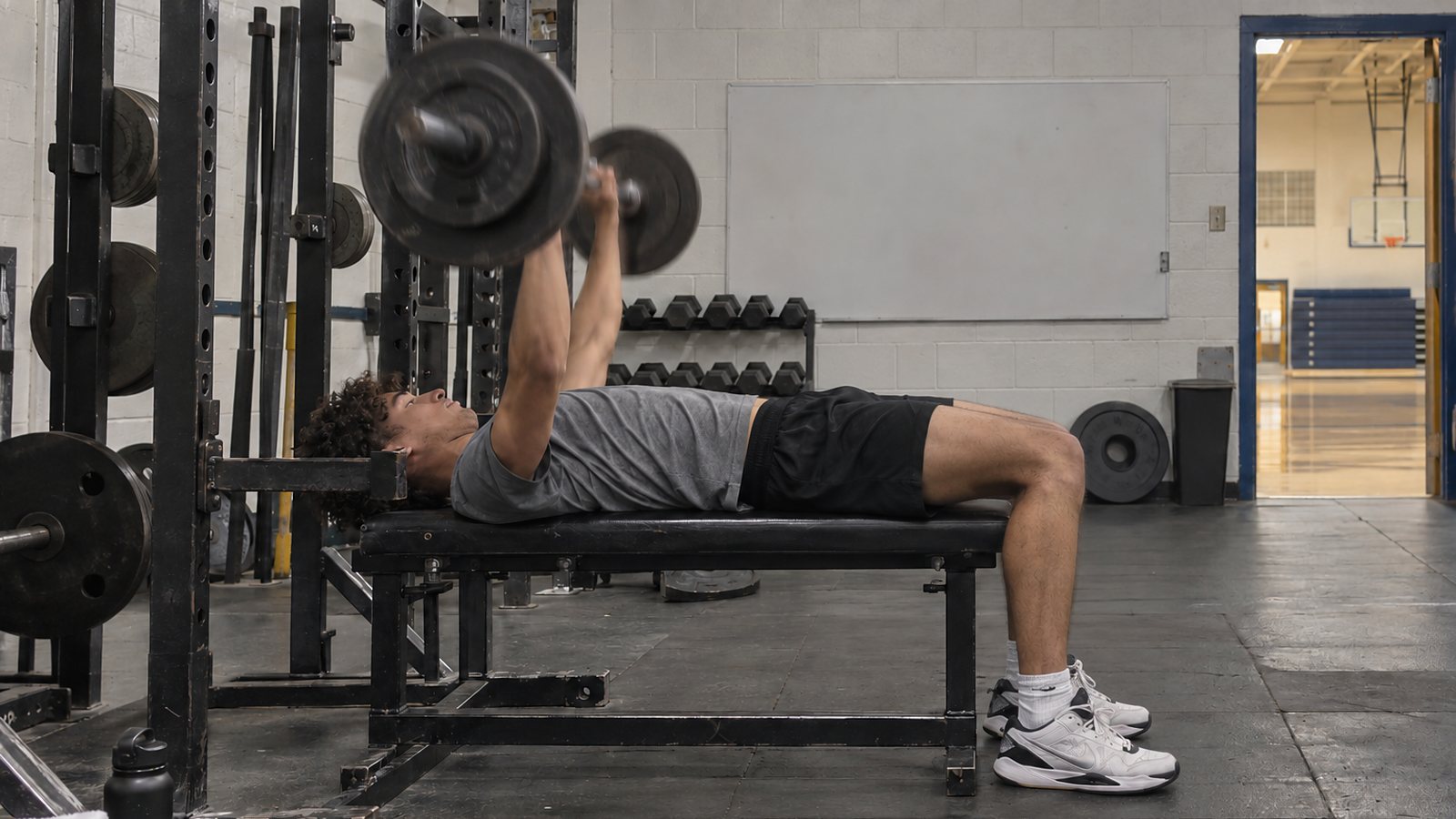
Bench Press Leg Drive: How to Use Your Legs Without Lifting Your Hips
Bench press leg drive is pushing through your feet to drive yourself along the bench toward your head, while your hips stay down.1 It keeps your upper back tight and your chest high as the bar comes down and goes back up.2 It is not lifting your hips off the bench.3
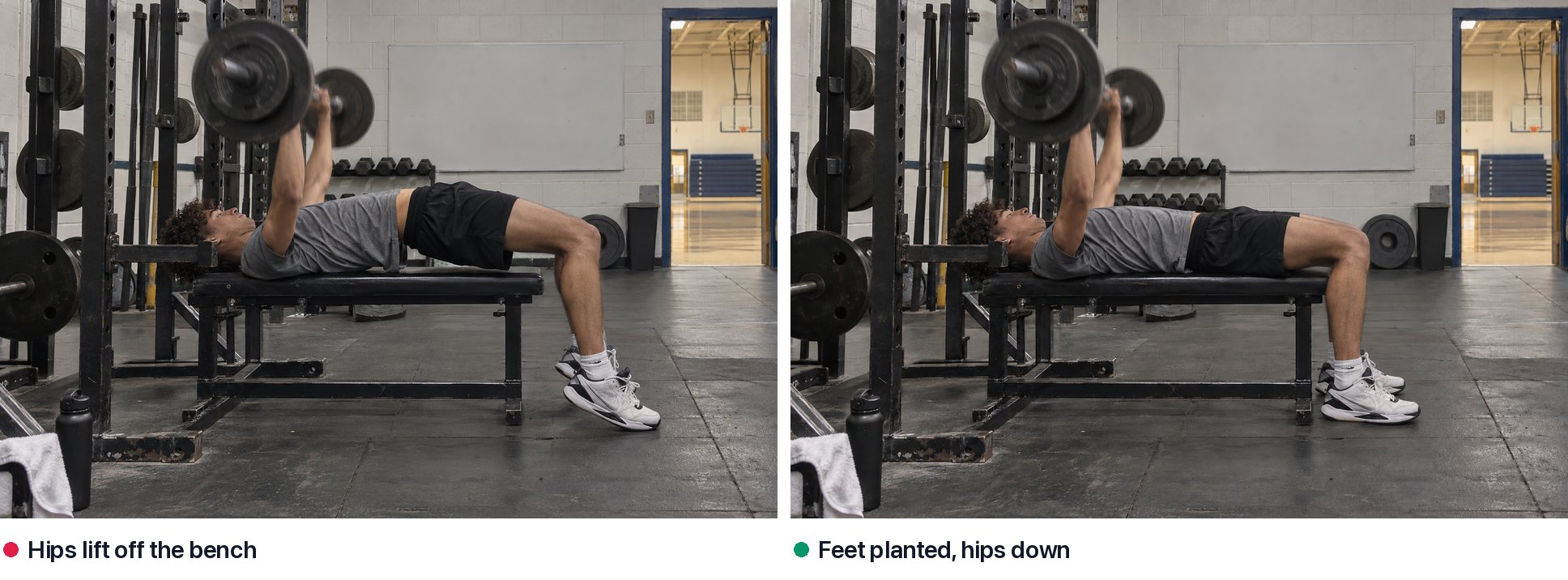
When it goes wrong, your hips lift off the bench or your feet slide.
What is leg drive?
Leg drive is the push from your feet into the floor that braces your body on the bench. The force goes along the bench and into your upper back, not up off it.1
How does leg drive help the bench press? It gives you tension and a stable base. The bar's weight on the way down tends to flatten your arch and drop your chest, and your legs push back against that to hold your position.2 As you press, squeezing your glutes and driving your heels into the floor pushes your chest slightly up and back into the bar.4
Your legs don't press the bar. Your arms and chest still do that work, and you can bench a large share of your max with your feet in the air.1 Powerlifting rules allow leg drive, as long as your feet stay flat and your hips stay on the bench.5
Bench press foot position: where to put your feet
Set your feet flat, with your heels about under or just behind your knees and a little wider than your hips. Rippetoe describes it as shins close to vertical,6 and Austin and Mann teach feet flat and under the knees for a flat-back press.7
Avoid two positions. Feet tucked far back under your hips, close together with the heels up, set you up to bridge the heavy reps.6 Feet out in front, with your knees nearly straight, get little bite against the floor,6 and they tend to slip when you drive.8
Flat or on your toes depends on your federation and how much you arch. Flat heels give the drive a solid base,9 and IPF rules require them.5 Lifters with a big arch often pull their feet far back and bench on their toes, where the rules allow it.8
If your heels can't reach the floor, stand your feet on plates or a low step.10 In competition you can use blocks up to 30 cm high.11
Feet on the bench
Putting your feet on the bench, or kicking them far out in front, gives you a bench press without leg drive. Holding your feet curled up in the air instead makes it harder to balance.12
It suits lifters who want to train the press with the legs taken out,12 and lifters whose lower back doesn't tolerate the arched set-up.10 Without the brace from your legs, Rippetoe expects you to lift less weight.10 It isn't legal in IPF competition, where your feet can't touch the bench.13
How to use leg drive on the bench press
- Set your feet first. Place your feet before you lie back, then settle your hips as you get under the bar.14
- Set your upper back. Pull your shoulder blades together and down, so more of your back is on the bench.7
- Build tension before the unrack. Squeeze your glutes and legs,15 then take a deep breath before the bar leaves the hooks.7
- Hold your position on the way down. Keep steady pressure through your heels so the descending bar can't flatten your arch.2
- Drive along the bench as the bar leaves your chest. Drive your heels into the floor and press.15 Push yourself toward the head of the bench, as if moving your hips toward your shoulders, not up.16
The timing takes practice, especially with heavy weights.17
When leg drive goes wrong
Lifting your hips off the bench is called bridging. The lifter uses the legs to heave the hips up, which raises the chest to meet the bar earlier.3
A foot slip is the other fault. When a foot slides under a heavy bar, the arch and chest position your legs were holding collapse.18
Does it matter?
Yes. Lifting your hips shortens the press and takes work away from your chest, shoulders and triceps.3 In powerlifting, raised hips or lifted feet make it a no lift.13 A foot slip under a heavy bar usually costs you the rep.19
Why your hips lift or your feet move
- Feet tucked back, heels up. With your feet too far under your hips and too close together, you're likely to bridge the heavy reps.6
- Driving up instead of along. Leg drive aimed up off the bench lifts the hips.2 Aim it along the bench, as if pushing your hips toward your shoulders.16
- Feet out in front of your knees. With your knees too straight, your feet get little grip on the floor6 and tend to slide.8
- Slippery floor or shoes. A foot slip usually comes from the floor or the soles of your shoes, such as powder or dirt underfoot.19
If keeping your hips down hurts your back, don't push through it. Change the range of motion, reduce the load or swap in a similar movement that is pain-free.20 See a doctor or physical therapist if back pain doesn't improve after a few weeks, stops your day-to-day activities or is worse at night. Get urgent help if it comes with numbness, tingling or weakness in both legs, numbness around your genitals or bottom, or changes in bladder or bowel control.21
How to fix your leg drive
Start with where your feet were:
- Tucked back with your heels up, or out in front of your knees: plant your heels flat (fix 1).
- Flat, about under your knees, but your hips still lifted: drive along the bench (fix 2).
- They slid, shifted or came up during the press: nail your feet to the floor (fix 3).
Try one fix at a time with a moderate weight, and film a set after each.
1. Plant your heels flat
Cue: Plant both heels flat, a little wider and further forward, before you unrack.
If your feet were tucked back, slide them forward until both heels sit flat, about under or just behind your knees, a little wider than your hips. A wider stance with flat feet takes the slack out of your hips and makes bridging hard.9 If your feet were out in front, bring your heels under your knees.
Drill: set your feet on every warm-up. Place your feet before you lie back under the bar,14 on every warm-up set as well as your work sets. Check them again before each set.
On your next filmed set: both heels stay flat and your hips stay on the bench on every rep.
2. Drive along the bench
Cue: Push the floor away toward the head of the bench as you press.
Before you unrack, plant your heels and feel your upper back pressed into the bench. As the bar leaves your chest, push the floor away toward the head of the bench, as if sliding yourself up it. The force goes along the bench, not up off it.2 When a hard rep slows, keep pushing toward the head of the bench instead of pushing your hips up.
Drill: paused bench presses. Lower the bar to a light touch on your chest. Think of touching your shirt, not your chest.22 Hold it still with your whole body tight, then press without a heave. Staying tight through the pause is a skill even competitive powerlifters work on,23 and it's how a competition bench is done.24
On your next filmed set: your hips stay on the bench as the bar slows on the last reps.
3. Nail your feet to the floor
Cue: Press your heels into the floor before the unrack, and keep them there.
Check the contact first. Slips usually come from the floor or your soles,19 so wear flat shoes with grippy soles and bench on a clean, dry floor with no chalk or powder underfoot. Place your feet flat, about under your knees, and press your heels down. Flat feet grip the floor better than toes, and a foot that rolls during a rep means the connection has loosened.9 Hold the same pressure through every rep, and drive through your heels as the bar leaves your chest.15
Drill: paused bench presses, feet locked. Use the paused presses from fix 2, and keep the same pressure through your heels during the pause as during the press.
On your next filmed set: both feet stay flat and still through every press.
See it in your own set
Your hips and feet are hard to watch while you bench, because your eyes stay on the ceiling,25 and a bridge often shows up only on the heavy reps.6 Film one set from the side at bench height, with your feet, hips and the bench clear of the rack. CueForm shows the reps where your feet moved or your hips lifted off the bench. Check your bench press leg drive from one video.
The barbell bench press guide covers the rest of the lift.
FAQ
Is leg drive cheating?
No. Leg drive holds your arch and chest position while your arms and chest move the bar.1 Cheating starts when your hips leave the bench: bridging shortens the press and takes work away from the muscles you're training.3 Keep your hips on the bench and leg drive is part of a strict press.
Is leg drive allowed in powerlifting?
Yes. In IPF competition, your feet stay flat on the floor, as flat as your shoes allow, and your head, shoulders and buttocks stay on the bench.5 Your feet may move if they stay flat, but they can't lift or touch the bench.13 You can stand on blocks up to 30 cm high.11
How much does leg drive add to your bench?
The studies so far found little difference. In a small study of 10 amateur lifters, maxes with and without leg drive were not significantly different.26 In another, five weeks of leg-drive training added no more strength than normal benching.27 Its clearest job is a stable base for your upper back.1
Should your feet be flat or on your toes?
Flat, for most lifters. The most common set-up keeps the whole foot on the floor.8 Flat heels give your leg drive a base and grip better than toes,9 and IPF rules require them.5 Lifters with a big arch often press on their toes with their feet pulled far back, where their federation allows it.8
Sources
-
Rippetoe M. Starting Strength: Basic Barbell Training, 3rd edition. The Aasgaard Company, 2011. Chapter 5, "Lower back, hips, and legs", p. 206. ↩
-
Rippetoe M. Starting Strength: Basic Barbell Training, 3rd edition. The Aasgaard Company, 2011. Chapter 5, "Lower back, hips, and legs", p. 207. ↩
-
Rippetoe M. Starting Strength: Basic Barbell Training, 3rd edition. The Aasgaard Company, 2011. Chapter 5, "Lower back, hips, and legs", p. 207. ↩
-
Nuckols G. How to bench press: the definitive guide. Stronger by Science, updated 2023. Section 3, "Biomechanics: Shoulder flexion". ↩
-
International Powerlifting Federation. Technical Rulebook, section 4.2, rule 2. Effective 1 March 2026. ↩
-
Rippetoe M. Starting Strength: Basic Barbell Training, 3rd edition. The Aasgaard Company, 2011. Chapter 5, "Feet", pp. 208–209. ↩
-
Austin D, Mann B. Powerlifting: The Complete Guide to Technique, Training, and Competition, 2nd edition. Human Kinetics, 2022. Chapter 5, "Mechanics of the Straight-Line Bench Press", p. 80. ↩
-
Nuckols G. How to bench press: the definitive guide. Stronger by Science, updated 2023. Section 2, "Setup: Foot position". ↩
-
Rippetoe M. Starting Strength: Basic Barbell Training, 3rd edition. The Aasgaard Company, 2011. Chapter 5, "Feet", p. 209. ↩
-
Rippetoe M. Starting Strength: Basic Barbell Training, 3rd edition. The Aasgaard Company, 2011. Chapter 5, "Feet", p. 210. ↩
-
International Powerlifting Federation. Technical Rulebook, section 4.2, rule 3. Effective 1 March 2026. ↩
-
Reactive Training Systems. Guided programming: squat, feet up bench, and deadlift technique analysis (opens in a new tab). Video; feet-up bench from 3:17. ↩
-
International Powerlifting Federation. Technical Rulebook, section 4.2.1, rules 2 and 9. Effective 1 March 2026. ↩
-
Rippetoe M. Starting Strength: Basic Barbell Training, 3rd edition. The Aasgaard Company, 2011. Chapter 5, "Feet", Figure 5-28, p. 209. ↩
-
Austin D, Mann B. Powerlifting: The Complete Guide to Technique, Training, and Competition, 2nd edition. Human Kinetics, 2022. Chapter 5, "Performing the Straight-Line Bench Press", p. 81. ↩
-
Nuckols G. How to bench press: the definitive guide. Stronger by Science, updated 2023. Section 4, "How can I keep my butt from coming off the bench?". ↩
-
Nuckols G. How to bench press: the definitive guide. Stronger by Science, updated 2023. Section 4, "How can I improve my leg drive?". ↩
-
Rippetoe M. Starting Strength: Basic Barbell Training, 3rd edition. The Aasgaard Company, 2011. Chapter 5, "Feet", p. 208. ↩
-
Rippetoe M. Starting Strength: Basic Barbell Training, 3rd edition. The Aasgaard Company, 2011. Chapter 5, "Feet", p. 210. ↩
-
Helms E, Morgan A, Valdez A. The Muscle and Strength Pyramid: Training, 2nd edition. Muscle and Strength Pyramids, 2019. "Adherence", p. 21. ↩
-
Rippetoe M. Starting Strength: Basic Barbell Training, 3rd edition. The Aasgaard Company, 2011. Chapter 5, p. 202. ↩
-
Rippetoe M. Starting Strength: Basic Barbell Training, 3rd edition. The Aasgaard Company, 2011. Chapter 5, p. 201. ↩
-
International Powerlifting Federation. Technical Rulebook, section 4.2, rule 8. Effective 1 March 2026. ↩
-
Rippetoe M. Starting Strength: Basic Barbell Training, 3rd edition. The Aasgaard Company, 2011. Chapter 5, "Learning to Bench Press", p. 187. ↩
-
D'Isanto T, D'Elia F, Aliberti S, Di Domenico F, Esposito G. Unified bench press through the elimination of leg-drive to promote sports inclusion. Physical Education of Students, 2023; 27(6): 319–324. ↩
-
Gardner JK, Chia JT, Peterson BM, Miller KL. The effects of 5 weeks of leg-drive training on bench press performance in recreationally-trained, college-age men. Journal of Science in Sport and Exercise, 2022; 4(3): 231–236. ↩