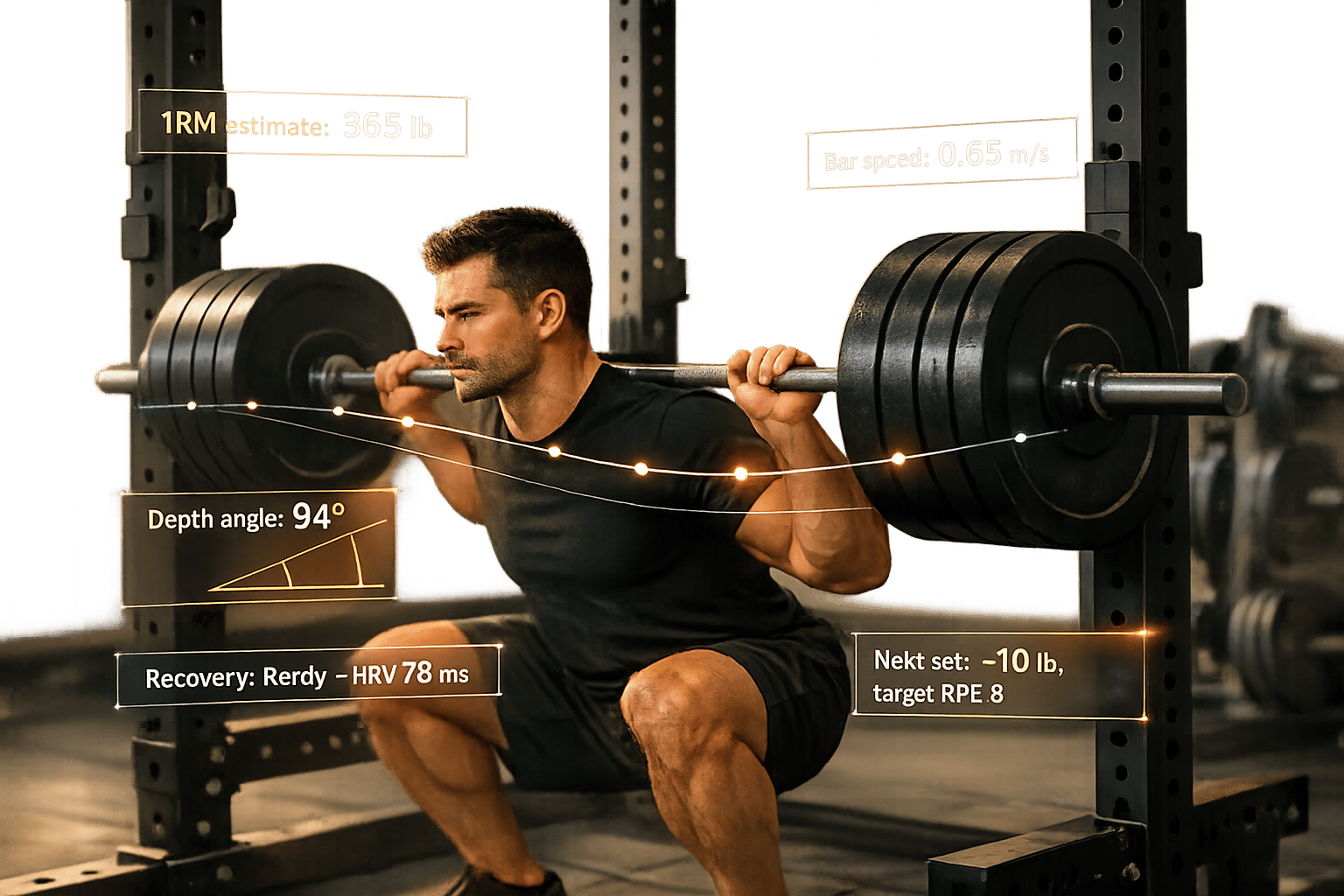
AI in Strength Training: Progress Tracking Explained
AI is reshaping strength training by offering precise, data-driven tools for tracking progress and improving workouts. Gone are the days of relying on notebooks or subjective guesses about your performance. With AI, you can:
- Automatically track key metrics like 1RM (One-Rep Max), bar speed, and volume load.
- Get real-time feedback on your technique and form, flagging issues like joint misalignment or poor bar paths.
- Monitor recovery using data from wearables, like Heart Rate Variability (HRV) and resting heart rate, to prevent overtraining.
- Adjust workouts dynamically through autoregulation, ensuring optimal intensity based on daily readiness.
AI platforms like CueForm AI combine video analysis with recovery insights to deliver personalized coaching. Whether it's tracking your squat depth or identifying fatigue, these tools provide actionable feedback that helps maximize gains while reducing injury risks. For just $10/month, CueForm AI offers detailed reports and a conversational AI coach to refine your training further.
Bottom line: AI takes the guesswork out of strength training, giving you clear, measurable progress and smarter workout adjustments. Ready to lift smarter? Let AI guide the way.
Key Metrics AI Tracks for Strength Training Progress
Performance Metrics: 1RM, Bar Speed, and Volume Load
AI systems focus on tracking metrics that directly reflect your strength progress. One of the most important is One-Rep Max (1RM). Instead of requiring you to test it manually, the AI estimates your 1RM weekly using your recent workout data, giving you a clear snapshot of your strength development.
Another standout feature is bar speed tracking. Using your smartphone camera, the AI measures how quickly the bar moves during each rep. Faster bar speed indicates you're fresh and strong, while slower speed suggests fatigue, even if the weight stays the same. This approach, called velocity-based training (VBT), allows you to adjust your workout intensity in real time based on your performance that day [4].
The system also calculates Volume Load automatically (weight × reps × sets) alongside Effective Sets, ensuring you're working hard enough to build muscle. By monitoring your Reps in Reserve (RIR) - the number of reps you could have done beyond a set - the AI evaluates whether you're pushing close enough to failure for optimal hypertrophy, which usually means being within 2-3 reps of failure [5]. This ensures your training is effective, not just busywork.
Some advanced platforms go further by tracking movement balance, monitoring your push-to-pull or hinge-to-squat ratios. This helps prevent muscle imbalances that could lead to injuries [6]. But effective training isn't just about performance; recovery plays a huge role too.
Recovery and Fatigue Indicators
Strength gains depend on balancing hard training with proper recovery. AI doesn't just record your workouts - it also tracks your recovery to ensure you're ready for the next session. Tools like Heart Rate Variability (HRV) and resting heart rate, often measured by wearables like Apple Watch or WHOOP, provide insights into your nervous system's recovery status [4].
If your HRV drops or your resting heart rate rises, it signals lingering fatigue or stress. The AI responds by adjusting your workout intensity to prevent overtraining. This is critical because even one week of intense training can spike cortisol and inflammation levels [7].
AI also factors in subjective data like your Rate of Perceived Exertion (RPE). For example, if you rate a session as an 8 out of 10 for difficulty, but the AI notices slower bar speed and low HRV, it flags that you're approaching "overreaching" territory. This proactive adjustment helps you avoid burnout before it escalates into overtraining [4][7].
Interestingly, physical recovery doesn't always align with mental recovery. Your body might recover biochemically, but you could still feel unmotivated or drained. By tracking both physiological data and mood, AI platforms can identify these disconnects and adjust accordingly [7].
Technique and Form Analysis
AI's ability to analyze form takes training to the next level. Using video, it evaluates joint angles, range of motion, and bar path for key lifts like squats, bench presses, and deadlifts [4].
The system flags form breakdowns that indicate fatigue or injury risk, such as knees caving in (knee valgus), a rounded lower back (lumbar flexion), or an inconsistent bar path. For example, a proper squat requires at least 15-20 degrees of ankle dorsiflexion and 120 degrees of hip flexion [2]. If you're not hitting these benchmarks, the AI alerts you immediately.
To ensure quality over quantity, the AI only counts reps that meet specific standards. Shallow reps or those with poor form don't contribute to your volume, eliminating "junk volume" - reps that don't help you get stronger and could increase injury risk [1].
Platforms like CueForm AI take this further by providing real-time feedback. For instance, during a squat, it might prompt you with cues like "knees out" or "chest up" to correct your technique mid-set. By filming short sets from the side, you receive detailed analysis of joint alignment and bar path - insights that even seasoned trainers might overlook [8][4]. This immediate feedback helps you refine your form and align your workouts with performance and recovery data seamlessly.
Real-Time Feedback and Adaptive Training with AI
Understanding Autoregulation in Training
Autoregulation is a flexible training method that adapts your workout intensity based on how you're performing that day, rather than sticking to a rigid plan created weeks in advance. Life happens - bad sleep, work stress, or lingering fatigue can throw off your training. That’s where AI-driven autoregulation steps in, acting like a GPS that recalculates your route in real time based on your readiness [3][13].
Here’s how it works: the system analyzes multiple data points simultaneously. For example, if you log a set of squats at 225 lbs and the AI notices your bar speed is slower than usual, it might reduce the weight for your next set. On the flip side, if you’re breezing through a set with energy to spare, it could push you to add intensity or reps [5][12].
"The research community proved autoregulation beats fixed loading. What AI does is make autoregulation practical for the everyday lifter." – SensAI [3]
The results speak for themselves. Athletes using autoregulation have boosted their one-rep max by nearly 50% more than those following fixed plans. They also report three times fewer training-related injuries [13]. Unlike relying on subjective feelings, AI uses hard data - like bar velocity, Rate of Perceived Exertion (RPE), and Reps in Reserve (RIR) - to decide if you should push harder or take it easy. Factors like stress, sleep, and recovery can cause your strength to vary by over 10% on any given day, and AI helps you adjust accordingly [3].
Preventing Overtraining and Maximizing Readiness
AI doesn’t just adapt your training in the moment - it also works proactively to prevent overtraining. By syncing with wearables like the Apple Watch, WHOOP, or Oura, it tracks recovery markers such as Heart Rate Variability (HRV) and sleep quality. If these indicators show poor recovery, the AI adjusts your workout before you even start your warm-up, reducing the risk of overtraining [9][11].
This kind of foresight is essential. Studies show that HRV-guided training can lead to a 10.1% improvement in VO₂max, compared to just 4.2% with predefined programs [3]. The AI fine-tunes the balance between training stress and recovery, keeping you in that "sweet spot" where growth happens without overreaching.
Platforms like CueForm AI take things further by combining recovery data with real-time feedback on your form. For instance, if the system notices both low HRV and form issues - like your knees caving in during squats - it flags these as signs of fatigue and a higher injury risk. You can then chat with the AI coach to adjust your session, perhaps swapping heavy lifts for lighter accessory work or even taking an extra rest day [10].
"Autoregulation isn't an excuse to take it easy; it's a strategy to train smarter." – GrabGains [13]
Whether you’re juggling a tough week at work or bouncing back from an intense workout, AI ensures your training aligns with your current capacity. This approach not only helps you make consistent progress but also keeps you healthy, seamlessly integrating performance and recovery into a system that adapts to your needs.
Why This AI Fitness Tracker Blows Others Away
Benefits of AI vs. Manual Progress Tracking
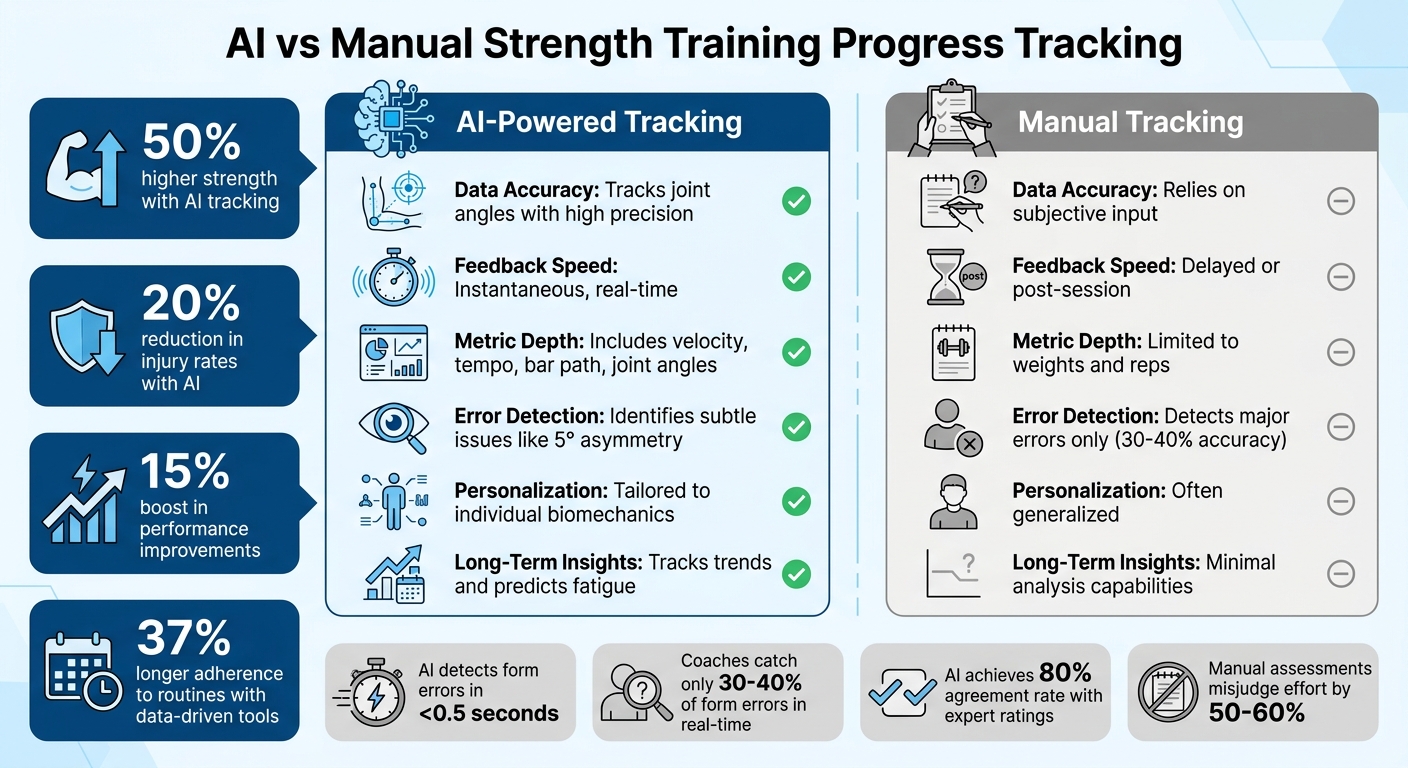
AI vs Manual Strength Training Progress Tracking Comparison
Comparison of AI and Manual Tracking Methods
When it comes to tracking progress in strength training, AI surpasses manual methods in precision, speed, and depth of analysis. Traditional manual tracking - like jotting down weights and reps in a notebook or using a basic app - captures only the surface-level data. In contrast, AI employs advanced tools like computer vision to assess joint angles, bar paths, movement velocity, and even time under tension, offering a level of detail that manual methods simply can't match [2].
One major difference lies in accuracy. Manual tracking often relies on subjective impressions, like how difficult a set felt or how "good" form appeared in the mirror. Studies show that these assessments can misjudge effort levels by as much as 50–60% [1]. AI, however, delivers objective, measurable feedback. Validation testing has shown AI systems to achieve an 80% agreement rate with expert human ratings, nearing the 85–90% consistency seen between two experienced trainers [14].
Speed is another area where AI shines. It provides real-time feedback, detecting issues like knee valgus or early hip rise in less than half a second - far faster than most coaches can react [14]. Zach Lush, a certified strength coach and co-founder of SportSensAI, explains the challenge coaches face:
"In a team setting, I can watch maybe 5-6 athletes closely during a lift session. The rest? I'm catching major breakdowns at best. Even experienced coaches admit they catch maybe 30-40% of form errors in real-time" [14].
The long-term results are equally compelling. Strength gains are about 50% higher with objective tracking systems compared to subjective assessments [1]. AI-driven analysis also reduces injury rates by 20% and boosts performance improvements by 15% [14]. Additionally, people using data-driven fitness tools stick with their routines 37% longer than those relying on manual methods [1].
Here's a quick breakdown of how AI and manual tracking stack up:
| Feature | AI-Powered Tracking | Manual Tracking |
|---|---|---|
| Data Accuracy | Tracks joint angles with high precision [2] | Relies on subjective input [2] |
| Feedback Speed | Instantaneous, real-time [1] | Delayed or post-session [2] |
| Metric Depth | Includes velocity, tempo, bar path, joint angles [2, 22] | Limited to weights and reps [1] |
| Error Detection | Identifies subtle issues like 5° asymmetry [14] | Detects major errors only (30–40% accuracy) [14] |
| Personalization | Tailored to individual biomechanics [2] | Often generalized [2] |
| Long-Term Insights | Tracks trends and predicts fatigue [1] | Minimal analysis capabilities [1] |
The edge AI offers in precision, speed, and depth makes it a game-changer for tracking and improving performance in strength training.
Getting Started with AI Progress Tracking
Integrating AI tracking into your fitness routine doesn’t have to be complicated. Let’s break it down step by step.
Requirements for Effective AI Integration
Getting started with AI progress tracking is simpler than you might expect. All you need is a smartphone with a camera for video-based tools [8]. Beyond that, the focus should be on capturing high-quality data.
AI systems generally require 2–3 weeks of consistent data to establish a performance baseline. Over 8–12 weeks, these systems can identify deeper trends and predict the best path for progression [1]. To ensure accurate analysis, record your lifts from angles that clearly display the bar path, joint positions, and range of motion [8]. Poor camera angles can interfere with the AI’s ability to provide precise feedback.
Adding personal details - such as your anatomy, fitness goals (e.g., strength, muscle growth, or injury recovery), and the equipment you use - enables the AI to deliver tailored coaching cues that align with your biomechanics [8]. For instance, CueForm AI uses this context to provide advice specific to your needs rather than generic tips.
When tracking progress, focus on core metrics like weight lifted, properly executed reps, and total volume [1]. Many AI tools now incorporate computer vision to ensure reps meet quality standards before counting them. This level of accuracy is why users often see up to 50% greater strength improvements when using objective tracking systems [1].
Using CueForm AI for Personalized Strength Training
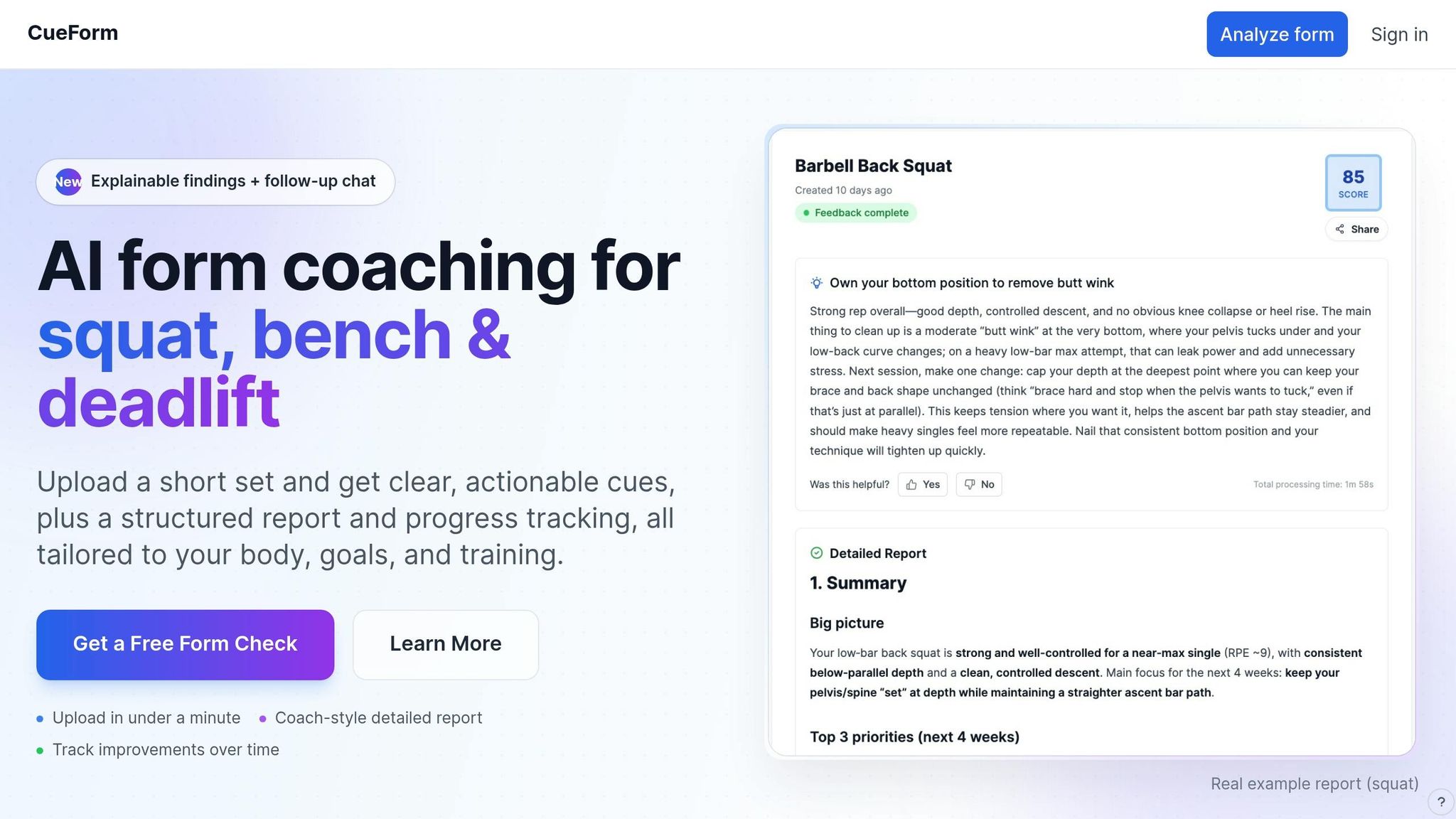
CueForm AI makes it easy to transform your data into actionable insights for key lifts. Its primary focus is on the "Big 3" lifts - squat, bench press, and deadlift - providing a straightforward process. Upload a video of your lift from a clear angle, share details about your anatomy and fitness goals, and the AI generates a detailed report. This report highlights areas for improvement, common issues, and specific cues to apply in your next session [8].
The platform offers unlimited quick feedback for free, breaking down specific issues and explaining the reasoning behind each cue - not just what to change, but why [8]. This clarity helps you better understand and implement the feedback.
For those looking for more, the Starter plan ($10/month or $89/year) includes unlimited detailed reports and access to a conversational AI coach [8]. You can ask follow-up questions, request alternative cues, or gain a better understanding of how a movement should feel based on your personal context.
CueForm AI also tracks your progress over time, maintaining a clean history of your form checks alongside performance metrics. By combining video-based technique analysis with long-term progress tracking, it provides a complete picture of your development - something that traditional methods often fall short of achieving.
Conclusion: The Future of Strength Training with AI
AI is reshaping the way we approach strength training by offering real-time, objective metrics like bar path consistency, joint angles, and barbell velocity. These insights remove the guesswork from tracking progress and provide a clear picture of where improvements can be made[8].
Studies show that systems relying on data-driven tracking lead to better strength gains compared to traditional methods, while also keeping users more engaged in their workouts over time[1]. This combination of precision and motivation is redefining what’s possible in fitness.
CueForm AI brings this cutting-edge technology straight to your smartphone. Whether you stick with the free plan for unlimited quick feedback or upgrade to the Starter plan ($10/month or $89/year) for detailed reports and extended AI coaching, you’ll gain access to professional-level analysis. It identifies issues, explains the reasoning behind its cues, and helps you track both technique and load progression over time - all in one place[8].
The fitness industry is already embracing AI at a rapid pace. In fact, the global AI in fitness and wellness market is projected to skyrocket from $9.8 billion in 2024 to $46.1 billion by 2034[1]. Early adopters are already reaping the benefits, from enhanced performance to fewer injuries, thanks to AI-powered tools that can catch even the common form mistakes - things even seasoned trainers might overlook[1]. These advancements are setting a new standard for optimizing training routines.
If you’re committed to improving your strength training, it’s not a matter of if you’ll incorporate AI - it’s when. This technology is ready to help you achieve measurable results. Start by uploading your first video to CueForm AI and discover the adjustments you need to maximize your gains while minimizing your risk of injury. The future of strength training is here. Why wait?
FAQs
How accurate are AI-estimated 1RMs compared to testing a true max?
AI-estimated one-rep maxes (1RMs) offer a reliable way to gauge your performance and set benchmarks for your training. While they might not align exactly with the maximum weight you could lift in a single attempt, they provide a practical and safer method to monitor progress and establish goals without the risks of testing your absolute limits.
What camera setup gives the best form analysis for my lifts?
To analyze your form effectively, make sure to record clear videos that capture your entire body during lifts. Good lighting and a clutter-free background can help ensure the footage is easy to review. Once recorded, you can upload these videos to an AI tool like CueForm AI. This platform uses computer vision technology to evaluate joint angles and movement patterns. Based on the analysis, it offers personalized feedback and practical tips to refine your technique and lower the chance of injuries.
What should I do if HRV and bar speed both drop?
If you notice both HRV (Heart Rate Variability) and bar speed dropping, it's a clear sign to dial back your training intensity or volume. These decreases point to heightened fatigue and potential suppression of your central nervous system (CNS). Ignoring these signals can hurt your performance and increase your risk of injury. Prioritizing recovery during this time is crucial to prevent overtraining and ensure steady progress over the long run.